Prices shown exclude VAT. (UK tax is not payable for deliveries to United States.) See Terms & Conditions for p&p rates. | |  | Wagner: Orchestral Excerpts Volume 1
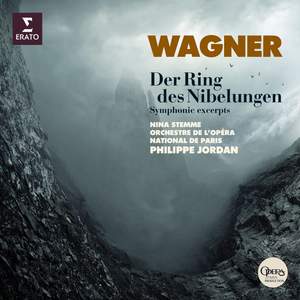
This selection of some of Wagner’s finest orchestral excerpts opens with the ‘storm-swept ballad’ of Der fliegende Holländer, the opera which launched his epoch-defining later masterpieces. The entire span of Der Ring des Nibelungen is represented in this programme, from the luminous rainbow bridge which leads the gods to Valhalla in Das Rheingold, the urgent drama of Die Walküre, and the atmospheric repose of the Forest Murmurs in Siegfried, to the tragic depths of Siegfried’s Funeral March. This recording has been praised for its ‘radiant sensuousness’. (Gramophone) Volumes 2 and 3 in this series are available on 8572768 and 8572769. | | | (also available to download from $6.00) | In stock - usually despatched within 1 working day. |
|
|
| |  | Wagner: Orchestral Highlights
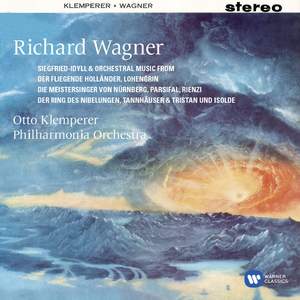
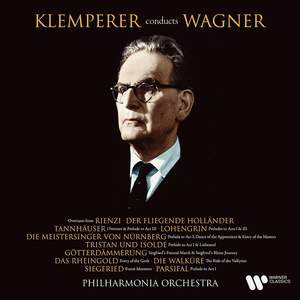
“There is not one performance on this set that is less than eloquent. It is plain from these recordings that Klemperer is a great Wagner conductor, probably the greatest in the world.” Gramophone Magazine | | | In stock - usually despatched within 1 working day. |
|
|
| |  | Wagner - Orchestral Music
| | | In stock - usually despatched within 1 working day. |
|
|
| |  | Wagner: Overtures and Preludes
| | | In stock - usually despatched within 1 working day. |
|
|
| |  | George London sings Wagner
George London was born in Montreal, Canada; when he was fifteen the family moved to the United States. His original surname was Burnstein (he also used Burnson for a time) and his forebears were from Širvintos in Lithuania. He began his singing studies in Los Angeles, and by the 1940s was touring with a trio that included Frances Yeend and Mario Lanza. His début in a leading role was in Rigoletto for San Francisco Opera in 1946. Three years later, in Vienna, he sang Amonasro in Aida, a role that also launched his Metropolitan Opera career in 1951. It was while London was singing the four villains in The Tales of Hoffmann in Vienna that Hans Knappertsbusch decided to recommend London to Wieland Wagner for the 1951 Bayreuth Festival. Seven years later, Knappertsbusch recorded four great Wagner scenes for Decca with George London. The recording appears here in its entirety, supplemented with one of the great scenes from their 1962 performance of Parsifal (recorded ‘live’ at the Bayreuth Festival it went on to become one of most venerated recordings of this opera) and the closing scene of Rheingold in which London appears on the celebrated Solti recording as Wotan. London’s vocal health began to deteriorate rapidly during the 1963–64 season; eventually the problem was diagnosed as paralysis of the vocal cords. Efforts to restore the voice proved fruitless, and in due course London had to accept that, at 46, his singing career was over. The operatic world had suffered a great loss. He died after a series of heart attacks in March 1985. George London is remembered as an exceptional and intelligent artist who combined a great voice and superb musicianship with a commanding stage presence. “his singing compels admiration: a fine firm line, unfailing exactness of intonation and rhythm (how often can that be said of most Wagnerian singers?), exemplary enunciation, intelligent and expressive treatment of words and a true sense of character – no wonder he is highly regarded by Bayreuth. He is supported here by most beautiful orchestral playing – Knappertsbusch’s masterly hand is everywhere apparent – which sets off Wagner’s instrumentation in a rich glow. […] These are not merely good performances: they have that intense, imaginative re-recreation of the music which lifts them out of that category.” Gramophone Magazine, March 1959 | 
| | | Scheduled for release on 15 July 2013. Order it now and we will deliver it as soon as it is available. |
|
|
| |  | The Britannic Organ, Vol. 5: Richard Wagner on Welte
Michael Welte (player organ), Franz Xaver Franz (organ), Anonymous (player organ), Clarence Eddy (player organ), Samuel Atkinson Baldwin (organ), Harry Goss-Custard (organ), Edwin H. Lemare (player organ), Kurt Grosse (organ), Thaddaus Hofmiller (player organ), Emil Paur (player organ), Edwin H. Lemare (organ), Harry Goss-Custard (player organ), Clarence Eddy (organ), Michael Welte (organ) | 
| | | (also available to download from $21.00) | Usually despatched in 2 - 3 working days. (Available now to download.) |
|
|
| |  | The Essential Wagner
Hildegard Behrens, Jessye Norman, Helga Dernesch, Cheryl Studer, Birgit Nilsson (sopranos), Marjana Lipovsek, Christa Ludwig (mezzos), Siegfried Jerusalem, Jon Vickers, Nicolai Gedda, Ben Heppner (tenors), Dietrich Fischer-Dieskau (baritone), Kurt Moll (bass) Bernard Haitink, Klaus Tennstedt, Herbert von Karajan, Andre Cluytens, Sir Adrian Boult The best-loved and most popular works by Richard Wagner, performed by the world’s leading artists, in an accessible format at budget price. | | | Usually despatched in 4 - 5 working days. |
|
|
| |  | Richard Strauss - Complete Music for Brass Ensemble
Royal Academy of Music Symphonic Brass, James Watson The Royal Academy's brass department has established itself as one of the foremost in the world. The department's professors are active performers at the highest professional level, and include principal players with London's leading orchestras and world-renowned solo performers. In addition to the resident teachers, visiting specialists regularly teach at the Academy-further increasing the range of expertise which students can draw on. Brass students are prepared for every aspect of the profession, from period performance on original instruments through big band to the avant-garde and session work. Professor James Watson divides his time between playing, teaching and conducting. He studied trumpet at the Royal Academy of Music, where he now holds the position of Artistic Director and Head of Brass. James's orchestral work has included principal trumpet posts with the Royal Philharmonic Orchestra, Orchestra of the Royal Opera House, London Sinfonietta, the Nash Ensemble and Philip Jones Brass Ensemble. Conducting positions have included Artistic Director of the renowned Black Dyke Mills Band, Artistic Director of the National Youth Brass Band of Wales and Vice President of the National Youth Wind Orchestra of Great Britain. "Excellent playing in an entertaining recital…brilliantly played and detailed… Throughout, the playing and ensemble of these brass professionals of the future are excellent" Gramophone “…the "Entry of the Gods into Valhalla"… opens with spectacular explosive force and the players maintain their bravado throughout. …this is a collection for brass aficionados. It is certainly splendidly recorded.” Gramophone Magazine, February 2009 | | | (also available to download from $10.50) | Usually despatched in 3 - 4 working days. (Available now to download.) |
|
|
| |  | Wagner - Symphonic Syntheses by Stokowski
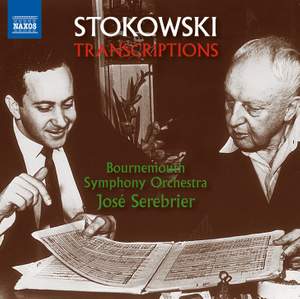
“Fine performances, revivifying these pioneering pieces.” BBC Music Magazine, December 2007 **** “It would be hard to imagine a more sumptuous disc. Stokowski, in these 'symphonic syntheses', enhances Wagner's already opulent orchestration with shrewdly added instrumental lines and with the vocal parts usually given to the strings. Then at times he thins the orchestration down for more transparent textures. José Serebrier conducts the Bournemouth SO in thrilling performances, passionate in a genuinely Stokowskian manner and treated to orchestral sound of demonstration quality. Stokowski's aim was to provide more satisfying orchestral items in concerts than the popular 'bleeding chunks'. So in the most ambitious item, on Tristan, we have between the Prelude and Liebestod a rich orchestral version of the Love Duet. Where the end of the duet builds up to that chilling interruption from King Marke, Stokowski has it lead seamlessly into the equivalent passage in the Liebestod. It works superbly. The selection starts excitingly with the Entry of the Gods into Valhalla and it is good to find Serebrier splendidly adding an anvil when Donner brings his hammer down. The Parsifal synthesis is limited to music from Act 3, thus ignoring the Good Friday Music. From DieWalküre comes the Magic Fire Music and, most excitingly, the Ride of the Valkyries. This is the finest of Naxos's Stokowski discs to date.” Gramophone Classical Music Guide, 2010 “Opulent Wagner arrangements provide a stunner…José Serebrier conducts the BSO in thrilling performances” Gramophone Magazine | | | (also available to download from $6.00) | Usually despatched in 2 - 3 working days. (Available now to download.) |
|
|
| |  | Wagner: Orchestral Highlights
Wagner: | Der fliegende Holländer: Overture recorded in the Concert Hall of Slovak Philharmonic, Bratislava, December 1988 Slovak Philharmonic Orchestra, Michael Halasz Tannhäuser: Overture recorded in the Concert Hall of Slovak Philharmonic, Bratislava, December 1988 Slovak Philharmonic Orchestra, Michael Halasz Lohengrin: Prelude to Act 1 recorded in the Concert Hall of Slovak Philharmonic, Bratislava, December 1988 Slovak Philharmonic Orchestra, Michael Halasz Das Rheingold: Entrance of the Gods into Valhalla recorded in the Concert Hall of Czechoslovak Radio, Bratislava, October 1988 Slovak Radio Symphony Orchestra, Uwe Mund Rienzi Overture recorded in the Teatro Cervantes, Malaga, 2-4 April 2002 Malaga Philharmonic Orchestra, Alexander Rahbari Götterdämmerung: Siegfried's Rhine Journey recorded in the Concert Hall of Czechoslovak Radio, Bratislava, October 1988 Slovak Radio Symphony Orchestra, Uwe Mund Die Walküre: Ride of the Valkyries recorded in the Concert Hall of Czechoslovak Radio, Bratislava, October 1988 Slovak Radio Symphony Orchestra, Uwe Mund |
| |
|
| |
|