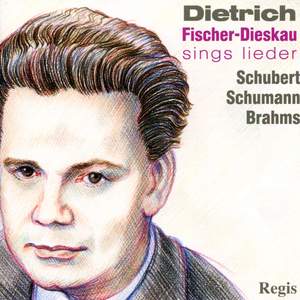
Prices shown exclude VAT. (UK tax is not payable for deliveries to United States.) See Terms & Conditions for p&p rates. | |  | Dietrich Fischer-Dieskau sings Lieder
Brahms: | Feldeinsamkeit, Op. 86 No. 2 Auf dem See (No. 2 from Acht Lieder und Gesänge, Op. 59) Abenddämmerung, Op. 49 No. 5 Alte Liebe, Op. 72 No. 1 Verzagen, Op. 72 No. 4 Regenlied (No. 3 from Acht Lieder und Gesänge, Op. 59) | Schubert: | Liebesbotschaft, D957 No.1 Der Atlas, D957 No. 8 Ihr Bild, D957 No. 9 Das Fischermädchen D957 No. 10 Die Stadt, D957 No. 11 Am Meer, D 957 No. 12 Die Taubenpost, D965A (D957 No. 14) Am feierabend (No. 5 from Die schöne Müllerin, D795) Trockne Blumen (No. 18 from Die schöne Müllerin, D795) Nacht und Träume, D827 | Schumann: | In der Fremde (No. 1 from Liederkreis, Op. 39) Waldesgesprach (No. 3 from Liederkreis, Op. 39) Mondnacht (No. 5 from Liederkreis, Op. 39) Schöne Fremde (No. 6 from Liederkreis, Op. 39) Auf einer Burg (No. 7 from Liederkreis, Op. 39) Wehmut (No. 9 from Liederkreis, Op. 39) Im Walde (No. 11 from Liederkreis, Op. 39) Frühlingsnacht (No. 12 from Liederkreis, Op. 39) |
“The main purpose of this frustratingly fragmentary and unevenly mastered compilation of Lieder treasure seems to be to give a sampler tasting of the young Fischer-Dieskau in the 1950s, with a varied palette of accompanists.” BBC Music Magazine, February 2010 **** “The voice is again in finest condition, the art wonderfully flexible in its transitions from light-heartedness to the intensity of despair. The Liederkreis songs include a magical "Mondnacht" and a vividly "faced" "Im Walde". The Brahms group opens with Feldeinsamkeit, masterly in control, technical and expressive. The remastered sound is very immediate, sometimes almost uncomfortably so, but the impression is strong, probably ineffaceable.” Gramophone Magazine, December 2009 | | | In stock - usually despatched within 1 working day. |
|
|
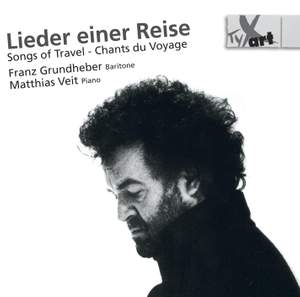
| |  | Lieder einer Reise (Songs of Travel)
Martin, F: | Monologues (6) from Hofmannsthal's Jedermann | Mendelssohn: | Erntelied (folksong) Op. 8 No. 4 Andres Maienlied (‘Hexenlied') Op. 8/8 Jagdlied 'Mit Lust tät ich ausreiten', Op. 84 No. 3 Neue Liebe, Op. 19a No. 4 | Schubert: | Der Atlas, D957 No. 8 Aufenthalt D957 No. 5 Das Fischermädchen D957 No. 10 Die Stadt, D957 No. 11 | Schumann: | Melancholie Op. 74 No. 6 (Francisco Saa de Miranda / Emanuel Geibel) Freisinn, Op. 25 No. 2 Aus den hebräischen Gesängen, Op. 25 No. 15 Der Spielmann, Op. 40, No. 4 | Wagner: | Branders Lied (No. 3 from Compositions (7) on Goethe's Faust, WWV15) Melodram Gretchens (No. 7 from Compositions (7) on Goethe's Faust, WWV15) Lied des Mephistopheles, 'Es war einmal ein Konig' (No. 4 from Compositions (7) on Goethe's Faust, WWV15) Der Tannenbaum, WWV 50 | Wolf, H: | Der Musikant (No. 2 from Eichendorff-Lieder) Heimweh (No. 12 from Eichendorff-Lieder) Der Tambour (No. 5 from Mörike-Lieder) Fussreise (No. 10 from Mörike-Lieder) |
The internationally renowned opera singer Franz Grundheber is engaged by all important opera houses from Paris to Barcelona, New York, and Hamburg to Vienna. His overwhelming performances of the most diverse characters have delighted audiences over past decades. On this CD the baritone proves himself to be a sensitive and expressive Lieder interpreter. As the renowned Austrian opera administrator Ioan Holender said: “Franz Grundheber’s quality has influenced the history of the Vienna State Opera – and that’s not all...“ | 
| | | (also available to download from $10.50) | Usually despatched in 8 - 10 working days. (Available now to download.) |
|
|
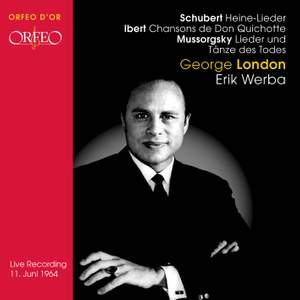
| |  | George London: LiederabendLive Recording 1964
George London was the outstanding Amfortas,Wotan and Dutchman of the late 1950s and early '60s, but also belonged among those singers with a mature vocal technique and intelligent characterisation who were able to enthuse audiences in the concert hall without relying merely on their stage charisma (even though that was present in abundance). At the height of his career, which was cut short tragically, London gave a lieder recital at the Theater an der Wien. It was there that he had laid the foundations of his European career (and thus also of his later, triumphant return to his native North America). London began his recital with the Heine songs from Schubert's Schwanengesang, wandered in the footsteps of Feodor Chaliapin by singing Jacques Ibert's Iberian-influenced Don Quichotte and finally Modest Mussorgski's Songs and Dances of Death - tone paintings of archaic grandeur in which he was wholly in his element. In all three cycles, Erik Werba as accompanist completely lived up to his reputation as a modest, but equal partner. In addition to this live recording from Austrian Radio, ORFEO here offers as a bonus the five songs by Henri Duparc with which George London had ten years earlier made his lieder debut before a microphone, in Canada, the country of his birth. | | | Usually despatched in 3 - 4 working days. |
|
|
| |  | Schubert: Lieder Collection
Schubert: | An die Musik D547 An Schwager Kronos, D369 Nähe des Geliebten, D162 Erlkönig, D328 Ganymed, D544 (Goethe) Wandrers Nachtlied II 'Über allen Gipfeln ist Ruh', D768 Jägers Abendlied, Second Setting, D368 Prometheus, D674 (Goethe) Liebesbotschaft, D957 No.1 Der Atlas, D957 No. 8 Ihr Bild, D957 No. 9 Die Stadt, D957 No. 11 Am Meer, D 957 No. 12 Die Taubenpost, D965A (D957 No. 14) |
Recorded Köln 1954 | | | Usually despatched in 3 - 4 working days. |
|
|
| |  | Schubert & Liszt - Lieder & TranscriptionsLieder of Schubert, and the lieder in their solo piano versions by Franz Liszt.
Schubert: | Gretchen am Spinnrade, D118 Rastlose Liebe, D138 Erlkönig, D328 Die Forelle, D550 Auf dem Wasser zu singen, D774 Die junge Nonne, D828 Wohin? (No. 2 from Die schöne Müllerin, D795) Der Jäger (No. 14 from Die schöne Müllerin, D795) Die böse Farbe (No. 17 from Die schöne Müllerin, D795) Der Müller und der Bach (No. 19 from Die schöne Müllerin, D795) Ständchen 'Leise flehen meine Lieder', D957 No. 4 Aufenthalt D957 No. 5 Die Stadt, D957 No. 11 |
Maciej Pikulski (piano), Elodie Méchain (mezzo), Lionel Peintre (baritone) | | | Usually despatched in 4 - 5 working days. |
|
|
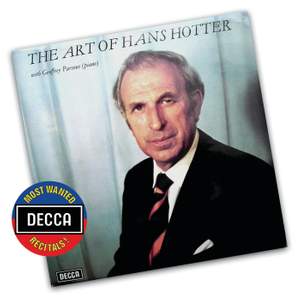
| |  | Hans Hotter - The Early EMI Recordings
Brahms: | Sonntag, Op. 47 No. 3 Ständchen, Op. 106 No. 1 Mit vierzig Jahren, Op. 94 No. 1 | Grieg: | Ich liebe Dich, Op. 5 No. 3 | Handel: | Aure, deh, per pietà (from Giulio Cesare) Soll'ich in Mamres Segens Au'n (from Joshua) Joshua: Wie willig trägt mein Vaterherz | Schubert: | Der Wanderer, D489 Der Doppelgänger D957 No. 13 Gruppe aus dem Tartarus, second version, D583 (Schiller) Die Stadt, D957 No. 11 Meeres Stille, D216, Op. 3 No. 2 (Goethe) Wohin? (No. 2 from Die schöne Müllerin, D795) Am Meer, D 957 No. 12 Der Doppelgänger D957 No. 13 | Schumann: | Die beiden Grenadiere, Op. 49 No. 1 Wer machte dich so krank? Op.35 No.11 (Kerner) Alte Laute, Op. 35, No. 12 Mondnacht (No. 5 from Liederkreis, Op. 39) | Wagner: | Und doch, s'will halt nich gehn (from Die Meistersinger) Doch eines Abends spat (from Die Meistersinger von Nürnberg) Leb wohl, du kühnes, herrliches Kind! (from Die Walküre) |
Recorded between 1947 & 1987 | | | Usually despatched in 4 - 5 working days. |
|
|
| |
|