This page lists all recordings of Mephistopheles' Song of the Flea, by Modest Petrovich Mussorgsky (1839-81) on CD & download (MP3 & FLAC). Generally, more recent releases are listed first, but with priority given to those that are in stock. |
Prices shown exclude VAT. (UK tax is not payable for deliveries to United States.) See Terms & Conditions for p&p rates. | |  | Oscar Natzka - Great Recordings 1939-50
| | | In stock - usually despatched within 1 working day. |
|
|
| |  | Russian Images - 1
Arensky: | Autumn, Op. 27 No. 2 | Balakirev: | Embrace, kiss | Borodin: | Dlya beregov otchizni dal'noy (For the Shores of thy Far Native Land) | Cui: | The Fountain Statue at Tsarskoye Selo, Op. 57 No. 17 | Dargomïzhsky: | The Night Zephyr The Miller I remember | Glinka: | How sweet it is for me to be with you Bolero (No 3 of A Farewell to St Petersburg) | Grechaninov: | The Prisoner, Op. 20 No. 4 | Lyatoshinsky: | Dawn, Op. 37 No. 1 Supreme Happiness, Op. 37 No. 2 | Medtner: | I have outlived my aspirations, Op. 3 No. 2 Spring Solace, Op. 28 No. 5 | Mussorgsky: | Forgotten Mephistopheles' Song of the Flea | Rachmaninov: | She is as beautiful as midday, Op.14 No. 9 It is time, Op. 14 No. 12 | Rimsky Korsakov: | On the hills of Georgia, Op. 3 No. 4 | Tchaikovsky: | Blagoslavlyayu vas, lesa (I Bless you, Forests), Op. 47 No. 5 Sred' shumnogo bala (Amid the din of the ball), Op. 38 No. 3 Serenada Don-Zhuana (Don Juan's Serenade), Op. 38 No. 1 |
| | | In stock - usually despatched within 1 working day. |
|
|
| |  | Gottlob Frick II
Gottlieb Frick became a member of the Bayreuth Opera Chorus in 1930 and launched his solo career in 1934. He later became one of the most important German basses and certainly contradicted an old saying among conductors, that a fine choral singer will never become a fine soloist. All arias sung in German | | | Usually despatched in 2 - 3 working days. |
|
|
| |  | Carlo Morelli
Chiara: | La Spagnola | Giordano, U: | Un dì, m'era di gioia (from Andrea Chénier) | Grever: | Alma mia | Leoncavallo: | Buona Zazà del mio buon tempo from Zazà Zazà, piccolo zingara from Zazà Zazà, piccolo zingara from Zazà Luigi Montesano (baritone) | Massenet: | Vision fugitive (from Hérodiade) | Mozart: | Deh! vieni alla finestra (from Don Giovanni) Luigi Montesano (baritone) | Mussorgsky: | Mephistopheles' Song of the Flea Luigi Montesano (baritone) | Ponce, M: | Si alguna vez | Ponchielli: | Maledici? O monumento (from La Gioconda) Pescator affonda l'esca (from La Gioconda) Così mantieni il patto? (from La Gioconda) Luigi Montesano (baritone) | Puccini: | Quanto?...Gia, mi dicon venal (from Tosca) Luigi Montesano (baritone) | Rossini: | Dunque io son? (from Il Barbiere di Siviglia) Luigi Montesano (baritone), Toti dal Monte (soprano) | Verdi: | Cortigiani, vil razza dannata (from Rigoletto) Vanne, la tua meta gia vedo…Credo in un Dio crudel (from Otello) Era la notte (from Otello) Lassù in cielo (from Rigoletto) Luigi Montesano (baritone), Toti dal Monte (soprano) Vanne, la tua meta gia vedo…Credo in un Dio crudel (from Otello) Luigi Montesano (baritone) |
Carlo Morelli (baritone) with Luigi Montesanto (baritone) Carlo Morelli made his debut at Alessandria’s Teatro Municipale as Tonio in “Pagliacci” in 1922. In order to avoid having his name confused with that of his brother, the tenor/baritone Renato Zanelli, he adopted “Carlo Morelli” as his stage name. He sang for La Scala, Chicago Civic Opera and the Metropolitan Opera in New York. Her later settled in Mexico and died in 1970. | | | Usually despatched in 2 - 3 working days. |
|
|
| |  | Alexander KipnisVictor Recordings 1945/6
In the search for suitable and evocative words to describe a particular vocal quality, usually, for the bass voice one would expect of course adjectives like deep, black, sonorous, cavernous, thundering, impressive or even noble. Rarely is the word beautiful used. However, in the case of Alexander Kipnis, it most certainly applies. Alexander Kipnis was born into a very poor family in Zhitomir, Ukraine on l February 1891. They were very proud of the extraordinary quality of his singing voice, which attracted the attention of a visiting cantor from Bessarabia, who heard him as a soloist in the local synagogue choir. So taken was he by the boy’s natural talent, that, with a promise of some payment, the cantor persuaded Alexander’s mother to let him leave home and become a chorister at his synagogue. Alexander was befriended by one of the older singers with whom he lodged and who taught him the rudiments of music and also some Lieder. Kipnis then won a scholarship to enter the Warsaw Conservatoire, initially to study conducting, but of course he continued to sing, his voice having broken and become a bass. He decided to move to Berlin, undertaking further vocal studies with the well-known teacher Ernst Grenzebach. This compilation is a tribute to one of the greatest bass voices ever to have recorded. | | | Usually despatched in 4 - 5 working days. |
|
|
| |  | Gedda, Nicolai: Live in Budapest 1984 - Goethe Songs
Beethoven: | Wonne der Wehmut, Op. 83 No. 1 Mit einem gemalten Band Op. 83, No. 3 Aus Goethes Faust | Boito: | Dai campi, dai prati (Mefistofele) Giunto sul passo estremo (from Mefistofele) | Massenet: | O Nature, pleine de grace (from Werther) Oui ce qu'elle m'ordonne... Lorsque l'enfant (from Werther) | Mozart: | Das Veilchen, K476 | Mussorgsky: | Mephistopheles' Song of the Flea | Schubert: | Wandrers Nachtlied I 'Der du von dem Himmel bist', D224 Rastlose Liebe, D138 Schäfers Klagelied, D121 (Goethe) Erster Verlust, D226 (Goethe) | Tchaikovsky: | None but the lonely heart, Op. 6 No. 6 | Thomas, Ambroise: | Elle ne croyait pas, dans sa candeur naïve (from Mignon) Adieu, Mignon! Courage! (Mignon) | Wolf, H: | Frühling übers Jahr (No. 28 from Goethe-Lieder) Anakreons Grab (No. 29 from Goethe-Lieder) Der Schäfer (No. 22 from Goethe-Lieder) |
| |
|
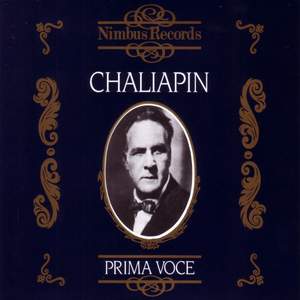
| |  | The Chaliapin Edition Volume 4: 1913-1921
Alnaes: | Sidste Reis, Op. 17 No. 2 | Brahms: | Sapphische Ode, Op. 94 No. 4 | Glinka: | Ivan Susanin (A Life for the Tsar): They Guess the Truth | Grieg: | En svane (No. 2 from Seks Digte af Henrik Ibsen, Op. 25) Abschied, Op. 4 No. 3 Stambogsrim (Verses in an Album), Op. 25 No. 3 Das alte Lied, Op. 4 No. 5 | Koenemann: | When the King Went Forth To War, Op. 7 No. 6 | Lyapunov: | The Tale of Tsar Ivan the Terrible, Op. 48 No. 4 | Malashkin: | O, yesli b mog virazit' v zvuke (Oh, Could I in Song Tell My Sorrow) | Mussorgsky: | Mephistopheles' Song of the Flea | Rachmaninov: | Yesterday we met, Op. 26 No.13 | Rimsky Korsakov: | On the hills of Georgia, Op. 3 No. 4 The Prophet, Op. 49 No. 2 | Rubinstein: | The Prisoner | Schubert: | Aufenthalt D957 No. 5 | Slonov: | A word of farewell | Tchaikovsky: | The Nightingale Op. 60 No. 4 | trad.: | The mother-in-law had seven sons-in-law Ah, the green oak has bent over the ravine A great big gnat |
| | | Usually despatched in 4 - 5 working days. |
|
|
| |  | Great Operatic Arias 6 - John Tomlinson Volume 1Sung in English
Borodin: | Ni sna, ni otdikha izmuchennoi dushe (from Prince Igor) Sung in English as 'No rest, no slumber’ Greshno tait, ya skuki ne lyublyu (from Prince Igor) Sung in English as 'The Prince has drunk his fill?...The sober life of boredom’ Zdorov-li, Knaz? (from Prince Igor) Sung in English as 'Igor, listen’ | Dargomïzhsky: | Okh, toto vse vi devky molodiye (from Russalka) Sung in English as 'Like every maiden in the whole of Russia’ | Handel: | I rage, I melt, I burn…O ruddier than the cherry (from Acis and Galatea) Samson: Honour and arms scorn such a foe | Lehmann: | Myself when young from In a Persian Garden | Mozart: | Wer ein Liebchen hat gefunden (from Die Entführung aus dem Serail) Sung in English as 'When a maiden takes your fancy’ Ich gehe, doch rate ich dir (from Die Entführung aus dem Serail) Sung in English as 'I’m going, but take my advice’ Helen Williams (Blonde) Vivat Bacchus! Bacchus lebe! (from Die Entführung aus dem Serail) Sung in English as 'Vivat Bacchus! Long live Bacchus!’ Barry Banks (Pedrillo) | Mussorgsky: | Mephistopheles' Song of the Flea Sung in English as 'There lived a king of old’ Skorbit dusha! (from Boris Godunov) Sung in English as 'My soul is sad' | Offenbach: | Couplets des deux hommes d'armes (from Geneviève de Brabant) Sung in English as ‘We’re public guardians bold yet wary’ Andrew Shore (baritone) | Sullivan, A: | A more humane Mikado never (from The Mikado) When a felon's not engaged in his employment (from The Pirates of Penzance) | Verdi: | A te l'estremo addio ... Il lacerato spirito (from Simon Boccanegra) Sung in English as 'A last farewell I bid you...My soul is torn with suffering’ Che mai vegg'io … Infelice! e tu credevi (from Ernani) Sung in English as 'Vain illusion! When I believed her’ |
“A strong voice, varied repertoire and vivid characterization make this an appealing disc” Gramophone Magazine | | | (also available to download from $10.50) | Usually despatched in 2 - 3 working days. (Available now to download.) |
|
|
| |  | A Tribute to Martti Talvela
| | | Usually despatched in 2 - 3 working days. |
|
|
| |  | Russian Vocal Masterpieces
| | | Usually despatched in 8 - 10 working days. |
|
|
| |
|