All recordingsPrices shown exclude VAT. (UK tax is not payable for deliveries to United States.) See Terms & Conditions for p&p rates. | |  | Ballets RussesRussian Dances and Ballets
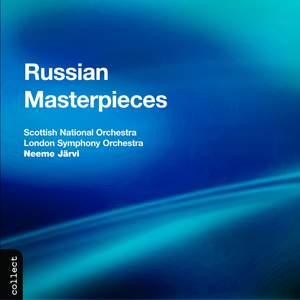
Although folk dances have a special place in Russian music, being raised to the status of character dances in works for the stage, the more classical forms taken over from the west are not neglected. During the nineteenth century the waltz, for example, tended more and more towards ‘pure’ music, giving rise to some highly virtuosic works in the manner of those by Weber or Liszt. Thus, in 1856 Glinka (1804-1857), founder of the Russian nationalist school, produced the definitive version of a Valse which had already aroused the enthusiasm of Berlioz. Its slightly melancholy principal theme reappears as a refrain between episodes in various keys, which give rise to passages of instrumental dialogue and to such bold strokes such as the cantabile for solo trombone in the third episode. Witty or ironic comments by the flutes or strings turn it virtually into a fantasia – which Shostakovich was to recall later. Scenes at parties and balls abound in opera. Tchaikovsky composed the waltz for Act Two of Eugene Onegin (1877) – with a chorus in its original version – so as to reflect the humdrum pretentiousness of the lesser, countrified aristocracy: it is closer to the waltz in Faust than to those he was to write for his ballets. This is in clear contrast to the majestic Act Three Polonaise, with its trio incorporating the traditional mazurka, which as the dance of aristocratic St Petersburg receptions is in a different class altogether. Marius Petipa, who became chief ballet master at the imperial ballet in 1869, restored to the art of dance the nobility and charm which had been killed off by an emphasis on technique. Tchaikovsky provided him with music suffused with the poetic inspiration lacking in the more straightforwardly rhythmic scores of composers like Drigo and Pugni. He was, however, criticised by those ballet-lovers who found his music too symphonic; his waltzes, refined rather than brilliant and frivolous, are often tinged with dramatic lyricism, even a sense of anxiety. The unusual flavour of the Waltz of the Flowers from The Nutcracker (1892) is largely created by the mysterious other-worldly horn-calls answered by rippling clarinet figures. Raymonda (1898) is a medieval romance choreographed by Petipa to music by Glazunov. Always melodious, subtle and graceful, it is sometimes highly evocative, as in the trance-like atmosphere in the dreamy slow-motion accompanying the heroine’s sleep (andante sostenuto) in the interlude before the second scene. The tradition of the grand ballet d’action persisted right up to the revolution brought about by Sergei Diaghilev. Reacting against the ‘double pirouettes and detestable sets of thirty-two fouettés’, the director of the Ballets Russes sought the character of the various folk-dances of Russia and other countries, which he remodelled for the stage using a basically classical technique. In his Parisian season in 1909 he presented the second act of Prince Igor (1887) against the background of a tawny-coloured desert steppe. The Polovtsian Dances, alternating spellbinding movements for the women and pounding, savage rhythms for the warriors, were directed by Mikhail Fokine: when a tumultuous wave of dancers rushed downstage at the end, stopping dead just short of the footlights, it brought the house down! Even Anatole Liadov, the composer of backwoods Russia, gave in to the infatuation of the Russian intelligentsia of around 1900 with ancient Greece. His Dance of the Amazon (1910), for Ida Rubinstein, employs two Greek chants, heavily reworked: the first theme suggests the Amazon riding on horseback, the second (meno mosso) emphasises the oriental atmosphere; brass and percussion suggest warlike activity – ushered in by a fanfare. After the 1917 Revolution it was thought that the creations of the Tsarist era would be unappealing to the sensibilities of the new Bolshevik listener. New themes and characters – stadiums and factories, sportsmen and workers – figured in ‘futurist’ (that is, revolutionary) musical experiments. In Shostakovich’s ballet The Golden Age (1930), which portrays the misadventures of a Soviet football team in a capitalist country, a clownish polka caricatures decadent western society. In Tahiti Trot (1928) Shostakovich pulled off the challenge of re-orchestrating Vincent Youmans’ Tea for Two in record time, and in so doing exploited all the expressive and comic possibilities, as well as the shock tactics, of avant-garde experiments. But offerings like these, from an enfant terrible ‘who had nothing to say to the people’, led the Communist Party, around 1932, to rein back cultural activity and reinstate a classical, academic aesthetic, which also extended to opera and ballet. The music of Prokofiev’s Love for Three Oranges (Chicago, 1921; Leningrad, 1927), precise, sturdily constructed and freshly coloured – as in the festive march from Act Two – was perfectly accessible, and yet it was later ignored in the USSR because of its libretto, which makes a feature of absurdity. Romeo and Juliet (1935/6, staged in 1940), on the other hand, with its universal subject, gained unanimous acceptance. The characterisation was exemplary: in the sombre, hieratic Dance of the Knights, with its great sweeps of sound, the menacing thrusts of the basses and brass powerfully convey the arrogance of a clan – as against the fresh sensitivity of youth portrayed by the central theme. Although Khachaturian was also suspected of ‘formalism’, his artistic approach always coincided with that of the regime. His incidental music for a 1940 production of Lermontov’s The Masked Ball portrays well the spiritual emptiness of imperial society: the entirely unsentimental waltz turns like a roundabout, relentlessly driven forward by the pursuit of pleasure. With Gayaneh (1943) Khachaturian goes back to his native Armenia. Part of the ballet’s final celebrations honouring the upbeat heroine of the ‘happy collective farm’ is the frenzied Sabre Dance, the middle section of which recalls an earlier pas de deux. It is an authentic piece of Transcaucasian folklore. Following his Lady Macbeth of the Mtsensk district, Shostakovich had fallen victim, in 1936, to official criticism. He attempted to redeem himself, or at least to behave himself, by writing lighter works, frothier, more facile – i.e. proletarian – for films, ballets, variety stages and what the USSR referred to as ‘jazz’ orchestras, which are more like our light music ensembles. The Suite No.2 for jazz orchestra (1938) was composed for one such group, run by Victor Knushevitsky. The main, somewhat sentimental, theme in its Waltz No.2, played on the saxophone, ends in a sort of good-natured refrain. This piece was used as music for film commercials in the West – and then as title music for Stanley Kubrick’s last film: what finer example of popularity could there be? | | | In stock - usually despatched within 1 working day. |
|
|
| |  | Sarah Chang: The Debut Recital
Chopin: | Nocturne No. 20 in C sharp minor, Op. post. | Elgar: | Salut d'amour, Op. 12 La Capricieuse, Op. 17 | Gershwin: | It Ain't Necessarily So (from Porgy and Bess) | Khachaturian: | Sabre Dance from Gayane | Kreisler: | Tempo di menuetto (in the style of Pugnani) | Liszt: | Consolation, S. 172 No. 3 in D flat major | Paganini: | Caprice for solo violin, Op. 1 No. 1 in E major 'The Argeggio' Caprice for solo violin, Op. 1 No. 15 in E minor | Prokofiev: | The Love for Three Oranges: March | Sarasate: | Carmen Fantasy, Op. 25 | Shostakovich: | Prelude for piano, Op. 34 No. 10 in C sharp minor Prelude for piano, Op. 34 No. 15 in D flat major | Tchaikovsky: | Souvenir d'un lieu cher, Op. 42: Mélodie in E flat major |
At just 11 years of age, Sarah Chang was, quite simply, an undisputed violinistic phenomenon. She appeared with Zubin Mehta and the New York Philharmonic at the age of eight, playing Paganini's First Violin Concerto, and recorded this debut recital disc a year later. The Debut was her first of many future Classical Billboard best-selling albums. Gramophone Magazine proclaimed, “This is an astonishing disc. Sarah Chang’s playing will enthrall and captivate in equal measure.” | | | In stock - usually despatched within 1 working day. |
|
|
| |  |
Leschenko, Argerich, Poltera & Lakatos “…no orchestra could possibly compete with the micro-fine gestural reactions and textural clarity exhibited by MarthaArgerich and Polina Leschenko in Terashima’s stunning transcription for two pianos (Prokofiev: Symphony No.1)…such is the chimerical nature of artistry on display here – not to say stunning virtuosity…Leshenko’s pulverising account of Prokofiev’s Seventh Sonata…is barely less technically formidable, but temperamentally she is a different class, so that the…opening movement hits home with mind-numbing potency…Add to this Roby Lakatos’s captivatingly “gypsyesque” Tchaikovsky and Prokofiev…and you have a very special disc indeed.” Julian Haylock, IRR | | | In stock - usually despatched within 1 working day. |
|
|
| |  | Ballets RussesRussian Dances and Ballets
| | | In stock - usually despatched within 1 working day. |
|
|
| |  | Heifetz in Performance
Narration in English with optional German and French subtitles | | | Usually despatched in 8 - 10 working days. |
|
|
| |  | Demilitarised Zones: Marches
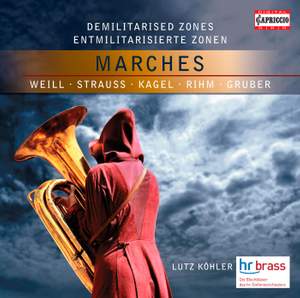
This re-release on Capriccio contains music picked by HR-brass. As with most brass band ensembles, they stand in the old tradition of music with ‘trumpets and drums’. HR-brass has taken a stand with their own CD on the subject of marches. This disc includes a varied programme from 10 Marches to miss the victory by Mauricio Kagel and demilitarised zone by HK Gruber to Beethoven’s Marschlied from “Egmont” and Wagner’s Funeral March from “Götterdämmerung”. “This brass-band sequence is at once a relishing of the sonorous medium and a sly critique. HR Brass is the brass section of the Frankfurt Radio Symphony Orchestra, fine players alert to sophisticated repertory.” Sunday Times, 28th October 2012 | | | (also available to download from $11.00) | Usually despatched in 2 - 3 working days. (Available now to download.) |
|
|
| |  | French Flavours
Paul Carr (Organ of St Chad’s Cathedral, Birmingham) The first solo recording of the magnificent Walker organ in St Chad’s Cathedral, played by Birmingham-based organist, Paul Carr, in his début recording. A brilliantly-colourful programme of French and French-inspired works, chosen to match the distinctively-Gallic character of the St Chad’s organ. Includes many works new to the catalogue. A must-hear recording of this wonderful recently-built organ, and some little-known new works. “Paul Carr shows himself to be an imaginative player with an ear for colour. In Dupre's Deux esquisses he has all the virtuosity required.” BBC Music Magazine, January 2013 *** | | | Usually despatched in 4 - 5 working days. |
|
|
| |  | Brodsky Quartet: Petits FoursFavourite Encores
plus: Schumann arr. Paul Cassidy: Sehr Langsam; Three Pieces from Kinderszenen arr. for Quartet and Piano Dvořák arr. Paul Cassidy: Humoresque for Quartet and Piano Philip Edward Fisher (piano)
Chandos Records signed an exclusive contract with the Brodsky Quartet in time for the celebrations of its fortieth anniversary in 2012. Formed in 1972, the Brodsky Quartet quickly emerged at the forefront of the international chamber music scene. It has performed more than 2000 concerts and made more than fifty highly acclaimed recordings. This is the Quartet’s first release on Chandos, and includes many of the encores it has performed over the years, notable for their novelty and diverse range of styles and emotions. All the pieces have been arranged by past or current members of the Quartet, and together form an entertaining and original collection. The Quartet has enjoyed many successful collaborations over the years, and regularly works with artists such as Elvis Costello, Sting, Anne Sofie von Otter, Martin Roscoe, Michael Collins, Tunde Jegede, Dawn Upshaw, and Björk. Its boundless energy and tremendous enthusiasm have led it in many artistic directions, from the classic quartet repertoire of Haydn, Beethoven, Schubert, and Tchaikovsky, to the very cutting edge of contemporary music and styles. Its passion to embrace ‘all good music’ has been the driving force behind its success and has kept its approach fresh and its enthusiasm high since its formation. One recurring characteristic of the performances of the Quartet is its inclusion of guest artists, who take the group away from the standard string quartet repertoire. This will be reflected in two further recordings to be released on Chandos in 2012: A CD of works by Debussy, with the multi-award-winning pianist Jean-Efflam Bavouzet in the Piano Trio and the harpist Sioned Williams and double-bass player Chris Laurence in the Deux Dances for harp and strings; and a disc of American songs with the bass-baritone Sir Willard White. “the Brodsky Quartet blow the musical cobwebs off some of the most cherishable miniatures in the repertoire...so swaggeringly sensual is the Brodsky's Playera (Sarasate), so alluringly suave their Caprice viennois (Elgar), in which they are joined by gifted viola player Robert Smissen, that it becomes hard to imagine these pieces played any other way - or any better.” BBC Music Magazine, April 2012 ***** “What is so striking about the playing of the Brodsky Quartet throughout is their brimming love for the music, with some ravishing shading down to the most hushed pianissimos. All this is caught in wonderfully rich and transparent sound, a credit to the Chandos engineers.” Gramophone Magazine, June 2012 | | | (also available to download from $11.00) | Usually despatched in 2 - 3 working days. (Available now to download.) |
|
|
| |  | Violin Romances
Borodin: | Serenade trans. Heifetz | Brahms: | Contemplations (Wie melodien zieht es mir) trans. Heifetz | Bruch: | Romance in A minor for violin & orchestra, Op. 42 | Castelnuovo-Tedesco: | Tango trans. Heifetz | Chopin: | Nocturne No. 16 in E flat major, Op. 55 No. 2 trans. Heifetz | Debussy: | Beau Soir trans. Heifetz | Dinicu: | Hora Staccato trans. Heifetz | Dvorak: | Romance in F minor, Op. 11 | Foster, S: | I Dream of Jeanie with the Light Brown Hair trans. Heifetz | Gershwin: | Summertime (from Porgy and Bess) A woman is a sometime thing (from Porgy and Bess) My man's gone now (from Porgy and Bess) It Ain't Necessarily So (from Porgy and Bess) Bess, you is my woman now (from Porgy and Bess) There's a boat dat's leavin' soon for New York (from Porgy and Bess) trans. Heifetz | Godowsky: | Triakontameron No. 11 'Alt Wien' trans. Heifetz | Goldmark: | Romance in A major, Op. 51 | Janacek: | Romance for violin and piano | Khachaturian: | Sabre Dance from Gayane trans. Heifetz | Kreisler: | Romance, Op. 4 | Liszt: | Romance oubliée, for viola/cello/violin & piano, S. 132 | Medtner: | Skazka (Fairy Tale), Op. 20 No 1 in B flat minor trans. Heifetz | Mendelssohn: | Song without Words, Op. 19b No. 1 in E major 'Sweet Remembrance' trans. Heifetz | Nielsen: | Romance for violin & piano, Op. 2 No. 1 | Ponce, M: | Estrellita trans. Heifetz | Prokofiev: | The Love for Three Oranges: March trans. Heifetz | Rachmaninov: | Melody, Op. 21 No. 9 trans. Heifetz How fair this spot, Op. 21 No. 7 trans. Heifetz | Ravel: | Valses nobles et sentimentales No. 6 in C major trans. Heifetz | Schumann, Clara: | Romances (3), Op. 22 | Sibelius: | Romance, Op. 78 No. 2 | Sinding: | Romance in E minor, Op. 30 | Svendsen: | Romance for Violin and Orchestra, Op. 26 | Turina: | La Oración del torero, Op. 34 trans. Heifetz | Valle, F: | Prelude XV, 'Ao pé da foguiera' trans. Heifetz | Vieuxtemps: | Romance, Op. 40 No. 1 | Wieniawski: | Romance sans paroles in D minor, Op. 9 Violin Concerto No. 2 in D minor, Op. 22: Romance |
Aaron Rosand (violin), Hugh Sung (piano), John Covelli (piano - Heifetz transcriptions) | | | Usually despatched in 8 - 10 working days. |
|
|
| |  | Emil Gilels: Early Recordings Volume 2All tracks recorded in the USSR, 1937-1954
Producer: Jonathan Summers Audio Restoration Engineer: Ward Marston “healthy doses of both tumultuousness and poignant delicacy” BBC Music Magazine, September 2010 **** “In large-scale sonatas by Glazunov, Medtner and Prokofiev, his playing glows with conviction and includes passagework spun off with an all-Russian legato. Then, his outwardly formidable and unsmiling demeanour on the concert platform is erased in a performance of Tchaikovsky's "Chant sans paroles" of a beguiling charm” Gramophone Magazine, October 2010 | | | (also available to download from $9.25) | Usually despatched in 2 - 3 working days. (Available now to download.) |
|
|
| |
|