All recordingsPrices shown exclude VAT. (UK tax is not payable for deliveries to United States.) See Terms & Conditions for p&p rates. | |  | Stravinsky: The Rite of Spring & Firebird Suite
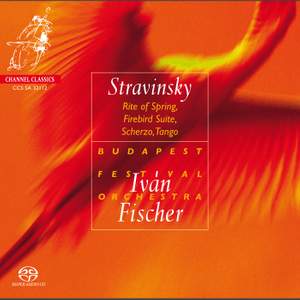
“A fascinating chance to compare a composer's own interpretation with a brilliant newcomer. Ivan Fischer's new Rite of Spring is lean and hungry, razor-sharp and matches his description of it: "fresh, pagan, scary, new and beautiful"...Quite deliberate in places (Spring Rounds is surely too slow) it is full of piercing, unfamiliar detail and accumulates tremendous weight.” The Observer, 22nd January 2012 “The Rite of Spring remains a seismic event in the history of music, still astounding in a performance as gripping and as powerful as this live account by Fischer’s BFO. These Hungarians manage the remarkable feat of making this familiar music sound ever fresh and new — I love Fischer’s chamber-music textures in Dances of the Adolescent Girls, and his Dance of the Earth sounds positively volcanic.” Sunday Times, 19th February 2012 “This is one of the earthiest, most pagan accounts of the ballet around. It’s also one of the most carefully considered whenever Stravinsky writes in a slow tempo...Whenever the music jerks into high gear — the notes cascading, polyrhythms jabbing — the contrast is doubly thrilling.” The Times, 24th February 2012 **** “Fischer and his Budapest forces possess the right ingredients: the orchestra is well drilled in an interpretation that's as straight as a Roman road; its strings are searing, and brass and wooodwind play in the clipped manner favoured by Stravinsky. In short, it's what the composer said he wanted from a performance of this music. The problem is that Stravinsky did not practise what he preached.” BBC Music Magazine, April 2012 ** “Fischer's The Rite of Spring is sensual and revealing...There's a elasticity to Fischer's conducting that keeps Stravinsky's score pliable...In a word, this is a 'musical' performance, one where every note seems an inevitable outgrowth of its predecessor. It's not the most viscerally exciting version on disc...[but it] avoids what Stravinsky himself labelled self-glorification.” Gramophone Magazine, May 2012 | | | In stock - usually despatched within 1 working day. |
|
|
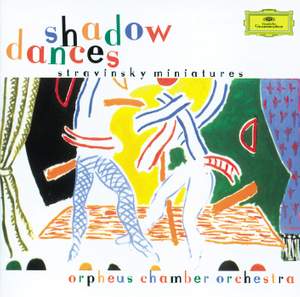
| |  | Stravinsky - Miniatures
Recording made in 1995. This recording was highly praised when released and in 2001 was awarded a Grammy. Stravinsky never had much time for conventions. His teacher Rimsky-Korsakov was similarly maverick, and was at his best when free of the strictures of the symphony and classical form. Stravinsky openly defied the Austro-German way of doing things, and adopted an unpredictable (if at times neo classical) style, and this CD contains some of the smaller works he produced that illustrate is unique, and sometimes quirky style. The two Suites were arranged from the original piano pieces intended for children. The three pieces for string quartet are unlike anything form the period – 1914. No sign of late romanticism here, or of the Second Viennese School. It is an utterly unique and new sound word – icy, different, but very Russian. The Octet sounds superficially like a dissonant wind divertimento by Mozart. Stravinsky’s opposition to the traditional structures of classical music softened a little towards the end of his life, and the Scherzo a la Russe and the Concerto in D for strings illustrate this well with their less spiky sound, and longer melodic lines. The complete list of pieces is: Tango, Suites for small orchestra, Concerto in D for strings, Concertino, Octet for winds, 3 Pieces for string quartet, Ragtime, Duet for two Bassoons, Fanfare for a New Theatre, and the Scherzo à la Russe for jazz orchestra. | | | In stock - usually despatched within 1 working day. |
|
|
| |  |
| | | In stock - usually despatched within 1 working day. |
|
|
| |  | Stravinsky - Piano Music
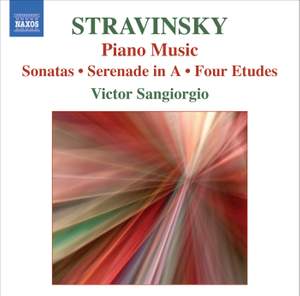
Victor Sangiorgio (piano) Composing at the piano was a life-long preoccupation for Stravinsky, whose music for the instrument spans a forty-year period and reflects his distinct stylistic changes. In his Four Etudes of 1908 the use of complex rhythmical patterns between the hands makes for fiendishly difficult execution. The clarity of each of the 1924 Sonatas’ three movements recalls the musical language of the 18th century. In 1925 Stravinsky embarked on a groundbreaking tour of the United States, where he signed his first recording contract for Brunswick. It was for this company that he wrote the Serenade, designing each movement to fit neatly on one side of a 78rpm gramophone record. “Victor Sangiorgio, a pianist new to me, plays this music with authority and assertiveness, captured in excellent sound….there is a wonderful revelation waiting in store for you!” Audiophile Audition | | | (also available to download from $6.00) | Usually despatched in 2 - 3 working days. (Available now to download.) |
|
|
| |  | Stravinsky: Petrushka
“Paavo Järvi's Telarc coupling of Petrushka and The Firebird Suite is outstanding in every way. Petrushka is so arresting that it invites comparison with the famous pioneering Ansermet account. It should be noted that Ansermet uses the original 1911 score, and Järvi the 1947 version. Switching between the two accounts, the surprise is the closeness of the two interpretations, with Ansermet pressing forward at one moment, Järvi the next, each relishing every detail of Stravinsky's sparkling orchestral palette, yet each completely individual. The more natural concert hall-balance in the superb acoustics of Cincinnati's Music Hall, adds ambient warmth and atmosphere, giving a translucent glow to the woodwind (yet still achieving wonderful detail), a rich patina to the strings, and filling out the brass sonorities without loss of bite. The important piano roulades, too, brilliantly played by Michael Chertock, glitter irridescently. Järvi's reading certainly doesn't lack histrionic qualities, yet it has added pathos, particularly the scene in the Moor's Room, and at the very end of the ballet. With Ansermet, Petrushka's ghost reappears fiercely, even demonically; Järvi chooses a distanced effect and creates a haunting atmosphere of desolate melancholy. The Firebird Suite is equally memorable. Again the wonderful Rimskyan colouring is conveyed in lusciously translucent detail, but the spectacular entry of Kashchei will surely make you jump, and the finale expands gloriously. Jack Renner, Telarc's outstanding chief recording engineer, produces the best bass drum in the business, and those thwacks as Järvi builds his final climax are riveting, as is the amplitude of the overall sound. So this CD not only offers truly memorable performances, splendidly played, but demonstration sound that audiophiles will relish.” Gramophone Classical Music Guide, 2010 “Järvi brings a sense of objectivity to the performance - the feeling that we are actually watching a puppet show on stage in front of us, instead of being caught up in the drama ourselves...[in The Firebird] Järvi and his Cincinnati players find a dreamy, other-worldly quality that's perfectly appropriate for this famous fairytale.” Catherine Chambers, bbc.co.uk, 22nd May 2003 | | | Usually despatched in 4 - 5 working days. |
|
|
| |  |
| | (Sorry, download not available in your country) | |
|
|
| |  |
| | | This item is currently out of stock at the UK distributor. You may order it now but please be aware that it may be six weeks or more before it can be despatched. |
|
|
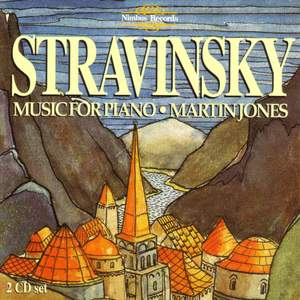
| |  | Igor Stravinsky: Piano Music
| | | Usually despatched in 4 - 5 working days. |
|
|
| |  |
| | | (also available to download from $10.50) | Usually despatched in 2 - 3 working days. (Available now to download.) |
|
|
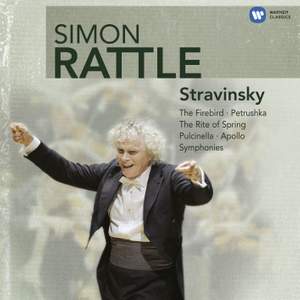
| |  | Simon Rattle conducts Stravinsky
On the face of it one would have thought that there was little in common between Igor Stravinsky (1882-1971) and Benjamin Britten (1913-1976), two interesting facts prove otherwise. Britten, born in Lowestoft in Suffolk on 22nd November (St. Cecilia’s Day), had already and studied with Frank Bridge by the time he went to Gresham’s School in Holt, Norfolk, in September 1928. The Master in charge of music on meeting him remarked “Oh, you’re the boy who likes Stravinsky!” Today that remark might be considered a compliment, at that time Stravinsky was reviled as THAT composer who had perpetrated the outrage called “The Rite of Spring” fifteen years earlier. The funeral service for Stravinsky, who died on 6th April 1971 in New York, was held as he had requested in Venice nine days later and he was laid to rest near his friend and ballet impresario, Serge Diaghilev, on the Island of San Michele. Britten, too, had a great love for Venice as can be heard in his last opera based on Thomas Mann’s “Death in Venice”. Both composers are also high on Sir Simon Rattle’s list of favourite composers. In 2003 he and his Berlin Philharmonic gave workshops and a performance of Stravinsky’s Rite of Spring to the city’s disadvantaged children and as a past Artistic Director of Britten’s beloved Aldeburgh Festival he has conducted many of his works including a number of those that had been found after the death of the composer. The box of Stravinsky contains works from all parts of his musical life including six ballets; three major ones from his youth – The Firebird, showing the inspired palette for exotic colour learnt from his teacher, Rimsky-Korsakov, Petrushka (in its revised version of 1947) and The Rite of Spring; two in his Neo-Classical style – Apollo and Pulcinella and extracts from Agon which shows the influence of his studies of serial technique as expounded by Anton Webern. There are also a number of his works that were inspired by jazz. The box of Britten contains besides the three great song cycles (Les Illuminations, Serenade for Tenor, Horn & Strings and Nocturne) the “War Requiem”, “Sinfonia da Requiem”, the ever popular “Young Person’s Guide to the Orchestra” and the most remarkable set of songs written in French when he was 15, “Quatre Chansons Françaises”. | | | In stock - usually despatched within 1 working day. |
|
|
| |
|