Brahms: Symphony No. 4 in E minor, Op. 98 - CD

This page lists all recordings of Symphony No. 4 in E minor, Op. 98, by Johannes Brahms (1833-97) on CD. Generally, more recent releases are listed first, but with priority given to those that are in stock.

Recommendations

Mid-Price Choice
July 2006
100 Greatest RecordingsEditor's Choice
November 2010
Editor's Choice
March 2009
Re-issue of the Month
June 2013
Re-issue of the Month
August 2011
4 star

All recordings

Prices shown exclude VAT. (UK tax is not payable for deliveries to United States.)
See Terms & Conditions for p&p rates.

Sir Adrian Boult conducts Brahms & Mendelssohn

Sir Adrian Boult conducts Brahms & Mendelssohn


Brahms:

Symphony No. 4 in E minor, Op. 98

Royal Albert Hall, London, 8 August 1975

BBC Symphony Orchestra

Mendelssohn:

Symphony No. 4 in A major, Op. 90 'Italian'

Royal Albert Hall, London, 29 July 1972

Royal Philharmonic Orchestra


Just prior to the Second World War, Sir Adrian Boult (1889–1983) single-handedly built the BBC Symphony Orchestra into a world-renowned ensemble that attracted such artists as Arturo Toscanini, Serge Koussevitzky and Bruno Walter to conduct it. After retiring from the BBCSO in 1950, Boult became chief conductor of the London Philharmonic until 1957. He continued to guest conduct and record prolifically until 1978 and enjoyed an ‘Indian summer’ in the studio with both English music (Vaughan Williams and Elgar) and nineteenth-century German repertoire (Beethoven, Brahms, Mozart, Schubert and Wagner). His early studies at the Leipzig Conservatory with Max Reger and with the charismatic conductor Arthur Nikisch, who knew Brahms, gave Boult a unique understanding of this composer.

Boult’s period in Leipzig also brought him in touch with the music of Mendelssohn, who had founded the Conservatory as well as being appointed as conductor of the Leipzig Gewandhaus Orchestra.

The live 1975 Proms performance of Brahms’s Symphony No.4 has never been issued before. The live account is more electrifying than the studio recording made in 1972. It has been recorded in stereo and fully captures the ‘Indian summer’ that Boult enjoyed at the Proms and in the studio with EMI at the time.

The Mendelssohn Symphony No.4 was recorded live in stereo and has never been issued before. It is a comparative rarity in that Boult’s only other recorded performances were in 1966 (unissued on CD) and in 1954 in mono.

“Vintage Boult performances recorded at the Proms. The Brahms has tremendous forward momentum, while the Mendelssohn exudes virtuosity.” BBC Music Magazine, May 2013 ****

Released or re-released in last 6 months

Historical Recordings - up to 25% off

ica classics Legacy - ICAC5093

(CD)

Normally: $15.50

Special: $12.40

(also available to download from $9.25)

In stock - usually despatched within 1 working day.

Brahms: Symphonies Nos. 1 & 4

Brahms: Symphonies Nos. 1 & 4


Brahms:

Symphony No. 1 in C minor, Op. 68

Live-Recording, Munich, Herkulessaal 30./31.10.2007

Symphony No. 4 in E minor, Op. 98

Live-Recording, Munich, Herkulessaal, 6.-10.02.2012


One year after the successful release of the 2nd and 3rd symphonies by Johannes Brahms, the present double CD now completes the full cycle of Brahms’s symphonies, as performed by the Symphonieorchester des Bayerischen Rundfunks under the direction of Mariss Jansons. Only a few weeks ago, Mariss Jansons finished the recording of the 4th symphony in Munich’s Herkulessaal. Along with his 1st symphony (“Beethoven’s Tenth”), it puts the finishing touch on the complete performance of Johannes Brahms’ symphonic works, compositions oriented around the creativity of his great role model, yet in many ways also forward looking and innovative.

The first complete Brahms cycle with Mariss Jansons.

A brand-new recording from February 2012.

“[Jansons’s account of these two Brahms symphonies] is notable for the care taken with articulation, phrasing and balance, and for the disciplined force of his Bavarian orchestra. All the more disappointing, then, that No 1 receives a performance that is generally so dull...Happily, in No 4, Jansons’s qualities come fully to the fore. Here everything is alive, and dullness is banished.” Sunday Times, 15th July 2012

“it's clear from the volatile wistfulness with which Jansons phrases its opening bars that he just loves the Fourth Symphony...This is undoubtedly a reading to return to.” BBC Music Magazine, October 2012 ***

“Throughout [the first] movement an assured Jansons successfully provides generous quantities of beauty, sadness and even menace...Jansons and his Bavarian Radio colleagues are impressive Brahmsians. Any serious collector should be happy to hold this set of Brahms’ symphonies.” MusicWeb International, August 2012

BR Klassik - 900112

(CD - 2 discs)

$19.25

(also available to download from $21.75)

In stock - usually despatched within 1 working day.

Nielsen & Brahms: Symphony No. 4

Nielsen & Brahms: Symphony No. 4


Brahms:

Symphony No. 4 in E minor, Op. 98

recorded 18-19 September 1959

Nielsen:

Symphony No. 4, Op. 29 (FS76) 'The Inextinguishable'

recorded 1-2 September 1959


Sir John Barbirolli was a champion of both Jean Sibelius and Carl Nielsen. He recorded all the Sibelius Symphonies and many of the orchestral works, but this 1959 recording of the Symphony No.4 ‘The Inextinguishable’ is Barbirolli’s only commercial recording of the music of Nielsen.

The symphony expresses ‘the elemental will to life’ and the explosive start to the symphony bears witness to the inextinguishable energy of the natural world. In the astonishingly powerful finale Nielsen places two timpani players at opposite sides of the orchestra, and from here their thundering volleys fly across the sound stage at each other. Barbirolli’s classic recording is a powerful rendition of Nielsen’s greatest symphony. Sir John was also a champion of the music of Brahms.

He recorded the four symphonies with the Vienna Philharmonic and the piano concertos with Daniel Barenboim. This 1959 recording of Symphony No.4 with the Hallé Orchestra was briefly available on CD over ten years ago, so this latest reissue is a welcome reminder of Barbirolli intense performance.

Historical Recordings - up to 25% off

Barbirolli Society - SJB1061

(CD)

Normally: $14.50

Special: $11.60

In stock - usually despatched within 1 working day.

Brahms & Schumann: Symphonies Nos. 1 & 4

Brahms & Schumann: Symphonies Nos. 1 & 4


Brahms:

Symphony No. 1 in C minor, Op. 68

Wiener Philharmoniker

Symphony No. 4 in E minor, Op. 98

London Symphony Orchestra

Schumann:

Symphony No. 1 in B flat major, Op. 38 'Spring'

London Symphony Orchestra

Symphony No. 4 in D minor, Op. 120

1956 version

London Symphony Orchestra


Born in Vienna in April 1902, the cheery-looking Josef Krips seems to have been pre-destined to achieve eminence in the Viennese classics. He recorded with both, the Wiener Philharmoniker and the key London orchestras for Decca in the 1940s, 50s and 60s and the interpretations have genuine expressive power while remaining devoid of exaggeration or affectation.

Here we have Krips giving us the First and Fourth symphonies, respectively of Brahms and Schumann. With the Wiener Philharmoniker he whips up an almost uncontainable sense of thrill in Brahms’s First. ‘I wrote the Symphony in that first flush of spring which carries a man away even in his old age, and comes over him anew every year’ wrote Schumann of his First Symphony. Krips’s way with the work is unforced and natural, and of his two recordings of Schumann’s Fourth (in 1952 and 1957), the second is included here.

This issue forms part of a series of five reissues devoted to the art of Josef Krips.

Recording producers: John Culshaw (Brahms No. 1); Victor Olof (Brahms No. 4); James Walker (Schumann No. 1); Christopher Whelan (Schumann No. 4);

Balance engineers: James Brown (Brahms No. 1); unidentified (Brahms No. 4); Ken Cress (Schumann No. 4); Gordon Parry (Schumann No. 4)

Recording locations: Sofiensaal, Vienna, Austria, October 1956 (Brahms No. 1); Kingsway Hall, London, United Kingdom, April 1950 (Brahms No. 4), October 1956 (Schumann No. 4), May 1957 (Schumann No. 1)

“the glory of this disc is Brahms 1 - an Andante of unalloyed bliss.” BBC Music Magazine, June 2011 ****/*

“The Schumann [Fourth] shows powerful structural conviction … It begins by striking just the right ominous note, and the Allegro grows from this compellingly … Krips’s avoidance of easy sentimentality is welcome, as is his refusal to linger affectionately over passages that please him at the expense of overall vision. Transfers are up to Decca’s customary high quality, giving a clean, immediate sound.” Gramophone Magazine

“Krips’s smiling, companionable approach is so sympathetic” Gramophone Magazine (Schumann Symphony No. 1)

“An extremely fine performance in many ways with plenty of weight and sense of purpose. The playing of the Vienna Philharmonic is both sensitive and splendidly alive; the slow movement is thoroughly felt and eloquently phrased. Krips’s reading combines strength and tenderness, power and lyrical feeling” Gramophone Magazine (Brahms Symphony No. 1)

“Superb… There are no histrionics about Krips’s reading, in which everything is beautifully proportioned and carefully calculated. The music moves forward to its natural climaxes, in each of the four movements, with a wonderful feeling of inevitability that leads logically and dramatically to the crowning achievement of the great Finale. The orchestral playing is sensitive, vigorous, and poised to a nicety, and the recording does full justice to it.” Gramophone Magazine (Brahms Symphony No. 4)

GGramophone Magazine

Re-issue of the Month - August 2011

Australian Eloquence - 4804325

(CD - 2 discs)

$14.50

In stock - usually despatched within 1 working day.

Brahms: Symphony No. 4

Brahms: Symphony No. 4

Recorded live at Royal Festival Hall, London, 5-8 October 2008


Beethoven:

Coriolan Overture, Op. 62

Brahms:

Fest- und Gedenksprüche, Op. 109

Symphony No. 4 in E minor, Op. 98

Geistliches Lied, Op. 30

Gabrieli, G:

Sanctus et Benedictus a 12

Schütz:

Responsorium: Saul, Saul, was verfolgst du mich SWV 415


Soli Deo Gloria is proud to release the last instalment of its successful Brahms Symphony series which sees John Eliot Gardiner and his Orchestre Révolutionnaire et Romantique explore the music of Johannes Brahms.

This album is a celebration of the Fourth Symphony and the various pieces that contributed to its making.

From baroque to romantic, and from great orchestral pieces to intimate choral works, the listener gains a wonderful insight into Brahms’s mind and music making, through pieces that he loved and inspired him.

The Fourth Symphony was described by Richard Strauss as “a giant work, great in concept an invention, masterful in its form, and yet from A to Z genuine Brahms, in a word, an enrichment to our art”. Drawing from many sources of the musical past, it is nevertheless absolutely unique.

It is impregnated with baroque influence – the Finale was directly inspired by Bach’s cantata Nach dir, Herr, verlanget mich. Brahms enjoyed conducting less known old repertoire such as Gabrieli’s Sanctus Benedictus and Schütz’s Saul, Saul. They influenced his choral writing as we can hear in the Geistliches Lied. Brahms was also famously inspired by Beethoven, and the Finale to the Fourth clearly owes to his Coriolan overture.

The booklet includes a conversation between John Eliot Gardiner and composer Hugh Wood, explaining how the pieces relate to each other and giving a moving account of Brahms as a composer and as a man.

This recording was made during the 2008 Brahms: Roots and Memories tour.

“Gardiner brings a delightful crispness and spontaneity to the work: he creates great sweeps of emotion without sacrificing inner details, and the Orchestre Révolutionnaire et Romantique respond to him by playing with warmth and passion.” METRO, 3rd September 2010

“[The motets] provide a surprising context for the symphony, given in a transparent, analytical performance by the Orchestre Révolutionnaire et Romantique. Harmony and counterpoint gleam, with no aural smudges and not a jot of bookish didacticism.” The Observer, 12th September 2010

“...the variety of tone, dynamic and texture from Orchestre Révolutionnaire et Romantique is consistently well defined...A no-prisoners account of Beethoven's Coriolan Overture opens a programme that explores Brahms' choral influences, with pristine excerpts of Gabrieli, Schütz and Bach.” The Independent on Sunday, 12th September 2010

“Gardiner's highly energised, raw-boned account, superbly played by the ORR and never dwelling unduly on inessential expressive details, has a real sense of culmination, of the end of a creative journey that the whole series of recordings has illuminated in a genuinely original way.” The Guardian, 16th September 2010 ****

“The symphony is upstaged by choral works (Schütz, Gabrieli, Beethoven and Brahms) which illuminate its creative background. The jewel is Brahms’s wondrous Geistliches Lied, giving the Monteverdi Choir its finest hour.” Financial Times, 17th September 2010 ***

“this disc is a triumph of imaginative programming, an education for anyone wishing to hear the music that inspired the composer...Gardiner’s approach is the antithesis of the muddy sound of most “classic” recordings. His tempi are brisk yet flexible, as Brahms wanted, but he refuses to sentimentalise the music.” Sunday Times, 26th September 2010 ****

“everything seems in focus: not just the tempo, but also the rhythmic drive and urgency seem absolutely right in the third and fourth movements...This performance gives a lively sense of what that authentic Brahms sound might have been like, and the music gains enormously - not an ounce of flab on these textures” BBC Music Magazine, December 2010 *****

“It's fascinating to hear the Bach cantata movement that inspired that Finale, with the orchestra in its comfort zone. The little-known choral pieces are done well.” Classic FM Magazine, December 2010 ****

“Textures are as transparent as chamber music. Phrases and ideas are nuanced, but disciplined...In short, Gardiner and his orchestra have placed the work firmly within the classical tradition, as a natural continuation from Brahms' symphonic idol Beethoven, rather than the seamless precursor to Wagner.” Charlotte Gardner, bbc.co.uk, 2nd November 2010

GGramophone Magazine

Editor's Choice - November 2010

SDG Brahms Symphonies - SDG705

(CD)

$17.25

(also available to download from $10.75)

In stock - usually despatched within 1 working day.

Brahms - Symphony No. 4 & Hungarian Dances

Brahms - Symphony No. 4 & Hungarian Dances


Brahms:

Symphony No. 4 in E minor, Op. 98

Hungarian Dance No. 1 in G minor

Hungarian Dance No. 3 in F major

Hungarian Dance No. 10 in F major

Hungarian Dance No. 17 in F sharp minor

Hungarian Dance No. 18 in D major

Hungarian Dance No. 19 in B minor

Hungarian Dance No. 20 in E minor

Hungarian Dance No. 21 in E minor


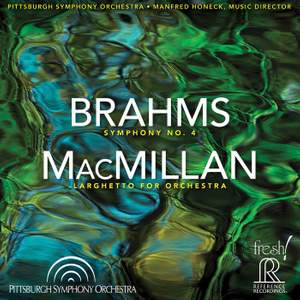
This release marks the completion of the Brahms symphony cycle with The Pittsburg Symphony Orchestra conducted by Marek Janowski. This series has been warmly applauded. “Classics Today” awarded previous releases in this cycle ‘10 out of 10’ and Classic FM Magazinze awarded the recordings of symphonies 2 & 3 “Disc of the Month”.

“…the Pittsburgh Symphony - increasingly one of the nation's finest - could easily be mistaken for a top German orchestra, like Leipzig or Dresden, in this music. The refulgence of the playing is a constant source of pleasure and any conductor who is as mindful of Brahm's ingenuity, invention and sheer vision as Janowski demands to be heard. The Hungarian Dances... are earthy and sinewy with plenty of surge factor in the lower strings and the requisite cheekiness in the phrasing exemplified by those traditionally tantalising hesitations and stompling downbeats.” Gramophone Magazine, March 2009

“It's been true for many years now that American orchestras have been sounding more middle- European, but the Pittsburgh Symphony could easily be mistaken for a top German orchestra, like Leipzig or Dresden, in this music. Listen to the slow movement of the Fourth Symphony where Marek Janowski really has his players leaning into the harmonic radiance of the writing. All those wondrous transfigurations evolve so naturally and so dreamily that the brawny exuberance of the Scherzo – tough and resilient in Janowski's hands – really does come as an unexpected blast.
Approaches differ greatly with regard to the highly innovative first movement, the whole of which constitutes a development of sorts. So, how soon do the darkening clouds descend? For some they cannot descend soon enough. But here it's as if Janowski is delaying the inevitable right through to the high anxiety of the final pages. He tightens the screw relatively late in the movement. The slow movement then restores some sense of prior well-being and inner calm, as does the still centre of the finale with its tranquil flute and trombone-led chorale variation. The refulgence of the playing is a constant source of pleasure.
The Hungarian Dances come in Brahms and Dvorák's orchestrations, their kinship self-evident.
They are earthy and sinewy with plenty of surge factor in the lower strings and the requisite cheekiness in the phrasing exemplified by those traditionally tantalising hesitations and stomping downbeats.”
Gramophone Classical Music Guide, 2010

GGramophone Magazine

Editor's Choice - March 2009

Super Audio CD

Format:

Hybrid Multi-channel

Pentatone - PTC5186309

(SACD)

$18.25

In stock - usually despatched within 1 working day.

Brahms: Symphony No. 4 in E minor, Op. 98, etc.

Brahms:

Symphony No. 4 in E minor, Op. 98

Hungarian Dance No. 2 in D minor

Hungarian Dance No. 4 in B minor

Hungarian Dance No. 5

Hungarian Dance No. 6 in D flat major

Hungarian Dance No. 7

Hungarian Dance No. 8 in A minor

Hungarian Dance No. 9 in E minor

Hungarian Dances arranged for orchestra by Peter Breiner.


“A rhythmically taut, finely structured reading with plenty of dynamism ad thrust, but giving full rein to the work's deep elegiac aspects.” BBC Music Magazine, October 2007

“It's a rhythmically taut, finely structured reading with plenty of dynamism and thrust, but giving full rein to the work's deep elegiac aspects and darker shadings.” BBC Music Magazine, October 2007 ****

“The LPO, London's finest Brahms ensemble, has been in vintage form during this cycle under Marin Alsop's measured and thoughtful direction.
Not since the classically incisive Loughran/ Hallé recordings of the mid-1970s has there been a more obviously collectable budget-price Brahms set.
Alsop's reading of the Fourth Symphony is not dissimilar to Sir Adrian Boult's 1972 LPO recording. Like Boult, Alsop is happy to establish a tempo and emotional trajectory for each movement and leave it at that – a plausible view given the astonishing degree of thematic integration that underpins the work.
As elsewhere in the cycle, tempi tend to be measured.
The Andante moderato is downright slow, though Alsop manages to maintain line and interest.
The Scherzo, happily, is a true Allegro giocoso, which is important. By acting out the role of a conventional finale, the Scherzo leaves the actual finale free to enact its own tragic destiny.
The recording sounds well if played at a decent level. In the Scherzo, the triangle (deliciously placed and recorded in the Hungarian Dances) is more an impression than a presence. There is also an editing glitch midway through the movement, not the first in this series. The seven Hungarian Dances, unorchestrated by Brahms, are heard in newly commissioned orchestrations by Peter Breiner. The thudding fairground timpani in No 6 doesn't appeal. Elsewhere, piquancy is the watchword, with stylish playing from the LPO, gamesomely led.”
Gramophone Classical Music Guide, 2010

“The LPO, London's finest Brahms ensemble, has been in vintage form during this cycle under Marin Alsop's measured and thoughtful direction.” Gramophone Magazine, February 2008

“Alsop’s triumphant cycle of Brahms symphonies with the LPO comes to a climactic end with this hugely impressive account of the Fourth. She has that ability, vital in music as dense as this, to hurry nothing, to make the most of the moment, yet always to maintain a sense of impetus.” Sunday Times

Naxos - 8570233

(CD)

$8.50

(also available to download from $6.00)

In stock - usually despatched within 1 working day.

Brahms - Symphonies Nos. 3 & 4

Brahms - Symphonies Nos. 3 & 4


Brahms:

Symphony No. 3 in F major, Op. 90

Symphony No. 4 in E minor, Op. 98


Virgin - The Classics - 3913302

(CD)

$10.50

In stock - usually despatched within 1 working day.

Brahms: Symphonies Nos. 1-4 (Complete)

Brahms: Symphonies Nos. 1-4 (Complete)


Sony Tandem - 82876873862

(CD - 2 discs)

$12.50

In stock - usually despatched within 1 working day.

Brahms: Symphony No. 4 in E minor, Op. 98

Brahms: Symphony No. 4 in E minor, Op. 98


LSO and Mariinsky - up to 25% off

LSO Live Haitink Complete Brahms Symphonies - LSO0057

(CD)

Normally: $7.75

Special: $6.20

In stock - usually despatched within 1 working day.

Page: 

 1   2   3   4   5   6   7   8   9   10   11   12   13   14   15   16   17 

 Next >>

Copyright © 2002-13 Presto Classical Limited, all rights reserved.