All recordingsPrices shown exclude VAT. (UK tax is not payable for deliveries to United States.) See Terms & Conditions for p&p rates. | |  | Sir John Barbirolli - Bucharest & Turin Concerts
Beethoven: | Symphony No. 7 in A major, Op. 92 recorded 'live' – Romanian Athenian, Bucharest, 13 September 1958 George Enescu Philharmonic Orchestra | Debussy: | La Mer recorded 'live' – Romanian Athenian, Bucharest, 13 September 1958 George Enescu Philharmonic Orchestra | Holst: | The Planets, Op. 32 (Mars, Venus, Mercury, Uranus & Jupiter). Recorded 'live' – Auditorium di Torino della RAI, 15 November 1957 RAI Symphony Orchestra, Turin | Vaughan Williams: | Fantasia on a Theme by Thomas Tallis recorded 'live' – Romanian Athenian, Bucharest, 13 September 1958 George Enescu Philharmonic Orchestra | Wagner: | Die Meistersinger von Nürnberg Overture recorded 'live' – Romanian Athenian, Bucharest, 13 September 1958 George Enescu Philharmonic Orchestra |
The Barbirolli Society's new 2-CD release brings together ‘live’ recordings, from the late 1950s, of Sir John conducting the George Enescu Philharmonic Orchestra and the RAI Symphony Orchestra, Turin. The complete concert from the Romanian Atheneum, Bucharest in September 1958 consisted of Wagner’s Overture to Die Meistersinger von Nürnberg, Vaughan Williams’s Fanstasia on a Theme by Thomas Tallis, Debussy’s La Mer and Beethoven’s Symphony No.7. The George Enescu Philharmonic was founded in 1868, the Romanian Philharmonic Society, conducted by Eduard Wachman, aimed at creating a permanent symphonic orchestra in order to promote musical culture and popularise classical music. When the palace of the Romanian Athenaeum was inaugurated, on 15 March 1889, concerts began to be held there, asnow, and is the headquarters of the Philharmonic. Eduard Wachman, conducted until 1907, and was succeeded by Dimitrie Dinicu, then in 1920, by George Georgescu, a remarkable conductor, student of Arthur Nikisch and Richard Strauss. After George Enescu died, in 1955, the Philharmonic took his name. The five movements from Holst’s The Planets (Mars, Venus, Mercury, Uranus and Jupiter) comes from a concert in Turin on15 November 1957. | 
| | | In stock - usually despatched within 1 working day. |
|
|
| |  | Leonard Bernstein conducts Debussy
Orchestra dell'Accademia di Santa Cecilia, Rome, Leonard Bernstein The first Bernstein Debussy DVD on the market. Includes DTS 5.1 sound! Includes Prélude à l'après-midi d'un faune, Debussys most famous work. This highly acclaimed concert with the Orchestre Dell’Accademia Nazionale di Santa Cecilia was recorded 1989 in Rome, one year before Bernstein´s death in 1990. 83 minutes 4:3, color PCM Stereo, DTS 5.1 | 
| | | In stock - usually despatched within 1 working day. |
|
|
| |  | Carlo Maria Giulini conducts Schubert, Debussy, Franck & Rossini
Berliner Philharmoniker, Carlo Maria Giulini In February 1969 Giulini presented a programme with a particularly intelligent compilation. Rossini's overture to Semiramide, Symphony No.4 by Schubert, Psyché et Éros by César Franck and La Mer (Debussy) outlined the development from classical music to Impressionism, with each composition already relating to the next one. On 15 February 1969 Joachim Matzner's critique in Die Welt was entitled "Drama and utmost sensitivity". He went on to say that there was hardly another conductor who could combine a melody so sensitively with dramatic tension. "All the melodic phrases, no matter how aristocratic and subtle his conducting, were threedimensional, the counterpoints, rather than being just an additional part were true to their name, defining accents were deployed. And yet, even when the music was intensified almost to the limit, in Giulini's hands it sounded fundamentally unostentatious – neither blurred nor conspicuous. His rendering of Debussy's La Mer in all its marvellous flexibility, its transparency, its colours that never took on a life of their own, made it one of the grandest events to have been put on in Berlin's concert halls for many a year." On 21 February 1969 Rudolph Ganz, writing in the Frankfurter Rundschau, started by praising the intelligent compilation of the programme. Of the overture to Semiramide he wrote that it was no jolly piece of noise but a paragon of precision; Schubert's Symphony No.4, dubbed by the composer the 'Tragic', was just that – neither pompous nor bathetic, but nervous and tense. The romantic climax was Franck's brief fragment Psyché et Éros and Eros and the thrilling finale was La Mer, which was "... extraordinarily animated and vivid. Here again Giulini's tense precision that missed not a single detail of the score was paramount, yet he coaxed a supreme performance from the musicians of the Philharmonic Orchestra." From the booklet note by Helge Grünewald | 
| | | In stock - usually despatched within 1 working day. |
|
|
| |  | Debussy - Orchestral Works
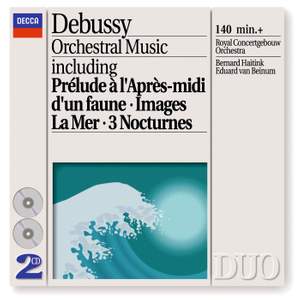
L’Orchestre de la Suisse Romande, Ernest Ansermet This volume of Debussy’s orchestral works under Ernest Ansermet brings together all of the composer’s acknowledged masterpieces together with some of the shorter pieces. The rare 1951 recording of Prélude à l’après-midi d’un faune and the 1949 recording of the Images make their first appearance on CD. Ansermet’s second recording of La Mer – he also recorded the piece for Decca in 1947, 1957 and 1964 – his first of the Nocturnes, and the early stereo version of Jeux are, likewise, all rarities. The anthology is completed with an authentically French-sounding Rapsodie pour clarinette as well as a lush Clair de lune and a delectable Petite suite. | 
| | | In stock - usually despatched within 1 working day. |
|
|
| |  | Debussy - La Mer
Philadelphia Orchestra & Temple University Women's Choir, Eugene Ormandy | 
| | | In stock - usually despatched within 1 working day. |
|
|
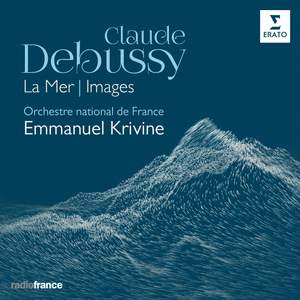
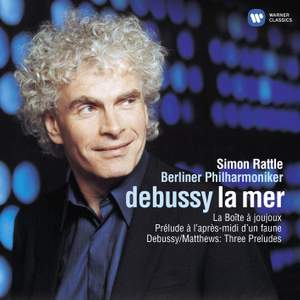
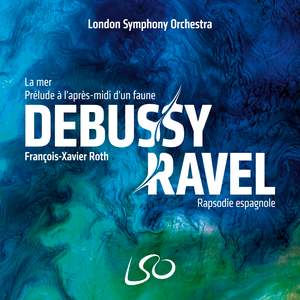
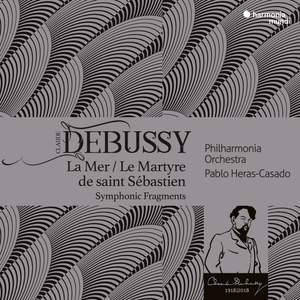
| |  | Debussy - La Mer
Berlin Philharmonic Orchestra, Herbert von Karajan “Karajan was always a matchless conductor of La mer, and this is a thrilling performance, L'après-midi is suitably languorous and sensual, and then the Daphnis and Chloé Second Suite, though without chorus, is no-holds-barred.” BBC Music Magazine, September 2008 ***** | | | In stock - usually despatched within 1 working day. |
|
|
| |  | Dutilleux, Debussy & Ravel
Royal Concertgebouw Orchestra, Mariss Jansons Recorded 1, 2 4 February 2007 (Debussy, Ravel); 7, 8 June 2007 (Dutilleux) “[Sitkovetsky] cuts an assertive line through [Dutilleux's L'arbre des Songes]' dark dissonance like a Gallic philosopher illuming the absurd. Jansons's orchestra is delicious in swarming, weightless textures. On either side, more solid works appear. Debussy's heaving, salty La Mer surges vividly, although not always with the threatening undercurrents that awed the non-swimming composer. Ravel's La Valse careers deliriously with grotesque steps neatly played, a rumbustious contrast to Dutilleux's contemporary scintillations.” The Times, 17th May 2008 **** “With excellent performances of Debussy's La mer, Ravel's La valse, and Henri Dutilleux' violin concerto
L'arbre des songes, Jansons demonstrates that he can also hold his own in French repertoire.This is actually an
understatement, since in La mer the briny seawater splashes in your face and you feel the swelling of the
waves, the ebb and flow, and the thrusting flow of the tide in a way that rarely happens in other recordings.
In La valse it is immediately the suggestive, secret mysterious opening bars that under Jansons' direction
imperceptibly and gradually lead, first carefully but shortly thereafter irresisibtly, to a dancing waltz. The
progression to the sinister dance of death in the last section becomes inevitable. Dmitry Sitkovetsky is the
first-class soloist in Dutilleux' fantastic violin concerto-a modern masterpiece for which the strongest
possible case is made. RCO 08001 is a high point in the entire catalog.” Erik Voermans, Parool, 4th March 2008 “...Jansons has the courage to explore the darkness behind the Gallic sophistication. So the fierceness of the spray is almost palpable in Debussy's La Mer, and there is menace in the way Ravel's La Valse whirls towards its conclusion.
The Concertgebouw Orchestra has the subtlety of colouring to bring something of its own to the music, from the pastel-edged tints of its solo woodwind to the velvety warmth of its strings and the edge of its brass. Last but not least, Dmitry Sitkovetsky explores the dreamland of Dutilleux's "violin concerto" with insight to match the composer's glistening orchestral writing.” The Telegraph, 26th April 2008 “The magic of Jansons's conducting with the orchestra of which he is chief conductor could not be more compelling.” Gramophone Magazine, July 2008 | | | In stock - usually despatched within 1 working day. |
|
|
| |  | Debussy - Orchestral Works Volume 1
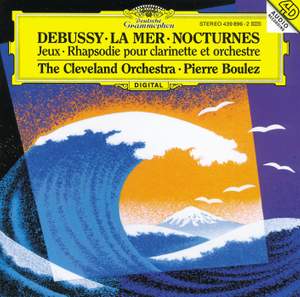
Orchestre National de Lyon, Jun Märkl Debussy was one of the most important and influential composers of the early twentieth century. This recording features two of Debussy’s most harmonically innovative and imaginatively orchestrated works. Prélude à l’après-midi d’un faune (Prelude to the Afternoon of a Faun) evokes a pagan world, as the faun of the title takes his ease in the afternoon shade on a summer day. The three symphonic sketches that constitute La mer (The Sea), inspired partly by Katsushika Hokusai’s famous colour woodcut The Great Wave Off Kanagawa, offer subtly nuanced evocations of the sea from dawn to midday, of the waves and of the dialogue of wind and sea. “The Prélude à l'Après-Midi opens with a beautifully shaped flute solo, but then becomes too generalised, without enough stabs of drama to lift its general mood of indolence, while La Mer motors along rather complacently and Jeux totally lacks the quicksilver wit and colouristic imagination that makes it one of the most elusive and potent of Debussy's late works. Whether it's more obvious delight in the luxuriance of the textures, or a sharper analytical insight into the way in which the pieces are constructed, it needs more character; what we get instead is elegant, undemanding background music.” The Guardian, 30th May 2008 ** “Debussy ushered in the modern age with breezy whole-tone scales and mere impressions of keys, which the musicians under Märkl paint with delicious colour. Märkl moves the phrases of La Mer like plump, urgent waves, or smoothes them like the deceptive calm ready to surge at any moment. A sense of lurking danger might have been more apparent, however. The Prélude à l'après-midi d'un faune paints beautifully the dancing sunlight but lacks that haunting hollowness in the flute that evokes the pagan past. Jeux is both playful and as tense as a tennis racket. But Children's Corner is a little overpowering for the nursery, the jauntiness now rather grotesque in expanded form.” The Times, 24th May 2008 *** “…this is bewitching music-making that should on no account be missed… One of the finest discs Naxos has ever released.” Classic FM Magazine Orchestral Disc of the Month “Markl and his players acquit themselves admirably, and as one-stop shopping for some of Debussy's most engaging orchestral works it's hard to beat.” American Record Guide | | | In stock - usually despatched within 1 working day. |
|
|
| |  | Proustor How The Heart Skips A Beat
Stéphanie Romberg, Eleonora Abbagnato, Manuel Legris, Stephane Bullion, Hervé Moreau (dancers) Orchestre de l'Opéra National de Paris & Ballet de l'Opéra National de Paris, Koen Kessels In 1974, Roland Petit, probably the greatest and certainly one of the most prolific of 20th century French
choreographers he was the first person to create a work based on Proust's novel, A la recherche du temps
perdu, completed in 1922, the year of his death.The book, better known to Anglo-Saxon readers as In Search
of Lost Time, in which the author's homosexuality is latent, was written over the last 14 years of his life. Marcel
Proust mingles childhood souvenirs with adolescent memories and is full of nostalgia for places once visited
and exhibitions he'd seen. He dwells lengthily on love, passion, and jealousy and inevitably questions one's
reason for living.
Proust ou les intermittences du coeur has now happily entered into the repertoire of the Paris Opéra Ballet.It
consists of 13 vignettes inspired by the seven lengthy tomes which complete the unabridged work, Petit has
chosen to convey the spirit of the novel via a succession of impressionistic tableaux which reflect the changing
moods of the writer as he oscillated between periods of intense happiness and deep depression.And
although the choreographer paints a merciless portrait of the aristocracy and bourgeoisie during the Belle
Epoque, the highlights of the work lie in the series of poetical pas de deux, which at times might have seemed
a little disconnected, but at which the French choreographer is past master. Choreography & stage direction Roland Petit; Designer Luisa Spinatelli; Sets Bernard Michel; Lighting Jean-Michel Désire Palais Garnier, March 2007 | | | In stock - usually despatched within 1 working day. |
|
|
| |  | In Memory of Arturo ToscaniniConcert given by the Symphony Of The Air, Carnegie Hall 3/2/1957
The Toscanini Memorial Concert preserved in this album was an altogether remarkable event: three great conductors
came forth to pay homage to their friend and colleague, each leading a work that Toscanini had interpreted
wonderfully. Only the Eroica was previously released from this memorable concert in any format and
the bonus selections were only issued on a Roulette mono LP (which also included Dvorak's New World
Symphony) as a fund-raising record for the Symphony of the Air; this is the first release of these performances
in stereo. | | | In stock - usually despatched within 1 working day. |
|
|
| |
|