All recordingsPrices shown exclude VAT. (UK tax is not payable for deliveries to United States.) See Terms & Conditions for p&p rates. | |  | Stravinsky: Symphonies & Concertos
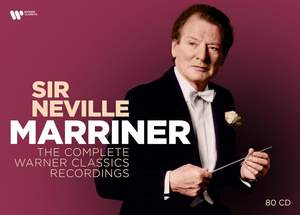
Igor Stravinsky (1882-1971) caused a sensation early on in the 20th century with the first performance in 1913 of his ballet Le sacre du printemps (The rite of Spring). This event marked the composer as a musician of the new century and throughout his life Stravinsky remained at the forefront of the musical avant-garde, keeping abreast of musical developments right up to he time of his death. All of the works in this set of orchestral pieces were written during Stravinsky's neo-classical period, which lasted from around 1920 until about 1953, after which he adopted the serial technique first developed by Arnold Schoenberg. “Highlights in this rather miscellaneous collection are Rattle's expert account of the Symphony in Three Movements, Michel Béroff's characterful performance of the Capriccio, and a sprightly complete Pulcinella from Neville Marriner.” BBC Music Magazine, April 2011 **** | | | In stock - usually despatched within 1 working day. |
|
|
| |  | Stravinsky - Later Ballets
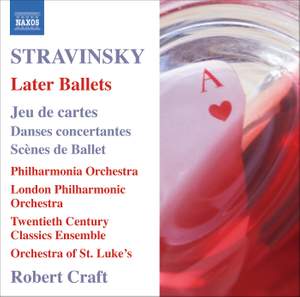
Stravinsky: | Jeu de cartes Commissioned by George Balanchine, Jeu de cartes is a prime example of melodic, rhythmic, and harmonic ideas emerging helter-skelter from Stravinsky’s imagination. Unlike his other ballets, it contains no slow music and no lovers’ pas-de-deux adagio. Philharmonia Orchestra Danses Concertantes Danses concertantes was the first large-scale piece composed entirely in what was to be Stravinsky’s Hollywood home for the next 24 years. Twentieth Century Classics Ensemble Scènes de ballet Orchestra of St. Luke’s Variations London Philharmonic Orchestra Capriccio for Piano and Orchestra (Rubies from the ballet Jewels) Mark Wait (piano) Orchestra of St. Luke’s |
First performed by the Chicago Symphony Orchestra under Robert Craft, Variations are the densest music Stravinsky ever wrote, yet the ingenious rhythmic structures allow every note to be heard. Ezra Pound, in a balcony at the Teatro La Fenice for a September 1934 performance of the Capriccio for Piano and Orchestra, wrote: “the piano and orchestra are as two shells of a walnut”. Alban Berg, who had shared the same concert with Stravinsky, remarked to the latter: “I wish I could write such happy music” “There are times when Craft brings a welcome rhythmic drive to the music, as in parts of Jeu de cartes and quite a lot of Danses concertantes. But energy, nervous excitement, biting wit - all these seem in short supply.” BBC Music Magazine, February 2008 *** “This collection of Stravinsky's later ballets represents the composer in lighter mood, making a delightful sequence, very well played and recorded under the authoritative direction of the composer's principal amanuensis. Jeux de cartes ('The Card Game') of 1936 points directly forward to Stravinsky's style in his opera The Rake'sProgress, the piece reflecting his love of the game of poker: the three main sections of the ballet represent first, second and third deals, with the Joker figuring in each. The piece was written for the great choreographer Georges Balanchine. Craft's performance with the Philharmonia has an aptly clean attack, with the chugging rhythms well lifted, very suitable for ballet. Danses concertantes represents Stravinsky in even lighter mood, the first major work he wrote after his arrival in the United States. It's fun music full of playfulness, ending with a jolly galloping theme in compound time. Scènes de ballet of 1944 was commissioned for a Broadway show, but sadly, the bars in 5/4 time were too difficult for the theatre orchestra to play, and it had to be abandoned for its original purpose, only to emerge later as a full concert piece and ballet. Variations, much the shortest item on the disc, represents Stravinsky using 12-tone technique, an uncompromising, densely packed five minutes which makes for difficult listening, while the Capriccio for piano and orchestra of 1929 returns to his jolly and light-hearted mood, the popular rhythms jauntily presented. Mark Wait is an outstanding soloist. Altogether, a delightful collection brilliantly played and recorded.” Gramophone Classical Music Guide, 2010 “…a delightful collection brilliantly played and recorded.” Gramophone Magazine, February 2008 | | | (also available to download from $6.00) | In stock - usually despatched within 1 working day. |
|
|
| |  | Stravinsky: Chamber Works & Rarities
| | | In stock - usually despatched within 1 working day. |
|
|
| |  |
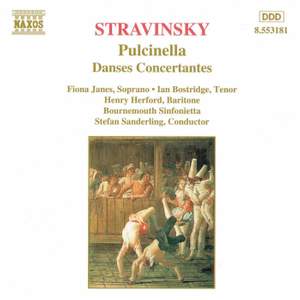
“Even if the performance were less than excellent this newcomer would be welcome. But it is very good indeed... Fiona James, Ian Bostridge and Henry Herford are outstandingly good... What can I say? Another "another Naxos winner"!!.” Classic CD, April 1996 ***** | | | (also available to download from $6.00) | In stock - usually despatched within 1 working day. |
|
|
| |  |
“…Apollon Musagète is the most substantial work on the disc, and the performance is characterised by impeccable balance, lithe phrasing and some effective solo playing, especially from the leader. More than that, it really dances, with lightness and elegance in the variations for Polyhymnia and Terpsichore, and affectionate melodic lines in the 'Pas de deux'.” BBC Music Magazine, May 2005 **** | | | Usually despatched in 4 - 5 working days. |
|
|
| |  |
| | | (also available to download from $10.50) | Usually despatched in 2 - 3 working days. (Available now to download.) |
|
|
| |  |
| | | Usually despatched in 3 - 4 working days. |
|
|
| |  | Stravinsky: Famous Ballets
The three great Stravinsky ballets plus major works such as the Symphonies of Wind Instruments, ‘Dumbarton Oaks’, Apollon musagète, and Le Chant du Rossignol in performances under the baton of Charles Dutoit, recognised as one of the greatest interpreters of this repertoire. These 4 CDs provide a superb introduction to one of the greatest 20th-century composers in critically acclaimed recordings. Recordings made in the 1980s and 1990s in the acoustically renowned Montreal Church of St Eustache. New booklet notes addressing Stravinsky’s career and special aptitude for the ballet. ‘The first big advantage of this new Dutoit version of the complete Firebird is that it provides substantial and very apt couplings, over an hour’s music in all, ravishingly played and superbly recorded.’ Gramophone review of Firebird, Scherzo fantastique, Feu d’artifice, October 1986 ‘So far as recording quality is concerned, this new release is quite outstanding … The playing of the Montreal Symphony Orchestra is first-rate in every department … The strings are rich in sonority, the wind-playing flawless, and phrasing throughout is sensitive. Take almost any section of the record and play it to a visiting friend and it will excite unqualified admiration both for orchestral playing and recording.’ Gramophone reviewing Le Sacre du Printemps in April 1985 | | | Usually despatched in 2 - 3 working days. |
|
|
| |
|