Ravel: Trois chansons madécasses

This page lists all recordings of Trois chansons madécasses, by Maurice Ravel (1875-1937) on CD & download (MP3 & FLAC). Generally, more recent releases are listed first, but with priority given to those that are in stock.

Recommendations

Editor's Choice
November 2012
Editor's Choice
May 2004
4 star

All recordings

Prices shown exclude VAT. (UK tax is not payable for deliveries to United States.)
See Terms & Conditions for p&p rates.

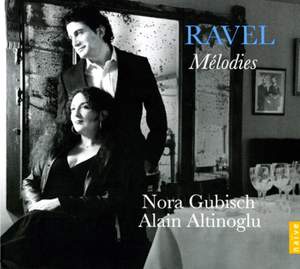
Ravel: Mélodies

Ravel: Mélodies


Ravel:

Histoires naturelles (5)

Trois chansons madécasses

with Magali Mosnier (flute) & Jérôme Pernoo (cello)

Nahandove, Aoua! Il est doux

Manteau des fleurs

Noël des jouets

Chanson de la mariée

Là-bas, vers l’eglise

Quel gallant m’est comparable

Chanson des cueilleuses de lentisques

Tout gai!

Tripartos

Les grands vents venus d'outre-mer

Sur l'Herbe

Ronsard à son âme

Rêves

Deux mélodies hébraïques


Nora Gubisch (mezzo-soprano) & Alain Altinoglu (piano)

The mélodies presented here were written between 1903 and 1927. They display in exemplary fashion the different facets of the art of Ravelian song. Some malcontents have declared them 'unclassifiable'. In fact, what is striking here is the diversity, the eclecticism, the independence of the composer when he chooses, as encounters and opportunities crop up, to illustrate a poem by Verlaine, to set to music the prose of Jules Renard, or to harmonise a Greek or Hebrew tune.

This footloose stroll through different times and cultures gives us an insight into the composer's inquiring mind, his determination to follow his wishes and desires, without noisily drawing attention to himself, yet tranquilly standing his ground in his personal world while apparently indifferent to the scandals he quite involuntarily provoked. The song texts reflect Ravel's literary culture, his interest in and respect for literature, which had been as Integral a part of his life as music ever since his adolescence, when, in the company of Ricardo Vines (great-great-uncle of Nora Gubisch), he frequented the bookshops and the second-hand booksellers along the Seine.

After musical studies at the Radio France Maîtrise and piano study with Catherine Collard, mezzo-soprano Nora Gubisch was awarded first prize for singing at the Paris Conservatoire, going on to study with Vera Rózsa, who became her principal teacher and mentor. She quickly earned leading rôles with the Paris Opéra, La Scala, Milan, San Francisco Opera, Salzburg, Aix-en-Provence and the BBC Proms. She has been a guest of the Vienna, New York and Munich Philharmonic Orchestras, Dresden Staatskapelle, Orchestre de Paris and London Symphony Orchestra, with conductors including Sir Colin Davis, Lorin Maazel, Georges Prêtre and Nikolaus Harnoncourt. She has formed a duo with pianist and conductor, Alain Altinoglu, now her husband, and has recorded many songs.

“Ravel effected an understated formal revolution in vocal music, the pieces performed here by mezzo-soprano Nora Gubisch with pianist Alain Altinoglu being notable for their commitment to textual interpretation rather than sheer operatic grandeur.” The Independent, 18th August 2012 ***

“Not since the incomparable Régine Crespin...has a female French singer brought such insights and vocal allure to her native song repertoire as Nora Gubisch...Her voice remains youthful and bright, but capable of producing a wide spectrum of timbres for the very different demands of this challenging Ravel programme...The Kaddish can surely have never been more moving than it sounds on this fabulous disc.” Sunday Times, 26th August 2012

“It is a long, long time since anyone delved into Ravel’s songs as persuasively as Gubisch and her regular accompanist. The French mezzo-soprano has a full, voluptuous voice, but the key to her artistry lies in the idiomatic touch she brings to the music, based on her understanding of the texts and the difference it makes to the musical line...An outstanding recital.” Financial Times, 1st September 2012 *****

“One of the many attractions of this lovely disc is the exceptionally thoughtful booklet essay by Nina Vines … The recording is very fine and natural, with excellent balance … as fine a performance as I have ever heard … The individual songs are splendid” International Record Review, November 2012

“Altinoglu exploits the colours and textures with the utmost eloquence … Gubisch, with a vocal timbre of mellifluous beauty and well-focused richness, responds with the striking malleable spectrum of sensibility to the varied scenarios that Ravel encapsulates.” Gramophone Magazine, November 2012

“[Gubisch] combines a beautiful voice with intelligence, crisp diction and a real sense of style...I would guess she's lived with this music for a long time...this is a disc from which young and even less young singers can learn a great deal. 'Aoua!', the central song of the Chansons madecasses, is truly terrifying, as it ought to be.” BBC Music Magazine, Christmas 2012 *****

GGramophone Magazine

Editor's Choice - November 2012

Naive - V5304

(CD)

$17.50

(also available to download from $11.00)

In stock - usually despatched within 1 working day.

The Very Best of Jessye Norman

The Very Best of Jessye Norman


Berlioz:

Roméo et Juliette, Op. 17: Premiers transports que nul n'oublie

Brahms:

Ihr habt nun Traurigkeit (Ein Deutsches Requiem, Op. 45)

Offenbach:

Les Contes d'Hoffmann (highlights)

Amours divins (from La Belle Helène)

On me nomme Hélène la blonde … dis-moi Vénus

Là vrai, je ne suis pas coupable (from La Belle Hélène)

Elle vient, c'est elle (from La Belle Hélène)

Poulenc:

Miroirs brûlants

La Fraîcheur et le feu

Ravel:

Trois chansons madécasses

Chanson du rouet

Si morne!

Schubert:

Dem Unendlichen, D291 (Klopstock)

Der Winterabend (Es ist so still), D938

Auflösung, D807

Wagner:

Wesendonck-Lieder (5)

Dich, teure Halle (from Tannhauser)

Allmächt’ge Jungfrau! (from Tannhäuser)

Johohoe! Traft ihr das Schiff im Meere an 'Senta's Ballad' (from Der fliegende Holländer)

Mild und leise 'Isolde's Liebestod' (from Tristan und Isolde)


Jessye Norman (soprano)

If anyone may lay claim to the title of prima donna assoluta of the late 20th century, it is surely Jessye Norman. She is one of the great communicators. Whether in the intimate setting of the Wigmore Hall in London, or the huge space of the Metropolitan Opera House, New York, she can give each listener the sense that her song is directed straight at them. Jessye Norman was born in Augusta, Georgia, in 1945. She studied at Howard University, the Peabody Conservatory and the University of Michigan. In 1968 she won the Munich International Music Competition, and this led to an invitation to sing in Berlin at the Deutsche Oper, where she made her debut as Elisabeth in Wagner's Tannhäuser. After that her career blossomed and she went on to conquer the world’s greatest opera houses including La Scala in Milan and the Metropolitan in New York. One of her greatest triumphs in New York was in 1982, in Robert Wilson's Great Day in the Morning, and in 1989 she was invited to sing the Marseillaise for the 14 July celebrations in the Place de la Concorde.

The music on these CDs presents a cross-section of Jessye Norman's repertory, in German and French opera, in Lieder and mélodie, in oratorio and even operetta. Since Wagner's Tannhäuser provided Jessye Norman with her first stage role, it is appropriate to begin with two arias from that opera. Senta's ballad from Der fliegende Holländer tells the story of the Flying Dutchman, who is condemned to sail the seas for eternity unless he can find a woman who will remain faithful unto death. The Wesendonck- Lieder were composed by Wagner in 1857–8 as a tribute to Mathilde Wesendonck, the wife of his friend Otto; particularly in 'Im Treibhaus' and 'Träume', they look forward to Tristan und Isolde. The three Schubert songs, and the solo from Brahms's German Requiem, bring the German part of the programme to a rapturous conclusion.

From Offenbach’s Les Contes d’Hoffmann Jessye Norman sings the role of Giulietta, a Venetian courtesan, who ruins the hero, Hoffmann, by urging him to take part in a duel, and then in a symbolic gesture demands from him the ultimate sacrifice – the gift of his reflection. 'The face that launched a thousand ships' – Helen of Troy in La Belle Hélène – is another kind of temptress, and shows the full extent of Norman's comic gifts. In the song cycles by Ravel and Poulenc we glimpse a different side of the artist. La Fraîcheur et le feu was composed in 1950 for the baritone Pierre Bernac, Poulenc's greatest interpreter; in the 1960s, Bernac gave many master-classes covering the whole world of French song, and Jessye Norman was one of his students. The poems set are entitled Vue donne vie (‘Sight gives life'), but Poulenc asked the author, Paul Eluard, to give him a new title for the song-cycle. 'Unis la fraîcheur et le feu' is the opening line of the fifth song: 'Unite the coolness and the fire'. That is exactly what Jessye Norman has always done, and – in Bernac's words – she has done it with 'profound humanity'.

EMI - The Very Best of... - 6217252

(CD - 2 discs)

$11.50

In stock - usually despatched within 1 working day.

French Songs

French Songs


Chausson:

Chanson perpétuelle, Op. 37

Delage:

Quatre Poèmes hindous

Ravel:

Trois poemes de Stephane Mallarmé

Trois chansons madécasses


Dame Janet Baker (mezzo-soprano)

Melos Ensemble of London

An intriguing, evocative and exotic recital in which Janet Baker joined The Melos Ensemble for a journey through some of the twentieth century's most alluring French compositions for voice and chamber ensemble.

"A most beautiful recital... in (Chausson's Chanson perpetuelle) Baker expands and exultingly finds herself most at home. It's a strong, highly effective performance and marks a measure of the extraordinary way in which she has mastered the always rather special art of singing in French... The contributions by members of the Melos Ensemble - the Hurwitz Quartet, the flutes of Richard Adeney and William Bennett, Gervase de Peyer and Stephen Trier playing clarinet, Lamar Crowson (piano) and, very important, the harp playing of Osian Ellis - are of superlative quality." Gramophone.

“A classic disc if ever there was one. This beautiful recital was made in 1966 and sounds as fresh today as the day it was made...This may be placed among Janet Baker's most outstanding recordings.” Penguin Guide, 2011 edition

Australian Eloquence - 4803670

(CD)

$10.50

In stock - usually despatched within 1 working day.

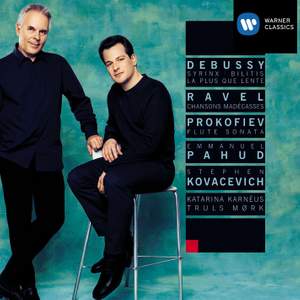
Debussy: Syrinx for solo flute, etc.

Debussy:

Syrinx for solo flute

6 Epigraphes antiques

La plus que lente

Prokofiev:

Flute Sonata in D major, Op. 94

Ravel:

Trois chansons madécasses


Emmanuel Pahud (flute), Stephen Kovacevich (piano), Truls Mørk (cello), Katerina Karnéus (mezzo soprano)

EMI - 5569822

(CD)

$13.00

In stock - usually despatched within 1 working day.

Ludus Verbalis Vol. 2

Ludus Verbalis Vol. 2


Britten:

Sacred and Profane, Op. 91

Hindemith:

Six Cansons nach Rilke

Lawson, Philip:

A Yeats Trilogy

Martin, F:

Songs of Ariel from Shakespeare's ‘The Tempest'

Martinu:

Ctyri madrigaly

Poulenc:

Sept Chansons

Ravel:

Trois chansons madécasses


Ensemble Vocal Aedes, Matthieu Romano (direction)

Through this second volume of secular music, the Ensemble Aedes continues their exploration of a cappella choral 20th and 21st centuries. In the wake of the first record (EL1128), they have selected 7 cycles where the word, its sound, and space for play and imagination are at the centre of the musical creation.

Eclecticism is thus once again put forward: amidst William Butler Yeats, Rainer Maria Rilke and Guillaume Apollinaire, we find William Shakespeare and Paul Eluard or anonymous texts bequeathed by the people and traditions from medieval England or Moravian folklore, and a cycle which the writer is none other than the composer himself. This disc also illustrates how culture and literary tradition of a country can shape, inspire, influence and sometimes dictate a mode of songwriting and vocal, especially when the composer appropriates a language that is not his own. Sacred texts, like secular texts, are treated as madrigals depicting human passions. This cycle invokes the last two volumes that will complete this series.

Eloquentia - EL1237

(CD)

$18.75

Usually despatched in 3 - 4 working days.

The French Album

The French Album


Fauré:

La Bonne Chanson, Op. 61

Poulenc:

Le Bal masqué

Ravel:

Trois chansons madécasses


When he sadly died earlier this year, the great baritone Dietrich Fischer-Dieskau left behind an amazing legacy of recordings. This CD features three relative rarities by French composers from the turn of the 20th century: La Bonne Chanson op. 61 by Gabriel Fauré, the Chansons Madécasses by Maurice Ravel, and Le Bal Masqué by Francis Poulenc.

The music is performed by Fischer-Dieskau with eleven soloists from the Berlin Philharmonic Orchestra, including the violinist Thomas Brandis, flautist Karlheinz Zöller, and the clarinettist Karl Leister. The pianist is Wolfgang Sawallisch, who although a highly regarded instrumentalist in his own right, is particularly renowned as one of the leading conductors of the time.

Acanta - 233651

(CD)

$13.75

(also available to download from $11.00)

Usually despatched in 4 - 5 working days. (Available now to download.)

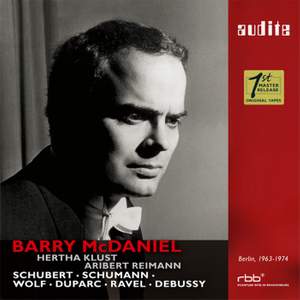
Barry McDaniel sings Schubert, Schumann, Wolf, Duparc, Ravel & Debussy

Barry McDaniel sings Schubert, Schumann, Wolf, Duparc, Ravel & Debussy


Debussy:

Le promenoir des deux amants

Duparc:

Chanson triste

Lamento

Le Manoir de Rosemonde

Extase

Soupir

Phidylé

Ravel:

Trois chansons madécasses

Eberhard Finke (cello) & Karlheinz Zoeller (flute)

Schubert:

Der Winterabend (Es ist so still), D938

Herbst, D945

Dass sie hier gewesen! D775 (Rückert)

Der Einsame, D800

Fahrt zum Hades, D526 (Mayrhofer)

Der Jungling und der Tod, D545 (Spaun)

Sprache der Liebe D410 (A W von Schlegel)

Fischerweise, D881 (Schlechta)

Über Wildemann D884 (Ernst Schulze)

Auflösung, D807

Schumann:

Gedichte (6) und Requiem, Op. 90

Nachtlied, Op. 96 No. 1

Der Spielmann, Op. 40, No. 4

Zigeunerliedchen I & II

Verratene Liebe, Op. 40, No. 5

Provencalisches Lied, Op. 139 No. 4

Mein Schöner Stern! Op. 101 No. 4

Aus den hebräischen Gesängen, Op. 25 No. 15

Ihre Stimme Op. 96 No. 3 (August von Platen)

Wolf, H:

An eine Æolsharfe (No. 11 from Mörike-Lieder)

Heimweh (No. 37 from Mörike-Lieder)

Lebe wohl (No. 36 from Mörike-Lieder)

Nimmersatte Liebe (No. 9 from Mörike-Lieder)

Der Tambour (No. 5 from Mörike-Lieder)

Abschied (No. 53 from Mörike-Lieder)


Barry McDaniel (baritone), Hertha Klust (piano) & Aribert Reimann (piano)

The American baritone Barry McDaniel was one of the outstanding singers of the post-war era. As a successful opera singer and Lieder interpreter, he enjoyed a long and eventful career, both in Germany and abroad. Despite numerous performances and many recordings for radio and television, he nonetheless remained largely unnoticed by the media, partly because his name almost vanished in the shadow of Dietrich Fischer-Dieskau, who was five years his senior. Unjustly so, since the two singers were equals as artists, albeit with different characters. Today, Barry McDaniel is hardly mentioned in specialist literature and one searches in vain for CDs since, until now, recordings from radio archives have not been phonographically processed. However, Audite now presents a première double CD of Lieder sung by Barry McDaniel. These studio recordings from the archives of Radio Berlin-Brandenburg (formally Sender Freies Berlin) were made between 1963 and 1974 with Hertha Klust and Aribert Reimann as accompanists.

This selection of songs by Schubert, Schumann, Wolf, Duparc, Ravel and Debussy reveals diverse facets of McDaniel’s artistic personality. His interpretations are characterised by an interleaving of knowledge and naivety, feeling and craftsmanship, expression and impeccable singing. Apart from his immaculate technique, his accent-free German is particularly remarkable.

Barry McDaniel moved from the USA to Germany in 1953 in order to further his studies. He then gave his first song recitals, together with Hermann Reutter, and later began a career as an opera singer. In 1961 he was engaged at the newly re-opened Deutsche Oper Berlin, where he remained for thirty-seven years. At the same time, he gave guest performances at the Vienna Staatsoper, the Metropolitan Opera New York, the Frankfurt Opera and the Munich Opera Festival, as well as broadcasting for radio and television. In addition, Barry McDaniel gave numerous song recitals, for example in Stuttgart, Karlsruhe, Hanover, Brunswick and Berlin, including, in the latter city, the first ever song recital at the newly built Philharmonie in 1963. Today, the 81-year-old baritone declares: “Whatever I sing, I have to believe in it.” That is exactly how these recordings sound.

“The American Barry McDaniel inevitably sang in the shadow of Fischer-Dieskau; but this double CD reveals his deeply thoughtful baritone, in superbly accompanied Lieder and melodie.” BBC Music Magazine, June 2012 ****

Historical Recordings - up to 25% off

Audite - AUDITE23426

(CD - 2 discs)

Normally: $17.75

Special: $14.20

(also available to download from $21.75)

Usually despatched in 3 - 4 working days. (Available now to download.)

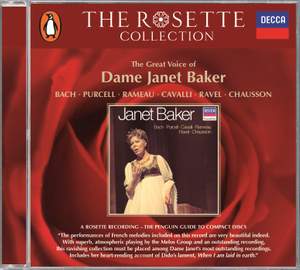
Dame Janet Baker - Grandi Voci

Dame Janet Baker - Grandi Voci


Bach, J S:

Vergnugte Ruh', beliebte Seelenlust (Contented rest,beloved inner joy) from Cantata No. 170

Cavalli:

Ardo, Sospiro E Piango (La Calisto)

Chausson:

Chanson perpétuelle, Op. 37

Delage:

Quatre Poèmes hindous

Purcell:

When I am laid in earth (from Dido and Aeneas)

But Death, Alas! (Dido And Aeneas)

With Drooping Wings (from Dido and Aeneas)

Rameau:

Cruelle mère des amours (from Hippolyte et Aricie)

Ravel:

Trois poemes de Stephane Mallarmé

Trois chansons madécasses


Decca Rosette Collection - 4767091

(Sorry, download not available in your country)

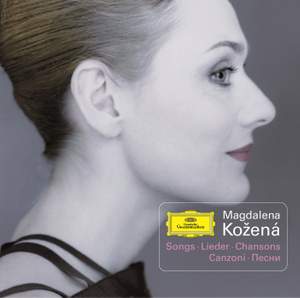
Songs

Songs


Britten:

A Charm of Lullabies for mezzo-soprano and pianoforte, Op. 41 (1947)

Ravel:

Trois chansons madécasses

Respighi:

Il tramonto

Schulhoff:

Drei Stimmungsbilder for mezzo-soprano, violin and pianoforte, Op. 12 (WV 30)

Shostakovich:

Satires 'Sketches of the past', Op. 109


Magdalena Kozena (mezzo-soprano)

GGramophone Magazine

Editor's Choice - May 2004

DG - E4715812

(CD)

$17.50

(Sorry, download not available in your country)

Usually despatched in 8 - 10 working days.

Ravel - Songs

Ravel - Songs


Ravel:

Chanson espagnole

Chanson française

Chanson écossaise

Chanson italienne

Chanson hébraïque

Chanson du rouet

Noël des jouets

Deux mélodies hébraïques

Deux épigrammes de Clément Marot

Cinq mélodies populaires grecques

Un grand sommeil noir

Manteau des fleurs

Si morne!

Don Quichotte à Dulcinée

Histoires naturelles (5)

Ballade de la reine morte d'aimer

Tripartos

Three Songs for Unaccompanied Mixed Choir

(version for solo voice & piano)

Ronsard à son âme

Les grands vents venus d'outre-mer

Sainte

Sur l'herbe

Rêves

Vocalise-étude en forme de habanera

Trois chansons madécasses


Inva Mula, Valerie Millot (sopranos), Claire Brua (mezzo-soprano), Gérard Theruel, Laurent Naouri (baritones), David Abramovitz (piano)

Naxos - 8554176-77

(CD - 2 discs)

$15.75

(also available to download from $11.25)

Usually despatched in 2 - 3 working days. (Available now to download.)

Page: 

 1   2 

 Next >>

Copyright © 2002-13 Presto Classical Limited, all rights reserved.