Prices shown exclude VAT. (UK tax is not payable for deliveries to United States.) See Terms & Conditions for p&p rates. | |  | Tell me the truth about love…
Barber, S: | Rain has fallen | Boulanger, L: | Vous m'avez regardé avec toute votre âme | Brahms: | Wir wandelten, wir zwei zusammen Op. 96/2 Am Sonntag Morgen Op. 49 No. 1 Du sprichst, daß ich mich täuschte, Op. 32 No. 6 | Bridge: | Adoration, H 57 | Chausson: | Le Charme, Op. 2 No. 2 (Silvestre) | Copland: | Heart we will forget him | Debussy: | La chevelure | Dunhill: | The Cloths of Heaven, Op. 30/3 | Fauré: | Fleur jetée, Op. 39 No. 2 | Grieg: | Jeg Elsker Deg, Op. 41 No. 3 | Hahn, R: | Infidélité | Ireland: | The Trellis | Loewe, C: | Ich kann's nicht fassen, nicht glauben, Op. 60 No. 3 | Marx: | Und gestern hat er mir Rosen gebracht | Quilter: | Love's Philosophy, Op. 3 No. 1 (Shelley) | Rachmaninov: | Summer nights Op.14 No. 5 | Schoenberg: | Warnung, Op. 3 No. 3 | Schubert: | Du liebst mich nicht D756 (Platen) | Schumann: | Seit ich ihn gesehen (No. 1 from Frauenliebe und Leben, Op. 42) | Strauss, R: | Nachtgang Op. 29 No. 3 | Weill, K: | Je ne t'aime pas (text: Maurice Magre) | Wieniawska: | En sourdine | Wolf, H: | O wär dein Haus durchsichtig wie ein Glas Geh' Geliebter, geh' jetzt (No. 34 from Spanisches Liederbuch: Weltliche Lieder) |
Some say love's a little boy, And some say it's a bird, Some say it makes the world go around, Some say that's absurd… W.H. AUDEN Charting the course of a love affair – in song – through the eyes of a young woman who begins by asking the universal question, Tell me the truth about love presents a programme of 19th and 20th century song. The album takes its title from Benjamin Britten’s 1938 seductive setting of W.H. Auden’s amusing poem and tries to pin down and define the most elusive of human emotions. The story takes us from love at first sight with Schumann’s Seit ich ihn gesehen, breathless with wonder and fervent reverance and Chausson’s Le charme which describes the quiver of excitement and the tender veneration the girl feels when the boy’s smile catches her unawares to Loewe’s Ich kann’s nicht fassen, nicht gluben to describe the lovers first encounter. As the love story unfolds and the couple become closer, it is illustrated with music such as Strauss’s Nachtgang, Rachmaninov’s Midsummer nights and Bridge’s Adoration. However the magic is soon broken and Sunday brings deception and betrayal. The girl finds out that the young man does not love her and she bitterly awakes from her dream. The feeling of love lost is brought to life through Brahm’s Am Sonntag Morgen, Schubert’s Du liebst mich nicht and Kurt Weill’s Je ne t’aime pas. As a postlude, Britten’s arrangement of Early one morning perfectly sums up the story of the young girl and the final message of ‘how could you use a poor maiden so?’ lingers in the ear. Amanda Roocroft has secured an international reputation as one of Britain’s most exciting singers, in opera, concert and recital and Joseph Middleton enjoys a busy and varied career as a chamber musician and song accompanist. | | | In stock - usually despatched within 1 working day. |
|
|
| |  | Teresa Berganza - An Evening of Song, 1985
Teresa Berganza is undoubtedly one of the greatest Spanish singers of the 20th century. She enchanted audiences in opera houses around the world. Throughout her career, she would give recitals of songs, especially the songs of her homeland. This recital includes songs by Haydn, Fauré, Respighi, Braga and Rossini. | | | In stock - usually despatched within 1 working day. |
|
|
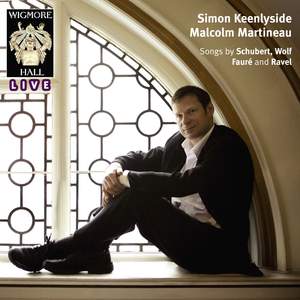
| |  | Simon Keenlyside & Malcolm Martineau
Fauré: | Aubade, Op. 6 No. 1 En sourdine, Op. 58 No. 2 (Verlaine) Green, Op. 58 No. 3 (Verlaine) Notre amour Op. 23 No. 2 Fleur jetée, Op. 39 No. 2 Spleen, Op. 51 No. 3 (Verlaine) Madrigal Op. 35 Le papillon et la fleur, Op. 1 No. 1 | Poulenc: | Hotel Encore | Ravel: | Histoires naturelles (5) | Schubert: | An Sylvia, D891 Die Einsiedlei D393 (Salis-Seewis) Verklarung D59 (Herder, after Pope) Die Sterne, D939 (Leitner) Himmelsfunken, D651 Ständchen 'Leise flehen meine Lieder', D957 No. 4 | Wolf, H: | Der Knabe und das Immlein (No. 2 from Mörike-Lieder) Gesang Weylas (No. 46 from Mörike-Lieder) An die Geliebte (No. 32 from Mörike-Lieder) Auf eine Christblume II (No. 21 from Mörike-Lieder) Lied eines Verliebten (No. 43 from Mörike-Lieder) Lied vom Winde |
He was already noted as a recitalist, and “a talent to cherish” as far back as 1989. Since appearing in La Scala in 1998 he has performed recitals all over the world, his repertoire including: Schubert, Schumann, Strauss, Brahms, Fauré, Wolf and Mahler. He has also recorded many English songs. Gramophone describe him as the finest baritone singer of Lieder this country has ever produced. In Simon's own words “I've probably got around 15 years, and think I can see the end of the tunnel. I've done most of the roles that suit me and some, like Papageno, I'll never want to drop…” “In Wagner I shan't go beyond Wolfram in Tannhauser. I know there's Beckmesser, but I'm afraid it's not a role that excites or fascinates me. I'll never get tired of the stand-and-sing roles like Germont in Traviata and Posa in Don Carlos - parts where you really have to act with your voice and pin the audience to their seats with inflexion, nuance and colour. I probably shan't sing Billy Budd again… and am moving down from Pelleas to Golaud. The two new roles I'm most excited about are Wozzeck and Rigoletto, which are both great theatre and call on a huge palette of colours. Wozzeck in particular, is a mountain any baritone wants to climb…” “The opening Schubert group demonstrates the baritone's natural and unaffected delivery - an ability to hold words and notes together in one single gesture - and his finely tuned vocalism, founded on a lightly rounded but always expressive tone. He sounds equally at ease in the French half of the programme. ...'En sourdine' flows beautifully...and the light humour of 'Le Papillon et la Fleur', Fauré's Op. 1 No. 1, is flawlessly conveyed in Martineau's enchantingly lithe pianism.” BBC Music Magazine, December 2009 “Hugo Wolf is at his most welcoming in "Der Knabe und das Immelein" and Keenlyside is at his most responsive in "An die Geliebte". Keenlyside is at his best in "Notre amour" - and very French. In… Malcolm Martineau: he has a collaborator in whom the life of texts as well as the music is experienced and communicated unfailingly.” Gramophone Magazine, November 2009 “you’re being invited to step into a more gently nuanced and delicately observed world, where the expressive weight of each phrase is being judged to perfection, with not a gram of emotional excess...this is such a successful document of the occasion that you might honestly end up feeling that you were [there]… and can be again, and again.” Andrew McGregor, bbc.co.uk, 22nd December 2009 | | | In stock - usually despatched within 1 working day. |
|
|
| |  | Fauré - The Complete Songs - 3Chanson d’amour
| | | In stock - usually despatched within 1 working day. |
|
|
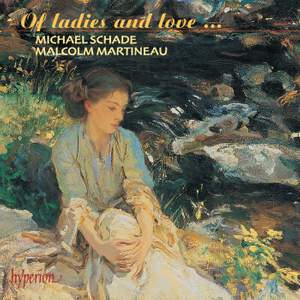
| |  | Of ladies and love ...
Beethoven: | Adelaide, Op. 46 Wonne der Wehmut, Op. 83 No. 1 Der Kuss, Op. 128 | Fauré: | Nell, Op. 18 No. 1 Adieu, Op. 21 No. 3, from Poème d'un jour Sylvie, Op. 6 No. 3 Lydia, Op. 4 No. 2 Fleur jetée, Op. 39 No. 2 | Liszt: | Sonetti di Petrarca (3) for voice & piano, S270 | Ravel: | Cinq mélodies populaires grecques | Schubert: | Trost: An Elisa, D97 Laura am Klavier, D388 An Sylvia, D891 Der Jüngling an der Quelle, D300 (Salis-Seewis) | Strauss, R: | Cäcilie, Op. 27 No. 2 Zueignung, Op. 10 No. 1 Nichts, Op. 10 No. 2 Morgen, Op. 27 No. 4 |
| | | In stock - usually despatched within 1 working day. |
|
|
| |  | Faure - Requiem & Songs
| | | In stock - usually despatched within 1 working day. |
|
|
| |  | Faure: Complete Songs, Vol. 2
Pierre Mollet (baritone), Simone Gouat (piano), Berthe Monmart (soprano), Renee Doria (soprano), Jacques Dutey (baritone), Tasso Janopoulo (piano) | |
|
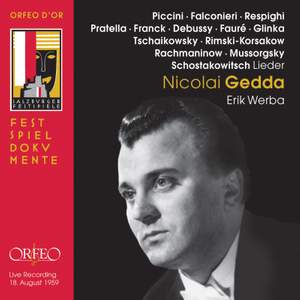
| |  | Nicolai Gedda
Debussy: | Beau Soir Mandoline (Verlaine) | Falconieri: | Vezzosette e care | Fauré: | Nell, Op. 18 No. 1 Fleur jetée, Op. 39 No. 2 | Franck, C: | La Procession | Glinka: | Barcarolle O du herziges trautes Magdelein | Mussorgsky: | Der Ziegenbock Das Sternlein Das Lied von der Armut, Op. 79, No. 7 | Piccinni: | O nuit, Dèesse du mystère | Pratella: | La strada bianca | Rachmaninov: | How fair this spot, Op. 21 No. 7 Oh, my field, Op. 4 No. 5 Vzgliani: pod otdalionnym svodom (Young Gypsy's Romance from Aleko) | Respighi: | Notte, P. 97 No. 1 Bella porta di rubini Stornellatrice | Rimsky Korsakov: | The Nymph Op. 56 No. 1 Die Tanne und die Palme, Op. 3, No. 1 | Schubert: | Nacht und Träume, D827 | Tchaikovsky: | He loved me so, Op. 28, No. 4 Serenada Don-Zhuana (Don Juan's Serenade), Op. 38 No. 1 | trad.: | Einsam klingt das kleine Glockchen Schneesturm |
At his first Salzburg recital on 18th August 1959, the legendary Swedish tenor Nicolai Gedda, accompanied by Erik Werba, triumphed in front of an enthusiastic audience. He endeared himself with his fluent command of four languages and with singing that was radiant in every register. The varied programme brought together compositions from Falconieri to Respighi and from Glinka to Shostakovich. | | | Usually despatched in 3 - 4 working days. |
|
|
| |  | Songs of Debussy and Fauré
Benita Valente (soprano), Lydia Artymiw (piano) | |
|
| |  | Mélodies - Airs d’opera
Fernand Faniard (tenor), Heinrich Baumgartner & Pierre Capdevielle South German Radio Symphony Orchestra & Orchestre Radio Symphonique de Strasbourg Faniard made his debut as a heroic tenor in 1926 in Antwerp and in 1930 made his debut at the Paris Opera. He only made two gramophone recordings of Flemish songs on 78s but some of his radio recordings survive. This CD includes Schumann’s Dichterliebe and songs by Fauré, Duparc and Saint-Saëns. | | | Usually despatched in 2 - 3 working days. |
|
|
| |
|