All recordingsPrices shown exclude VAT. (UK tax is not payable for deliveries to United States.) See Terms & Conditions for p&p rates. | |  |
At the time of its first performances in 1846, Elijah was hailed as one of the great oratorios alongside Handel’s 'Messiah'. It tells the story of the prophet with imposing grandeur, inspirational orchestration and beautiful arias, recitatives and choruses. This mighty piece requires even mightier orchestral and choral forces and the Gabrieli singers are reinforced by the talented Gabrieli Young Singers’ Scheme and the Wroclaw Philharmonic Choir. This recording sees over 440 musicians taking part, including 92 string players and over 300 singers. “Step into Victorian Birmingham with Paul McCreesh’s “authentic” recording of Mendelssohn’s epic Old Testament oratorio...The thumping grandeur of the big choruses is magnificent. But against that must be placed McCreesh’s tendency to insert wallowing rallentandos before every transition, and fuzzy choral diction.” The Times, 1st September 2012 *** “the choral singing is a marvel.” Sunday Times, 2nd September 2012 “one of the striking aspects of the performance is the way that Paul McCreesh so naturally places the great set pieces within the context of a multifaceted expressive whole...familiar moments in Elijah sound newly minted here, McCreesh approaching them with polished, fluent phrasing and using the period instruments of his orchestra to underpin emphases and to add vibrant colour.” The Telegraph, 15th September 2012 “McCreesh here totally re-imagines it: the big choruses are transparent as well as massively impressive...and there is no danger of religiosity in the fresh-voiced solos of Rosemary Joshua, Sarah Connolly and Simon Keenlyside...In all, a spectacularly successful reinvention of the British choral tradition.” The Observer, 23rd September 2012 “Connolly sings with mellifluous tone and Simon Keenlyside is an Elijah of spirit and intelligence: he may not have the sheer weight of a Bryn Terfel, but he's alive to every shift of meaning and his diction is, as ever, impeccable. The gut strings, unimpeded by vibrato, bring splendid urgency to the texture” BBC Music Magazine, November 2012 **** “Miraculously, McCreesh succeeds in relating Elijah’s sound world to Mendelssohn’s more familiar, lighter-sounding works while never underplaying the performance’s staggering heft. The combined choirs produce a sonority which has to be heard to be believed. The doomy, dramatic numbers are simply terrifying...McCreesh’s Berlioz disc was a highlight of 2011; this Elijah is even better. Flawless, in other words.” The Arts Desk, 6th October 2012 “There’s a definite histrionic side to the role and Keenlyside doesn’t short-change us but when listening to him I was reminded again and again what a fine lieder singer he is...[Ward is] clear and accurate and shows excellent breath control. Furthermore, his pitching is spot-on...The orchestral playing is superb...This is a marvellous recording of Elijah...Anyone who cares about this fine work should try to hear it.” MusicWeb International, October 2012 “unashamedly committed and thoroughly dramatic…this a reading to make one hear Mendelssohn’s masterpiece anew…The recording is beautifully presented in an exquisitely designed ‘book format’” Choir & Organ, November/December 2012 “The sound is massive when required, but the articulation is never unwieldy and there is delicacy too … [the organ is] a splendid beast and, except in one instance, you would never know that it was dubbed on electronically...Sarah Connolly and Rosemary Joshua are both excellent. From the crib of ‘Death and the Maiden’ at the opening to the final ‘Amen’, this is a triumph.” Gramophone Magazine, November 2012 | | | In stock - usually despatched within 1 working day. |
|
|
| |  |
Jacqueline Delman (soprano), Norma Procter (contralto), George Maran (tenor), Bruce Boyce (baritone) & Michael Cunningham (treble) London Philharmonic Orchestra & Choir & Hampstead Parish Church Boys’ Choir, Josef Krips Born in Vienna in April 1902, the cheery-looking Josef Krips seems to have been pre-destined to achieve eminence in the Viennese classics. He recorded with both, the Wiener Philharmoniker and the key London orchestras for Decca in the 1940s, 50s and 60s and the interpretations have genuine expressive power while remaining devoid of exaggeration or affectation. Mendelssohn’s Elijah was premiered to great acclaim and was perhaps the greatest triumph of his lifetime performances of the oratorio were attended by, among others, Queen Victoria and Prince Albert. It became second in popularity to Handel’s Messiah in English-speaking lands and elsewhere held its own in the choral repertoire. In the character of Elijah, Mendelssohn created a musical personality as comprehensive as any in 19th-century opera. The oratorio as a whole encompasses lofty choral outbursts, heartfelt sentiment, profundity and even humour. This recording, made at the end of the mono era in 1954, was, for long, a benchmark for this work and at long last receives its first CD release on Decca. The notes for this issue are by Tully Potter and it forms part of a series of five reissues devoted to the art of Josef Krips. Recording producer: James Walker Recording location: Kingsway Hall, London, UK, September 1954 “Boyce sings the part with studied beauty, as indeed do all the other soloists, and the chorus is in excellent form. Josef Krips sets them some rapid tempi here and there, but the result is lively and interesting … plenty of orchestral detail even in the loud choruses … Norma Procter’s singing is always beautiful” Gramophone Magazine “Krips does not neglect variety in the directing of his forces...Boyce sings and responds with imagination and intelligence...Like the other soloists, he knows how to enunciate clearly without prissy overstressing...[Maran] possesses a forthright voice, sometimes a bit hard-edged, which he uses with understanding...The recording, originally in glorious mono, is clearer than on some choral discs from recent times.” International Record Review, May 2011 | | | In stock - usually despatched within 1 working day. |
|
|
| |  | Sung in German
Claudia Barainsky (soprano), Franziska Gottwald (mezzo), Rainer Trost (tenor), Thomas E. Bauer (baritone) Chorus Musicus Köln, Das Neue Orchester, Christoph Spering Just as the composer would have wanted it, Christoph has selected a full chorus and a magnificently dimensioned orchestra for this recording. The New Orchestra performs on historical instruments and has gained renown as an outstanding interpreter of the music of the romantic era. Both the chorus and orchestra were founded by Christoph Spering. This is a fresh, brisk and sharp live performance. “Spering directs an enthusiastic and briskly paced performance...Bauer is up among the best of them as the great Prophet, oozing authority and presence...Claudia Barainsky is full of life and spirit, mixing vocal purity with a sense of drama which gives great distinction to everything in which she is involved.” International Record Review, March 2011 | | | In stock - usually despatched within 1 working day. |
|
|
| |  | Sung in German. Edition Peters
Mendelssohn’s magnificent oratorio Elijah brings to life the tumultuous times and personal drama of the Biblical prophet in a sweeping series of recitatives, arias and choruses in which the composer’s Romantic genius drew deeply from the wellsprings of Bach and Handel. In this new recording (sung in German) Jun Märkl, one of the most notable conductors of his generation, leads an outstanding cast of soloists headed by Ralf Lukas, and Germany’s longest-standing radio symphony orchestra and its acclaimed choir. “...this excellent performance of Mendelssohn’s great Biblical oratorio thrills both in the surges of choral glory and in the moments of tender reflection. Tenor Genz’s lyrical singing of the aria known in English as If With All Your Hearts alerts you early to the quality of the performance.” The Telegraph, 8th October 2010 ***** “This is in every way a 'big' Elijah. Climaxes are full-blooded from both orchestra and chorus, and in the narrative sections conductor Jun Märkl brings out the drama with telling use of contrasts in both texture and tempo. Most important of all, Ralf Lukas's Elijah is the impatient, hot-tempered prophet imagined by Mendelssohn” BBC Music Magazine, December 2010 **** “there is a keen sense of the drama unfolding in front of one's eyes, and an unfailingly musical quality to Jun Märkl's directing that is enormously satisfying.” Classic FM Magazine, January 2011 *** | | | (also available to download from $10.75) | In stock - usually despatched within 1 working day. |
|
|
| |  |
| | | In stock - usually despatched within 1 working day. |
|
|
| |  | Sung in German
| | | In stock - usually despatched within 1 working day. |
|
|
| |  | Mendelssohn: EliasGerman-language version
| | | In stock - usually despatched within 1 working day. |
|
|
| |  | Sung in English
| | | In stock - usually despatched within 1 working day. |
|
|
| |  |
| | | In stock - usually despatched within 1 working day. |
|
|
| |  | Sung in English
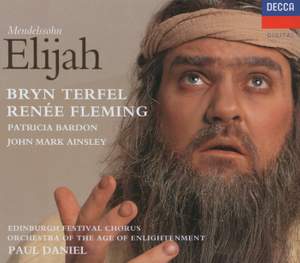
“Paul Daniel and Bryn Terfel ensure that this is one of the most dramatic performances of the oratorio on disc. The young conductor, with the advantage of an excellent period instrument orchestra, has looked anew at the score and as a reveals much of the rhythmic and dynamic detail not always present in other performances, at least those available in English. His accomplishment in terms of pacing and balance is also praiseworthy, and he earns further marks for using the trio, quartet and double quartet of soloists Mendelssohn asks for in specific pieces, so as to vary the texture of the music. Bryn Terfel simply gives the most exciting and vivid account of the prophet's part yet heard. His range, in terms of vocal register and dynamics, is huge; his expression, mighty and immediate, befits a man of Elijah's temperament. As the score demands, anguish, anger and sympathy are there in full measure, displayed in exceptional definition of words, and when this Elijah calls on the Lord for the saving rain, the Almighty could hardly resist such a commanding utterance. Yet there's always the inwardness part of the role demands. As far as the other soloists are concerned, for the concerted numbers Daniel has chosen voices that nicely match each other in timbre. The chorus is alert and unanimous in both attack and well thought-through phrasing, but its actual sound can be a little soft-centred, partly because allimportant consonants are ignored. The orchestral playing is exemplary.” Gramophone Classical Music Guide, 2010 | | | In stock - usually despatched within 1 working day. |
|
|
| |
|