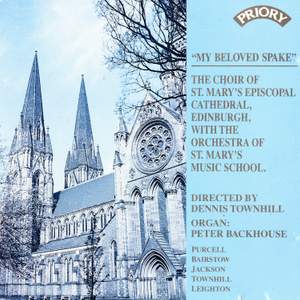
Prices shown exclude VAT. (UK tax is not payable for deliveries to United States.) See Terms & Conditions for p&p rates. | |  | My Beloved SpakeAnthems by Henry Purcell & Pelham Humfrey
Humfrey: | Magnificat and Nunc dimittis in E minor from Evening Service O Lord my God | Purcell: | Rejoice in the Lord alway ('The Bell Anthem'), Z49 Hear my prayer, O Lord, Z15 My beloved spake, Z28 O sing unto the Lord, Z44 Remember not, O Lord, our offences, Z50 Jehova, quam multi sunt hostes mei! Behold now, praise the Lord, Z3 |
Established in the 1670s, the Choir of St John’s College, Cambridge is today one of the finest college choirs in the world, known and loved by millions for its recordings and concert tours. On this album, the Choir and St John’s Sinfonia, conducted by Andrew Nethsingha, perform works by Henry Purcell and Pelham Humfrey. They are joined by four soloists: Iestyn Davies, James Gilchrist, David Stout, and Neal Davies. Humfrey was an English composer of the seventeenth century, known mainly for his verse anthems. Being well travelled, he produced works that in their vocal character show the influence of Italian music, and in the instrumental writing that of French music. That said, from these major foreign influences Humfrey forged a personal style that is uniquely English. Although as a composer he was generally forward-looking, his music also shows sub-elements of the English Golden Age of yesteryear. O Lord my God, for instance, is influenced by John Dowland’s celebrated Lachrimae Pavan of almost eighty years earlier. In contrast, the Magnificat and Nunc dimittis were composed simply to be liturgically appropriate, with a text setting that is naturalistic and direct. Humfrey died at the age of twenty-seven, but even at this young age, he exerted a strong influence on his peers, including Henry Purcell, who as a young boy sang treble in Humfrey’s Chapel Royal Choir. The works by Purcell recorded here range from works written when the composer was in his teenage years (Jehova, quam multi sunt hostes mei being a masterly example) to the crowning glory of the recording, O sing unto the Lord, which Purcell wrote when he was in his thirties, and compositionally on fire. At this stage of his career no other composer could touch him. Instruments and voices sing from the same hymn sheet, form and content are inseparable, past and present musical styles seamlessly intermingle, technique and virtuosity are indistinguishable from each other – and soloists and choir mesh together in a dazzling and life-affirming way. “The warm continental sound of the boys' voices might sometimes bestow an unexpectedly 'foreign' accent on this music (albeit shot through with imports from France and Italy), but the commitment, intensity and lucidity compels. And Nethsingha has assembled a formidable team.” BBC Music Magazine, February 2013 **** “It is nice these days to have a chance to hear some of Purcell's church anthems sung by a choir of boys and men...It is in integrated works such as O Lord my God, where the expressive urgency of this choir's soloists can rub off, that the choir is at its best; less successful are the more patchwork pieces” Gramophone Magazine, January 2013 “Nethsingha juxtaposes such relatively unfamiliar fare with masterpieces including O Sing unto the Lord. He is a committed custodian of the Oxbridge choral tradition, as are his fine soloists” Sunday Times, 2nd December 2012 | | | (also available to download from $10.50) | In stock - usually despatched within 1 working day. |
|
|
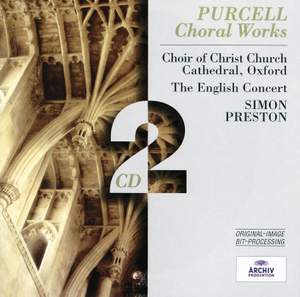
| |  | Purcell: Anthems
Purcell: | They that go down to the sea in ships, Z57 Jehova, quam multi sunt hostes, Z135 My beloved spake, Z28 O sing unto the Lord, Z44 Lord, how long wilt thou be angry?, Z25 Who hath believed our report?, Z64 Behold, I bring you glad tidings, Z2 In thee, O Lord, do I put my trust, Z16 Te Deum & Jubilate Deo in D, Z232 Funeral Sentances Remember not, O Lord, our offences, Z50 March and Canzona in C minor Thou knowest, Lord I was glad when they said unto me, Z19 O Lord God of hosts, Z37 O give thanks unto the Lord, Z33 |
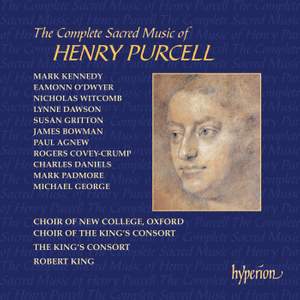
Purcell wrote so much in so many different spheres of musical activity that it is easy to forget that one of his main tasks was to be a royal composer, to provide music for the occasions of State in Westminster Abbey, just as the Gabrielis had done for the Doge at St Mark’s, or Lully for the French monarchs at Versailles. One of the most notable – and highly praised – accounts of Purcell’s choral music came from the Choir of St. John’s College, Cambridge, conducted by George Guest. They made three records for Argo – in 1964, 1972 and 1975 – covering Purcell’s Music for the Chapel Royal, a selection of Verse Anthems, the Te Deum and Jubilate and other works. The three are collected on a 2CD set. Texts are included in the booklet. “Vibrant readings of some of Purcell's best loved choral works unalloyed by 'authentic' prissiness” BBC Music Magazine, October 2012 **** “The impact of Inia Te Wiata's entry in They that go down to the sea in ships is almost sensational … Outstanding among the soloists is the counter-tenor, Charles Brett. The orchestral playing is sprightly, the choral singing polished” Gramophone Magazine “The performances are excellent. James Bowman is in splendid voice and he is well matched by Charles Brett (in this music, the others are really a supporting cast to the countertenors). The orchestra plays with its usual sensitivity of tone and nuance. As for Mr. Guest, he understands the Funeral Sentences in no mean manner, for it is easy to overdo the pain or to adopt the stiff upper lip, yet he manages to combine the two in goodly proportion” Gramophone Magazine | | | (Sorry, download not available in your country) | In stock - usually despatched within 1 working day. |
|
|
| |  | Music for Pleasure and Devotion
Purcell: | A Suite of Theatre Music If music be the food of love, Z379 Three Parts upon a Ground Close thine eyes and sleep secure, Z184 Ground in Gamut Rejoice in the Lord alway ('The Bell Anthem'), Z49 Voluntary in D minor, Z718 Funeral Sentances Fantazia VIII Of all the instruments that are, Z263 The Fairy Queen: Masque of the Four Seasons Te Deum & Jubilate Deo in D, Z232 In guilty night (Saul and the Witch of Endor), Z134 Pavans Nos. 1, 2, 3 & 4 Jehova, quam multi sunt hostes, Z135 When on my sick bed I languish, Z144 Beati omnes qui timent Dominum, Z131 My beloved spake, Z28 |
| | | In stock - usually despatched within 1 working day. |
|
|
| |  | Henry Purcell: Choral Works
Purcell: | Service in B flat major, Z230 Te Deum & Jubilate Deo in D, Z232 Magnificat & Nunc Dimitus in G minor, Z231 O God, thou hast cast us out, Z36 O Lord God of hosts, Z37 Remember not, O Lord, our offences, Z50 Lord, how long wilt thou be angry?, Z25 O God, thou art my god, Z35 Man that is born of a woman, Z27 Thou know'st, Lord, Z 58c Jehova, quam multi sunt hostes, Z135 My heart is inditing, Z30 O sing unto the Lord, Z44 My beloved spake, Z28 They that go down to the sea in ships, Z57 Praise the Lord, O Jerusalem, Z46 |
| | | In stock - usually despatched within 1 working day. |
|
|
| |  | Purcell: Come Ye Sons of Art
| 
| | | Scheduled for release on 17 June 2013. Order it now and we will deliver it as soon as it is available. |
|
|
| |  | The Majesty of thy Glory
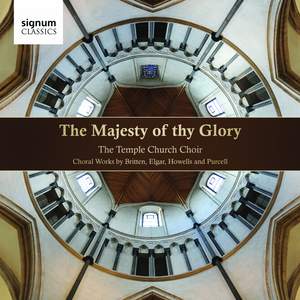
Greg Morris & Ian le Grice (organ) The Temple Church Choir with The Temple Players, James Vivian (director) The Temple Church is one of the most historic and beautiful churches in London. Situated between Fleet Street and the Thames Embankment, its recorded musical history extends back to its restoration in 1841, although a church has stood on the site for over 800 years. The modern choir is comprised of 18 boy choristers and 12 professional choirmen – an excellent opportunity for the choristers who receive singing and theory tuition as well as generous scholarships towards their education. The programme explores three fascinating and contrasting settings of the ‘Te Deum’: A stalwart of the church liturgy (first conceived as far back as AD 387), these settings span over 300 years of English music history, composed respectively in 1694 (Purcell), 1897 (Elgar) and 1944 (Howells). This disc is complemented by the release of James Vivian’s English Organ Music from the Temple Church, also released this month. “ Works by our three greatest composers on this vigorous, enjoyable disc celebrate divine majesty and the musical resources of the Temple Church, on Thameside.” Sunday Times, 19th December 2010 *** “Diction is clear and choral attack is crisp throughout, intonation is excellent...James Vivian moulds a flexible (though shapely) interpretation, the Temple's acoustic bathing choir and organ in a sumptous glow, absorbing and diffusing the wide dynamic range with ease. Such enterprising and polishing music-making deserves widespread currency.” Gramophone Magazine, April 2011 | | | Usually despatched in 3 - 4 working days. |
|
|
| |  | Purcell: Sacred Music
Purcell: | My beloved spake, Z28 Te Deum & Jubilate Deo in D, Z232 O Lord, thou art my God Z41 Lord, how long wilt thou be angry?, Z25 Remember not, O Lord, our offences, Z50 Hear my prayer, O Lord, Z15 Music for the Funeral of Queen Mary, 1695: Funeral Sentences |
November 1694 was a busy month for Purcell. First, the triumphant return to London of King William III from the campaign in Flanders saw the composer produce a new anthem depicting the vanquishing of the King’s enemies. Secondly, for the celebration of St Cecilia’s Day, composed not the expected ode, but a Te Deum and a Jubilate. The Te Deum is full of grandeur, with the extra trumpets adding some thrilling drama to sections of the work. The scoring is also intimate, with some of Purcell’s most personal music – especially ‘ Vouchsafe, O Lord’, where the piling up of dissonances depicts a cry for mercy remarkable for the period. These two works are masterpieces in Purcell’s output. However, the triumph was to be short-lived. In December 1694 a smallpox epidemic swept London, and Queen Mary died on 28 December. Purcell produced some of his greatest music for the Funeral Sentences, which he composed for her burial Setting words found in The Book of Common Prayer, Purcell’s music is moving and austere, and the sense of grief is almost palpable. The muted drums and Flatt trumpets in the Canzona leave a lasting impression on the listener. Purcell himself was dead eleven months later, aged 36. | | | Usually despatched in 4 - 5 working days. |
|
|
| |  | Canticum Canticorum
| | | (also available to download from $10.50) | Usually despatched in 2 - 3 working days. (Available now to download.) |
|
|
| |  | Henry Purcell: Sacred Music, Dioclesian & Songs
Purcell: | Music for the Funeral of Queen Mary, 1695 Hear my prayer, O Lord, Z15 Prophetess or The History of Dioclesian, Z627: extracts Strike The Viol (Ode Come Ye Sons Of Art Away) Chacony in G minor Sweeter than Roses (from Pausanius, the Betrayer of his Country, Z585) Here the deities approve, Z339 If music be the food of love, Z379 In the black dismal dungeon of despair, Z190 Lord, how long wilt thou be angry?, Z25 My beloved spake, Z28 Remember not, O Lord, our offences, Z50 Curtain Tune from Timon of Athens Z632 |
| | | Usually despatched in 4 - 5 working days. |
|
|
| |  | Purcell - Verse Anthems
| | | (also available to download from $10.50) | Usually despatched in 8 - 10 working days. (Available now to download.) |
|
|
| |
|