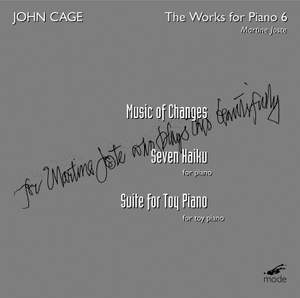
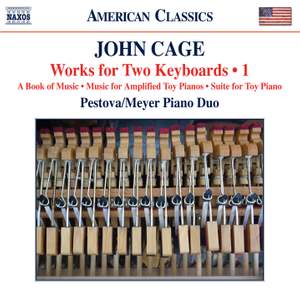
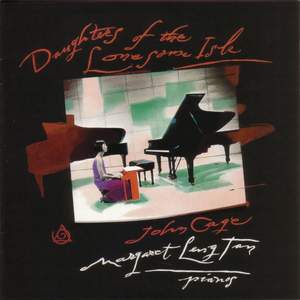
Prices shown exclude VAT. (UK tax is not payable for deliveries to United States.) See Terms & Conditions for p&p rates. | |  | Cage - Concert for piano and orchestra
Burkhard Wissemann, Michael Dietz, Christoph Keller, Johann Nikolaus Matthes, Hermann Danuser, Bell Imhoff & Doris Sandrock Ensemblle Musica Negativa, Rainer Riehn John Cage (1912-1992) was one of the most controversial composers of the 20th century. He is best known for his 1952 work 4'33" which involves not a single note of music being played. This selection of Cage's music provides a rare opportunity to get to know a range of works that were written between the years 1939-65, which were some of the composer's most productive years. Credo in Us is a ballet score written for Cage's long-time partner and collaborator the choreographer and dancer, Merce Cunningham. Imaginary Landscape is scored for four performers who play a muted piano and cymbal as well as two variable-speed phonographs with amplifiers, Imaginary Landscape No.1 is important for being one of the first examples of electro-acoustic music. Cage's Concert for Piano and Orchestra has no overall score, but all the parts are written out in detail. A performance of the Concert may include all of the instruments, but may also be performed as a solo, duet, trio or any combination of the given instruments, resulting in a change of title (e.g. solo for piano or Concert for piano, voice and 2 violins, in case it is combined with a Solo for Voice.) In this recording two solo voices are used. The Suite for Toy Piano is one of Cage's works for prepared piano and the Music for Carillon bring this collection to a fascinating conclusion. | | | In stock - usually despatched within 1 working day. |
|
|
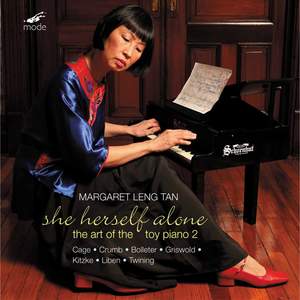
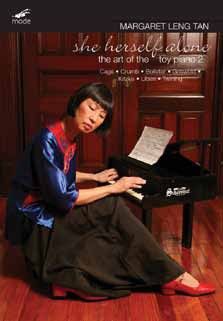
| |  | She Herself Alone:The Art of the Toy Piano 2
Margaret Leng Tan (toy pianos, toy instruments, piano, percussion, music boxes, voice) In addition to being a renowned new music pianist, Margaret Leng Tan is the foremost specialist at the toy piano. She has performed worldwide with her miniature instruments, bestowing them with serious music status in repertoire both written for her and arrangements. For this disc of attractive yet challenging music, Ms. Tan performs Cage’s classic Suite for Toy Piano plus her arrangement of Cage’s seminal Dream for toy & grand piano (a work that foreshadowed new age music); and her arrangement for voice and toy instruments of a recent song by George Crumb. Ms. Tan uses no less than six different toy pianos here. Some works find the toy piano performed with other instruments including grand piano, toy zithers, music boxes, glockenspiels and percussion, with Ms. Tan as a veritable one-person toy orchestra. Her initial toy piano CD, The Art of the Toy Piano on Philips/Point (1997) was critically acclaimed and a strong cross-over seller. This long awaited follow-up recording combines serious classics (Cage’s Suite) with colorful fun (Griswold), a sultry blues-tango (Twining), drama (Crumb), to haunting meditations (Cage’s Dream and Liben). Also available on DVD with full video. Original 96khz/24-bit recording. Liner notes by Margaret Leng Tan. | | | Usually despatched in 3 - 4 working days. |
|
|
| |  | She Herself Alone:The Art of the Toy Piano 2
Margaret Leng Tan (toy pianos, toy instruments, piano, percussion, music boxes, voice) In addition to being a renowned new music pianist, Margaret Leng Tan is the foremost specialist at the toy piano. She has performed worldwide with her miniature instruments, bestowing them with serious music status in repertoire both written for her and arrangements. For this disc of attractive yet challenging music, Ms. Tan performs Cage’s classic Suite for Toy Piano plus her arrangement of Cage’s seminal Dream for toy & grand piano (a work that foreshadowed new age music); and her arrangement for voice and toy instruments of a recent song by George Crumb. Ms. Tan uses no less than six different toy pianos here. Some works find the toy piano performed with other instruments including grand piano, toy zithers, music boxes, glockenspiels and percussion, with Ms. Tan as a veritable one-person toy orchestra. Her initial toy piano CD, The Art of the Toy Piano on Philips/Point (1997) was critically acclaimed and a strong cross-over seller. This long awaited follow-up recording combines serious classics (Cage’s Suite) with colorful fun (Griswold), a sultry blues-tango (Twining), drama (Crumb), to haunting meditations (Cage’s Dream and Liben). Also available on DVD with full video. Original 96khz/24-bit recording. Liner notes by Margaret Leng Tan. SPECIAL DVD FEATURES: Each work is treated to its own visual mood, and captures the theatricality of Ms. Tan’s performance combined with the exotic toy instrumentation, as directed by Spanish cinematographer Anton Cabaleiro. Filmed in high-definition video. Uncompressed Stereo PCM audio in 96khz/24-bit. | | | Usually despatched in 3 - 4 working days. |
|
|
| |  | John Cage & Morton Feldman
Cage works: Jeanne Kirstein (prepared piano, piano, and toy piano); Feldman works: David Tudor, Morton Feldman, Edwin Hymovitz, Russell Sherman (pianos), Matthew Raimondi & Joseph Rabushka (violins), Walter Trampler (viola) & Seymour Barab (cello) This double-CD set combines two of the key titles of Columbia Records’s legendary “Music of Our Time” series curated by David Behrman. Jeanne Kirstein’s recording of Cage’s early keyboard works remains a touchstone of Cagean interpretation notwithstanding the passage of time. Christian Wolff recalls, "I remember Cage saying that Jeanne Kirstein’s playing caught the spirit in which the pieces were written at the time he wrote them—a kind of simple excitement and enthusiasm (also, surely, out of the discovery of the preparing of the piano and the great new sounds)." | | | Usually despatched in 2 - 3 working days. |
|
|
| |  | Cage: Complete Piano Music Vol. 8 - Hommage à Satie
| | | Usually despatched in 2 - 3 working days. |
|
|
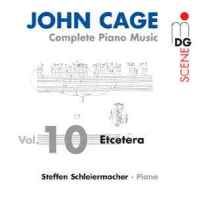
| |  | Cage: Complete Piano Music Vol. 10
| | | Usually despatched in 2 - 3 working days. |
|
|
| |  | Cage: The Seasons
“This is an enchanting CD, every item a sheer delight. Margaret Leng Tan worked with Cage in the last decade of his life, and her earlier recordings show a special sympathy for Cage's keyboard music. The second of her New Albion CDs included the piano solo version of The Seasons, and Cage was honest enough to admit to her that he had help from Virgil Thomson and Lou Harrison in making the orchestral version recorded here. The result is Cage at his most poetic, evoking each of the four seasons in lovely changing colours. There are two realisations of one of the last of what are called Cage's 'Number Pieces', Seventy-Four, written for the American Composers Orchestra a few months before his death in 1992. This seamless garment of sustained sound in two overlapping parts is an immensely moving document from a unique human being at the end of his life. Anyone who responds to the spiritual minimalism of Pärt, Górecki or Tavener will understand, especially in these dedicated performances. The Concerto for Prepared Piano (1951) takes its rightful place as the major classic for the transformed instrument with orchestra – a status emphasised by this fastidious performance with its delicate sonic tapestry, including discreet radio, all reflecting Cage's absorption with ori- ental philosophy. Tan has recorded the Suite forToy Piano (1948) before. This time the sound is closer, you can hear her in-breath just before some movements, and we could have done with more precise rhythms. Lou Harrison's orchestration is perfectly in the spirit and makes a fascinating complement – Cage writing memorable tunes! This disc shows that much of Cage has now entered the mainstream and that his music is unique.” Gramophone Classical Music Guide, 2010 | | | Usually despatched in 4 - 5 working days. |
|
|
| |  | Cage: Music for Piano Volume 3Piano Works & Cello Works
Marco Simonacci (cello) & Giancarlo Simonacci (piano) Recording: June 2009, Fazioli Hall, Sacile, Italy John Cage (1912–92) is regarded as one of the most influential and controversial composers of the 20th century. It is not only his music that this reputation is based on – his ideas were revolutionary, and he cast doubt on the supremacy of European art, and music when it was unchallenged and such views were considered heretic. Cage rejected the status held by harmony, instrumentation, and even the development of music from one point to another. He disconnected harmony from rhythm to liberate western music from its hitherto privileged hierarchies – iconoclastic stuff for 1940s America! Cage studied with Schoenberg in Los Angeles, and although he adopted the 12-tone technique he abandoned Schoenberg’s expressionist style. Cage was also influenced the maverick composer – Erik Satie. Satie had also ridiculed the musical establishment, and Cage arranged Satie’s longest work Socrate (a monodrama for piano and voice) for two pianos. It is worth mentioning that Cage’s favourite Satie composition was Vexations, a short work for piano, with instructions that it may be performed 840 times without pause or change. Recording made in 2009. Important repertoire and an ideal introduction to John Cage. | | | Usually despatched in 4 - 5 working days. |
|
|
| |
|