All recordingsPrices shown exclude VAT. (UK tax is not payable for deliveries to United States.) See Terms & Conditions for p&p rates. | |  | Wagner: Tristan und IsoldeRecorded live at Glyndebourne, Lewes, Sussex on 1st August and 6th August 2007.
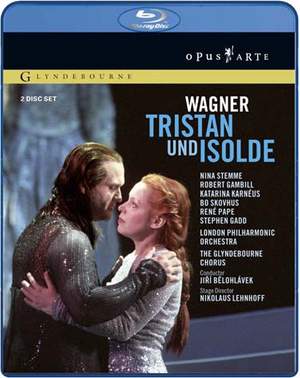
Note: This Blu-ray Disc (BD) is not compatible with standard DVD players Glyndebourne’s celebrated production of Nikolaus Lehnhoff’s Tristan und Isolde is a supremely intelligent achievement; gravely beautiful, haunting and meditative, it is deeply reflective rather than visceral, fortified by Roland Aeschlimann's stunningly effective set, a womb-like space through which the protagonists move like gods. Conductor Jirí Belohlávek mirrors Lehnhoff's approach in his sophisticated plumbing of the score's depths, with every shift in texture carefully laid bare by an inspired London Philharmonic Orchestra. Nina Stemme's Isolde and Robert Gambill's Tristan, both gloriously lyrical, are matched by superb performances from René Pape as the betrayed and vulnerable King Marke and Bo Skovhus as Kurwenal, deeply touching in his helpless devotion to Tristan. This High Definition recording of a production of uncommon intimacy reveals the opera's music and drama in a new light. Picture: 1080i High Definition / 16:9 Sound: 2.0 & 5.0 Dolby TrueHD Video codec: AVC/MPEG-4 Disc size: 2 x BD50 Subtitles: EN/FR/DE/ES/IT Menu language: EN Region code: All regions Running time: Approx 358 mins Bonus material: Illustrated synopsis & cast gallery Do I hear the light? - a film by Reiner E. Moritz Artist biographies. ‘On the set’ - a slide show of the set being built. ‘Trimborn on Tristan’ – a talk by Richard Trimborn ‘I don’t think that I have ever witnessed a more perfect realisation of a Wagner opera than this superb Tristan und Isolde. …[Jirí Belohlávek] is scrupulous with the score, and takes his time over it: the pauses and silences are immense and there is no factitious attempt to whip up excitement by speeding. …a great and unforgettable occasion’ The Daily Telegraph “A performance realised to Glyndebourne's highest standards - the chorus and stage brass are Bayreuth-level, the casting immaculate (they can all really sing these parts) and Belohlávek's conducting balanced with a Goodall-like attention to the filigree detail of Wagner's new-wave scoring” Gramophone Magazine, August 2008 “Stemme's fiery Irish princess is even finer than on the Domingo CD… Gambill's burly Tristan projects a darker, more resigned intensity… Pape's black-voiced Marke rightly dominates the stage… Karneus is a passionate, lusciously sung Brangäne. Lehnhoff's Glyndebourne production doesn't outclass Daniel Barenboim's magnificent video... But those looking for a Tristan with warmth and immediacy will find it certainly shares Barenboim's benchmark recommendation.” BBC Music Magazine, March 2008 ***** “I don’t think that I have ever witnessed a more perfect realisation of a Wagner opera than this superb Tristan und Isolde. …[Jirí Belohlávek] is scrupulous with the score, and takes his time over it: the pauses and silences are immense and there is no factitious attempt to whip up excitement by speeding. …a great and unforgettable occasion” The Telegraph “a performance realised to Glyndebourne's highest standards – the chorus and stage brass are Bayreuthlevel, the casting immaculate (they can all really sing these parts), and Belohlávek's conducting balanced with a Goodall-like attention to the filigree detail of Wagner's new-wave scoring.
Old-style analyses of the music used to talk about the 'glance' motif. Lehnhoff's staging deploys a series of heartbreaking glances: Stemme's Isolde when Karnéus's Brangäne tells her she's taken the love draught, Stemme again when Tristan arrives in Act 2, Pape's Marke as he sees the lovers together and, at BrokebackMountain-level, Skovhus's Kurwenal as he cradles Gambill's Tristan then breaks away, half in fear of his lord's death, half in fear of his feelings for him. In fact, has a Tristan ever been so deeply loved by his lady and squire as here, or felt so wretched at betraying his king? And is Skovhus actually the greatest Kurwenal yet recorded? Roland Aeschlimann provides a geometrically attractive whorl of a standing set, concentric wooden circles telescoping towards a constantly varied horizon: a ship, a spaceship, everywhere, nowhere – perfect. The lighting (Robin Carter and Aeschlimann) has a genuine physical presence and seems to reinvent the colour blue. At the point of Isolde's almost belated arrival in Act 3, a surreal, Ingmar Bergman-like atmosphere permeates events: she arrives from behind on high as a figure of death and wraps him in a black cloak, while Skovhus's poignant Kurwenal gets a non-realistic, Brechtian centre-stage for his fights and death” Gramophone Classical Music Guide, 2010 | | | In stock - usually despatched within 1 working day. |
|
|
| |  | Wagner: Tristan und IsoldeBayeruth Festival Staging
Tristan und Isolde in the acclaimed production by Heiner Müller from the Bayreuth festival from 1995, conducted by Daniel Barenboim with fire and sensitivity. Siegfried Jerusalem as Tristan and Waltraud Meier as Isolde have consistently drawn enthusiastic acclaim for their performance, not only in the year of the premiere, but in subsequent years as well Heiner Müller and stage designer Erich Wonder have compressed the monumental story into a clear and fascinating geometry of love. Wonder created highly evocative spaces through projections of colours and forms which shift according to the mood One widely noted example of Müller´s elegant, restrained interpretation, in which small gestures replace sweeping displays of passion, is the famous love duet, in which Tristan and Isolde, instead of embracing rapturously, stand back to back and side by side and touch, ever so lightly, only the tips of their fingers. Subtitles: Chinese, English, French, German, Spanish “Daniel Barenboim's earliest performances of Tristan at Bayreuth are documented in a DVD of the 1981 production by Jean-Pierre Ponnelle (filmed in 1983) with René Kollo and Johanna Meier in the title-roles (available from DG). In 1993, when he was vastly more experienced and assured in his handling of this formidable score, Barenboim returned to the work in conjunction with playwright and theatre director Heiner Müller. This recording was made two years later, over seven days during the festival's rehearsal period. One imagines that the acts were filmed (without audiences) on separate days, to great advantage where the singers' stamina is concerned: but one particularly evident edit, at the point of Isolde's long-awaited entrance in Act 3, indicates that this is in some respects a hybrid product, halfway between a live performance and a studio version of a particular staging. This is a fine and intensely moving account of a supreme masterpiece of musical theatre. It is not perfect, with the setting for Act 2 particularly unappealing, but it is serious in its dramatic, theatrical intent, and (that Act 2 setting apart) accomplished in its realisation. Müller's conception of the work is austere, not expecting setting or acting to get in the way of things which are best left to the music, and on the whole he has managed a difficult assignment with flair and conviction. Nowhere is this clearer than at the end, where Waltraud Meier sings the Liebestod from the front of the stage, with no semaphoring gestures and only facial expression and beautifully graded vocal projection to convey the essence of the drama. Singers with more opulent voices have undertaken the role, yet Meier's contained, richly nuanced approach to both acting and singing is ideally suited to this production. Her Tristan, Siegfried Jerusalem, is no less impressive, with a poised demeanour avoiding the woodenness that afflicts so many Wagner tenors. Add a marvellously sonorous Marke in Matthias Hölle, no weaknesses in the other roles, and the virtues stack up to something special. Does Barenboim's very explicit musical moulding actually fit with such a restrained stage production? Or is the whole point in the contrast between the visible and the audible? Such basic questions make one think yet again about the nature and significance of Wagner's most provocative and inexhaustible work for the stage. Something special, indeed.” Gramophone Classical Music Guide, 2010 “This is a fine an intensely moving account of a supreme masterpiece of musical theatre. Müller's conception of the work is austere… and on the whole he has managed a difficult assignment with flair and conviction. …Meier's contained, richly nuanced approach to both acting and singing is ideally suited to this production. Her Tristan Siegfried Jerusalem, is not less impressive, with a poised demeanour avoiding the woodenness that afflicts so many Wagner tenors. Add a marvellously sonorous Marke in Matthias Hölle, no weaknesses in the other roles, and in the virtues stack up to something special.” Gramophone Magazine, November 2008 “As for the long awaited debuts of Meier and Jerusalem, the audience was ecstatic, so much so that Jerusalem excitedly hugged and kissed his partner several times during the curtain calls” Herald Tribune “...a splendid partnership of Siegfried Jerusalem at his finest and the rich-voiced Waltraud Meier, also at her freshest...Barenboim is in his element” Penguin Guide, 2010 **** | | | In stock - usually despatched within 1 working day. |
|
|
| |  | Wagner: Tristan und Isolde
Staged and Directed by: Jean-Pierre Ponnelle “With Johanna Meier’s unusually powerful Isolde and René Kollo’s resplendent, expressive Tristan, a better cast is hardly imaginable today” Westdeutsche Allgemeine Zeitung “For a supposedly 'difficult' opera, there's a fair choice of DVD Tristans… But this 1983 Bayreuth version, reappearing at last here on DVD, remains the finest. Jean-Pierre Ponnelle's staging steers impressively between the Romantically naturalistic and the poetic: a gnarled tree trunk doubles as ship and castle, and Isolde is symbolically isolated by her encircling robes. René Kollo and Johanna Meier don't have huge voices, but sing and act with unusual expression, and even look good. Matti Salminen as King Mark and Hanna Schwarz as Brangäne are heartbreakingly intense...” BBC Music Magazine, December 2007 ***** “This Bayreuth Tristan (first seen in 1981) is an almost perfect marriage of fairy-tale beauty (legendary Arthurian settings, "period" costumes) and interventionist Regie. Meier, of all princess, spell-casting witch and consumed lover, is a risk-taking Isolde, slamming the sword with the missing fragment into the wide swaying ship deck. Kollo's hero has Hotter-like detail, intensity and pain. ...the younger Daniel Barenboim secures thrilling drama-enhancing playing from the Festival Orchestra. But the ultimate triumph is Ponnelle's - he staged the show, designed the set and the costumes, and directed this film of it.” Gramophone Magazine, November 2007 “Barenboim's DVD, with evocatively beautiful sets by Jean-Pierre Ponnelle, presents an essentially poetic vision of Tristan...The video production is very well managed, using six cameras imaginatively, often in close-up, bringing out the beauty of the sets. Meier rises superbly to the challenge of the final Liebestod, rounding off an impressive performance” Penguin Guide BBC Music Magazine
DVD Choice - December 2007 |
| | | In stock - usually despatched within 1 working day. |
|
|
| |  | Wagner: Tristan und Isolde
“both [Heppner and Eaglen] are vocally at their peak, singing like angels, totally unstrained and finely focused. The young René Pape as King Mark is formidably impressive too, with Katarina Dalayman a superb Brangäne...Levine brings out the power and concentration of this epic, drawing brilliant playing from the Met. Orchestra” Penguin Guide, 2010 *** | | | In stock - usually despatched within 1 working day. |
|
|
| |  | Wagner: Tristan und IsoldeRecorded live at the Bayreuth Festival, Germany, in August 2009.
Recorded live at the Bayreuth Festival in July & August 2009, this production marks the beginning of an exciting new long-term partnership between the Bayreuth Festival and Opus Arte. The prestigious music festival takes place each year in northern Germany in a theatre that Wagner himself personally supervised the design and construction of. The festival has become a pilgrimage destination for Wagner enthusiasts, who often have to wait up to ten years to obtain a ticket! Katarina Wagner, the great-grand daughter of Richard Wagner, is currently codirector of the festival together with her sister Eva Wagner-Pasquier. Tristan und Isolde was first performed in 1865 and provided inspiration to many composers including Mahler, Strauss, Szymanowski and Berg. It is widely acknowledged as one of the peaks of the operatic repertoire, and has been performed regularly since is premiere. This production, by renowned director Christoph Marthaler, stars leading Wagner exponents Robert Dean Smith and Irene Theorin in the title roles, supported by the Bayreuth Festival Chorus and Orchestra conducted by Peter Schneider. ‘Peter Schneider conducted with real feeling for the score and the prelude to the first act stole upon the ear with the magic of Bayreuth’s amazing acoustics. Robert Dean Smith is now a fine Tristan with a really beautiful voice. …Robert Holl made a moving King Marke, his magnificent bass nobly used. Some of the most beautiful singing came from Clemens Bieber's Young Seaman at the beginning.’ The Stage ‘In Tristan the standard of conducting and singing is high. Peter Schneider draws seamless playing from the orchestra, contouring Wagner’s long arcs of sound as only someone of his experience can do. Iréne Theorin and Robert Dean Smith make a well-balanced couple – she all temperament and sound, he emotionally neutral but vocally flawless.’ The Financial Times “As in all great stagings - and I have no doubt that this is one - a list of unforgettable links between text, music and action soon accumulates. It's hard to know where to point the awards finger first in such a complete ensemble performance...Despite the ferocious competition, absolutely unmissable.” Gramophone Magazine, May 2010 | | | Usually despatched in 2 - 3 working days. |
|
|
| |  | Wagner: Tristan und IsoldeLive Recording from The Anhaltisches Theater Dessau 2007
Richard Decker, Marek Wojciechowski, Iordanka Derilova, Ulf Paulsen, Kostadin Arguirov, Alexandra Petersamer, Jörg Brückner & Nico Wouterse Dessau Philharmonic, Golo Berg (conductor) & Johannes Felsenstein (director) Set Design and Costumes by Stefan Rieckhoff "There are no bounds to the longing, the desire, the bliss, and the anguish of love. The world, power, fame, glory, honor, chivalry, loyalty, friendship…all are swept away. Only one thing is left alive…yearning, yearning, insatiable desire….“ Richard Wagner Of all operas, perhaps the one that least needs ingenious extramusical assistance is ‚‘Tristan,‘‘ this aurally erotic work that speaks so vividly to the listener‘s inner eye. Wagner‘s score is simply more illustrative and sensuously pictorial than any series of stage pictures could be. Golo Berg’s sensuous conducting of the Dessau Philharmonic, continually presses that truth home. He leads the orchestra in a lithe and propulsive performance that showes unusual consideration for the wonderful voices of the singers. A sensational opera night at a small German opera company. “The cheering was loud and prolonged (…) This Dessau Tristan is a musical gem and makes for a superb evening.” MDR Running Time: 225 min
Picture Format: 16:9
Sound Format: Dolby Digital 5.1, DTS 5.1
Menu Languages NTSC: GB
Subtitle Languages NTSC: D, F, GB, I, SP
| | | Usually despatched in 2 - 3 working days. |
|
|
| |  | Opera Explained: Wagner's Tristan and Isolde
Wagner: | Tristan und Isolde An Inroduction to the Opera |
Written and Read by Christopher Cook An entertaining but informative series introducing the major operas of the repertoire, with historical background, an explanation of the plot and a presentation of the main arias and themes. Opera Explained is a unique idea. Nothing of its kind exists. An ideal introduction to individual operas either to prepare for the full Naxos recording, or a visit to the opera house. | | | (also available to download from $6.00) | Usually despatched in 2 - 3 working days. (Available now to download.) |
|
|
| |  | Wagner: Tristan und Isoldedirected by Olivier Py
Subtitles: Fr, Eng, Ger, Span "A bold gamble and an exemplary success.... An interpretation that is intelligent, superlatively
musical and unfailingly sensitive." Le Monde | | | Usually despatched in 3 - 4 working days. |
|
|
| |  | Wagner: Tristan und Isolde
Subtitles: English - French - Italian - German Recorded live on 7th July, 1973 | | | Usually despatched in 8 - 10 working days. |
|
|
| |  | Wagner: Tristan und Isolde
Jon Fredric West (Tristan), Waltraud Meier (Isolde), Kurt Moll (Marke), Marjana Lipovcek (Brangaene), Bernd Weikl (Kurwenal), Claes H. Ahnsjo (Melot), Kevin Conners (Hirt), Hans Wilbrink (Steuermann), Ulrich Reß (Stimme eines jungen Seemanns) Bayerisches Staatsorchester, Chorus of the Bayerische Staatsoper, Zubin Mehta, stage direction by Peter Konwitschny Recording Date: 1998
Place of recording: From the Bayerische Staatsoper Munich
Running Time: 2 DVD / 241 min
Picture Format: 16:9 HDTV
Sound Format: PCM Stereo, Dolby Digital (Stereo)
Menu Languages PAL: D, GB, F, I, SP, NL, S
Subtitle Languages PAL: D, GB, F, NL
| | | Usually despatched in 2 - 3 working days. |
|
|
| |
|