All recordingsPrices shown exclude VAT. (UK tax is not payable for deliveries to United States.) See Terms & Conditions for p&p rates. | |  | Dvorak: Requiem & Rossini: Stabat Mater
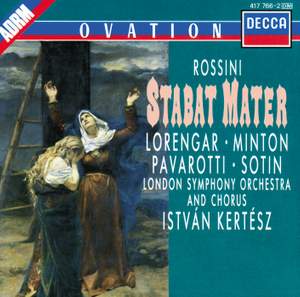
Dvořák naturally gave a great deal of attention to the genre of the oratorio, and it was his work in this area that firmly established his reputation in the English-speaking world. Rossini very much admired Pergolesi’s fine setting of the Stabat Mater, but had not felt equal to attempting his own. The decision to try came as a result of a plea from a Spanish prelate, Fernández Varela, who wished to possess an original Rossini manuscript. However, Rossini succumbed to an attack of lumbago and had given the score to Giovanni Tadolini to complete. Rossini forbade any publication or performance of the score as it stood and eventually supplied another publisher (Troupenas) with a complete, all-Rossini score. Together with the Mozart Requiem and his Masonic music, these are the only sacred works recorded by Kertész for Decca. Both feature Pilar Lorengar singing the soprano parts and the Rossini also features Luciano Pavarotti, dazzling in his tenor solo. “Robust, colourful performances. Not the last word in subtlety, perhaps, but boasting fine analogue Decca engineering and some outstanding soloists.” BBC Music Magazine, February 2013 **** “Lorengar's singing is particularly sensitive and appealing in the quieter passages … The four soloists combine beautifully in the quartet "Recordare, Jesu pie", and the chorus with them in "Pie Jesu, Domine", perhaps the loveliest movement in the work … The hero of the occasion is Kertész. He gets choral singing and orchestral playing of the finest quality from the Ambrosian Singers and the London Symphony Orchestra. It is abundantly evident that he cherishes a great love for this work … tremendous vitality and care for balance … The big climaxes are thrilling and altogether Kertesz and his forces make one revise one's qualified view of the work to a very large extent. This is certainly the finest performance of it that I have ever heard” Gramophone Magazine (Dvorák) “[Lorengar] is attractive in all she does, and phrases with delicacy … Minton moves surely through the octave-and-a-fifth leaps, the octave-and-a-fifth arpeggios, of "Fac ut portem" … Pavarotti always delights me with the ease and naturalness of his singing, and his pure vowels; his solo in the first number is outstanding. In the celebrated "Cuius animam" he rings out splendidly … Sotin has a voice of firm focus and beautiful timbre” Gramophone Magazine (Rossini) | | | (Sorry, download not available in your country) | In stock - usually despatched within 1 working day. |
|
|
| |  |
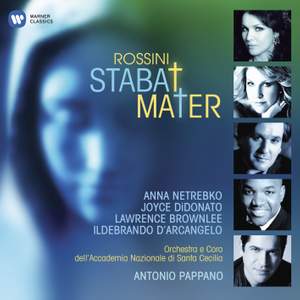
Antonio Pappano and Italy’s leading symphony orchestra, Orchestra dell’Accademia Nazionale di Santa Cecilia, continue their highly successful collaboration with EMI Classics with a studio recording of Rossini’s work for chorus, orchestra and soloists, Stabat Mater. They are joined by four international star soloists: Anna Netrebko, Joyce DiDonato, Lawrence Brownlee and Ildebrando D’Archangelo. “The blend of Anna Netrebko's soprano and Joyce DiDonato's mezzo-soprano is particularly effective, both in duet form on "Quis est homo", and underpinned by Lawrence Brownlee's tenor on the opening "Stabat mater dolorosa", while Ildebrando D'Arcangelo brings a magisterial poise to his solo” The Independent, 5th November 2010 **** “The chief glory here is the Accademia di Santa Cecilia chorus, one of the greatest in the world. It's well played, too, though not everyone will like the edge on the brass. Anna Netrebko fans will like her hell-for-leather Inflammatus, but the best of the soloists is bass Ildebrando D'Arcangelo: well-nigh ideal.” The Guardian, 11th November 2010 *** “The Accademia Chorus is one of the world’s best, and the full, honeyed tone is a constant pleasure. Another of the recording’s rocks is the bass soloist, Ildebrando d’Arcangelo, who never confuses eloquence with shouting and hits his notes dead centre...Brownlee avoids vocal preening and makes sure we can still sense the text’s grieving mother, sharing Christ’s pain.” The Times, 19th November 2010 *** “Pappano's tremendous new recording brings out every ounce of its darkness and force. With a superb quartet of soloists, and the deeply coloured playing and singing of his Italian forces, the piece emerges newly minted as a dramatic masterpiece of harmonic twists and turns, spine-tingling solos and heaven-storming choruses: a superb act of reinterpretation.” The Observer, 21st November 2010 “Although Rossini isn’t ideal Netrebko repertoire, she sounds positively Verdian in the dramatic hellfire of Inflammatus...Her bright timbre is ideally complemented by DiDonato’s plush, silken mezzo...Pappano lives the text like the great opera conductor he is, bringing consolation as well as fire and brimstone to Rossini’s heady spiritual brew.” Sunday Times, 28th November 2010 **** “A precondition for success here is the assembling of a matched quartet of technically accomplished singers blessed with a sense of the Rossini style. Pappano has this absolutely. The pairing of Anna Netrebko and Joyce DiDonato is a match made in heaven...This is one of the great choral recordings.” Gramophone Magazine, January 2011 “Pappano and his team really nail the work in a way I've not experienced before...What makes this recording so special is how the specifically Italian credentials of the music resound as though to the manner born...this is the most endearing benchmark performance of what is now revealed as a truly honest work.” International Record Review, January 2011 “Pappano is alive to nuance and inflection in Rossini's score. He allows Anna Netrebko and Joyce DiDonato ample scope for display but never at subtlety's expense...Imaginatively conceived and beautifully delivered.” Classic FM Magazine, February 2011 ***** “There is no shortage of good recordings of Rossini's Stabat Mater, but few do this gloriously uplifting work as much justice as Antonio Pappano's new recording...There is a compelling commitment to this performance. The opening chorus, with its hushed cloak-and-dagger atmosphere punctuated by dramatic outbursts, showcases choral singing of a terrific intensity that pins you to your seat.” bbc.co.uk, 12th April 2011 | | | In stock - usually despatched within 1 working day. |
|
|
| |  |
| | | In stock - usually despatched within 1 working day. |
|
|
| |  |
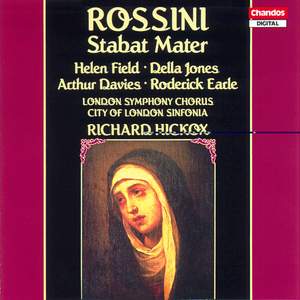
“Hickox rightly presents Rossini's Stabat Mater warmly and with gutsy strength...All four soloists here are first rate, not Italianate of tone but full and warm, and the London Symphony Chorus sings with fine attack as well as producing the most refined pianissimos” Penguin Guide, 2011 edition | | | (also available to download from $10.50) | In stock - usually despatched within 1 working day. |
|
|
| |  | Carlo Maria Giulini conducts Rossini, Gabrielli & Geminiani
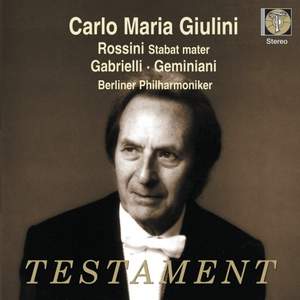
During the Berlin Festival of 1978 Giulini conducted two concerts of Italian music with the Philharmonic Orchestra on 13 and 14 September: the Sonata pian’ e forte by Giovanni Gabrieli, the Concerto grosso in G minor, Op.3 No.2 by Francesco Geminiani and Rossini's Stabat mater for soloists, chorus and orchestra. As Klaus Geitel put it in Die Welt on 15 September, "Carlo Maria Giulini never ceases to surprise his public. He does not restrict himself to the run of the mill, however fine. Of all major conductors who mount the Philharmonic Orchestra's rostrum he follows the least beaten path. The main item of the evening was the Stabat mater, the core of the mid-life crisis that beset the 40-year-old Rossini and almost silenced him until the end of his life, nearly three decades later… Giulini's interpretation was reverent and dignified without, however, making the charm of the work descend to the religious profundities that are only served up in the North." From the booklet note by Helge Grünewald | | | Usually despatched in 4 - 5 working days. |
|
|
| |  | Rossini: Stabat MaterFerenc Fricsay Edition Volume 11
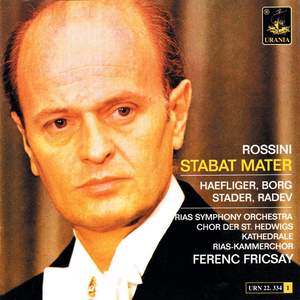
Maria Stader (soprano), Marianna Radev (alto), Ernst Haeflifer (tenor) & Kim Borg (bass) RIAS-Kammerchor, RIAS-Knabenchor, Berlin Mädchenchor, Chor des Hedwigs-Kathedrale & RIAS-Symphonie-Orchester, Ferenc Fricsay In the 1950s Ferenc Fricsay was almost the only conductor to perform Rossini's Stabat Mater in Germany.With this interpretation of the Stabat Mater Fricsay demonstrates that Rossini's music does not merely consist of operatic solo numbers accompanied by a spirited orchestra. Simply by casting singers such as Maria Stader and Ernst Haefliger, who generally showed a less operatic approach, Fricsay reveals his discovery of subtle musical interactions in Rossini's dramaturgy.The RIAS Symphony Orchestra, an ensemble of international standing under Fricsay, realises his intentions in a precise and unpretentious fashion. “Fricsay in concert, and a dramatic reading of Rossini's sacred masterpiece. …accomplished live performance that has about it the true blaze of faith.” Gramophone Magazine, October 2009 | | | Usually despatched in 3 - 4 working days. |
|
|
| |  |
| | | (Sorry, download not available in your country) | Usually despatched in 2 - 3 working days. |
|
|
| |  |
| | | Usually despatched in 8 - 10 working days. |
|
|
| | | |  |
| | | (Sorry, download not available in your country) | Usually despatched in 8 - 10 working days. |
|
|
| |
|