All recordingsPrices shown exclude VAT. (UK tax is not payable for deliveries to United States.) See Terms & Conditions for p&p rates. | |  | Not Just Dowland
Carolyn Sampson (soprano) & Matthew Wadsworth (lute & theorbo) The programme, entitled ‘Not Just Dowland’ sets the father of English song alongside his contemporary Robert Johnson, who notably composed for the plays of Shakespeare, and the Italians Monteverdi, Grandi, Piccinini, Caccini and Merula. There are also instrumental items by Johnson, Ferrabosco, Rosseter and Kabsberger. “Everything was so perfect, the evening seemed to pass in a flash,” was The Independent’s verdict on the Wigmore Hall recital in December 2008 by soprano Carolyn Sampson and lutenist Matthew Wadsworth. “The soprano Carolyn Sampson is blessed with a lovely voice …and the lutenist Matthew Wadsworth … really is a class apart among exponents of this increasingly popular musical instrument.” “Carolyn Sampson’s pure soprano cossets the words, savouring their expressive implications, relishing their shifts of rhythm and subtly sighing with bliss, yearning or heartache, depending on the circumstances.” The Telegraph, 29th January 2010 **** “One of the chief delights... is the opportunity to hear the theorbo at close quarters...in the skilled hands of Matthew Wadsworth it takes centre stage, both as a solo instrument and as an exquisite companion to Carolyn Sampson's sweet, lyrical soprano...a ravishing programme of beguiling melancholia.” The Observer, 7th February 2010 | 
| | | In stock - usually despatched within 1 working day. |
|
|
| |  | Dowland - In Darkness Let Me Dwell
Hille Perl (viola da gamba), Dorothee Mields (soprano) & Lee Santana (lute) The Sirius Viols John Dowland, born in London around 1563, was the most renowned lutenist in Europe. As a composer, he captured perfectly the fashionable melancholy of the Elizabethan age. For her new album In Darkness Let Me Dwell, viola da gamba virtuoso Hille Perl has selected some of Downland’s songs, coupled with instrumental pieces from his famous collection Lachrimae, or Seven Tears (1604). Together with her viola da gamba ensemble The Sirius Viols, the Amercian lutenist Lee Santana and the soprano Dorothee Mields Hille Perl eloquently portrays the melancholy spirit of Dowland’s music. In the songs, the solo lute pieces, the gaillards and pavanes for viola da gamba consort this melancholy is infinitely touching, and highly expressive. For this recording, The Sirius Viols was able to use copies of original instruments from the workshop of renowned instrument maker Tilman Muthesius from Potsdam. “It might not be evident in Sting's versions, but the music of the 16th-century composer John Dowland involved an appreciation of the way despair could be surmounted by its transformation into melancholy artistic expression.
That shines through the "Seven Shades of Melancholy" captured in these 15 interpretations by lutenist Lee Santana and a consort of viola da gamba led by Hille Perl, with soprano Dorothee Mields giving full account of the "despaire, griefe and sorrowe" in Dowland's lyrics.” The Independent, 13th February 2009 **** “Mields's slight accent aside, the songs are a pleasure to listen to: the voice - full yet light and with just a hint of vibrato - blends fully with the sonorous, well balanced and highly musical Sirius Viols… while yielding to the gentle majesty of Santana's expertly played lute...” Gramophone Magazine, May 2009 | | | In stock - usually despatched within 1 working day. |
|
|
| |  | Anne Sophie von Otter - In My Element
| | I let the music speak No Wonder (arr. by Elvis Costello and Ensemble) I Want to Vanish (arr. by Elvis Costello and Ensemble) | Bizet: | L'amour est un oiseau rebelle 'Habanera' (from Carmen) Les tringles des sistres tintaient (from Carmen) | Brahms: | Zigeunerlieder Op.103 : 1. He, Zigeuner, greife in die Saiten ein! Zigeunerlieder Op.103 : 5. Brauner Bursche führt zum Tanze | Chaminade: | Ah! si l'amour prenait Mignonne, à l'amour j'ai lié | Dowland: | In darkness let me dwell | Grieg: | Haugtussa, Op. 67 No. 8 'Ved Gjætle-Bekken' | Haas, P: | Seven Songs in a Folk Style, Op. 18 (unreleased) | Handel: | Qui d'amor from Ariodante Hercules: The world, when day's career is run Hercules: When beauty sorrow's liv'ry wears | Mahler: | Rheinlegendchen (Des Knaben Wunderhorn) Oft denk' ich, sie sind nur ausgegangen (Kindertotenlieder) | Monteverdi: | Adagiati, Poppea - Oblivion soave (L'incoronazione di Poppea) Disprezzata regina (L'incoronazione di Poppea) A Dio, Roma! (L'incoronazione di Poppea) | Mozart: | Parto, parto, ma tu ben mio (from La Clemenza di Tito) Oh Dei, che smania è questa (La Clemenza di Tito) Ah, qual gelido orror...Il padre adorato (from Idomeneo) No, la morte io non pavento (Idomeno) Non so più cosa son, cosa faccio (from Le nozze di Figaro) Voi che sapete (from Le nozze di Figaro) | Offenbach: | Barcarolle (from Les Contes d'Hoffmann ) Portez armes Vous aimez le danger… Ah! que j’aime les militaires! | Purcell: | Dido and Aeneas: Dido's Lament 'When I am laid in earth' | Schubert: | Im Abendrot, D799 Erlkönig, D328 | Schumann: | Süsser Freund Die Meerfee Op. 125 No. 1 | Strauss, R: | Sein wir wieder gut (from Ariadne auf Naxos) | Weill: | Buddy on the Nightshift My ship Surabaya Johnny (from Happy End) |
“Smart, sophisticated and opinionated, Anne Sofie von Otter has become a star by doing exactly what she wants” Opera News | | | In stock - usually despatched within 1 working day. |
|
|
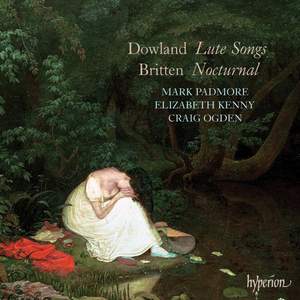
| |  | Britten & Dowland - Lute Songs
Mark Padmore (tenor) & Elizabeth Kenny (lute) “Padmore provides context by singing Dowland's original song before Craig Ogden steals in, alert to the Nocturnal's every nuance, and with a palette of colours both caressing and disquieting. Completing the frame, 'Flow my Tears' is beautifully inflected, though finer still is 'In Darkness let me Dwell' where in the final bars Padmore's enrapt engagement seems to conjure up the very chill of death.” BBC Music Magazine, February 2008 **** “Mark Padmore again shows why he is one of today's finest tenors. The quicker songs, like "Away with these self-loving lads", gain in clarity from a semi-declamatory approach, while the slower are eerily viol-like.” Gramophone Magazine, Janurary 2008 “A simply brilliant disc. I can’t praise it enough. A bronze Liz Kenny should be on the empty plinth in Trafalgar Square, in my opinion” Early Music Today “Since Emma Kirkby’s first recording in the late-1970s, we have known what to expect from Dowland’s lute songs. Some fine discs have followed, but not until Mark Padmore and Elizabeth Kenny’s new release has there been one as radical in
its potential impact on our understanding of the music. With tonal purity intact, voice and lute add subtle decoration, rhythmic fluidity, drama and rich poetic sensibility to these songs” The Independent on Sunday “... extraordinary diction and whispering chamber-like intimacy … [Mark Padmore] joy in conveying the emotional core of each situation” Gramophone Magazine | | | In stock - usually despatched within 1 working day. |
|
|
| |  | Dowland - Lute Songs
Dowland: | Flow my teares (Lacrimæ) Galliard Lady Laiton's Almain Fortune my foe Frogg Galliard Weepe you no more, sad fountaines Me, me, and none but me What if I never speed? Lasso vita mia The Shoemaker's Wife Can she excuse my wrongs? (First Booke of Songes, 1597) Mistress White's Thing Round Battle Galliard Wilt thou unkind thus reave me? Come away, come, sweet love Sorrow, stay If that a sinner's sigh Mr. Dowland's Midnight Say love if ever thou didst find Lachrimae Pavan Can she excuse my wrongs? (First Booke of Songes, 1597) If my complaints could passions move Katherine Darcy's Galliard Come again, sweet love doth now invite I saw my Lady weepe Orlando Sleepeth Tarleton's Riserrectione Sir John Smith, His Almain Mistress White's Nothing My Lord Chamberlaine his Galliard From silent night Flow not so fast, ye fountains My Lord Willoughby's Welcome Home Mrs. Winter's Jump Melancholy Galliard Lady Hunsdon's Puffe Shall I sue? In darkness let me dwell The First Galliard Can she excuse my wrongs? (First Booke of Songes, 1597) Come heavy sleep Captain Digorie Pipers Galliard Go, nightly cares |
Alfred Deller (counter-tenor), Robert Spencer (lute) Alfred Deller’s Dowland has become part of our history. The most legendary of English countertenors distilled the very essence of the melancholy of the 17th century English song in general and of the composer of the Lachrimae in particular. | | | In stock - usually despatched within 1 working day. |
|
|
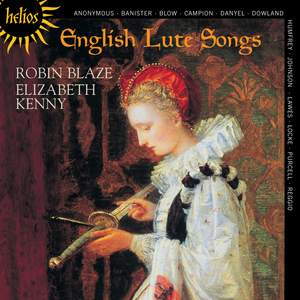
| |  | English Lute Songs
anon.: | The Last of the Queenes Maskes - lute solo | Banister: | Come unto these yellow sands Where the bee sucks Dry those eyes Full fathom five Give me my lute | Blow: | Lovely Selina | Campion: | Fair, if you expect admiring | Danyel: | Rosa - lute solo Can doleful notes? | Dowland: | In darkness let me dwell Time stands still Behold a wonder here | Johnson, R: | Full fathom five Where the bee sucks Fantasia - lute solo | Lawes, W: | Why so pale and wan, fond lover? He that will not love (Persuasions not to Love) I'm sick of love (To Sycamores) Gather ye rosebuds (To the Virgins, to make much of Time) | Locke: | The delights of the bottle | Purcell: | Riggadoon, Z653 - lute solo Song Tune ['Ah how pleasant 'tis to love', Z353] - lute solo Lilliburlero, Z646 - lute solo Tis Nature's voice Be welcome then, great Sir Song Tune ['Still I'm wishing', Z627] - lute solo Sefauchi's Farewell, Z656 By beauteous softness | Reggio: | Arise, ye subterranean Winds |
Robin Blaze (countertenor) & Elizabeth Kenny (lute) English Lute Songs covers a variety of styles by composers such as Blow, Dowland, Campion, Lawes and Purcell; some for voice and lute and some for lute alone. It is a disc which aims to look beyond the standard repertoire for countertenor and lute and hopefully introduce listeners to some lesser known pieces which will delight and enthrall. Robin Blaze and Liz Kenny have performed these works together on the concert platform to great acclaim. “Robin Blaze has the special ingredients to transcend any latent prejudice [of countertenors], especially in a recital as wide-ranging and intelligently programmed as this. Blaze has the means to colour his texts, not just with superior diction, but timbral variation to keep the listener hearing each song
afresh … there are too many highlights to list … superb. Another fine achievement from two of Britain’s brightest and best” Gramophone Magazine “Robin Blaze has the versatility and range of nuances needed to encompass such an eclectic repertoire and the precision of focus in his limpid countertenor makes even a trifle like The delights of the bottle an invigorating experience … an enterprising recital disc” International Record Review “Can be recommended without reservation … the wonderful By beauteous softness, from Queen Mary’s Birthday Ode of 1689, given this performance, I could quite easily listen to for ever … there’s a remarkable technical ease and innate literary intelligence about Blaze’s singing which together with the
astounding beauty of his voice makes this one of the most outstanding recitals of its kind on disc” BBC Music Magazine “Wonderfully performed … among the new generation of countertenors, Robin Blaze is the genuine article. Blaze [has] poised intensity, unswerving intelligence and sensitivity to the sheer, melting beauty of his instrument” BBC Music Magazine “I so admire Robin Blaze. He possesses an entirely natural sounding instrument, a polished technique, a subtle refined musicianship. Here, with his delicately soft timbres, he draws us into the world of each piece … the most delightful and intoxicating experience … I was entranced” Gramophone Magazine | | | Usually despatched in 2 - 3 working days. |
|
|
| |  | Baroque Voices 18 - Dowland: Ayres
Gérard Lesne (alto) Ensemble Orlando Gibbons These beautiful and melancholy “Ayres” by the English 16th century composer John Dowland may be seen as precursors of the songs of the Romantic period, two centuries later. They are performed here by the renowned combination of Gerard Lesne and the Ensemble Orlando Gibbons. | | | Usually despatched in 4 - 5 working days. |
|
|
| |  | Byrdland
Lawrence Zazzo (countertenor) Paragon Saxophone Quartet A tantalising fusion of ancient and modern, ‘Byrdland’ explores the world of the Renaissance song accompanied by
a modern-day saxophone quartet. All the songs on the disc were written by the great composers working in England in
the 16th and 17th centuries. Recent recordings by artists as diverse as Sting and Brian Asawa have partnered the
singer with the more traditional lute. “Zazzo's interpretation of the text and tasteful shaping of melody would grace any kind of performance style, and it is intriguing to hear some tenderly realised polyphonic lines delineated by the Paragon Saxophone Quartet. Byrd's "Lullaby" and Gibbon's "The Silver Swan" get an attractive alternative life here. ...a rare example of successfully reinventing "early" music.” Gramophone Magazine, October 2007 “…the elegant phrasing and sumptuous tonal character of the Paragon Quartet's playing… combines the warm intimacy of a viol consort with the fruit richness of shawms and crumhorns. Zazzo has one of the most flawless, beautifully-controlled voices you could wish to hear. ...his sound and technique rival even Scholl's and his diction is excellent in this astute mixture of familiar and lesser-known pieces.” BBC Music Magazine, Proms 2007 **** | | | Usually despatched in 4 - 5 working days. |
|
|
| |  | The John Dowland CollectionWith new booklet article, Dowland timeline, and sung texts in English
Dowland: | Lachrimae Antiquae If my complaints could passions move Can she excuse my wrongs? (First Booke of Songes, 1597) Come away, come, sweet love My Lady Hudson's Allmande A Piece without title The Shoemaker's Wife Come again, sweet love doth now invite Come heavy sleep Mr. Dowland's Midnight Sir John Smith, His Almain Semper Dowland Semper Dolens Lachrimae Gementes I saw my Lady weepe Flow my teares (Lacrimæ) Fine knacks for ladies Shall I sue? Lachrimae Tristes Me, me, and none but me Forlorn Hope Fancy (Fantasie No. 2) Weepe you no more, sad fountaines Lachrimae Coactae Go, nightly cares The Right Honourable Ferdinando The most sacred Queene Elizabeth her Galliard Tell me, true Love Lachrimae Amantis In darkness let me dwell A Fantasie My Lord Chamberlaine his Galliard Far from triumphing Court I shame at mine unworthiness Lachrimae Verae |
Barbara Bonney, Anne Sofie von Otter, Nigel Rogers, Andreas Scholl & Göran Söllsche The Consort of Musicke Whether gay or sad, simple or complex, John Dowland’s music has the power to move us four centuries after its composition. This wide-ranging anthology explores all aspects of the work of England’s greatest songwriter and lutenist, performed by leading exponents of his art today. “The collection might have sounded like a bit of a hotchpotch were it not for the fact that Dowland's celebrated Lachrimae pavans are woven through the sequence, giving the whole a sense of unity and shape. All in all, it makes a nostalgic and inspiring testimony to Dowland's versatility.” BBC Music Magazine, May 2007 **** | | | Usually despatched in 2 - 3 working days. |
|
|
| |  | The Best of Andreas Scholl
Scholl's voice rushes through the bloodstream' -The Times. | | | Usually despatched in 2 - 3 working days. |
|
|
| |
|