All recordingsPrices shown exclude VAT. (UK tax is not payable for deliveries to United States.) See Terms & Conditions for p&p rates. | |  | Debussy: Solo Piano Music
Angela Hewitt’s previous forays into the French repertoire have been praised for their ‘tenderness, Gallic wit, verve, and—the most important ingredient of all—charm’. These qualities are very much to the fore in this new disc of Debussy featuring some of the composer’s most sunlit, delightful and popular works. Children’s Corner was written for Debussy’s beloved daughter (though not, as Hewitt explains, for her to play immediately). Hewitt embraces the music’s wit, artful references and gentle beauty. The atmospheric Suite bergamasque includes the famous ‘Clair de lune’. Also included are the tragic Masques and gorgeously exuberant L’isle joyeuse. Hewitt and Debussy are a perfect match. “This is one of the better offerings for Debussy's 150th anniversary...This generously filled disc finds Hewitt utterly persuasive in the three suites at its heart...Hyperion caputres the sound marvellously. Hewitt has the knack of noticing details without letting them detract from the musical flow...Special mention should be made of 'Clair de lune': it is quite an achievement for its lyrical beauty to be heard afresh.” BBC Music Magazine, December 2012 ***** “Hewitt has put together an ideal introduction to Debussy, but it’s one that can be enjoyed equally by experienced listeners – thanks to the artless touch and precise colours the Canadian pianist brings to each piece.” Financial Times, 27th October 2012 **** “There's not a trace of the "impressionistic" about her treatment of any of them: this is Debussy portrayed in clean, bright colours and sharply focused detail, with every rhythm precisely etched...it's undeniably high-class playing, even when you don't agree with some of its details.” The Guardian, 4th October 2012 **** “Hewitt’s spectrum of touch, her fluency and sense of colour are deployed with equal enchantment in the first of the two arabesques, her lightness, rhythmic precision and varieties of tonal weight making the second arabesque into a glistening, fanciful filigree...Hewitt brilliantly and sensitively points up the traits that lend the music such distinctive character and evocative presence, not least in an account of “L’Isle joyeuse” that is pure, ravishing radiance.” The Telegraph, 5th October 2012 ***** | | | In stock - usually despatched within 1 working day. |
|
|
| |  | Boris Berman - Debussy: Pour le piano
Debussy: | Pour le piano Piano Masterclass at the Royal Northern College of Music |
Internationally regarded as one of the great keyboard teachers of our time, Boris Berman is well known to the audiences of nearly fifty countries. Since 1979 he has lived in the U.S. and has taught at Boston University, Brandeis University,Indiana University, and is currently head of the piano department at the Yale School of Music. Among other acclaimed CDs he has recorded the complete piano works of Sergei Prokofiev for the Chandos label. In this masterclass he works on Debussy's "Pour Le Piano" | | | In stock - usually despatched within 1 working day. |
|
|
| |  | Jean-Bernard Pommier plays Debussy
Claude Debussy was an excellent pianist, and Marguerite Long, who worked with him, admired “the suppleness, caress and depth of his touch”, as well as his “full, intense sonority, free of any harshness in the attack, like Chopin”. After the elegant, delicate Arabesques of 1888, in 1901 Debussy published his first important piano work, Pour le piano, in the tradition of the great baroque keyboard masters whom he so admired; it was to his dear daughter Chouchou, born in 1905, that he dedicated the six simple miniatures of Children’s Corner, a blend of emotion, playfulness and humour. “When one can’t afford to travel, one must make do with the imagination,” he said, commenting on the Estampes, whose heady sonorities and magical evocations refer to the Orient, Spain, and the spirit of France; Debussy was also capable of irony, as in La Plus que lente, composed in 1910 as “café music”. Less well-known, the Pièce pour le Vêtement du blessé was composed for a charity during the First World War devoted to dressing the wounds of soldiers. Marguerite Long described L’Isle joyeuse (1904) as an exuberant, “joyful gust of wind” and “a celebration of rhythm”; it is also a superb exploration of tone-colour and nuance. “Pommier's Debussy selection displays many facets of both the composer and performer. Children's Corner is spirited and the Estampes particularly engaging. The highlight is a wonderfully droll La plus que lente.” BBC Music Magazine, December 2009 | | | In stock - usually despatched within 1 working day. |
|
|
| |  | Debussy - Complete Piano Works Volume 3
“Where Bavouzet breaks out into blazing Mediterranean sunlight, Rogé is happy to withdraw into shadow-land. Time and again his playing suggests emotion recollected in tranquillity rather than turmoil;… "Poissons d'or" is a marvellous distillation of indolence and flashing disruption.” Gramophone Magazine, July 2008 | | | In stock - usually despatched within 1 working day. |
|
|
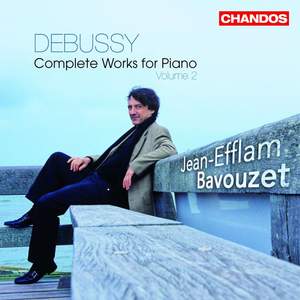
| |  | Debussy - Complete Works for Solo Piano Volume 2
“Bavouzet's strengths…to the fore, with glowing colours in the opening Ballade and Valse romantique, followed by sparkling elegance in the Danse.” BBC Music Magazine, January 2008 **** “While Bavouzet is no slouch in the tone-colour department, his interpretations do not primarily concern themselves with sound-painting. Instead he focuses upon clarity of textures, rhythmic precision, well differentiated articulation, plus scrupulous balances between the hands and within chords. Timbral variety and tonal allure arise from these elements working together. As you listen to Bavouzet's effortless rhythmic lilt and buoyant sense of line in the Tarantelle styrienne, Masques and 'Jardins sous la pluie', or his firm bass underpinnings and impeccably calibrated arabesques throughout L'isle joyeuse, you don't perceive the 'hammerless' piano of Debussy's dreams. Instead, the piano's innards morph into a finely honed chamber orchestra. Similarly in 'Pagodes', Bavouzet's sharply profiled melodies shed welcome animated light on a piece that's often interpreted too flaccidly. Some might favour a warmer, more curvaceous way with the Valse romantique but Bavouzet's shapelier urgency proves more convincing in Pour lepiano's central Sarabande, as well as its earlier incarnation in the cycle of 'forgotten' Images. The recorded sound is never less than pleasing.” Gramophone Classical Music Guide, 2010 “No gently meandering Debussy for French pianist Jean-Efflam Bavouzet in his second complete works instalment. Structure and clarity are, if not all, then at least to the forefront here, and the composer gains. In a way, by making the textures so clear, Bavouzet reveals (to an extent) how the magician does his tricks – and it just leaves you admiring Debussy all the more.” Gramophone Magazine “If anything, Jean-Efflam Bavouzet surpasses the high standards he set in his previous Debussy release… with this second instalment. …he focuses upon clarity of textures, rhythmic precision, well differentiated articulation, plus scrupulous balances between the hands and within chords.” Gramophone Magazine, Janurary 2008 “Debussy playing does not come any better than this” Penguin Guide, 2011 edition | | | (also available to download from $10.50) | In stock - usually despatched within 1 working day. |
|
|
| |  |
| | | In stock - usually despatched within 1 working day. |
|
|
| |  | Debussy: Complete Solo Piano Music, Vol.1
| | | (Sorry, download not available in your country) | In stock - usually despatched within 1 working day. |
|
|
| |  |
Also available as part of the Debussy - The Piano Works box set, ALC4002. | | | In stock - usually despatched within 1 working day. |
|
|
| |  | Debussy: Complete Piano Works, Vol. 3
| 
| |
|
| |  | Claude Debussy, Vol. 21930-1953
| 
| |
|
| |
|