All recordingsPrices shown exclude VAT. (UK tax is not payable for deliveries to United States.) See Terms & Conditions for p&p rates. | |  | Vivat Brahms Vol. 1
James Barralet (cello) & Simon Callaghan (piano) The first volume of Brahms Chamber Music on the SOMM label, recorded with Simon Callaghan at the piano, includes the first cello sonata and the 21 Hungarian Dances – the latter arranged by James. The second volume will comprise the second cello sonata, the opus 91 songs - also arranged by James - and the piano trio in C major. The second volume will be released in November. | 
| | | In stock - usually despatched within 1 working day. |
|
|
| |  | Brahms & Dvorak: Dances
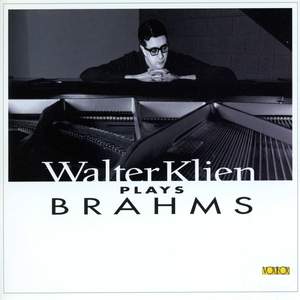
Alfred Brendel and Walter Klien perform the original two piano arrangements of Brahms’ Hungarian and Dvorak’s Slavonic dances. | 
| | | In stock - usually despatched within 1 working day. |
|
|
| |  | Brahms: Violin Concerto
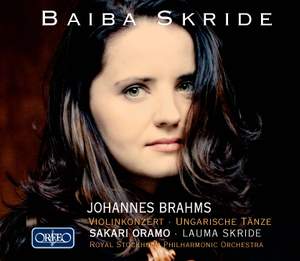
Baiba Skride is not just one of the most sought-after artists when it comes to finding a soloist for one of the great violin concertos. She is also much in demand for chamber music. This makes her ideal for her new recording, her first on the ORFEO label, devoted to the work of Johannes Brahms. It is a highly promising start to our collaboration with this First-Prize winner of the Queen Elisabeth Competition in Brussels in 2001. Besides Brahms’s Violin Concerto, she here offers his Hungarian Dances in the version for violin and piano made by Joseph Joachim. The long-standing musical partnership of Brahms and Joachim is reflected doubly here, for Joachim was also the dedicatee of the Concerto. Baiba Skride’s Brahms interpretations are themselves characterized by happy musical constellations. In Sakari Oramo she has a conductor who is himself a violinist and who offers the appropriate momentum with the Royal Philharmonic in Stockholm. One clearly hears the energy and vigour with which every instrumental grouping plays. Thus the great arch of the work is perfectly formed, from the solo interjections (not just from the violin!) to the symphonic dialogue between the partners. The chamber-music intimacy of the Hungarian Dances could not be achieved more powerfully or more beautifully than in Baiba Skride’s tried-and-tested duo partnership with her sister Lauma Skride at the piano. Unhindered by the “pianistic” violin part with its many double stoppings, Baiba develops an ensemble that is in tempo and in its gestures carefully moulded with the piano. The piano may have what is clearly an accompanying part, and Lauma Skride certainly adapts to her sister’s playing in an unpretentious manner, but nor is her part understated. The result is a performance of these atmospheric dances that is at times resilient and fiery, at other times melodic, gentle and smooth. They belong just as much to Brahms’s art as do the formal stringency and unity we find in his large-scale works – and it is all the lovelier when we find all of this on a single CD recording. “This performance...reveals Baiba Skride as the complete violinist, with an exceptionally precise, reliable technique, splendid tone and presence, and discerning musicianship, who makes the quietest moments tell. And her playing is complemented by a sympathetic, finely balanced accompaniment.” Gramophone Magazine, October 2011 “It’s soon clear that Baiba Skride is going to give an intensely poetic, singing account of the solo part [of the Concerto]. Her technique sounds flawless – as one would expect at this level – but I really admired the consistency of her tone, especially above the stave, as well as her ability to sustain the line.” John Quinn, MusicWeb International, November 2011 | | | In stock - usually despatched within 1 working day. |
|
|
| |  | Brahms - Hungarian Dances & Dvorak - Slavonic Dances
It must have come as quite a shock to those who had known Brahms as only a composer of serious music – notably three piano sonatas, the first piano concerto and the monumental Paganini and Handel variations – to experience the collection of 16 Waltzes published in 1866 when the composer was 33. They were probably begun ten years earlier and form an album of memories reminiscent, in their variety of colour, of the different places in which he had first heard them – Hungarian, Tyrolean and even Nordic picked up no doubt from the sailors who frequented the bars in Hamburg where the composer played to earn a living. The Liebeslieder followed three years later and were originally set for vocal quartet and piano duet; five years later they were published without the vocal parts. The Hungarian Dances were composed and published over a period of eleven or twelve years ending 1870, Brahms orchestrated three of them in 1873. Brahms recommended Dvorák, eight years his junior, to his publisher, Simrock, in 1877 and the following year duly published the first set of Slavonic Dances which they commissioned. The second set followed eight years later. Both sets were originally composed for piano duet and later orchestrated. These recordings are one of the many that Beroff and Collard have made together. | | | In stock - usually despatched within 1 working day. |
|
|
| |  | Brahms & Joachim: Hungarian Dances
The forty-year friendship between Brahms and Joseph Joachim, violinist and composer, was one of the most significant and fruitful relationships in nineteenth-century music. Their admiration of each other’s artistry was profound and unwavering, and bore sustained creative fruit on Brahms’s side of which his Violin Concerto and Double Concerto are only the most famous examples. Joachim’s transcriptions of Brahms’s famous Hungarian Dances – originally written for piano duet or solo piano – are technically challenging for any violinist, and superbly idiomatic, constituting a kind of gypsy ‘Art of the Violin’. They represent the summit of Brahms’s ‘Hungarian’ art, and Joachim’s powers of transcription match them with violin writing of the greatest fastidiousness and authentic feeling. The brilliant Hagai Shaham, acclaimed for his recordings of Hubay, is the ideal performer. “Hagai Shaham and Arnon Erez complement each other perfectly here, evincing fire, fury, and sweet sadness.” BBC Music Magazine, July 2008 ***** “This is a magnificent… Shaham and Erez… playing together with such ease that it's easy to forget the art and care that have gone into achieving such beautiful ensemble.” Gramophone Magazine, August 2008 “Joseph Joachim's violin arrangements of Brahms's Hungarian Dances more often than not appear singly as concert encores, so it is good to have the whole set presented here, and especially in virtuoso performances from the Israeli violinist Hagai Shaham that get to the heart of the style.
If in musical terms Joachim's own set of variations pales by comparison, this is hardly the fault of Shaham, nor of his expert duo partner Arnon Erez: the playing fizzes with energy and suavity.” The Telegraph, 24th May 2008 | | | In stock - usually despatched within 1 working day. |
|
|
| |  | Brahms: Hungarian Dances, WoO 1 Nos. 1-21 (complete)
Kurt Masur's invigorating and warm-hearted accounts of the Brahms Hungarian Dances are welcomed back to the catalogue. “these recordings are early digital material and there is no background noise at all... The acoustic is clear and warm and this serves to enhance these performances by an orchestra and conductor who have this music in their bones... Very highly recommended” MusicWeb International | | | In stock - usually despatched within 1 working day. |
|
|
| |  | Brahms: Hungarian Dances No. 1-21 & Waltzesfor Four Hands
“A beguiling take on the Hungarian Dances with lashings of rubato, coupled to a set of waltzes that exchanges salon innocence for concert hall sophistication.” BBC Music Magazine, August 2012 **** | | | Usually despatched in 3 - 4 working days. |
|
|
| |  | Brahms: Hungarian Dances, WoO 1 Nos. 1-21 (complete)
| | | Usually despatched in 2 - 3 working days. |
|
|
| |  | Brahms: Hungarian Dances, WoO 1 Nos. 1-21 (complete)Arranged by Joseph Joachim
| | | This item is currently out of stock at the UK distributor. You may order it now but please be aware that it may be six weeks or more before it can be despatched. |
|
|
| |  | Brahms: Hungarian Dances, WoO 1 Nos. 1-21 (complete)
Krassimira Jordan & Thomas Kreuzberger (piano) Krassimira Jordan is Professor of Piano and Artist-in-Residence at Baylor University, Texas, USA and has established an international reputation as a concert pianist and recording artist. Thomas Kreuzberger has been a professor at the University of Music and Performing Arts in Vienna since 1993 and is Professor and Chairman of the university’s Institute for Conducting. | | | (also available to download from $10.50) | Usually despatched in 2 - 3 working days. (Available now to download.) |
|
|
| |
|