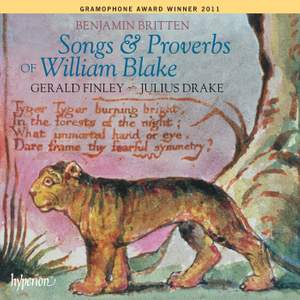
All recordingsPrices shown exclude VAT. (UK tax is not payable for deliveries to United States.) See Terms & Conditions for p&p rates. | |  | Britten: Songs & Proverbs of William Blakeand other songs
The unbeatable, multi-award-winning partnership of Gerald Finley and Julius Drake turn to the composer Benjamin Britten for their latest Hyperion release. Although Britten is particularly celebrated for the substantial body of music he composed for the tenor voice, the composer also left an important legacy of music for baritone. Characteristically, Britten’s output for low voice was also inspired by the talents of specific performers with whom he was closely associated, among them Dietrich Fischer-Dieskau and John Shirley-Quirk. In addition to song-cycles, individual songs and folksong arrangements, Britten wrote challenging baritone roles in operas as diverse as Billy Budd (1951), Owen Wingrave (1970) and Death in Venice (1972)—the title role of the second of these made very much Gerald Finley’s own in his magnificent interpretation in Margaret Williams’s 2001 television film of the opera. This disc contains Britten’s two important song cycles for baritone: Tit for Tat, setting the poems of Walter de la Mare, and the more substantial and challenging Songs and Proverbs of William Blake. The latter was written for Dietrich Fischer-Dieskau; designed to showcase his unique blend of intense lyricism and dramatic characterization, qualities which are undoubtedly also exhibited by Gerald Finley. Also included are some of Britten’s popular folksong settings, and a selection of later songs, which received exposure and publication only after the composer’s death in December 1976. “Finley as ever acquits himself as a fine singer, a conscientious artist and a thoroughly reliable musician....In all (including the Blake) Julius Drake is the superb pianist.” Gramophone Magazine, July 2010 “Gerald Finley sings them all with such an unwaveringly beautiful tone and attention to every syllable, and pianist Julian Drake is so wonderfully attuned to the baritone's inflections...Finley comes into his own in the final Every Night and Every Morn, and Drake's handling of the powerfully wrought accompaniments is superb.” The Guardian, 3rd June 2010 **** “Finley’s watchwords are directness and clarity, both of which come across to splendid effect in the folk-song arrangements and the comic duet The Deaf Woman’s Courtship, in which he performs both parts. Drake is his admirable partner in this outstanding enterprise.” Sunday Times, 13th June 2010 **** “[Finley] just seems to be singing naturally, but at the same time he colors and inflects with astonishing specificity. He manages to vary the repeats in those folk-song settings where verses are repeated...His diction is crisp and clear, which adds to the dramatic impact of his singing.” Fanfare, 26th October 2010 | | | In stock - usually despatched within 1 working day. |
|
|
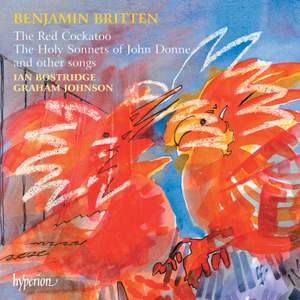
| |  | Britten - Songs
“Bostridge is in the royal line of Britten's tenor interpreters. Indeed his imaginative response to words and music may come closer than any to Pears himself. He's heard here in a veritable cornucopia of mostly unfamiliar and unknown songs (the Donne cycle apart), mainly from the earliest period of Britten's song-writing career when his inspiration was perhaps at its most free and spontaneous. The three settings from Ronald Duncan's This way to the Tomb nicely match that poet's florid, vocabulary-rich style as Britten was to do again two years later in Lucretia, with 'Night', based on a B-minor ground bass, a particularly arresting piece. The Auden settings, roughly contemporaneous with On this Island, all reflect Britten's empathy with the poet at that time. The third, To lie flat on the back, evinces Britten's gift for writing in racy mode, as does When you're feeling like expressing your affection, very much in the style of Cabaret Songs. Much deeper emotions are stirred by the two superb Beddoes settings (Wild with passion and If thouwilt ease thine heart), written when the composer and Pears were on a ship returning home in 1942. The red cockatoo itself is an early setting of Waley to whom Britten returned in Songs fromthe Chinese. All these revelatory songs are performed with full understanding and innate beauty by Bostridge and Johnson, who obviously have a close artistic rapport. The Donne Sonnets are as demanding on singer and pianist as anything Britten wrote, hence their previously small representation in the catalogue. Both artists pierce to the core of these electrifying songs, written after, and affected by, Britten's visit to Belsen with Menuhin in 1945. The recording catches the immediacy of these riveting performances. A richly satisfying issue.” Gramophone Classical Music Guide, 2010 | | | Usually despatched in 2 - 3 working days. |
|
|
| |
|