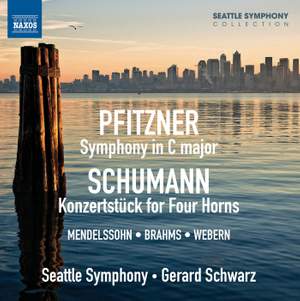
All recordingsPrices shown exclude VAT. (UK tax is not payable for deliveries to United States.) See Terms & Conditions for p&p rates. | |  | Hans Pfitzner: Symphony in C major
The musical expression of German Romanticism is the theme of this disc. The trajectory of Schumann’s Konzertstück, Op. 86, written for four horns and orchestra, goes from heroism to introspection. Two of his Symphonic Etudes, Op. 13, were orchestrated by no less a figure than Tchaikovsky, while Albert Parlow orchestrated four of Brahms’ most exciting Hungarian Dances. Mendelsssohn’s Overture to his Ballad Opera Die Heimkehr aus der Fremde (Song and Stranger) embodies classical virtues. Anton Webern’s Langsamer Satz for string quartet has been vibrantly orchestrated by Gerard Schwarz. Hans Pfitzner, one of the last representatives of the movement, is represented by his concise, melodic Symphony in C major. | | | (also available to download from $6.00) | Usually despatched in 2 - 3 working days. (Available now to download.) |
|
|
| |  | Schumann: Works for Piano and Orchestra
Gerhard Oppitz recreates Schumann’s unique romantic world in exemplary fashion, flawlessly mastering the technical demands. He has a very personal passion for Schumann’s compositions and is accompanied by an orchestra ideally suited to his vision, the Bamberger Symphoniker. “[Oppitz] has the work so much under his fingers that it's as if nothing is a problem for him...the result is sleek without penetrating the surface....Oppitz's performances of [the couplings] are more compelling than his Concerto.” Gramophone Magazine, June 2012 “this unlikely transcription [of the Konzertstuck] proves to be not only likeable but also something to return to, aided in this case by a lively and vivid performance, with Gerhand Oppitz a deft and sensitive pianist and Marc Andrae inspiring a detailed response from the excellent Bamberg Symphony Orchestra...As for the familiar Piano Concerto, this receives an unsentimental performance” International Record Review, May 2012 | | | (also available to download from $10.50) | Usually despatched in 2 - 3 working days. (Available now to download.) |
|
|
| |  | The Staatsoper Unter den LindenLive Recording from The Staatsoper Unter den Linden Berlin, 1998
A curious notion: the Berliner Philharmoniker as guest performers at the State Opera Unter den Linden. Daniel Barenboim, as both the host and the conductor of the concert, had invited the ensemble to perform in the historically distinguished setting of the opera. The varied programme started with Beethoven‘s blithe Eighth Symphony, which deservedly no longer counts as one of Beethoven‘s lesser symphonic works. This was followed by a rare gem of Romantic music: the concert piece for four horns and orchestra Op. 86 by Robert Schumann, in which the solo quartet interacts with the orchestra as a concertino group. This imaginatively arranged three-part concert piece - brimming with vitality, catchy melodies and wit - was composed in 1849, seven years before Schumann‘s death. As performing the piece calls for consummate skill in all of the instrument‘s manifold playing techniques, it is regarded as a daunting and highly complex task among horn players. Perhaps that explains why the attractive composition is only presented so seldom. The next item on the programme was Franz Liszt‘s symphonic poem „Les Préludes“ - with an entirely instrumental performance of Richard Wagner‘s „The Ride of the Valkyries“ that was yet redolent of the Valkyrie‘s wild Hoyotoho cry, the impassioned opera conductor brought his concert with the Berliner Philharmoniker to a perfect close. Sound Format: PCM Stereo, DD 5.1 Picture Format: 16:9 DVD Format: DVD 9, PAL Running Time: 76 mins FSK: 0 | | | Usually despatched in 2 - 3 working days. |
|
|
| |  | Schumann - Symphonies Nos. 1-4Live Recordings 2006-8
Robert Schumann the symphonist still stands in the shadow of Schumann the composer for piano and voice (the fate of Schumann the opera composer is no different). The idea that an orchestra with a great tradition of performing the Romantic repertoire should have good reason to play Schumann’s orchestral works gladly and regularly – even offering cycles of them – is something that the Vienna Symphony Orchestra and its chief conductor Fabio Luisi have put into practice, to their credit. The conductor and his orchestra meet all the orchestral challenges that Schumann places before them. They play with the greatest of technical subtlety and beauty of tone, from the spirited First, the 'Spring' Symphony, via the muted atmosphere of the Second, then the Third, 'Rhenish', with its rich palette of moods and impressions, to the fantasy of the Fourth Schumann’s art of climax and the conclusive manner of his repetitions are here heard just as clearly as are his deft combinations of Romantic colours and shadings. Thus the fourth movement of the Rhenish is accorded the sacred tone that is appropriate to it, just as the 'Romanze' in the Fourth Symphony is played as if it were a lover’s serenade. Fabio Luisi furthermore masters the tempo shifts and capricious quirks in Schumann’s fast movements. Here, the Vienna Symphonic plays with dizzying brilliance – and all is achieved 'live', without the safety net of the studio. To complement the symphonies, the present recording also includes the Konzertstück for 4 Horns Op. 86, a powerful, vital work that stands in close proximity to the 'Rhenish', and which was composed during one of Schumann’s most productive periods. Schumann utilises the form of the Konzertstück to explore those spaces between the 'competitive' aspect inherent in a concertante work and the ensemble aspect of soloists and orchestra playing together as a symphonic ensemble. At the same time, the composer explores the possibilities of the modern valve instruments that themselves present further technical subtleties (and hurdles too). This work was long regarded as near-unplayable, but it is a matter of course that the horn players of the Vienna Symphony here play it with complete, sovereign command. “Most successful is the Rhenish Symphony No. 3, with a surging account of the opening Allegro, and an appropriately sombre view of the famous 'Cologne Cathedral' penultimate movement.” BBC Music Magazine, December 2010 **** “Luisi and the Vienna Symphony Orchestra, covering all four symphonies plus the stirring Konzertstück, follow the modern fashion for bracing speeds, period-style articulation and pronounced accents.” Financial Times, 10th July 2010 **** “...manifest affection...glows from every bar of his performances (the Vienna Symphony seems willing to take on board his love for the music)” Gramophone Magazine, September 2010 “Luisi's approach to the Schumann symphonies is perfectly conventional, but bears his familiar hallmarks of sensitivity and stylishness...The result is one of the best of recent traditional cycles of these works, lacking the bracing rawness of some period-instrument accounts maybe, but thoroughly satisfying in its own right.” The Guardian, 27th May 2010 **** “The tempi are sometimes daring – a langourous Larghetto in the Frühlingssymphonie, a slightly frantic Lebhaft in the Rheinische – but convincingly argued. Though Vienna's fruity clarinets dominate the sound, the articulation is excellent.” The Independent, 23rd May 2010 | | | Usually despatched in 3 - 4 working days. |
|
|
| |  | Horn Concertos
Handel: | Water Music Suite No. 2 in D major, HWV349 Francesco Roselli, Willy Küchler (horn) Festival Strings Lucerne, Rudolf Baumgartner Water Music Suite No. 1 in F major, HWV348: excerpts | Mozart: | Horn Concerto No. 2 in E flat major, K417 Wilhelm Bruns (horn) Quadriga-Quartett & Mannheimer Mozartorchester, Thomas Frey Horn Concerto No. 3 in E flat major, K447 Wilhelm Bruns (horn) Quadriga-Quartett & Mannheimer Mozartorchester, Thomas Frey Horn Concerto No. 4 in E flat major, K495 Wilhelm Bruns (horn) Quadriga-Quartett & Mannheimer Mozartorchester, Thomas Frey Horn Quintet in E flat, K407 Wilhelm Bruns (horn) Quadriga-Quartett | Schumann: | Konzertstück for four horns, Op. 86 Hornquartett der Staatskapelle Dresden & Staatskapelle Dresden, Herbert Blomstedt | Strauss, R: | Horn Concerto No. 1 in E flat major, Op. 11 Hermann Baumann (horn) Kölner-Sinfonie-Orchester, Günter Wand | Telemann: | Concerto TWV 51:D8 in D major for horn, strings & b.c. Erich Penzel (horn) Collegium aureum, Franzjosef Maier Concerto TWV 54:Es1 in E flat major for 2 horns, 2 violins, strings & b.c. Erich Penzel (horn) Collegium aureum, Franzjosef Maier |
| | | Usually despatched in 2 - 3 working days. |
|
|
| |  | Dvorak - Symphony No. 9
On arriving in the USA and taking up his functions at the head of the Conservatory in September 1892, Antonin Dvorák threw himself into the study of Amerindian music and the songs of Stephen Foster; but the true revelation came from the songs of the Black population, which enthralled him. His 9th symphony, “From the New World”, was clearly inspired by these songs, although the title should be understood as designating a work sent from the United States to his friends who had remained in Europe. This new recording features a rare performance of the symphony on instruments of the period by the specialist orchestra Le Chambre Philharminique directed by the internationally renowned conductor Emmanuel Krivine. The three movements of the Konzertstück form a true concertante work, in which Schumann strives to exploit the resources of the modern horn. But he never allows virtuosity to stifle the musical discourse. The first movement, heroic in tone, is marked Lebhaft (lively). The short Romanze foreshadows the solemn Maestoso of the ‘Rhenish’ Symphony (1850), and moves without a break into the radiant finale, marked Sehr lebhaft (very lively) and dominated by rapid virtuoso runs, which reverts to the epic atmosphere of the work’s opening. La Chambre Philharmonique, created under the aegis of Emmanuel Krivine, is the result of a utopian ideal. A new type of orchestra, composed of musicians from the greatest European ensembles all motivated by the same desire to make music, La Chambre Philharmonique places pleasure and discovery at the heart of its musical adventure. Since its debut at La Folle Journée in Nantes (2004), La Chambre Philharmonique has met with keen interest wherever it has played. The ensemble has worked with prestigious soloists such as Andreas Staier, Emanuel Ax, Christophe Coin, and Véronique Gens. The orchestra recorded Mozart’s C minor Mass with the Accentus Chamber Choir, Sandrine Piau, Anne-Lise Sollied, Paul Agnew, and Frédéric Caton for Naïve in 2005, and subsequently toured this programme widely in 2006. The second recording of La Chambre Philharmonique and Emmanuel Krivine, devoted to Mendelssohn (2007), won numerous awards in the press. “…this reading… approaches Dvorák's sound works and with a bracing performance of Schumann's Konzertstück is certainly worthy of investigation.” BBC Music Magazine, October 2008 *** “Krivine secures biting attack in both works using a reduced body of strings, 8.8.7.6.5, which undoubtedly helps in securing great clarity, with timpani standing out cleanly - particularly important in the Dvorák, and encouraging Krivine to opt for fast allegros. The reduced string band also encourages pianissimos of breathtaking intensity, dramatically contrasted against the sharp impact of the extreme fortissimos. The Schumann Konzertstück... features four of the orchestra's horn soloists, each producing a ripe, fruity tone, with some brilliant tonguing in the triplets of the first movement and in the scales and arpeggios of the finale.” Gramophone Magazine, November 2008 | | | (also available to download from $10.50) | Usually despatched in 3 - 4 working days. (Available now to download.) |
|
|
| |  | Horn - Greatest Works
Brahms: | Horn Trio in E flat major, Op. 40 Peter Damm (hunting horn), Amadeus Webersinke (piano), Manfred Scherzer (violin) | Françaix: | Divertimento Peter Damm (horn), Peter Rösel (piano) | Gounod: | 6 Mélodies (selection) Peter Damm (horn), Peter Rösel (piano) | Haydn: | Horn Concerto No. 1 in D major, Hob.VIId:3 Peter Damm (horn), Matthias Eisenberg (harpsichord), Matthias Pfaender (cello), Manfred Pernutz (double bass) Kammerorchester C. P. E. Bach der Deutschen Staatsoper Berlin, Hartmut Haenchen | Heinichen: | Concerto for 2 Horns and 2 Flutes in F major Peter Damm (horn), Dieter Pansa (horn) Capella Sagittariana, Eduard Melkus | Mendelssohn: | Der Jäger Abschied: Wer hat dich, du schöner Wald, Op. 50 No. 2 (arr. for horn quartet) Members of the Leipzig Radio Symphony Orchestra Abschied vom Walde (No. 3 from Sechs Lieder in Freien zu singen, Op. 59) (arr. for horn quartet) Members of the Leipzig Radio Symphony Orchestra | Rossini: | Le rendez-vous de chasse Prelude, Theme & Variations Peter Damm (horn), Peter Rösel (piano) | Saint-Saëns: | Morceau de concert in F minor, Op. 94 Peter Damm (horn) Staatskapelle Dresden, Siegfried Kurz Romance in F major, Op. 36 Peter Damm (horn), Peter Rösel (piano) | Schumann: | Konzertstück for four horns, Op. 86 Peter Damm (horn), Klaus Pietzonka (horn), Dieter Pansa (horn), Johannes Friemel (horn) Staatskapelle Dresden, Siegfried Kurz Adagio and Allegro in A flat major, Op. 70 Peter Damm (horn), Amadeus Webersinke (piano) | Weber: | Horn Concertino in E minor, Op. 45 Peter Damm (horn) Staatskapelle Dresden, Siegfried Kurz |
| | | Usually despatched in 4 - 5 working days. |
|
|
| |  | Edition Staatskapelle Dresden - Volume 12
recorded live | | | (also available to download from $10.50) | Usually despatched in 2 - 3 working days. (Available now to download.) |
|
|
| |  | Concertos for Horn Quartet and Orchestra
| | | Usually despatched in 2 - 3 working days. |
|
|
| |  | Concertos for Four Horns
| | | (also available to download from $6.00) | Usually despatched in 2 - 3 working days. (Available now to download.) |
|
|
| |
|