Brahms: String Quartet No. 1 in C minor, Op. 51 No. 1

This page lists all recordings of String Quartet No. 1 in C minor, Op. 51 No. 1, by Johannes Brahms (1833-97) on CD, SACD & download (MP3 & FLAC). Generally, more recent releases are listed first, but with priority given to those that are in stock.

Recommendations

Chamber Choice
June 2007
First Choice
September 2010

All recordings

Prices shown exclude VAT. (UK tax is not payable for deliveries to United States.)
See Terms & Conditions for p&p rates.

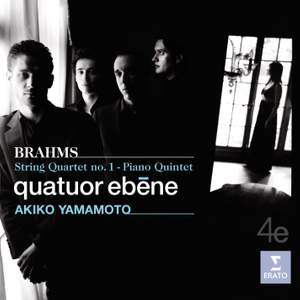
Brahms - Piano Quintet & String Quartet No. 1

Brahms - Piano Quintet & String Quartet No. 1


Brahms:

String Quartet No. 1 in C minor, Op. 51 No. 1

Piano Quintet in F minor, Op. 34

Akiko Yamamoto (piano)


For their second Virgin Classics release the members of the Quatuor Ebène turn from the native French repertoire of their first release (Debussy, Ravel, Fauré) to music firmly in the Austro-German tradition, Brahms’ first string quartet and first piano quartet. Joining them for the quintet is the Japanese pianist Akiko Yamamoto; when the five musicians played the piece together in London in 2006, the Independent newspaper had the following to say: “This talented group wound up their concert with a brilliant performance of Brahms' Piano Quintet in F minor, with the piano acting as a firm anchor, while the strings sang their hearts out. Come back soon.”

The Ebène’s debut on Virgin Classics, the programme of French quartets released in September, has been receiving high praise: “Three French masterpieces (Debussy, Fauré, Ravel) played by young musicians with a rare degree of expressive subtlety, blended sonorities and electrifying joy. The late Fauré quartet achieves a fine balance between sounding suave and pulsing with life. Debussy quivers with febrile emotions, while the Ravel soars to heaven with refinement and poise,” said The Times, awarding the recording five stars. Also in the UK the Independent described the quartet as: “a Gallic equivalent of the Kronos Quartet, a widely acclaimed, award-winning group of young players whose dynamism and open-minded versatility is helping transform French classical music ... This set encompassing the principal string quartets of early-20th-century French music demonstrates something of the breadth and intensity of their abilities, not least in the different emphases they place on the passages, disruptively blending bowed and pizzicato notes which characterise the second movements of Debussy's String Quartet in G Minor and Ravel's String Quartet in F Major. Ravel modelled his piece as a homage to the earlier composition, and it's in the striking dynamic range which, despite its restricted pace, the Quatuor Ebène bring to the très lent third movement that best demonstrates their elegant command of the material. In Fauré's String Quartet in E Minor, they brilliantly negotiate the contrast between the melancholy cast of the first two movements and the more contented, even animated tone of the final movement, by allowing the lingering impressions of the second movement's see-sawing undulations to haunt the rest of the piece. “

The Debussy quartet also featured in the Quatuor Ebène’s programme at last year’s 2008 Salzburg Festival, eliciting the following reactions from leading Austrian media:

“The quartet plays on a sensational technical level with a commitment that assures expressivity for every note, keeping the overall sound lush and colourful while also providing a well-rounded harmonic subtlety. The very first bars of the Debussy quartet gave evidence of the application, fascinating in its clarity, of a pastel artist’s technique, illuminating the polyphonic connections ... [and] squaring, so to speak, the quartet circle, a feat which this ensemble, though still young, carries off in masterly fashion. Moreover, the Quatuor Ebène ensures that scrupulously conceived musical structures are also sensuous in quality, and the musicians are sensitive to the play of tensions in directional chordal shadings – that beauty in dissonance, so to speak, which can so captivate the listener.” (Die Presse)

“In the space of just a few years [the Quatuor Ebène] has made its way to become one of the world’s top quartets. Beyond youthful French charm, the quartet is notable for its distinctive musical approach and technical supremacy. From its first bars, Claude Debussy’s G minor quartet fascinated with is variety of colours, delicate nuances and the specific sensibility of sound. For all the loving attention to detail, there was a sense of scale and passion. Vibrato was used sparingly, but in absolutely the right way. It is unusual for a quartet to be cheered after the first work in its programme, but that was the case on this occasion.

Naturally the Quatuor Ebène has a special connection with the spirit and tonal precision of the French repertoire, but its interpretations in other idioms are also on the highest level.” (Salzburger Nachrichten)

“The C minor Quartet requires playing of the utmost passion if its complex textures are not to sound clogged, and this is what it receives here, though the delicacy and affection the players bring to the two middle movements are also admirable qualities too seldom heard. Akiko Yamamoto proves to be an ideal partner in the Piano Quintet, which achieves an extraordinary sense of drive and emotional abandon in the Finale.” BBC Music Magazine, October 2009 ****

Building a Library

First Choice - September 2010

Virgin - 2166222

(CD)

$12.25

In stock - usually despatched within 1 working day.

Brahms - String Quartet No. 1 & String Quintet No. 2

Brahms - String Quartet No. 1 & String Quintet No. 2


Brahms:

String Quartet No. 1 in C minor, Op. 51 No. 1

Recorded: 4-6 July 2003, Potton Hall, Suffolk

String Quintet No. 2 in G major, Op. 111

Recorded: 4-6 September 2003, Potton Hall, Suffolk


Thomas Kakuska

Belcea Quartet

“The Belcea again, even better in Brahms. The account of the C minor Quartet is full-bloodedly dramatic, but their sumptuous interpretation of the Op. 111 Quintet (with Thomas Kakuska, viola) is one of the finest versions currently available.” BBC Music Magazine, April 2009 *****

EMI Encore - 2357122

(CD)

$7.25

In stock - usually despatched within 1 working day.

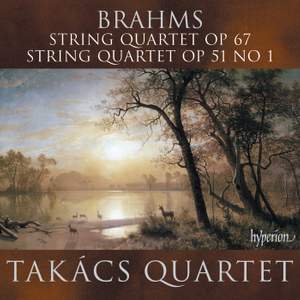
Brahms - String Quartets Nos. 1 & 3

Brahms - String Quartets Nos. 1 & 3


Brahms:

String Quartet No. 3 in B flat major, Op. 67

String Quartet No. 1 in C minor, Op. 51 No. 1


New recordings by the Takács Quartet on Hyperion have become important landmarks in the musical calendar. This second disc of Brahms string quartets looks set to repeat all the commercial and critical success of their first.

It took twenty years for the famously self-critical Brahms to release his Op 51 string quartets for publication. Despite frequent requests, they were held back until they had reached his requisite standard of perfection. It is clear that Brahms’s struggle with the string quartet medium eventually led him to find an intensely personal language for it, with an unmistakable originality of melody and texture. Op 51 No 1 is both suffused with great musical richness and organically unified, with each idea growing with unerring logic out of the last in a process of continual development, and the main subject of each movement clearly arising out of the same germ.

Having hesitated so long over his first two string quartets, Brahms managed to produce their successor, Op 67, without any protracted birth-pangs, and the fact that the new work was dedicated to a well-known physician prompted him to elaborate on the medical analogy. ‘I am’, he told Theodor Wilhelm Engelmann (the husband of the pianist Emma Brandes, and himself a keen amateur cellist) ‘publishing a string quartet, and may need a doctor for it (as with the first ones). This quartet rather resembles your wife—very dainty, but brilliant! … It’s no longer a question of a forceps delivery; but of simply standing by. There’s no cello solo in it, but such a tender viola solo that you may want to change your instrument for its sake!’

“Muscular, austere, tautly argued performances from a close-knit group.” Gramophone Magazine, December 2008

“Their approach is alert, texturally clear and passionate … these are admriable performances which I recommend to any prospective buyer … this new Takács reading weighs in at the top end of the many available versions” BBC Music Magazine

“The Takács chart the music’s undulating emotions with a compelling assuredness … playing of radiant warmth and phrasal sensitivity. Andrew Keener and Simon Eadon work wonders in capturing a warm yet articulate ambience for these physically imposing and richly detailed scores. Strongly recommended” International Record Review

“Viola to the fore in the third movement, Agitato, of No 3; and Geraldine Walther, firm-toned and assertive, rises to the occasion as the only un-muted instrumentalist here. Agitation isn't consistently maintained though because the Takács Quartet tend to ease the tension in places. Yet there is no slack in the other movements.
This close-knit group unanimously stretch or tighten the rhythm, achieving evenly matched dynamics such as the sotto voce sequences in the opening Vivace, the hushed dolce e grazioso in the recapitulation of the Andante and the stilled peace of the G flat sixth variation in the finale. Walther is well in the picture in this movement too whereas elsewhere she appears occasionally to lose focus.
Not so in No 1. Her place on the right of the ensemble is firmly assured here. The work is 'commonly held to be representative of Brahms's austerity and asceticism' (Edwin Evans), and these epithets are apposite for the Takács, spare of style and tone. The players' control over the first movement doesn't preclude a range of rubato that serves to sharpen the musical argument.
Nor does it preclude a linear drive that knits the six themes of the last movement into a coherent whole, while they do not let up on the melancholy of the middle movements, the third particularly dark. The recording is tonally credible but is widely separated.”
Gramophone Classical Music Guide, 2010

“Viola to the fore in the third movement, Agitato, of No 3; and Geraldine Walther, firm-toned and assertive, rises to the occasion as the only un-muted instrumentalist here. Agitation isn't consistently maintained though because the Takács Quartet tend to ease the tension in places. Yet there is no slack in the other movements.
This close-knit group unanimously stretch or tighten the rhythm, achieving evenly matched dynamics such as the sotto voce sequences in the opening Vivace, the hushed dolce e grazioso in the recapitulation of the Andante and the stilled peace of the G flat sixth variation in the finale. Walther is well in the picture in this movement too whereas elsewhere she appears occasionally to lose focus.
Not so in No 1. Her place on the right of the ensemble is firmly assured here. The work is 'commonly held to be representative of Brahms's austerity and asceticism' (Edwin Evans), and these epithets are apposite for the Takács, spare of style and tone. The players' control over the first movement doesn't preclude a range of rubato that serves to sharpen the musical argument.
Nor does it preclude a linear drive that knits the six themes of the last movement into a coherent whole, while they do not let up on the melancholy of the middle movements, the third particularly dark. The recording is tonally credible but is widely separated.”
Gramophone Classical Music Guide, 2010

GGramophone Awards 2009

Finalist - Chamber

Hyperion - CDA67552

(CD)

$16.75

In stock - usually despatched within 1 working day.

Brahms: String Quartets & Piano Quintet


Brahms:

String Quartet No. 1 in C minor, Op. 51 No. 1

String Quartet No. 2 in A minor, Op. 51 No. 2

String Quartet No. 3 in B flat major, Op. 67

Piano Quintet in F minor, Op. 34

Rudolf Serkin (piano)


Sony Tandem - 88697099432

(CD - 2 discs)

$12.25

In stock - usually despatched within 1 working day.

Brahms: Complete String Quartets & Clarinet Quintet

Brahms: Complete String Quartets & Clarinet Quintet


Brahms:

String Quartet No. 1 in C minor, Op. 51 No. 1

String Quartet No. 2 in A minor, Op. 51 No. 2

String Quartet No. 3 in B flat major, Op. 67

Clarinet Quintet in B minor, Op. 115

Charles Neidich (clarinet)


Brahms’ standing among the world’s greatest classical composers is confirmed by his inclusion, together with Bach and Beethoven, in the ‘Three Bs’ triumvirate. A leading figure of the Romantic period who excelled in almost every form, he was particularly renowned for his contributions to chamber music; this release details four such examples, all expertly performed by the Juilliard Quartet.

As with the symphony, Brahms was very conscious of the tradition that lay behind the genre of the string quartet, and it is said that he spent the better part of a decade working on Op.51. While No.1 is known for its gritty intensity – brilliantly captured in this recording – No.2, which looks back to Beethoven’s Op.18 through its first movement’s impeccable sonata-allegro form, was written along altogether more lyrical lines. The work presents an engaging follow-up to the experimental Third Quartet in Bb major and is wonderfully complemented by the ensuing Clarinet Quintet Op.115. Here a spirit of mellow reflection comes to the fore, providing a perfect ending to a delightful collection.

The Juilliard String Quartet is one of the longest establishd chamber ensembles, renowned for the interpretative clarity of a range of repertoire from Beethoven to Elliott Carter, and their account of these works – some of Brahms’ most famous – has been described as ‘the stuff of charismatic greatness’. Featuring exemplary playing from clarinettist Neidich, this compilation brims with colour and expression.

Recorded in the 1990s.

Last year the Juilliard Quartet received a Grammy Award for Lifetime Achievement.

Newton Classics - 8802131

(CD - 2 discs)

$16.50

Usually despatched in 2 - 3 working days.

Amsterdam Sinfonietta play Brahms & Schoenberg

Amsterdam Sinfonietta play Brahms & Schoenberg


Brahms:

String Quartet No. 1 in C minor, Op. 51 No. 1

version for string orchestra

Schoenberg:

Verklärte Nacht, Op. 4

version for string orchestra


Amsterdam Sinfonietta, Candida Thompson (artistic leader)

To illustrate the progressiveness of Brahms's harmonic style, Schönberg quoted his String Quartet opus 51 in C minor, arguing that Brahms's 'developing variation technique' and phrase structure were among the essential materials of Verklärte Nacht.

The Amsterdam Sinfonietta performs the original version of this string quartet, with the addition of a bass part created by the bass player and arranger Marijn van Prooijen.

In 1899, Arnold Schönberg wrote within three weeks the string sextet entitled Verklärte Nacht. It was inspired by Richard Dehmel's poem of the same name from Weib und Welt, a volume of poetry that caused great controversy at the time because of the sexual nature of its subject matter.

Arnold Schönberg arranged the string sextet for string orchestra in 1917 on the request of the Viennese publisher Universal Edition, and only then did the work become widely known. The composer corrected the orchestral score in 1943, adapting dynamics and tempos to increase the transparency of his arrangement. This is the version used by Amsterdam Sinfonietta in the present recording.

Amsterdam Sinfonietta occupies a unique position on the Dutch music scene as professional string orchestra. It is regularly invited to perform in concert halls throughout the world as one of the very few large-scale string ensembles on the international scene. The ensemble consists of 23 chamber musicians and its repertoire covers a variety of styles, ex tend ing from the Baroque repertoire to contemporary works. What sets Amsterdam Sinfonietta apart from the ‘regular’ chamber orchestras is the top priority it gives to a ‘chamber music mentality’.

“Fascinating to hear the Brahms String Quartet Op 51 No 1 simply transcribed for string orchestra, with a double-bass line added by Sinfonietta player Marijn van Prooijen. The Amsterdam ensemble revels in the first movement’s symphonic textures, but later movements prove less convincing...But wonders return in the closing pages, managed with exquisite delicacy.” The Times, 24th April 2011 ***

“when one gets used to the scale of the performance and its replacement of muscularity by weight in the texture, the performance works effectively in what is one of Brahms's most racked and intense minor-key works...Pairing it with an intensely neurotic account of Schoenberg's much more familiar string-orchestra version of Verklärte Nacht (originally a string sextet) certainly points up the connections between Brahms and the young Schoenberg” The Guardian, 28th April 2011 ***

“This is not a neurotic reading [of Verklärte Nacht] but it is one in which the listener is made very aware of the shivery moonlight. The incipient tonal lushness has been toned down and the resulting fragility works well” International Record Review, July 2011

“In immensely rich and refulgent surround sound, another welcome issue in the Amsterdam Sinfonietta’s series of issues documenting sensitive arrangements for fuller orchestra of great chamber music works.” london24.com, 17th June 2011

“the Amsterdam Sinfonietta's phrasing is internally supple throughout an interpretation that yields little in intensity to older, weighty recordings...some phenomenally alert responses on the part of the Amsterdam Sinfonietta and a recording quality of comparable range and depth.” Gramophone Magazine, September 2011

Super Audio CD

Format:

Hybrid Multi-channel

25% off Channel Classics

Channel - CCSSA30411

(SACD)

Normally: $16.75

Special: $12.56

Usually despatched in 4 - 5 working days.

Brahms - String Quartets Nos. 1-3

Brahms - String Quartets Nos. 1-3

The Auryn Series Vol. XVI


Brahms:

String Quartet No. 1 in C minor, Op. 51 No. 1

String Quartet No. 2 in A minor, Op. 51 No. 2

String Quartet No. 3 in B flat major, Op. 67


Brahms laboured long and hard over the composition of his string quartets but the effort paid off in abundance with resulting masterpieces of the chamber music repertoire. The Auryn Quartet were formed in 1981.They have an exclusive contract with TACET and have recorded music by Beethoven, Haydn and Britten, receiving many awards and international critical acclaim.

Tacet - The Auryn Series - TACET155

(CD - 2 discs)

$26.00

Usually despatched in 2 - 3 working days.

Brahms: String Quartets Nos. 1 & 2

Brahms: String Quartets Nos. 1 & 2


Brahms:

String Quartet No. 1 in C minor, Op. 51 No. 1

String Quartet No. 2 in A minor, Op. 51 No. 2


“The Cleveland Quartet bring tremendous clarity to Brahm's richly textured writing without sacrificing any warmth or passion. Supported by a suitably opulent recording, these performances must rank among the finest in the catalogue.” BBC Music Magazine, December 2008 *****

“You could go many a long day without encountering a more overtly romantic composer than the Brahms you meet here” Gramophone Magazine

Telarc - CD80346

(CD)

$9.75

This item is currently out of stock at the UK distributor. You may order it now but please be aware that it may be six weeks or more before it can be despatched.

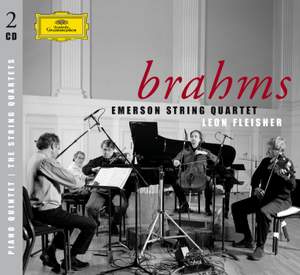
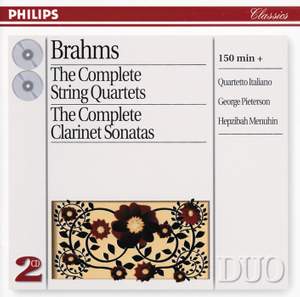
Brahms: Complete String Quartets

Brahms: Complete String Quartets


Brahms:

String Quartet No. 1 in C minor, Op. 51 No. 1

String Quartet No. 2 in A minor, Op. 51 No. 2

String Quartet No. 3 in B flat major, Op. 67

Piano Quintet in F minor, Op. 34

with Leon Fleisher (piano)


“When you have an intelligent, technically almost superhuman ensemble like the Emerson Quartet, playing with obvious feeling for the music, reservations about quartet-style fly out of the window.” BBC Music Magazine

“Technical finesse has always been a given with this group, and as ever their playing has a sureness and ease that leaves most ensembles behind. Their reading of the ebullient Third Quartet is particularly fine, with the leader imbuing the ravishing second-movement melody with teasing little portamenti. And in the finale, lyricism is combined with an infectious élan.” Gramophone Magazine, September 2007

BBC Music Magazine

Chamber Choice - June 2007

DG - 4776458

(CD - 2 discs)

$26.00

Usually despatched in 2 - 3 working days.

Brahms: String Quartet No. 1 in C minor, Op. 51 No. 1, etc.

Brahms:

String Quartet No. 1 in C minor, Op. 51 No. 1

Clarinet Quintet in B minor, Op. 115


Antoine-Pierre de Bavier (clarinet)

Vegh Quartet

(Recorded in 1949)

Archipel Records - ARPCD0287

(CD)

$8.00

Usually despatched in 2 - 3 working days.

Page: 

 1   2   3   4 

 Next >>

Copyright © 2002-13 Presto Classical Limited, all rights reserved.