All recordingsPrices shown exclude VAT. (UK tax is not payable for deliveries to United States.) See Terms & Conditions for p&p rates. | |  | Sommernachtskonzert 2013 / Summer Night Concert 2013
The Summer Night Concert of the Vienna Philharmonic is an annual open-air event that takes place in the park of Schönbrunn Palace in Vienna with the palace as a magnificent backdrop. Everyone is invited to come to this unique occasion – with free admission. Each year up to 100,000 people take up the invitation. The concert is also broadcast on TV and radio in more than 60 countries, and thus reaches an audience of millions. Classical music at the very highest level, but without barriers, accessible to everyone. In 2013 Lorin Maazel will conduct the Summer Night Concert for the first time. Swiss tenor Michael Schade joins the orchestra as guest-soloist. With this year’s program the orchestra celebrates Wagner and Verdi in honor of their anniversaries. Since 2008 the Vienna Philharmonic has provided an outstanding experience for the people of Vienna and guests to their city with this free concert in the park of Schönbrunn Palace. The palace and its Baroque park, which have UNESCO World Heritage status, are an extraordinary setting for this musical gift. In the recent years the orchestra has been conducted by Gustavo Dudamel, Valery Gergiev, Franz Welser-Möst, Daniel Barenboim and Georges Prêtre. Among the previous guest soloists: Yefim Bronfman and Benjamin Schmid. This year the concert takes place on May 30. For over five decades, Lorin Maazel has been one of the world’s most esteemed and sought-after conductors. | 
| | | In stock - usually despatched within 1 working day. |
|
|
| |  | Wagner at the OrganThe Transcriptions of Edwin Lemare
Released for the Wagner bicentenary in May 2013, the first disc by a British organist entirely devoted to Wagner, and a major contribution to the small discography of Wagner transcriptions for a solo instrument. Wagner’s major orchestral works, including the Overture to Mastersingers and Ride of the Valkyries, in virtuoso transcriptions for solo organ by Edwin Lemare. Played by Jonathan Vaughn on the 1911 Harrison and Harrison organ of St Mary Redcliffe in Bristol – regarded as one of the finest high Romantic organs ever built. Jonathan Vaughn is a former organ scholar of St John’s College, Cambridge, and is most often heard accompanying the world-class choir of Wells Cathedral in his capacity as assistant organist of the Cathedral. This debut solo recording from Jonathan Vaughn demonstrates his supreme virtuosity in powerfully dramatic repertoire, as well as the immense range of tone colour of the Redcliffe organ, and will capture the imagination of all lovers of Wagner’s music. | 
| | | In stock - usually despatched within 1 working day. |
|
|
| |  | GötterdämmerungAlfred Pringsheim's Transcriptions from Wagner's Most Famous Operas for Two Pianists
As part of the Wagner 200th birth date celebrations, Israeli/German piano duo Yaara Tal & Andreas Groethuysen release "Goetterdaemmerung - Transcriptions for two pianists from Wagner’ most famous operas" on Sony Classical. “The most impressive aspects of these transcriptions is Pringsheim's intuitive grasp of the potential of the two-piano medium and his avoidance of any amateurish over-writing...The intensity of focus and unflagging momentum Tal and Groethuysen bring to this complex score is impressive...a thoroughly enjoyable contribution to the Wagner bicentennial offerings.” International Record Review, May 2013 | 
| | | In stock - usually despatched within 1 working day. |
|
|
| |  | Wagner: Orchestral Excerpts Volume 3
Themes of love and passion dominate these orchestral excerpts from Wagner’s music dramas. The legend of Tannhäuser contrasts the sensual allure of Venus with the ideals of courtly love and religious devotion. Die Meistersinger von Nürnberg pits an inspired but rash young singer against the traditions of the old masters in a song competition, with a beautiful girl as the prize. Tristan und Isolde, based on one of the world’s great love stories, is considered Wagner’s most revolutionary work, seamlessly blending themes of love and death into a shattering apotheosis. Gerard Schwarz’s other selections of Wagner excerpts can be found on 8572767 and 8572768. “Marc is an excellent singer, thankfully free of the gusty tone production which afflicts too many Wagnerian sopranos today. She sings with expressiveness, delicacy and a real feeling for the text” MusicWeb International, October 2012 | | | (also available to download from $6.00) | In stock - usually despatched within 1 working day. |
|
|
| |  | Wagner: Orchestral Highlights
“There is not one performance on this set that is less than eloquent. It is plain from these recordings that Klemperer is a great Wagner conductor, probably the greatest in the world.” Gramophone Magazine | | | In stock - usually despatched within 1 working day. |
|
|
| |  | Birgit Nilsson sings Wagner
Wagner: | Schlafst du, Gast? Ich bin's! (from Die Walküre) Helge Brilioth (Siegmund) Orchestra of the Royal Opera House, Covent Garden, Leif Segerstam Dies alles – hab’ ich nun geträumt? (from Parsifal) Helge Brilioth (Parsifal), Norman Bailey (Amfortas) Orchestra of the Royal Opera House, Covent Garden, Leif Segerstam Gerechter Gott! (from Rienzi) London Symphony Orchestra, Sir Colin Davis Johohoe! Traft ihr das Schiff im Meere an 'Senta's Ballad' (from Der fliegende Holländer) The John Alldis Choir & London Symphony Orchestra, Sir Colin Davis Weh mir, so nah (from Die Feen) London Symphony Orchestra, Sir Colin Davis Wesendonck-Lieder (5) London Symphony Orchestra, Sir Colin Davis Tristan und Isolde: Prelude to Act 1 Wiener Philharmoniker, Hans Knappertsbusch Wie lachend sie mir Lieder singen (from Tristan und Isolde) Grace Hoffmann (Brangäne) Wiener Philharmoniker, Hans Knappertsbusch Tristan und Isolde: Prelude & Liebestod Wiener Philharmoniker, Hans Knappertsbusch |
Birgit Nilsson. Richard Wagner. It was an operatic marriage made in heaven that lasted for over twenty years and, thanks to recordings, continues to thrill music lovers around the world. She sang her first Wagnerian part in Stockholm. It was Senta in Der fliegende Holländer. It was greeted rapturously and throughout her long career it was for her Wagner and Strauss roles that she was most noted. Many of the greatest recordings of music dramas and operas by these composers have featured her, and many appear on Decca. However, she also made two Wagner records for Philips – one with Leif Segerstam in 1974 of extended scenes from Walküre and Parsifal, another, in 1972, with Colin Davis of the Wesendonck-Lieder and extracts from Der fliegende Holländer, Rienzi and the little-known early Wagner opera, Die Feen (The Fairies). Also included are scenes from Tristan und Isolde, one of her great calling cards and of which she made at least two live recordings, one studio recording with Georg Solti, and another of scenes (with Grace Hoffman as Brangäne) with Hans Knappertsbusch. Nilsson’s voice had the clear, silvery sound that seems to be characteristic of Scandinavian singers. It was rock solid, encompassed over two octaves, and was perfectly even, top to bottom. It was also enormous. Especially in the upper part of the voice it could take on a laser-like quality that simply sliced through the densest orchestral sound and speared listeners to the backs of their seats. That meant the great moments of a Wagnerian opera were truly monumental – a surging orchestra and a soprano who dominated everything, combined into an overwhelming climax as Wagner must have heard in his dreams. Here is a snapshot of some of those great moments, captured on record, and bringing together three complete LPs – two made for Philips (Segerstam, Davis) and one for Decca (Knappertsbusch). “Her Kundry, in the most crucial scene of the opera, is lulling, sensuous, the menace more sinister because it is not revealed in any hardness of tone or phrasing … It is an immensely subtle performance, a proper reconciliation of great vocal gifts with an intelligent understanding of the most difficult moment of the most difficult of all operas. […] a showpiece for Miss Nilsson's great powers” Gramophone Magazine (Parsifal, Walküre) “Even allowing for the fact that these were demonstration records when they first appeared, the sound on this CD is astonishing in its lifelike presence and its warmth. As nobody has surpassed Knappertsbusch to this day as a Wagner conductor in the inevitable sweep and grandeur of his direction […] What glorious singing Nilsson gives us; full throated in the great passage, “O blinde Augen!”, which she ends with an electrifying top B natural, producing another (no mere glancing at the note) on "lacht" just before her thrilling singing of the curse.” Gramophone Magazine (Tristan und Isolde) | | | In stock - usually despatched within 1 working day. |
|
|
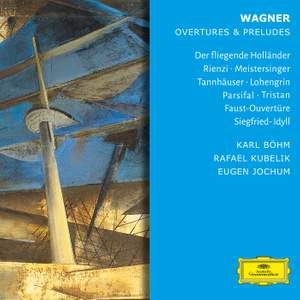
| |  | Wagner: Overtures & Preludes
| | | In stock - usually despatched within 1 working day. |
|
|
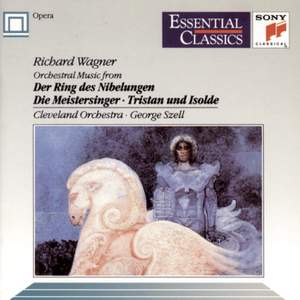
| |  | Wagner - Orchestral Favourites from the operas
| | | In stock - usually despatched within 1 working day. |
|
|
| |  | Leopold Stokowski conducts
This historical recording has been remastered from the original tapes and illustrates Stokowski’s advocacy for “New Music.” “Adroit advocacy for new music on Disc 1 coupled with performances of 19th-century works that are so elaborately inflected and hyper-glamorous as to leave the German orchestra in near disarray.” BBC Music Magazine, December 2009 | | | (also available to download from $21.75) | In stock - usually despatched within 1 working day. |
|
|
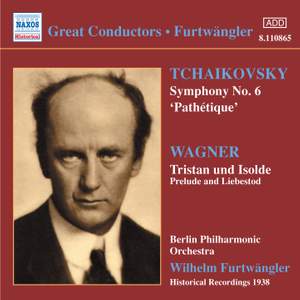
| |  |
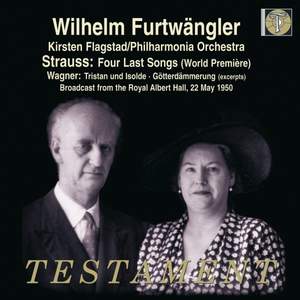
“Furtwängler is in incandescent form in the Tristan excerpts, and even more so in the Dawn and Rhine Journey from Act 1 of Götterdämmerung. The music whizzes along with the most virtuoso contributions possible from the recently formed Philharmonia, the horns, headed by Dennis and Aubrey Brain, very much to the fore. Flagstad then sings the Immolation with quite wonderful freshness and conviction... The Tristan Prelude and Liebestod offer a similar frisson. Has the Prelude ever sounded so impassioned and urgent as here? Did Flagstad... ever convey so much tragic passion?” Gramophone Magazine, June 2007 “The world premiere of Four Last Songs in its best transfer ever, plus some previously unissued Wagner from the same concert.” BBC Music Magazine, September 2007 ***** “The urgency and purity of Flagstad's singing in these live recordings, made at the Royal Albert Hall in May 1950, bear witness to her extraordinary qualities, defying age - as indeed Wilhelm Furtwangler does in his radiant conducting” Penguin Guide, 2010 edition */** “Here's a live recording of the concert in 1950 when Flagstad gave the premiere of Strauss's Four Last Songs, followed by some truly unforgettable Wagner; yet it's the latter that makes the CD so exciting. Flagstad and Furtwängler had several collaborations in these Wagnerian excerpts, but caught live in very reasonable sound they produce performances that lift one out of one's seat. Furtwängler is in incandescent form in the Tristan excerpts, and even more so in the Dawn and Rhine Journey from Act 1 of Götterdämmerung. The music whizzes along with the most virtuoso contributions possible from the recently formed Philharmonia, the horns, headed by Dennis and Aubrey Brain, very much to the fore. Flagstad then sings the Immolation with quite wonderful freshness and conviction, and this at the end of a longish programme. The results are to invoke thetingle factor. It is worth mentioning that the pair had just been giving Ring cycles at La Scala and seem entirely at one in their readings. The Tristan Prelude and Liebestod offer a similar frisson. Has the Prelude ever sounded so impassioned and urgent as here? Did Flagstad, in her numerous recordings of the Liebestod, ever convey so much tragic passion? Probably not, and she is in much better voice than in the complete 1952 set. The performance of the Strauss, previously available on the 'grey market', is now heard in improved sound; but Flagstad, for all the richness of her singing, gives a fairly generalised interpretation compared with many that were to follow, and the conductor was never the greatest of Straussians. Still, as a historic document this is an important issue. The whole disc, carefully remastered, is a treasure.” Gramophone Classical Music Guide, 2010 | | | In stock - usually despatched within 1 working day. |
|
|
| |
|