All recordingsPrices shown exclude VAT. (UK tax is not payable for deliveries to United States.) See Terms & Conditions for p&p rates. | |  | The Very Best of Mirella Freni
Mirella Freni was one of Herbert von Karajan’s favourite singers; indeed, he is known to have commented that if he could have any voice in the world, it would be hers. Combining a stunning voice with heartfelt acting, Freni is equally at home in the lighter roles, such as Mozart’s Susanna and Zerlina, as in the weightier roles of Puccini’s Manon Lescaut and Tosca. This collection brings together arias from throughout Freni’s illustrious career. | 
| | | In stock - usually despatched within 1 working day. |
|
|
| |  | Puccini: Opera Arias
“Everything Gheorghiu achieves here is technically assured, thought through and emotionally rewarding. This is a deeply satisfying traversal of the Puccini canon.” Gramophone Magazine | | | In stock - usually despatched within 1 working day. |
|
|
| |  | Puccini ≡ Passion
Cheryl Barker first broke the hearts of audiences worldwide as Mimì in Baz Luhrman’s imaginative production of La bohème. In Puccini ≡ Passion the radiant Australian soprano delivers beguiling performances in a panoply of Puccini’s heroines in favourite arias, accompanied by the State Orchestra of Victoria under the baton of Richard Bonynge. Opera expert Rodney Milnes comments in the booklet: “Puccini famously liked to write about "little women", but he gave them "big" music, which is one thing that makes Cheryl Barker so ideal an interpreter of his soprano roles ... her lyric soprano, with an indefinably sweet vibrancy built in to the tone, adds immeasurably to her appeal. With that vibrancy comes a sense of vulnerability, which helps her bring the characters alive in both vocal and dramatic terms ... This most welcome disc allows her to present an overview of Puccini's women from the very beginning.” Issued for the first time on SACD, this disc is for all lovers of Puccini, encompassing his most popular soprano arias from Manon Lescaut, Tosca, La bohème and Madama Butterfly, one of Barker’s favourite roles, as well as arias from Le Villi, Edgar, La rondine, Suor Angelica, Gianni Schicci and Turandot. Barker ends with two little known treasures, the folksong-like ‘E l’uccellino’, and ‘Sole e amore’, an 1888 song whose melody Puccini later re-used in La bohème. And in a departure from his usual repertoire Richard Bonynge brings fresh imagination and sparkle to Puccini’s masterful orchestral palette. Cheryl Barker’s most recent CD, also for Melba and released in 2011, was Pure Diva (MR301129), a very personal tribute to her teacher and fellow Australian soprano, the great Dame Joan Hammond. | | | In stock - usually despatched within 1 working day. |
|
|
| |  | The Callas Effect (Deluxe Edition)2CD / 1DVD
Bellini: | Casta Diva (from Norma) Col sorriso d'innocenza (from Il Pirata) | Bizet: | L'amour est un oiseau rebelle 'Habanera' (from Carmen) Carreau! Pique! La mort! (from Carmen) | Catalani: | Ebben? Ne andrò lontana (from La Wally) | Delibes: | Où va la jeune Indoue? 'Bell Song' (from Lakmé) | Giordano, U: | La mamma morta (from Andrea Chénier) | Gluck: | Divinités du Styx (from Alceste) | Gounod: | Ah! Je ris de me voir (from Faust) | Mozart: | In quali eccessi ... Mi tradì quell'alma ingrate (from Don Giovanni) | Ponchielli: | Suicidio! (from La Gioconda) | Puccini: | O mio babbino caro (from Gianni Schicchi) Si, mi chiamano Mimi (from La Bohème) In questa reggia (from Turandot) Vissi d'arte (from Tosca) Un bel di vedremo (from Madama Butterfly) Senza mamma, o bimbo (from Suor Angelica) Sola, perduta, abbandonata (from Manon Lescaut) | Rossini: | Una voce poco fa (from Il barbiere di Siviglia) | Saint-Saëns: | Amour, viens aider ma faiblesse (Samson et Dalila) | Thomas, Ambroise: | Ah, pour ce soir...Je suis Titania (from Mignon) | Verdi: | Mercè, dilette amiche 'Bolero' (from I Vespri Siciliani) Caro nome (from Rigoletto) Ah, fors'è lui che l'anima (from La Traviata) La luce langue (from Macbeth) D'amor sull'ali rosee (from Il Trovatore) Surta è la notte...Ernani! Ernani, involami (from Ernani) Ritorna vincitor! (from Aida) Tu che la vanità (from Don Carlo) |
DVD 'The Callas Effect' 1. Introduction 2. Humble Beginnings 3. The New Star 4. Norma at Covent Garden 5. Records and Romance 6. La Traviata 7. Il Trovatore 8. Bringing drama to the opera stage: Tosca 9. Concerts 10. Audience Response 11. High Society and Fashion 12. Losing Voice 13. 'Sola, perduta, abbandonata' 14. The Callas Effect today 15. Conclusion
Maria Callas is the ultimate and original diva. Widely regarded as the greatest Opera singer and performer of all time whose life, voice and performances have intrigued, thrilled and inspired all others. Maria Callas 34 years after her death Maria Callas remains the definition of a diva. She is not only the world's bestselling soprano but also EMI Classic's bestselling artist of all time. Widely regarded for her intense characterisation and unique interpretations she has become a cultural icon whose music and life continues to influence today. “Her reputation, extremely high when she died, has become ever greater in the years since her death. As a personality she remains controversial, but as an artist hardly at all: her genius is recognised as supreme by virtually all opera lovers, indeed it is often from listening to her many recordings that people discover what an incredibly potent art form opera can be.” BBC Music Magazine The Music This wonderfully constructed 2CD collection of opera arias highlights Callas’s spectacular climb to fame tracking her move from innocent young woman to the tragic heroine in her later years through the opera arias she recorded. Featuring the most special and exquisitely interpreted arias of her output this collection brings together such opera favourites as O mio babbino caro, Vissi d’arte and Casta diva. Callas’s recordings have featured prominently in many critically acclaimed movies including Academy Award winner Philadelphia and Academy Award Nominated Milk Callas is the immortal diva whose music transcends time and sounds as unique and inspired today. Many noted musicians have quoted Callas as a musical influence including Linda Ronstadt, Patti Smith, Emmylou Harris, Celine Dion, Jason Mraz and Rufus Wainwright. Documentary EMI Classics has made The Callas Effect because there are powerful first-hand accounts that have not before been revealed of how and why Callas has exerted a unique and extraordinary effect – on other celebrity opera singers, on distinguished stage directors, on actors and actresses, on backstage theatre crews, on recording staff, on impresarios, on audiences who queued up for days and nights to see her, and now on young music-lovers who are captivated by her CDs and DVDs. People from all these walks of life, newly captured just for this memoir and including some who personally knew her, are the passionate witnesses of Maria Callas’s genius in The Callas Effect, which also includes extracts from her performances, recordings and interviews. “memorable artistry is evident everywhere - utterly exemplary in its musical intelligence, stirring in its interpretative eloquence. The technique dazzles in marvellously expressive trills...and everywhere, of course, the uniquely penetrating dramatic involvement.” International Record Review, January 2012 “This makes a good Callas set for beginners. It contains arias that showcase a good section of her most successful repertoire and it captures her voice at its best.Exactly when it is captured remains a mystery, however: the set’s main problem for pre-existing fans and aficionados is that, while it contains information about where and with whom each track was recorded, we are not given any dates.” MusicWeb International, January 2012 | | | In stock - usually despatched within 1 working day. |
|
|
| |  | The Callas Effect (Experience Edition)
Bellini: | Casta Diva (from Norma) Col sorriso d'innocenza (from Il Pirata) | Bizet: | L'amour est un oiseau rebelle 'Habanera' (from Carmen) Carreau! Pique! La mort! (from Carmen) | Catalani: | Ebben? Ne andrò lontana (from La Wally) | Delibes: | Où va la jeune Indoue? 'Bell Song' (from Lakmé) | Giordano, U: | La mamma morta (from Andrea Chénier) | Gluck: | Divinités du Styx (from Alceste) | Gounod: | Ah! Je ris de me voir (from Faust) | Mozart: | In quali eccessi ... Mi tradì quell'alma ingrate (from Don Giovanni) | Ponchielli: | Suicidio! (from La Gioconda) | Puccini: | O mio babbino caro (from Gianni Schicchi) Si, mi chiamano Mimi (from La Bohème) In questa reggia (from Turandot) Vissi d'arte (from Tosca) Un bel di vedremo (from Madama Butterfly) Senza mamma, o bimbo (from Suor Angelica) Sola, perduta, abbandonata (from Manon Lescaut) | Rossini: | Una voce poco fa (from Il barbiere di Siviglia) | Saint-Saëns: | Amour, viens aider ma faiblesse (Samson et Dalila) | Thomas, Ambroise: | Ah, pour ce soir...Je suis Titania (from Mignon) | Verdi: | Mercè, dilette amiche 'Bolero' (from I Vespri Siciliani) Caro nome (from Rigoletto) Ah, fors'è lui che l'anima (from La Traviata) La luce langue (from Macbeth) D'amor sull'ali rosee (from Il Trovatore) Surta è la notte...Ernani! Ernani, involami (from Ernani) Ritorna vincitor! (from Aida) Tu che la vanità (from Don Carlo) |
This wonderfully constructed 2CD collection of opera arias highlights Callas’s spectacular climb to fame tracking her move from innocent young woman to the tragic heroine in her later years through the opera arias she recorded. Featuring the most special and exquisitely interpreted arias of her output this collection brings together such opera favourites as O mio babbino caro, Vissi d’arte and Casta diva. “memorable artistry is evident everywhere - utterly exemplary in its musical intelligence, stirring in its interpretative eloquence. The technique dazzles in marvellously expressive trills...and everywhere, of course, the uniquely penetrating dramatic involvement.” International Record Review, January 2012 | | | In stock - usually despatched within 1 working day. |
|
|
| |  | Karine Babajanyan – Puccini Arias
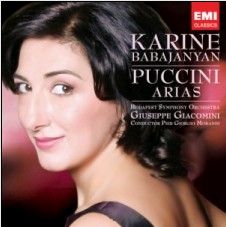
Armenian soprano Karine Babajanyan has made an international impact as Cio-Cio San in numerous Madama Butterfly productions and is one of today's outstanding performers of Puccini’s divas. “Karine Babajanyan succeeds not only acting wise but also gives us a musically complex portrayal of the title heroin...” the press wrote about her debut at the Opera House Graz as Cio-Cio-San, a role she has since performed at the New National Theatre Tokyo, the Hamburg State Opera, the Opera House Frankfurt, the State Theatres of Saarbrucken and Wiesbaden, and at the Stuttgart State Opera. Karine Babajanyan began her musical education with piano lessons at the age of seven and continued with singing and choir direction studies at the Erivan City Conservatory, graduating with distinction. After participating in master classes in Italy the young artist returned to her native country. Here, she received her first engagement at the Armenian National Opera. The versatile artist is hailed by both the press and the public for her “…warm-timbred, youthful dramatic voice…” in all the important roles of her repertoire e.g. the Contessa in ‘Le nozze di Figaro’, Fiordiligi in ‘Cosi fan tutte’, Mimi in ‘La Bohéme’, Leonora in ‘Il Trovatore’, just to name a few. In 2007 the attractive soprano made her widely noticed debut as Tosca at the Bregenz Festival in Austria – seen by cinema-goers worldwide in the opera scene in the James Bond film ‘Quantum Of Solace’. Further guest performances took Karine to the Aalto Theatre in Essen, the Mannheim National Theatre, to Bern, Basle, Oslo, Dorset and Mexico, where she keeps celebrating triumphs in roles such as Tatjana (Eugen Onegin), Norma, Leonora (La forza del destino), Maria (Mazeppa)‚ Maddalena (Andrea Chénier) and the press comments “not only is her voice true, powerful and beautiful, but she has that natural presence with which only few are blessed”. “There was great excitement at the British debut of Armenian soprano Karine Babajanyan in the title role, and she fully satisfied the anticipation. She has attracted rave reviews in Germany, Switzerland and Israel, and local audiences were indeed fortunate to see this remarkable singer so early in her career. Not only is her voice true, powerful and beautiful, but she has that natural presence with which only few are blessed, and her performance was magnetic” Blackmore Vale Magazine on Karine Babajanyan’s UK debut in Norma with Dorset Opera “Her technique sounds rock solid and her musical instincts are unerring. The surprise of the disc is the excellent condition of the 68-year-old Giuseppe Giacomini in the Butterfly and Manon Lescaut duets. He rounds off with a ringing Nessun dorma that puts most tenors half his age to shame.” Sunday Times, 5th April 2009 *** “Thanks partly to her appearance in the opera scene in Quantum of Solace, the Armenian soprano Karine Babajanyan is reaching a wide audience. Her appearance as Tosca is echoed here in a stirring "Vissi D'Arte", while her experience as Cio-Cio San comes through in the Butterfly arias "Un Bel Di, Vedremo" and the duet "Bimba Dagli Occhi Pieni Di Malia"; her partner in that, Giuseppe Giacomini, gets a showcase in "Nessun Dorma".” The Independent, 27th March 2009 *** | | | In stock - usually despatched within 1 working day. |
|
|
| |  | Puccini’s Heroines
“The clamorous reception given by the MET audience echoed my approbation; she is a finished glorious artist with a big divinely beautiful voice and a superior understanding of style, timing, and emotion… A tall, extremely pretty women, Diener also has a quality I find quite rare on today's opera stages: dignity. She radiated effortless and dignified self-possession that rendered important and touching actions that too often can seem to be only meaningless capers. I long to hear her again in anything she cares to sing.” Classical Singer | | | In stock - usually despatched within 1 working day. |
|
|
| |  | The Essential PucciniFamous arias & duets
Puccini: | Che gelida manina (from La Bohème) Carlo Bergonzi (tenor) Si, mi chiamano Mimi (from La Bohème) Carlo Bergonzi (tenor), Cesare Siepi (bass), Ettore Bastianini (baritone), Renata Tebaldi (soprano), Renato Cesari (bass) O soave fanciulla (from La Bohème) Carlo Bergonzi (tenor), Ettore Bastianini (baritone) Quando me'n vo (from La Bohème) Ettore Bastianini (baritone), Fernando Corena (bass), Gianna d' Angelo (soprano), Renata Tebaldi (soprano) In un Coupe?...O Mimi, tu piu non torni (from La Bohème) Carlo Bergonzi (tenor), Ettore Bastianini (baritone) O mio babbino caro (from Gianni Schicchi) Renata Tebaldi (soprano) Ch'ella mi creda libero e lontano (from La Fanciulla del West) Jussi Björling (tenor) Senza mamma, o bimbo (from Suor Angelica) Maria Chiara (soprano) Viene la sera (from Madama Butterfly) Carlo Bergonzi (tenor), Renata Tebaldi (soprano), Fiorenza Cossotto (mezzo) Un bel di vedremo (from Madama Butterfly) Renata Tebaldi (soprano) Una nave da guerra...Scuoti quelle fronda (from Madama Butterfly) Renata Tebaldi (soprano), Fiorenza Cossotto (mezzo) Humming Chorus (from Madama Butterfly) Con onor muore (from Madama Butterfly) Carlo Bergonzi (tenor), Renata Tebaldi (soprano) Preludio Sinfonico Donna non vidi mai (from Manon Lescaut) José Carreras (tenor) In quelle trine morbide (from Manon Lescaut) Kiri Te Kanawa (soprano) Oh, sarò la più bella...Tu, tu, amore? (from Manon Lescaut) Kiri Te Kanawa (soprano), José Carreras (tenor) Mario! Mario! Mario! ...Son qui! ... Mia gelosa! (from Tosca) Luciano Pavarotti (tenor), Mirella Freni (soprano) Tre sbirri...Una carozza...Presto 'Te Deum' (from Tosca) Michel Sénéchal (tenor), Sherrill Milnes (baritone) Vissi d'arte (from Tosca) Mirella Freni (soprano) E lucevan le stelle (from Tosca) Luciano Pavarotti (tenor) Chi il bel sogno di Doretta (from La Rondine) Renata Tebaldi (soprano) Signore, ascolta! (from Turandot) Montserrat Caballé (soprano) Non piangere, Liù! (from Turandot) Luciano Pavarotti (tenor), Montserrat Caballé (soprano) Ah! Per l'ultima volta (from Turandot) Luciano Pavarotti (tenor), Montserrat Caballé (soprano) In questa reggia (from Turandot) Joan Sutherland (soprano), Luciano Pavarotti (tenor) Nessun dorma (from Turandot) Luciano Pavarotti (tenor) Tosca: Santa ampolle Recondita armonia (from Tosca) |
| | | (Sorry, download not available in your country) | In stock - usually despatched within 1 working day. |
|
|
| |  | Kiri Te Kanawa - Greatest HitsSelected vocal works including 'Senza mamma', 'Depuis le jour' and more
| | | In stock - usually despatched within 1 working day. |
|
|
| |  | Mirella Freni: The First Recitals 1959-1961
Bellini: | Ah! Se una volta sola (from La Sonnambula) Münchner Rundfunkorchester, Ino Savini Eccomi in lieta vesta...Oh! quante volte (from I Capuleti e I Montecchi) Münchner Rundfunkorchester, Ino Savini | Bizet: | Je dis que rien ne m'épouvante (from Carmen) sung in Italian (as 'Io dico, no, non son paurosa') with preceding recitative Münchner Rundfunkorchester, Ino Savini | Mascagni: | Son pochi fiori (from L'Amico Fritz) Münchner Rundfunkorchester, Ino Savini | Puccini: | Senza mamma, o bimbo (from Suor Angelica) Münchner Rundfunkorchester, Ino Savini O mio babbino caro (from Gianni Schicchi) Münchner Rundfunkorchester, Ino Savini Si, mi chiamano Mimi (from La Bohème) Orchester der Wiener Volksoper, Argeo Quadri O soave fanciulla (from La Bohème) Viktor Remsey (tenor) Orchester der Wiener Volksoper, Argeo Quadri Donde lieta usci (from La Bohème) Orchester der Wiener Volksoper, Argeo Quadri Signore, ascolta! (from Turandot) Orchester der Wiener Volksoper, Argeo Quadri Tu che di gel sei cinta (from Turandot) Orchester der Wiener Volksoper, Argeo Quadri Viene la sera (from Madama Butterfly) Gino del Ferro (tenor) Orchester der Wiener Volksoper, Argeo Quadri | Verdi: | Sul fil d'un soffio etesio (from Falstaff) Münchner Rundfunkorchester, Ino Savini |
The first of these solo recitals (1959) is with the orchestra of the Bavarian State Opera, conducted by Savini.The second with the Vienna’ s Volksoper orchestra,devoted to Puccini, is taken from a very rare LP and is released on CD for the first time in its entirety. | | | Usually despatched in 2 - 3 working days. |
|
|
| |
|