Prices shown exclude VAT. (UK tax is not payable for deliveries to United States.) See Terms & Conditions for p&p rates. | |  |
“Communion, musical and spiritual, is what this intensely beautiful Karajan set provides. The playing of the Berlin Orchestra is consistently beautiful, near to the atmospheric ideal. A superb achievement.” Penguin Guide “...in its glowing beauty, Karajan's Parsifal comes closest to the ideal of Schopenhauerian or Buddhist renunciation of will that the opera itself may strive towards.” Gramophone Magazine, May 2010 “In most respects this is the most perfect, atmospheric Parsifal yet committed to disc or cassette. Admitting the vocal imperfections, few as they are, the set attempts an artistic, or at least technical superiority which it fairly achieves.” Gramophone Magazine, 1981 “Karajan's Parsifal seems to grow in stature as an interpretation on each rehearing; on its CD transfer it appears to have acquired a new depth, in terms of sound, because of the greater range of the recording and the greater presence of both singers and orchestra. As in practically all cases, CD offers a more immediate experience. Karajan's reading, a trifle stodgy in Act 1, grows in intensity and feeling with the work itself, reaching an almost terrifying force in the Prelude to Act 3 which is sustained to the end of the opera. Moll's Gurnemanz is a deeply expressive, softly moulded performance of notable beauty. Vejzovic, carefully nurtured by Karajan, gives the performance of her life as Kundry. Hofmann's tone isn't at all times as steady as a Parsifal's should be, but he depicts the character's anguish and eventual serenity in his sincere, inward interpretation. Van Dam is a trifle too placid as Amfortas, but his singing exhibits admirable power and fine steadiness. Nimsgern is the epitome of malice as Klingsor. The choral singing doesn't have quite the confidence of the superb orchestral playing, which has both qualities of Keats's imagining of beauty and truth in abundance.” Gramophone Classical Music Guide, 2010 | | | In stock - usually despatched within 1 working day. |
|
|
| |  |
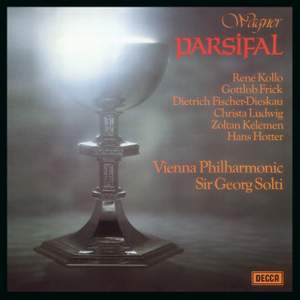
“The evenness of the cast is a strong asset here...Ludwig's is the most securely and warmly sung Kundry on any version, CD or LP, and achieves all the agonized feeling and crazed passion of her rivals without any resort to vocal exaggeration...Fischer-Dieskau expresses, as one would expect, every aspect of Amfortas's tortured soul and mind” Gramophone Magazine, September 1986 “Solti's singing cast could hardly be stronger, every one of them pointing words with fine, illuminating care for detail; and the complex balances of sound, not least in the Good Friday Music, are beautifully caught” Penguin Guide, 2010 *** | | | In stock - usually despatched within 1 working day. |
|
|
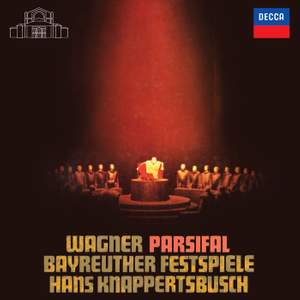
| |  | This performance was recorded in the Festspielhaus, Bayreuth, in 1961.
| | | Usually despatched in 2 - 3 working days. |
|
|
| |  |
Falk Struckmann (Amfortas), Klaus Florian Vogt (Parsifal), Ante Jerkunica (Titurel), Robert Holl (Gurnemanz), Krister St. Hill (Klingsor), Katarina Dalayman (Kundry), Brenden Gunnell (Erster Gralsritter), Thilo Dahlmann (Zweiter Gralsritter), Julia Westendorp (Erster Knappe), Cécile van de Sant (Zweiter Knappe), Jeroen de Vaal (Dritter Knappe), Pascal Pittie (Vierter Knappe) & Anna Stephany (Eine Stimme von oben) Netherlands Radio Philharmonic Orchestra, Netherlands Radio Choir & State Male Choir "Latvija", Jaap van Zweden HYBRID SACD4+DVD This live recording of Wagner’s opera Parsifal comes from a memorable concert that took place in the Concertgebouw in Amsterdam in December 2010. It is performed by the Netherlands Radio Philharmonic Orchestra, Netherlands Radio Choir and conductor Jaap van Zweden. The cast includes tenor Klaus Florian Vogt in the title role, celebrated bass Robert Holl as Gurnemanz, bassbaritone Falk Struckmann as Amfortas, and soprano Katarina Dalayman as Kundry. The set also includes a bonus DVD featuring video footage of highlights from the performance. Although first conceived in 1857, Parsifal ended up being Wagner’s last opera production at Bayreuth in 1882. The story is loosely based on the legend of the Arthurian knight Sir Percival and his quest for the Holy Grail. Born in Amsterdam in 1960, Jaap Van Zweden began his musical career as a violinist, becoming at 19 the youngest ever concertmaster of the Royal Concertgebouw Orchestra. In 1997, van Zweden made the decision to conduct full time, and was named the chief conductor of the Netherlands Symphony Orchestra where he remained until 2003. In 2000, he added the music directorship of the Residentie Orchestra of The Hague to his credits, a post he held until 2005. Jaap van Zweden began his third season as music director of the Dallas Symphony Orchestra last year. His commitment to the orchestra was recently extended through the 2015-16 season. “[the] string playing in the Act III prelude is world-class in its depth of beauty of tone and emotional intensity...the Dutchman Robert Holl is probably the great Gurnemanz of our time, declaiming every word with feeling and singing gloriously for a man with a 40-year career behind him. Kundry is probably Katarina Dalayman’s most congenial Wagner role, feminine and voluptuous but with a high C to make you sit up in your seat.” Sunday Times, 7th August 2011 **** “This new recording of Wagner's last work is in most respects very fine...Perhaps the main glory here is the superb playing of the Netherlands Radio Philharmonic Orchestra. It responds to every demand of the score, under the inspiring baton of Jaap van Zweden, who seems to be the ideal man to conduct this incredible score...He has a mainly good set of soloists, with the veteran Robert Holl as a strong, moving Gurnemanz” BBC Music Magazine, November 2011 **** “It's hard to describe this live recording without descending into hyperbole...Jaap van Zweden retains magisterial control over the epic sweep of the piece. A uniformly excellent cast are on top form too: Klaus Florian Vogt (Parsifal) is powerful, shining and easy of voice, and he's matched by Katarina Dalayman (Kundry) on fiery form and the superb Robert Holl (Gurnemanz). Wagner performances don't often come more intense, epic or beautiful than this” Classic FM Magazine, November 2011 ***** “It's obvious that [van Zweden] has consciously opted to play down the story's pomp and stress the piety...We get playing of amazing warmth - a soothing bath of sound that implies godliness, devotion and tranquillity...[Holl's Gurnemanz] is a wonder of wisdom and insights...[Dalayman's] Kundry is a towering performance. Falk Struckmann's Amfortas is a truly damaged soul, his anguish the work of a truly great singing actor” International Record Review, November 2011 “This set is, I presume, the result of a single, concert-hall performance...Katarina Dalayman, Falk Struckmann and Klaus Florian Vogt do much to transcend the performance's oratorio-like ambience...the combined forces of the Netherlands Radio Choir and Latvian State Male Choir bring an appropriate weight of tone to a performance that certainly can't be accused of skating blithely over the great work's surface.” Gramophone Magazine, December 2011 | | | Usually despatched in 4 - 5 working days. |
|
|
| |  |
| | | Usually despatched in 4 - 5 working days. |
|
|
| |  |
This performance with the Choir and Orchestra of the Bayreuth Festspiele was recorded at Bayreuth in 1960. | | | Usually despatched in 2 - 3 working days. |
|
|
| |  |
DSD Recording, Mariinsky Concert Hall, St Petersburg, 5–13 June 2009. The Mariinsky label’s first recording of an opera by Wagner features an exceptional international cast led by René Pape, Gary Lehman and Violeta Urmana. The Mariinsky Theatre has a long association with Wagner’s music. The composer himself conducted at the Theatre, which in 1863 was the location of the first performance of music from his as yet unstaged Ring Cycle. Over the past decade Valery Gergiev has become a frequent conductor of Wagner’s operas, establishing a formidable reputation in the repertoire, although remarkably this is his first recording of the composer’s operas. Wagner described his final complete opera as a ‘A Festival Play for the Consecration of the Stage’ and the work has always sparked controversy, mixing moral and religious themes with music of irresistible sumptuousness. The opera was inspired by Wolfram von Eschenbach’s Arthurian poem Parzifal. Yet despite the story’s overt Christian imagery, Wagner also draws on ideas from other beliefs including Buddhism. The ‘harmonic experiments’ that he adopted for his previous opera Tristan und Isolde are further refined to create music of astonishing beauty that still retains and reflects the deep morality of the tale. Recording took place between 5 and 13 June 2009 at the Mariinsky Concert Hall in St Petersburg, incorporating live concert performances. It was recorded in high resolution multi-channel DSD by award-winning producer James Mallinson and engineered by John Newton and Dirk Sobotka. Parsifal will be the fourth opera on the Mariinsky label. Previous releases have included Shostakovich’s The Nose, Shchedrin’s The Enchanted Wanderer and Stravinsky’s Oedipus Rex, which have collected numerous international awards. The Nose, the label’s debut release, also received two Grammy Award nominations. Sung in German, Notes in Russian (cyrillic), English, French and German. Libretto in German with Russian (cyrillic), English & French translations. “Above all, this is Gergiev's Parsifal and it is the superlatively good playing of the Mariinsky Orchestra that, with René Pape's gloriously sung Gurnemanz, makes this new set essential listening for Wagnerians” Hugh Canning , IRR September “The great strengths of his performances in the theatre here underpin at least one remarkable performance: René Pape's outstanding Gurnemanz. Gary Lehman's Parsifal is competent, while Violeta Urmana's Kundry mixes thrilling moments with unstable ones. Gergiev's conducting is more than sufficient compensation for those minor shortcomings, though.” The Guardian, 26th August 2010 ***** “What really distinguishes this...is Gergiev. His reading is vivid and luminous, generally expansive but with fluidly shifting tempos, unashamedly guilty of theatrical excitement. Yet he evokes a rapt quality which does convey an authentic spirituality - passionate 'Russian soul', perhaps, rather than sombre Germanic brooding, but if so, so much the better.” BBC Music Magazine, October 2010 ***** “... it’s for René Pape’s majestic Gurnemanz that Wagnerites will want this set. Violeta Urmana’s Kundry is unexpectedly voluptuous, while Gary Lehman makes a conscientious Parsifal...sceptics should be won over by the way his wonderful orchestra and chorus bring Wagner’s problematic swansong to life.” Financial Times **** “Above all, this is Gergiev's Parsifal and it is the superlatively good playing of the Mariinsky Orchestra that, with Pape's gloriously sung Gurnemanz, makes this new set essential listening for Wagnerians...[Pape's] beautifully rounded tone and poetic diction make musical highlights of his long monologues” International Record Review, September 2010 “His approach is vigorously dramatic and red-blooded, treating this massive score as an urgent call to arms rather than a dreamy meditation. The Mariinsky Orchestra plays with glowing commitment throughout...Lehman is an agreeably youthful Parsifal, bright in voice and clear in diction...Evgeny Nikitin and Nikolai Putilin bring a distinctively Russian intonation to Amfortas and Klingsor.” The Telegraph **** “...on grounds of the general excellence of its singers and the cumulative authority of the interpretation, this is a performance to be reckoned with...it has an imaginative force, overall, which pushes any hints of contrivance to the musical and dramatic margins.” Gramophone Magazine, Awards Issue 2010 “[Gergiev delivers] a reading full of emotional intensity and he's helped by an impressive team of soloists. Gary Lehman is powerfully clarion-like in the title role and Rene Pape is an authoritative Gurnemanz...Urmana's Kundry, full of self-loathing, passion and longing, is hard to forget.” Classic FM Magazine, December 2010 *** “a glowing, spacious, near-flawless performance. The solid cast, headed by the tenor Gary Lehman as Parsifal, includes the greatest Gurnemanz of our time: the bass René Pape, in resplendent voice.” New York Times, 26th November 2010 BBC Music Magazine
Disc of the month - October 2010 |
| | | Usually despatched in 3 - 4 working days. |
|
|
| |  | Recorded at the Bayreuth Festspielhaus, 7th August 1959
Hans Beirer (Parsifal), Martha Mödl (Kundry), Eberhard Waechter (Amfortas), Josef Greindl (Titurel), Jerome Hines (Gurnemanz), Toni Blankenheim (Klingsor), Georg Paskuda, Donald Bell, Claudia Hellmann, Ursula Boese, Harald Neukirch, Herold Kraus, Ruth-Margaret Pütz, Rita Bartos, Gisela Schröter, Dorothea Siebert & Elisabeth Witzmann Hans Knappertsbusch | | | Usually despatched in 3 - 4 working days. |
|
|
| |  | Recorded live at the Royal Opera House, Covent Garden, London, 16 June 1959
Karl Liebl (Parsifal), Gottlob Frick (Gurnemanz), Gerda Lammers (Kundry), Eberhard Waechter (Amfortas), Forbes Robinson (Titurel), Otakar Kraus (Klingsor), Edgar Evans (First Knight), Joseph Rouleau (Second Knight), Robert Bowman, Raymond Nilsson (Squires), Jeannette Sinclair, Lauris Elms, Joan Carlyle & Judith Pearce (Flower-Maidens) Covent Garden Orchestra, The Covent Garden Opera Chorus, Boys from the Choir of St. Margaret’s Church, Westminster & Students of the Edith Cavell Secondary School, Rudolf Kempe Wagner’s last music-drama, Parsifal, was performed at Covent Garden for the first time after the Second World War in 1951, conducted by the Music Director Karl Rankl, and with Kirsten Flagstad as Kundry and Ludwig Weber as Gurnemanz, among a distinguished but not invariably suitable cast, and in the same production as its first performance in the house, in 1914. It is worth remembering that in the late forties there was no recording of the complete work available, though there had been substantial excerpts, including an almost complete Act III, under the great Parsifal conductor Karl Muck, that had been in the catalogue since 1928. Nonetheless, the opera still had a reputation, separate from Wagner’s other works, of being pretentious, religiose and above all, slow. Then in 1952 Decca published a complete recording made at performances given the year before at the reopening of the Bayreuth Festival under Hans Knappertsbusch, the successor to Muck as Parsifal conductor-in-chief: he conducted it 55 times in Bayreuth between 1951 and 1964, the year before he died. That recording made an immense impression, partly because the sound was so staggering, the acoustics of the Festspielhaus having been caught wonderfully well by the Decca recording crew and partly because, listened to at home, and with the text in the booklet that Decca sold separately, Parsifal revealed itself to many sceptics as a work of overwhelming beauty, depth and humanity. It had long been revered by musicians, especially composers – and particularly composers who were in general opposed to Wagner and all he stood for, such as Debussy and Stravinsky – for its breathtakingly original orchestration and its harmonic boldness. But these were now revealed as being in the service of what The Record Guide described as “Wagner’s last, strangest and deepest thoughts”. from the booklet note Michael Tanner, 2010 “[Liebl] avoids the stodginess and blandness that often afflicts singers in the part...Gerda Lammers is an admirably ungutteral Kundry, and to have Covent Garden stalwarts Otakar Kraus and Forbes Richardson in the cast reinforces the special qualities of this performance.” Gramophone Magazine, July 2010 | | | Usually despatched in 4 - 5 working days. |
|
|
| |  |
"Reiner Goldberg… sings the most sheerly beautiful Parsifal on record and also manages to delineate clearly the pure fool's development into the rugged saint of Act 3… The musicality, clarity and unexaggerated truthfulness of Goldberg's performance cannot be too highly praised." Gramophone “This work always sounds best recorded 'live' in Bayreuth, but this recording, made as a soundtrack for Hans-Jürgen's Syberberg's extraordinary film, is very fine if not overwhelming.” BBC Music Magazine, March 2010 **** | | | Usually despatched in 4 - 5 working days. |
|
|
| |
|