All recordingsPrices shown exclude VAT. (UK tax is not payable for deliveries to United States.) See Terms & Conditions for p&p rates. | |  | Gunter Wand conducts Handel & Mozart
“One doesn’t much think of Handel when considering Wand and indeed, we only hear the Overture from the Music for the Royal Fireworks, a performance which, once past an uneasy downbeat, has a deal of stretchy phraseology in the lentemente section and a nourished string tone throughout.” MusicWeb International, 6th May 2013 | 
| | | In stock - usually despatched within 1 working day. |
|
|
| |  | Handel: Music for the Royal Fireworks & Water Music Suites Nos. 1-3
| | | In stock - usually despatched within 1 working day. |
|
|
| |  | Handel - Music for the Royal Fireworks
Ensemble Zefiro was founded in 1989 by oboists Alfredo Bernardini and Paolo Grazzi together with bassoonist Alberto Grazzi and consists of talented musicians drawn from leading Baroque orchestras. Zefiro regularly appears to great acclaim at major European, Asian and South American festivals. Its recordings have received accolades around the world, including ‘Grand Prix du Disque’, supporting Zefiro’s reputation for virtuosic performances and a lively approach to repertoire. On the Ensemble’s latest stunning CD, the group has chosen Haendel’s famous ‘Music for the Royal Fireworks’ together with four Concerti. There is much here of interest for the listener including well-known melodies from the ever-popular oratorio, ‘The Messiah’. “Zefiro play the grand Ouverture with the perfect synthesis of splendour and dance-like charisma… "La réjouissance" trips along lightly without a hint of clumsiness, but still has ample juicy magnificence. There are several other good recordings available, but this zesty and fluid performance is a welcome change from stodgy readings in which everything is hammered home mercilessly. Zefiro bring a marvellous sense of light and shade to this music. Zefiro also perform all three of the Concerti per due cori... These shapely performances are phrased and paced to perfection... This is one of the most enjoyable discs of Handel's orchestral music to have come my way in a long time...” Gramophone Magazine, August 2009 “What makes the disc into a must-hear is the pairing with the three Concerto a due cori, Handel's last, ebullient recycling of "greatest hits" from his operas and Italian cantatas.” The Independent on Sunday, 19th July 2009 “What the Italian wind-based orchestra Zefiro, led by oboist Alfredo Bernardini, achieve here is remarkable, giving these ceremonial masterpieces an expressive lilt and rounded warmth - no relentless rhythms, but perky dances, gracious phrasing and, in the famous fireworks music, an unexpected depth of emotion.” The Observer, 2nd August 2009 “…once past the curious opening… the players want for nothing in immediacy or colour. They contrive majesty without pomposity, and there's a deal of gleeful thrusting in the confrontational face-offs which animate the Allegro continuation. The easeful suavity of the 'Bourrée' neatly counterpoints the arcadian lilt of 'La paix', while the two concluding menuets are appealingly crisp and... Laced with infectious swagger, the three Concerti a due cori... provide an inspired and inspiring coupling.” BBC Music Magazine, October 2009 *** “The Italian ensemble Zefiro, directed by oboist Alfredo Bernardini, specialise in 18th-century music that gives prominence towards wind instruments. This lends itself to Handel's Musicfor the Royal Fireworks, written for the public celebrations of the Peace of Aix-la-Chapelle in London's Green Park (1749). Zefiro play the grand Ouverture with the perfect synthesis of splendour and dance-like charisma (too many versions possess too little of the latter). 'La réjouissance' trips along lightly without a hint of clumsiness, but still has ample juicy magnificence. There are several other good recordings available, but this zesty and fluid performance is a welcome change from stodgy readings in which everything is hammered home mercilessly. Zefiro bring a marvellous sense of light and shade to this music. Maybe Bernardini's sparkling and communicative approach would have been too subtle for the great British outdoors in 1749, but it is curious that this beautifully engineered recording was made outside in the cloisters of a former Jesuit college in Sicily. Zefiro also perform all three of the Concerti perdue cori (1747-48) that Handel arranged for orchestra and two 'choirs' of woodwind and brass. These were intended as entr'actes in oratorio concerts, and it is fun to play 'name that tune'. These shapely performances are phrased and paced to perfection, and exploit an enjoyable range of instrumental colours (whether oboe trios or bucolic horns, almost everything here feels right). This is one of the most enjoyable discs of Handel's orchestral music in a long time.” Gramophone Classical Music Guide, 2010 | | | In stock - usually despatched within 1 working day. |
|
|
| |  | Handel - Fireworks Music & Water Music
On a cold January day in 1989, two dozen oboes, twelve bassoons, nine horns, nine trumpets and two giant double drums were gathered in a north London church to make what became of Hyperion’s most iconic recordings: The King’s Consort’s recreation of Handel’s Musick for the Royal Fireworks is a sonic triumph of jaw-dropping majesty, its authenticity only stopping short at burning down the venue. Ten years later Robert King and The King’s Consort turned their attentions to the Water Music. Handel’s commission was for an enormous party on the river Thames given by George I. A large orchestra was present on the musicians' barge: a good-size string section (despite the King’s outspoken loathing of ‘violeens’) and a substantial wind presence. The sound of a large baroque wind band produces a magnificent sonority. Similarly, a colourful continuo force on the river seems probable. The rhythmic impetus of a pair of baroque guitars combined with the colours of two harpsichords lends the music a vital danceband-like rhythm section, much in keeping with the King’s colourful intentions for his evening’s entertainment! “This recording recreates the scale of [the] original outdoor performance with 24 oboes, nine each of horns and trumpets, a dozen bassoons, and a mighty percussion of four pairs of timpani including a unique pair of extra-large ‘double drums’ and four side-drummers. The effect is shattering, the
clearest justification for ‘authenticity’ in performance” BBC Music Magazine Top 1000 CDs Guide (on Musick for the Royal Fireworks) “The King’s Consort makes Handel’s music dance … the whole thing is toe-tappingly infectious” Classic CD (on Water Music) “A rewarding programme, imaginatively realised and played with panache. Strongly recommended” Gramophone Magazine (on Water Music) | | | In stock - usually despatched within 1 working day. |
|
|
| |  | Handel - Water & Fireworks Music & Coronation Anthems
Handel: | Music for the Royal Fireworks, HWV351 arr Mackerras London Symphony Orchestra, Sir Charles Mackerras Water Music Suites Nos. 1-3, HWV348-350 Prague Chamber Orchestra, Sir Charles Mackerras Coronation Anthem No. 3, HWV260 'The King Shall Rejoice' Choir of King’s College, Cambridge & English Chamber Orchestra, Sir Philip Ledger Coronation Anthem No. 2, HWV259 'Let Thy Hand be Stengthened' Choir of King’s College, Cambridge & English Chamber Orchestra, Sir Philip Ledger Coronation Anthem No. 4, HWV261 'My Heart is Inditing' Choir of King’s College, Cambridge & English Chamber Orchestra, Sir Philip Ledger Dixit Dominus, HWV 232 Teresa Zylis-Gara (soprano), Dame Janet Baker (mezzo-soprano), Robert Tear (tenor) & John Shirley-Quirk (baritone) Choir of King’s College, Cambridge & English Chamber Orchestra, Sir David Willcocks |
George Frideric Handel was born in Halle, a son of a barber-surgeon of some distinction who was 63 when Handel was born. His aptitude for music presented itself early and he was soon performing to the royalty and aristocracy. At 18 he moved to Hamburg but his real chance to develop his musical talents came when he moved to Rome in 1706. His Dixit Dominus – a setting of Psalm 109 – is now thought to have been written for the festival of Our Lady of Mount Carmel the following year. It shows how well Handel, a German Protestant, had been accepted by his hosts that the Cardinal should commission him to provide music for such a Catholic occasion. Ten years later Handel was in England and the provision of the Water Music for an excursion by barge on the Thames so delighted the new King George I (previously Elector of Hannover) that he duly forgave the composer for his behaviour whilst in his service in Germany. In 1727 Handel provided four anthems for the Coronation of King George II of which one, Zadok the Priest, has been performed at every subsequent Coronation. The final work in this set is the Music for the Royal Fireworks written to celebrate the Peace of Aix-la-Chapelle in 1749. | | | In stock - usually despatched within 1 working day. |
|
|
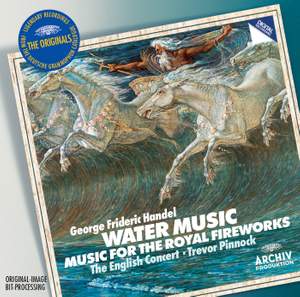
| |  | Handel - Water Music & Music for the Royal Fireworks
“It's unlikely that George I ever witnessed performances that live up to this one. They are sparkling; tempos are well judged and there's a truly majestic sweep to the opening F major French overture; that gets things off to a fine start but what follows is no less compelling with some notably fine woodwind playing, so often the disappointing element in performances on period instruments. In the D major music it's the brass department that steals the show and here, horns and trumpets acquit themselves with distinction. Archiv Produktion has achieved a particularly satisfying sound in which all strands of the orchestral texture can be heard with clarity. In this suite the ceremonial atmosphere comes over particularly well, with resonant brass playing complemented by crisply articulated oboes. The G major pieces are quite different from those in the previous groups, being lighter in texture and more closely dance-orientated. They are among the most engaging in the WaterMusic and especially, perhaps, the two little 'country dances', the boisterous character of which Pinnock captures nicely.” Gramophone Classical Music Guide, 2010 “They play on period instruments with great zest, especially so in the Fireworks Music. Speeds are consistently well choen. One test is the famous 'Air', which here remains an engagingly gentle piece.” Penguin Guide, 2011 edition | | | (Sorry, download not available in your country) | In stock - usually despatched within 1 working day. |
|
|
| |  | Handel - Water Music & Firework Musicfor trumpets and timpani
Trompetenensemble, Joachim Schäfer Handel’s two most famous works were composed for outdoor extravaganzas on the Thames. The King dismissed Handel’s preference for strings and insisted on the use of military instruments. This release is a timely fanfare for the fast approaching Handel Year 2009. | | | In stock - usually despatched within 1 working day. |
|
|
| |  | Handel - Water Music Suites
Recorded March 1993, remastered February 2008 “An outstanding disc which I foolishly overlooked back in 1993, not realising Savall et al. were such fine Handelians; it sounds spectacular now, remastered from stereo to effective but not overblown multi-channel SACD.” BBC Music Magazine, September 2008 ***** | | | In stock - usually despatched within 1 working day. |
|
|
| |  |
| | | In stock - usually despatched within 1 working day. |
|
|
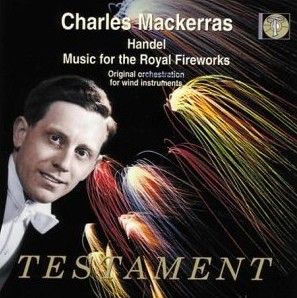
| |  | Music for the Royal Fireworks
“Over the night of 13-14 April 1959 in St Gabriel's Church, Cricklewood, a recording session took place, historic in every way, when the young Charles Mackerras conducted a band of 62 wind players plus nine percussionists in Handel's Music for the Royal Fireworks. With no fewer than 26 oboists topping the ensemble, it was only possible to assemble such a band after all concerts and operas had finished for the day. They began at 11pm and finished at 2.30 in the morning, yet so far from sounding tired or jaded, the players responded to the unique occasion with a fizzing account of Handel's six movements. The success of this extraordinary project fully justified Mackerras's determination to restore the astonishing array of instruments that Handel himself had assembled for the original performance in Green Park in April 1749. It's thrilling to hear that 1959 recording, at last transferred to CD, with sound that's still of demonstration quality, full and spacious, with a wide stereo spread. It's true that Mackerras takes the introduction to the overture and the 'Siciliana' at speeds far slower than he would choose today, but this was a recording which marked a breakthrough in what later developed as the period performance movement. As a coupling for the Fireworks Music, Mackerras devised a composite Concerto a due cori which draws on two works written with that title around 1747. It makes a splendid piece, in which the massed horns bray gloriously. Whatever the degree of authenticity, this is an electrifying collection, superbly transferred.” Gramophone Classical Music Guide, 2010 | | | In stock - usually despatched within 1 working day. |
|
|
| |
|