This page lists all recordings of Aure, deh, per pietà (from Giulio Cesare), by George Frideric Handel (1685-1759) on CD. Generally, more recent releases are listed first, but with priority given to those that are in stock. |
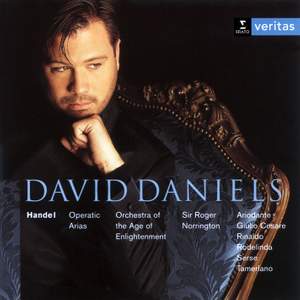
All recordingsPrices shown exclude VAT. (UK tax is not payable for deliveries to United States.) See Terms & Conditions for p&p rates. | |  | Handel Operatic Arias
“Sheer delight from first bar to last.” BBC Music Magazine “Here is a countertenor who, for once, gives an inkling of what the castrato voice did for Handel and his music ... Every track is a winner on this disc. More please.” Sunday Times “The ever-increasing popularity of Handel and his contemporaries, and their employment of alto castratos, has encouraged the development of countertenors capable of similar vocal feats to the original interpreters of the heroic roles in these works. Among these David Daniels can certainly be counted as a leading contender. He displays and deploys his talent here in a wide range of arias reflective and dramatic. His amazing technique runs through Tamerlano's virtuoso 'A dispetto' and Bertarido's 'Vivi tiranno!' without a blemish in the sound and with every division in its place yet part of a confidently delivered whole: by and large Daniels's runs and embellishments are smoothly accomplished. In more reflective pieces such as Giulio Cesare's 'Aure, deh, per pietà' (he also tackles Sesto's 'Cara speme' from Giulio Cesare, a particularly liquid, subtle piece of singing), Bertarido's 'Dove sei?' and Ariodante's sad lament, 'Scherza infida', written for the great Senesino, he uses his impeccable Italian to express wide-ranging emotions. Throughout, Roger Norrington and the Orchestra of the Age of Enlightenment give excellent support. The recording is blameless so there's every reason for readers to sample this fine exposition of the countertenor's art.” Gramophone Classical Music Guide, 2010 | | | In stock - usually despatched within 1 working day. |
|
|
| |  | Great Handel Arias
| | | Usually despatched in 4 - 5 working days. |
|
|
| |  | Hermann Uhde
Albert, E: | Hüll' in die Mantille dich fester ein (from Tiefland) | Bizet: | Votre toast je peux vous le rendre 'Toreador Song' (from Carmen) | Handel: | Dall'ondoso periglio (from Giulio Cesare) Aure, deh, per pietà (from Giulio Cesare) | Verdi: | Cortigiani, vil razza dannata (from Rigoletto) Tutte le feste (from Rigoletto) | Wagner: | Die Frist ist um (from Der fliegende Holländer) Dank, König, dir, daß du zu richten kamst! (from Lohengrin) Erhebe dich, Genossin meiner Schmach! (from Lohengrin) Leb wohl, du kühnes, herrliches Kind! (from Die Walküre) | Weber: | Hier im ird'schen Jammertal (from Der Freischütz) Schweig, schweig (from Der Freischütz) |
Hermann Uhde was a German Wagnerian baritone. In December 1961 Audrey Williamson wrote in Opera magazine: “On the opera stage the connection of intellect and passion is seldom. This is why stage singers like Hermann Uhde deserve the greatest appreciation; they uplift the opera to the highest level of musical drama.” All arias are sung in German | | | Usually despatched in 2 - 3 working days. |
|
|
| |  | The Best of Andreas Scholl
“Scholl's voice rushes through the bloodstream” The Times | | | Usually despatched in 2 - 3 working days. |
|
|
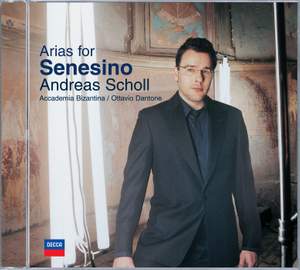
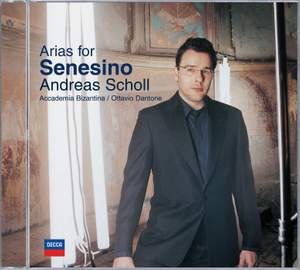
| |  | Arias for Senesino
“…Andreas Scholl… has developed the confidence and showmanship of a seasoned dramatic artist. Scholl's collaboration with Accademia Bizantina is proving to be a fruitful one which has breathed life into some of the forgotten delights of Baroque music. Ottavio Dantone coaxes some thrilling playing from the ensemble, combining refined lyricism with flamboyant virtuosity in true Italian style.” BBC Music Magazine, September 2005 **** “Scholl sings this stunningly, the reams of coloratura dazzlingly even yet never mechanical, and delivered on seemingly inexhaustible reserves of breath. …it is the slower, soulful numbers that remain longest in the memory, above all 'Cara Sposa' and the scenas from Rodelinda and Giulio Cesare. The grace and intensity of the singing are matched by vivid accompaniments from Ottavio Dantone's period band, and caught in a sympathetic acoustic. Enthusiastically recommended.” Gramophone Magazine, Awards Issue 2005 BBC Music Magazine
Opera Choice - September 2005 |
| | | Usually despatched in 2 - 3 working days. |
|
|
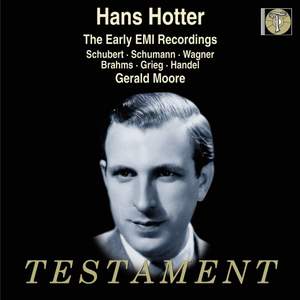
| |  | Hans Hotter - The Early EMI Recordings
Brahms: | Sonntag, Op. 47 No. 3 Ständchen, Op. 106 No. 1 Mit vierzig Jahren, Op. 94 No. 1 | Grieg: | Ich liebe Dich, Op. 5 No. 3 | Handel: | Aure, deh, per pietà (from Giulio Cesare) Soll'ich in Mamres Segens Au'n (from Joshua) Joshua: Wie willig trägt mein Vaterherz | Schubert: | Der Wanderer, D489 Der Doppelgänger D957 No. 13 Gruppe aus dem Tartarus, second version, D583 (Schiller) Die Stadt, D957 No. 11 Meeres Stille, D216, Op. 3 No. 2 (Goethe) Wohin? (No. 2 from Die schöne Müllerin, D795) Am Meer, D 957 No. 12 Der Doppelgänger D957 No. 13 | Schumann: | Die beiden Grenadiere, Op. 49 No. 1 Wer machte dich so krank? Op.35 No.11 (Kerner) Alte Laute, Op. 35, No. 12 Mondnacht (No. 5 from Liederkreis, Op. 39) | Wagner: | Und doch, s'will halt nich gehn (from Die Meistersinger) Doch eines Abends spat (from Die Meistersinger von Nürnberg) Leb wohl, du kühnes, herrliches Kind! (from Die Walküre) |
Recorded between 1947 & 1987 | | | Usually despatched in 4 - 5 working days. |
|
|
| |
|