Prices shown exclude VAT. (UK tax is not payable for deliveries to United States.) See Terms & Conditions for p&p rates. | |  |
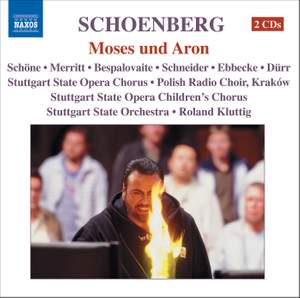
Wolfgang Schöne, Chris Merritt, Irena Bespalovaite, Bernhard Schneider, Michael Ebbecke, Karl-Friedrich Dürr, Ulrich Frisch, Saša Vrabac, Stephan Storck, Emma Curtis & Alois Riedel Stuttgart State Orchestra, Stuttgart State Opera Chorus, Polish Radio Choir, Kraków & Stuttgart State Opera Children’s Chorus, Roland Kluttig “There are excellent things in this bargain-price Moses und Aron… Perhaps most impressive is the natural way that the big ensembles flow, the multifarious counterpoint of voices and instruments making complete musical and dramatic sense with no sense of strain but plenty of conviction. Overall this new version hardly displaces Boulez's ideally authoritative reading with Günter Reich's darkly eloquent Moses and Richard Cassilly's charismatic Aron.” BBC Music Magazine, October 2006 **** | | | (also available to download from $11.25) | In stock - usually despatched within 1 working day. |
|
|
| |  | Live recording from the Ruhrtriennale 2009 at the Jahrhunderthalle Bochum
Dale Duesing, Andreas Conrad, Ilse Eerens, Karolina Gumos, Finnur Bjarnason, Michael Smallwood & Boris Grappe Bochumer Symphoniker & ChorWerk Ruhr, Michael Boder Directed for stage by Willy Decker. One of the greatest revolutions in the history of mankind happened nearly 3000 years ago: the transition from polytheism to monotheism through the prophet Moses. God revealed himself directly to Moses, instructing him in absolute truth. God’s call to Moses presented a new idea that exploded all previous religious concepts: ‘One God – unique, eternal, intangible, inconceivable’. Moses understands this concept, but is unable to express it, and therefore God appoints Moses’ brother Aaron as his spokesman. They are bound to fail: Aaron can only approach sharing the idea by compromising its meaning, whilst Moses is left to search fruitlessly for “the word I lack …”. When Arnold Schoenberg composed what he regarded as the dramatisation of his religious beliefs, he felt as though he was himself a Moses of the art. “Endowed with a sense of mission”, Schönberg continually reflected on how “to make the unfathomable, fathomable”. The operatic staging of this extraordinary idea by Hans Mayer involves scenic visions that make demands on stage machinery way beyond the boundaries of possibility. The impact of his grandiose composition is a deeply religious debate, uncompromising, radical and forthright. Picture format DVD: NTSC 16:9 Sounds formats DVD: PCM Stereo, DD 5.0, DTS 5.0 Region code: 0 Booklet notes: English, German, French Subtitles: English, Deutsch, Français Running time:112 mins | | | Usually despatched in 2 - 3 working days. |
|
|
| |  |
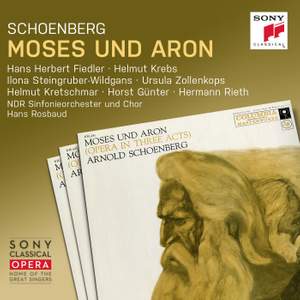
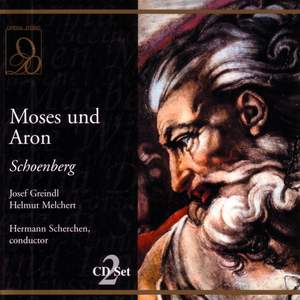
Günter Reich (Moses), Louis Devos (Aron) Chor und Sinfonieorchester des Österreichischen Rundfunks, Michael Gielen Schoenberg started composing Moses und Aron (Aaron has an ‘a’ missing owing to the composer’s superstition about the number 13) in 1928, working on the libretto and score up to 1933. Fleeing Vienna to escape the Nazi persecution of the Jewish population, Schoenberg settled in the US where he continued working throughout the 1940s to complete Act 3. Moses und Aron was premiered in 1954. Struggling with the original biblical story and wrestling with its contradictions, Schoenberg was concerned that the audience would not grasp the extended diatribe by Moses of his brother’s love for craven images. In fact, his challenge was also that of Moses’ – how to translate a lofty, intellectual and abstract message without diluting or destroying it. In style, the work is severe, and nearer to oratorio than opera. However, in its dramatic and bloodthirsty moments it matches anything in Puccini’s Turandot. A 12-tone Turandot, crossed with the fugal style found in the oratorios of Bach or Handel best describes this gritty, imposing, daunting 20th-century masterpiece. ‘The CD transfer of Gielen’s account certainly underlines the raw intensity in his approach to which Boulez would never aspire.’ Gramophone | | | Usually despatched in 4 - 5 working days. |
|
|
| |  | Schoenberg - Choral Works
“Craft proves that fastidious balance and a lightness of touch are all that's required to uncork Schoenberg's ecstatic lyricism.” Gramophone Magazine, May 2008 “There are few alternative versions of most of these pieces, and the disc is well worth acquiring by any Schoenbegian.” BBC Music Magazine, January 2008 **** | | | (also available to download from $6.00) | Usually despatched in 2 - 3 working days. (Available now to download.) |
|
|
| |  | Sung in German. Live Recording from the Vienna State Opera 2006, Co-production with the Teatro Real, Madrid
Recording Date: 2006
Place of recording: Live Recording from the Vienna State Opera
Running Time: 110 min. + interview 24 min
Picture Format: 16:9
Sound Format: PCM Stereo, Dolby Digital 5.1, DTS 5.1
Menu Languages NTSC: D, F, GB, SP
Subtitle Languages NTSC: D, F, GB, I, SP
“Nickler takes an effectively practical tack, abstract but straightforward. Three-dimensional video conjures the miracles of the first act, staff into serpent and so fourth, whilst in Act 2 it becomes the focus of consumer materialism. The Golden Calf is revealed as a set of letters spelling out ICH BIN GOTT, the counterpart of Moses's tablets of stone. Such intelligent, dramatic pragmatism lends equal lustre to the musical values. It's good to hear a conductor who is steeped in verismo conveying the underestimated sweep of these Biblical declamations... Both Grundheber and Moser seize every cue for lyrical expression, and the super-size chorus is every bit the collective hero/anti-hero of the piece.” Gramophone Magazine, August 2007 “Musically, the performance is first-rate, with Franz Grundheber commanding in the Sprechstimme role of Moses, and Thomas Moser coping valiantly with the Aaron's taxing tenor writing. …with Daniele Gatti at the helm this unremittingly intense opera leaves a strong impression.” BBC Music Magazine, July 2007 **** “Despite the flood of brilliant music that evokes God, Moses, Aron, Israelites, an orgy, and everyone and everything else, the music is essentially only a messenger. And that is the radical, reflexive idea here: that even this opera itself is probably inadequate to convey the basic unknowability of a higher power. That Schoenberg even attempted to address all of this -- using a multiplicity of techniques in the same piece -- is a bit formidable. He tackles a project with dimensions and implications that are far beyond what most of us can even conceive.” MusicWeb International “A student recently asked Milton Babbitt what he made of the plot of Moses und Aron. 'Oh I don't know, I'm not really a plot person,' he replied. 'Boy meets Girl, Moses meets Aron…' Of course, there's more than a grain of truth to Babbitt's quip. The bonus to this appearance of Schoenberg's 'opera fragment' on DVD is a discussion which does not attempt to explain what the piece is 'about' (dread phrase) but throws up some arresting images along the way, not least the suggestion that Moses is a 'Führer des Jüdischen Volks'. It certainly accords with the director Reto Nickler's conception of the work as 'a highly topical psychodrama that represents the thorny path between theory and practice'. Indeed, Schoenberg's absurdly unrealisable stage directions make the last scene of Les Troyens pale into insignificance. Nickler takes an effectively practical tack, abstract but straightforward. Three-dimensional video conjures the miracles of the First Act, staff into serpent and so forth, while in Act 2 it becomes the focus of consumer materialism. Aron dons a natty gold jacket while the chorus wave hankies of the same material, economically symbolising the banality of their demands and theology. The Golden Calf is revealed as a set of letters spelling out ICH BIN GOTT, the counterpart of Moses's tablets of stone. Such intelligent, dramatic pragmatism lends equal lustre to the musical values. It's good to hear a conductor who is steeped in verismo conveying the underestimated sweep of these Biblical declamations, even if it is inevitably at the expense of many of the notes. Both Grundheber and Moser seize every cue for lyrical expression, and the super-size chorus is every bit the collective hero/anti-hero of the piece. The prologue to Act 2 is typically stark and precise, with harsh lighting and tenebrous murk reflecting the sotto voce polyphony of abandonment as the Jewish people sit motionless. Their grim suitcases, their raised clenched fists and mob behaviour, all allude to fresher horrors in Jewish history, until they whip out gold party-frocks and dinner- jackets for the orgy. The Ephraimites become Scaramangas, murdering the true believers to a backdrop of clicking cameraphones and rolling TV coverage – then Z-list celebs totter on as alter egos of the Four Naked Virgins, copulating with the God-letters while Buñuel-esque images of cruelty dominate the giant TV screens. No wonder the Viennese loved it.” Gramophone Classical Music Guide, 2010 | | | Usually despatched in 2 - 3 working days. |
|
|
| |  |
“ Moses und Aron is respected rather than loved, with the reputation of being a tough assignment for all concerned. One of the essays in the booklet accompanying this recording calls it a didactic opera. Pierre Boulez, however, is a conductor in whom didacticism is close to a passion, and he's obviously passionate about this opera. We take it for granted that, in any work to which he feels close, every detail will be both accurate and audible. But for Schoenberg Moses und Aron was a warning as well as a homily, and as much a confession of faith as either. Boulez, often himself a Moses preaching against anti-modern backsliding, is at one with Schoenberg here. Some such reason, surely, has led to this being not only a performance of immaculate clarity, but of intense and eloquent beauty and powerful drama too. The recording was made during a run of stage performances, but in the Concertgebouw in Amsterdam, not in the theatre. In the beautiful acoustic of their own hall, the orchestra plays with ample richness and precision, and the sometimes complex textures benefit enormously from a perceptible space around them. The choral singing matches the orchestral playing in quality: beautiful in tone, eloquently urgent, vividly precise in the difficult spoken passages. The soloists are all admirable, with no weak links. Merritt in particular seems to have all that the hugely taxing role of Aron demands: a fine control of long line, intelligently expressive use of words, where necessary the dangerous demagogue's glamour. Pittman-Jennings is a properly prophetic Moses, grand of voice. This is one of Boulez's finest achievements.” Gramophone Classical Music Guide, 2010 | | (Sorry, download not available in your country) | |
|
|
| |  |
Werner Haseleu (Moses), Reiner Goldberg (Aron), Heinz Stryczek (Ephraimite), Ekkehard Wlaschiha (Second Elder), Leonard Andrzej Mroz (Priest), Paul Glahn (Third Elder), Hermann Christian Polster (Another Man), Armin Ude (Young Man), Gisela Pohl, Rosemarie Lang, Renate Krahmer, Roswitha Trexler (Naked Virgins) Leipzig Radio Chorus, Dresden Boys Choir, Leipzig Radio Symphony Orchestra, Herbert Kegel | | | Usually despatched in 4 - 5 working days. |
|
|
| |  | Pierre Boulez conducts Schoenberg II
Schoenberg: | Friede auf Erden, Op. 13 BBC Singers Kol Nidre, for Rabbi-Narrator, Mixed Chorus and Orchestra, Op. 39 BBC Symphony Orchestra Drei Volkslieder Op. 49 BBC Singers Kanons (2) BBC Singers Drei Volkslieder Op. 49 BBC Singers Four Pieces for Mixed Chorus, Op. 27 BBC Singers Three Satires for Mixed Chorus, Op. 28 BBC Singers Stücke (6), Op. 35 BBC Singers Dreimal tausend jahre, Op. 50a De Profundis (Psalm 130), Op. 50b for mixed choir a cappella Moderner Psalm für Sprecher, Chor und Orchester, Op. 50c A Survivor from Warsaw, Op. 46 Günther Reich (speaker) BBC Singers, BBC Symphony Orchestra Gurrelieder Marita Napier (Tove), Yvonne Minton (Waldtaube),Jess Thomas (Waldemar), Kenneth Bowen (Klaus-Narr), Siegmund Nimsgern (Bauer), Günter Reich (narrator) Four Orchestral Songs, Op. 22 Yvonne Minton (mezzo) BBC Symphony Orchestra Chamber Symphony No. 2, Op. 38b Ensemble InterContemporain Moses und Aron Günther Reich (Moses), Richard Cassilly (Aron) |
| | | In stock - usually despatched within 1 working day. |
|
|
| |  | Herbert Kegel conducts Schoenberg, Berg & Webern
Gisela Schroter (mezzo-soprano), Rosemarie Lang (mezzo-soprano), Roswitha Trexler (mezzo-soprano), Gert Westphal (narrator), Werner Haseleu (narrator) Leipzig Radio Chorus, Berlin Radio Choir, Dresden Boys Choir, Prague Male Chorus, Leipzig Radio Symphony Orchestra, Leipzig Radio Symphony Orchestra, Dresden Philharmonic Orchestra, Herbert Kegel | | | Usually despatched in 4 - 5 working days. |
|
|
| |  | Pierre Boulez conducts Schoenberg
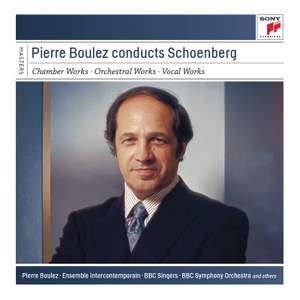
Schoenberg: | Septet (Suite) in E flat major, Op. 29 Verklärte Nacht, Op. 4 3 Pieces for Chamber Orchestra Serenade, Op. 24 5 orchestral pieces, Op. 16 Ode to Napoleon Buonaparte, Op. 41 Variations for Orchestra, Op. 31 Verklärte Nacht, Op. 4 (version for string orchestra) Erwartung, Op. 17 Pierrot lunaire, Op. 21 Lied der Waldtaube (from Gurrelieder) Friede auf Erden, Op. 13 Kol Nidre, for Rabbi-Narrator, Mixed Chorus and Orchestra, Op. 39 Folksong Arrangements (4) Kanons (2) Four Pieces for Mixed Chorus, Op. 27 Three Satires for Mixed Chorus, Op. 28 Stücke (6), Op. 35 Dreimal tausend jahre, Op. 50a De Profundis (Psalm 130), Op. 50b for mixed choir a cappella Moderner Psalm für Sprecher, Chor und Orchester, Op. 50c A Survivor from Warsaw, Op. 46 Gurrelieder Four Orchestral Songs, Op. 22 Die Jakobsleiter Chamber Symphony No. 1 in E major, Op. 9 Accompaniment to a Cinematographic Scene, Op. 34 Moses und Aron Chamber Symphony No. 2, Op. 38b |
| 
| | | In stock - usually despatched within 1 working day. |
|
|
| |
|