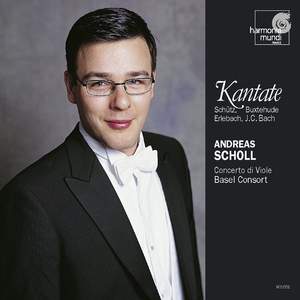
All recordingsPrices shown exclude VAT. (UK tax is not payable for deliveries to United States.) See Terms & Conditions for p&p rates. | |  | Kantate - German Baroque Cantatas
Albertini: | Sonata IV pour violon et basse continue in C minor | Bach, J C: | Lamento 'Ach daß ich Wassers gnug hätte' | Buxtehude: | Fried- und Freudenreiche Hinfahrth, BuxWV 76 Jubilate Domino, omnis terra, BuxWV 64 | Erlebach: | Wer sich dem Himmel übergeben | Legrenzi: | Sonata Quinta a quattro, viole da gamba o come piace aus "La Cetra", 1673 | Rovetta: | Ach, Herr, laß deine lieben Engelein | Schütz: | O Jesu, nomen dulce SWV 308 Herzlich lieb hab ich dich, o Herr, SWV 348 Was hast du verwirket SWV 307 | Tunder: | Salve mi Jesu |
The pieces on this recording demonstrate the consummate art with which the German composers reconciled the new ideas imported from Italy at the very beginning of the 17th century (the principle of the basso continuo, accompanied monody, the concertato technique) with local traditions, thereby giving birth to works of a subtle beauty and an almost inexhaustible richness. This stylistic revolution paved the way to the flourishing of great forms like the vocal solo, the spiritual concert, the cantata, etc. cultivated by composers as different as Schütz, Buxtehude, Tunder and Erlebach: in the very heart of Baroque Europe the Germans were taking their place. “…the union of youthful timbre, sublime instrumental playing and explorative repertoire achieves a rare kind of perfection here. …essential for lovers of Baroque vocal music.” Gramophone Magazine, August 2008 | | | In stock - usually despatched within 1 working day. |
|
|
| |  | Dulcis Memoria von Schutz bis Rosenmuller
Bertali: | Sonata a 2 in A minor William Dongois (trumpet), Ghislaine Wauter (violin) | Buchner, P F: | Sonata No. 3 William Dongois (trumpet), Ghislaine Wauter (violin) Jesu, dulcis memoria William Dongois (trumpet), Ghislaine Wauter (violin), Meinderd Zwart (counter-tenor) Sonata No. 4 William Dongois (trumpet), Ghislaine Wauter (violin) | Capricornus: | Surrexit pastor bonus William Dongois (trumpet), Meinderd Zwart (counter-tenor) | Kindermann: | Canzon No. 5 William Dongois (trumpet), Ghislaine Wauter (violin) Ach Herr, strafe mich nicht William Dongois (trumpet), Ghislaine Wauter (violin), Meinderd Zwart (counter-tenor) Violin Sonata in D minor Ghislaine Wauter (violin) Magnificat Octavi Toni | Rosenmüller: | Sonata Prima a 2 William Dongois (trumpet), Ghislaine Wauter (violin) Sonata Seconda a 2 William Dongois (trumpet), Ghislaine Wauter (violin) | Schütz: | Herzlich lieb hab ich dich, o Herr, SWV 348 William Dongois (trumpet), Ghislaine Wauter (violin), Meinderd Zwart (counter-tenor) |
| |
|
| |  | Heinrich Schütz: Symphoniae Sacrae
Schütz: | Benedicam Dominum in omni tempore, SWV 267 Fili mi, Absalon, SWV 269 Veni, dilecte mi, in hortum meum, SWV 274 Jubilate Deo in chordis, SWV 276 Von Gott will ich nicht lassen, SWV 366 Herr, unser Herrscher, wie herrlich ist dein Nam, SWV 343 Meine Seele erhebt den Herren, SWV 344 Herzlich lieb hab ich dich, o Herr, SWV 348 Es steh Gott auf, SWV 356 Herr, nun lässest du deinen Diener, SWV 352 Lobet den Herrn in seinem Heiligtum, SWV 350 Freuet euch des Herren, ihr Gerechten, SWV 367 |
Matteo Messori (organ/director) Capella Augustana Recording made in 2003. Capella Augustana is recording the complete works of Schütz for Brilliant Classics, which will consist of 30 CDs. Comprehensive booklet essay and sung texts. Heinrich Schütz lived a long and successful life, and studied with some of the greatest masters of the time, including Monteverdi and Giovanni Gabrieli. He is generally considered to be the greatest German composer of the early Baroque. Travelling between positions in Copenhagen, Kassel and Dresden, his life was hit by personal tragedies – he outlived his wife and all his children, and the Thirty Years War severely disrupted his employment. This CD contains selections from two of his three sets of Symphoniae Sacrae. The first set, composed in 1629, uses Latin texts, whilst the second and third sets are set to German texts. Schütz’s genius lay in his ability to set words to music. The rhythmic strength of his music lies in his ability to capture the nuances of the words, and this skill enabled him to make a major contribution to Luther’s aim of establishing the vernacular as the literary and liturgical language of the Protestant religion. A similar move had been made in England with the adoption of English rather than Latin in sacred music with the introduction of The Book of Common Prayer in the mid-16th century. | | | Usually despatched in 4 - 5 working days. |
|
|
| |
|