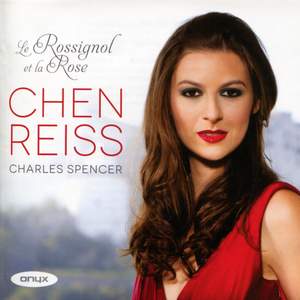
All recordingsPrices shown exclude VAT. (UK tax is not payable for deliveries to United States.) See Terms & Conditions for p&p rates. | |  | Chen Reiss: The Nightingale and the Rose
Bellini: | Vanne, o rosa fortunata | Berg: | Die Nachtigall | Brahms: | An die Nachtigall, Op. 46 No. 4 (Text: L.C.H. Hölty) | Fauré: | Les roses d'Ispahan Op. 39 No. 4 | Franck, C: | Roses et papillons Le mariage des roses | Grieg: | Seks Sange, Op. 48 No. 4 'Die verschwiegene Nachtigall' Zur Rosenzeit (No. 5 from Seks Sange, Op. 48) | Guastavino: | La rosa y el sauce | Hahn, R: | Le rossignol des lilas | Krenek: | Die Nachtigall | Mahler: | Ablösung im Sommer (Lieder und Gesänge aus der Jugendzeit) | Meyerbeer: | Die Rosenblätter | Purcell: | Sweeter than Roses (from Pausanius, the Betrayer of his Country, Z585) | Rimsky Korsakov: | The Nightingale and the Rose | Saint-Saëns: | Le Rossignol (de Banville) | Schubert: | Heidenröslein, D257 | Schumann: | Die Rose, die Lilie, die Taube, die Sonne (No. 3 from Dichterliebe, Op. 48) Meine Rose, Op. 90 No. 2 | Sherwin, M: | A Nightingale Sang in Berkeley Square | Strauss, R: | Rote Rosen, AV76 Das Rosenband, Op. 36 No. 1 | Viardot-Garcia: | Les deux roses | Weber: | Das Röschen ('Ich sah ein Röschen am Wege steh’n'), J. 67 (Op. 15 No. 5) | Zeira: | Shnei Shoshanim (Two roses) |
Chen Reiss (soprano) & Charles Spencer (piano) Chen Reiss’s debut album 'Liaisons' was internationally acclaimed for both the repertoire selection and the sheer brilliance of the musicianship displayed by Reiss. Gramophone magazine called her performances of arias by Haydn, Mozart, Salieri and Cimarosa "standard-setting" and BBC Music magazine called it "top-drawer". For her second ONYX CD Chen Reiss and pianist Charles Spencer have assembled a wonderful collection of songs on the subject of 'The Nightingale and the Rose' – songs that convey the magic of being in love, the heartbreak of love lost, the memories, the fun, the fantasies all associated with that strange, mysterious, dangerous and all-powerful condition – love. In repertoire that ranges from Purcell to Krenek, Hahn to Meyerbeer and Rimsky-Korsakov, and ends in Berkeley Square in London, this is a programme tailor-made for Chen Reiss’s remarkable voice and it will seduce you. “It is a measure of her gifts that Chen Reiss takes all these composers in her stride. That vocal stride is impressive: sustained lyric tone that is only rarely forced...Charles Spencer is as ever the perfect partner” BBC Music Magazine, April 2013 **** “Reiss fields a supple, vernal lyric-coloratura that soars without strain or hardness into the stratosphere. Discerningly partnered by Charles Spencer, she can spin a pure legato and always phrases musically, with rubato growing naturally from the curve of the line and the flux of the harmony...this is a more-than-promising recital from a soprano whose vocal ease and allure make her an artist to watch.” Gramophone Magazine, March 2013 | | | In stock - usually despatched within 1 working day. |
|
|
| |  | Schumann Favourite Songs
“full unblemished tone, faultless legato...thoughtful phrasing - many pleasures to offer” Gramophone Magazine “Felicity Lott is a connoisseur's artist, far greater than many more illustrious and publicised rivals...here with great poise and completely unaffected artistry...treasurable” Penguin Guide | | | In stock - usually despatched within 1 working day. |
|
|
| |  | The Flagstad Recitals Volume 1Schubert, Brahms, Schumann, Wolf & Strauss - Lieder
Brahms: | Vier ernste Gesänge, Op. 121 Treue Liebe, Op. 7, No. 1 Am Sonntag Morgen Op. 49 No. 1 Auf dem Kirchhofe, Op. 105 No. 4 Wie Melodien zieht es mir, Op. 105 No. 1 Alte Liebe, Op. 72 No. 1 Bei dir sind meine Gedanken (No. 2 from Sieben Lieder, Op. 95) Wir wandelten, wir zwei zusammen Op. 96/2 Dein blaues Auge, (No. 8 from Acht Lieder und Gesänge, Op. 59) | Schubert: | Dem Unendlichen, D291 (Klopstock) Erlkönig, D328 Am Grabe Anselmo's D504 Des Mädchens Klage D191b Ave Maria, D839 | Schumann: | Der Nussbaum, Op. 25 No. 3 Die Soldatenbraut Op. 64 No. 1 Meine Rose, Op. 90 No. 2 Liebeslied, Op. 51 No. 5 Die Lotosblume, Op. 25 No. 7 Widmung, Op. 25 No. 1 Lust der Sturmnacht, Op. 35 No. 1 In der Fremde (No. 1 from Liederkreis, Op. 39) Zum Schluß, Op. 25 No. 26 Previously Unpublished | Sinding: | Leit etter livet og liv det! Op. 55, No. 5 Sylvelin, Op. 55, No. 1 Der skreg en fugl, Op. 18, No. 5 Den Jomfru gik i valmu-Vang? Op. 50, No. 5 | Strauss, R: | Befreit, Op. 39 No. 4 Mit deinen blauen Augen, Op. 56 No. 4 Lob des Leidens, Op. 15 No. 3 Ich trage meine Minne, Op. 32 No. 1 Ständchen, Op. 17 No. 2 Geduld Op. 10 No. 5 | Wolf, H: | Gesang Weylas (No. 46 from Mörike-Lieder) Gebet (No. 28 from Mörike-Lieder) Über Nacht Lieder aus der Jugendzeit Der Freund (No. 1 from Eichendorff-Lieder) Heb’ auf dein blondes Haupt (No. 18 from Italienisches Liederbuch) Anakreons Grab (No. 29 from Goethe-Lieder) Morgenstimmung Zur Ruh, zur Ruh! |
The first of four 2-CD “Flagstad Recitals” features Kirsten Flagstad in Brahms and Schubert on CD1 as well as CD premieres of songs by Schumann (including her previously unpublished “Zum Schluss”), Strauss, Wolf and Sinding on CD2. Her great power and control placed her among those with the natural capacity for success in the ‘big’ songs with its special thrill, but there is no want of gentleness in the quieter ones. The American critic, Virgil Thomson, probably spoke for the whole audience when he wrote on Flagstad’s return to the United States in 1947: ‘Never in this writer’s concert-going lifetime has there been available any other vocal artistry of such sumptuous natural acoustics, such perfect technical control and such sound musicianship’. "Throughout, one is stirred by the sheer beauty of the sound." Gramophone “deeply felt … wonderfully radiant tone … very touching” [Brahms] “the operatic drama of Der Erlkönig is as memorable as the gently ravishing cantilena of Am Grabe Anselmos” The Penguin Guide to Bargain Compact Discs "…worth having for the Wolf group alone." Gramophone | | | In stock - usually despatched within 1 working day. |
|
|
| |  | Schumann - Frauenliebe und Leben
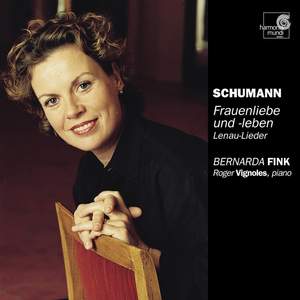
Schumann: | Frauenliebe und -leben, Op. 42 Gedichte (6) und Requiem, Op. 90 Mignon ('Kennst du das Land, wo die Zitronen blühn'), Op. 79 No. 29 Der Nussbaum, Op. 25 No. 3 Aufträge, Op. 77 No. 5 Die Lotosblume, Op. 25 No. 7 Ständchen, Op. 36 No. 2 Nachtlied, Op. 96 No. 1 Der Sandmann, Op. 79 No. 13 Das verlassene Mägdlein, Op. 64 No. 2 Die Kartenlegerin, Op. 31 No. 2 |
‘The value of Schumann’s songs lies chiefly in their spiritual depth, and in this respect they belong with the greatest and most magnificent inexistence; indeed on can say, with regard to the finest of them, that there are few creative works that can be placed quite beside them.’ Franz Brendel “one of the loveliest accounts of Schumann's cycle on disc. [Fink] is outstanding, too, in the beautiful late Lenau settings, and there's supremely musical piano-playing from Vignoles.” Sunday Times | | | In stock - usually despatched within 1 working day. |
|
|
| |  | Schumann: Dichterliebe
“With this recital Christian Gerhaher confirms his pre-eminence in Lieder, and bids fair to equal or surpass his fellow baritones by dint of his attractively warm, firm tone and his complete understanding of the songs. In Dichterliebe he fully enters into the melancholic, romantic world of the rejected lover, projecting the love and sorrow in a committed yet unexaggerated manner. It's hard to imagine a reading by a voice of his kind that could possibly surpass his inspired performance – and that includes even the legendary Fischer-Dieskau. He makes as good a case as possible for the SixPoems and Requiem, though it's hard to breathe life into the broken-backed ballad that is DieLöwenbraut. On the other hand, Gerhaher arrestingly enacts the melodrama of Belsatzar, biting consonants to the fore; the sadness of Derarme Peter benefits from the same thoughtful approach as Dichterliebe. Huber supports his partner with finely honed playing. The recording could not be better balanced or more immediate. This is, in every respect, a winner.” Gramophone Classical Music Guide, 2010 “Gerhaher's Dichterliebe sets a new standard for intelligent leider singing. Like Olaf Bar, Gerhaher has an impeccable touch with consonants; singing through them and connecting and shaping the subsequent vowels eloquently. His musicality is evident, but the text is pre-eminent. Gerold Huber's accompaniment is equally rewarding; beautifully pitched, fluid playing. An excellent recital.” The Independent on Sunday | | | In stock - usually despatched within 1 working day. |
|
|
| |  | Barry McDaniel sings Schubert, Schumann, Wolf, Duparc, Ravel & Debussy
Debussy: | Le promenoir des deux amants | Duparc: | Chanson triste Lamento Le Manoir de Rosemonde Extase Soupir Phidylé | Ravel: | Trois chansons madécasses Eberhard Finke (cello) & Karlheinz Zoeller (flute) | Schubert: | Der Winterabend (Es ist so still), D938 Herbst, D945 Dass sie hier gewesen! D775 (Rückert) Der Einsame, D800 Fahrt zum Hades, D526 (Mayrhofer) Der Jungling und der Tod, D545 (Spaun) Sprache der Liebe D410 (A W von Schlegel) Fischerweise, D881 (Schlechta) Über Wildemann D884 (Ernst Schulze) Auflösung, D807 | Schumann: | Gedichte (6) und Requiem, Op. 90 Nachtlied, Op. 96 No. 1 Der Spielmann, Op. 40, No. 4 Zigeunerliedchen I & II Verratene Liebe, Op. 40, No. 5 Provencalisches Lied, Op. 139 No. 4 Mein Schöner Stern! Op. 101 No. 4 Aus den hebräischen Gesängen, Op. 25 No. 15 Ihre Stimme Op. 96 No. 3 (August von Platen) | Wolf, H: | An eine Æolsharfe (No. 11 from Mörike-Lieder) Heimweh (No. 37 from Mörike-Lieder) Lebe wohl (No. 36 from Mörike-Lieder) Nimmersatte Liebe (No. 9 from Mörike-Lieder) Der Tambour (No. 5 from Mörike-Lieder) Abschied (No. 53 from Mörike-Lieder) |
Barry McDaniel (baritone), Hertha Klust (piano) & Aribert Reimann (piano) The American baritone Barry McDaniel was one of the outstanding singers of the post-war era. As a successful opera singer and Lieder interpreter, he enjoyed a long and eventful career, both in Germany and abroad. Despite numerous performances and many recordings for radio and television, he nonetheless remained largely unnoticed by the media, partly because his name almost vanished in the shadow of Dietrich Fischer-Dieskau, who was five years his senior. Unjustly so, since the two singers were equals as artists, albeit with different characters. Today, Barry McDaniel is hardly mentioned in specialist literature and one searches in vain for CDs since, until now, recordings from radio archives have not been phonographically processed. However, Audite now presents a première double CD of Lieder sung by Barry McDaniel. These studio recordings from the archives of Radio Berlin-Brandenburg (formally Sender Freies Berlin) were made between 1963 and 1974 with Hertha Klust and Aribert Reimann as accompanists. This selection of songs by Schubert, Schumann, Wolf, Duparc, Ravel and Debussy reveals diverse facets of McDaniel’s artistic personality. His interpretations are characterised by an interleaving of knowledge and naivety, feeling and craftsmanship, expression and impeccable singing. Apart from his immaculate technique, his accent-free German is particularly remarkable. Barry McDaniel moved from the USA to Germany in 1953 in order to further his studies. He then gave his first song recitals, together with Hermann Reutter, and later began a career as an opera singer. In 1961 he was engaged at the newly re-opened Deutsche Oper Berlin, where he remained for thirty-seven years. At the same time, he gave guest performances at the Vienna Staatsoper, the Metropolitan Opera New York, the Frankfurt Opera and the Munich Opera Festival, as well as broadcasting for radio and television. In addition, Barry McDaniel gave numerous song recitals, for example in Stuttgart, Karlsruhe, Hanover, Brunswick and Berlin, including, in the latter city, the first ever song recital at the newly built Philharmonie in 1963. Today, the 81-year-old baritone declares: “Whatever I sing, I have to believe in it.” That is exactly how these recordings sound. “The American Barry McDaniel inevitably sang in the shadow of Fischer-Dieskau; but this double CD reveals his deeply thoughtful baritone, in superbly accompanied Lieder and melodie.” BBC Music Magazine, June 2012 **** | | | (also available to download from $21.00) | Usually despatched in 3 - 4 working days. (Available now to download.) |
|
|
| |  | Schumann: Complete Lieder Volume 6
Andrea Lauren Brown (soprano), Thomas E. Bauer (baritone) & Uta Hielscher (piano) This sixth disc in the Naxos series of the complete Schumann Lieder features the 26 songs of Myrthen (Myrtles), which date from February of that year. Robert Schumann’s literary interests influenced his choice of the poems he used for his songs, many of which were composed in a burst of activity during the ‘Year of Song’ 1840. Dedicated to his beloved Clara (myrtles were used for bridal wreaths), this album of exquisite songs explores themes of devotion, longing, loneliness, matrimony and maternity. His Six Poems and Requiem of August 1850 set mournful texts by Lenau, concluding with an anonymous Medieval poem ‘Héloïse's lament for Abelard’. “Bauer has a meaty, sizable voice and brings real engagement to the text.” BBC Music Magazine, September 2011 *** | | | (also available to download from $6.00) | Usually despatched in 2 - 3 working days. (Available now to download.) |
|
|
| |  | Schumann: Dichterliebeand selected songs
Schumann: | Dichterliebe, Op. 48 Belsazar, Op. 57 Mein Schöner Stern! Op. 101 No. 4 Ihre Stimme Op. 96 No. 3 (August von Platen) Die Sennin, Op. 90 No. 4 Liebesbotschaft, Op. 36 No. 6 Der Spielmann, Op. 40, No. 4 Alte Laute, Op. 35, No. 12 Du bist wie eine Blume, Op. 25 No. 24 Meine Rose, Op. 90 No. 2 Drei Gedichte von Emanuel Geibel, Op. 30 |
Daniel Johannsen (tenor) & Elena Larina (piano) The most prolific period of Schumann’s vocal composition began in 1840, in which he composed more than 140 songs, with the culmination being Dichterliebe. Award-winning tenor Daniel Johannsen and his duo partner, Elena Larina, consistently emphasize the compositional subtleties of these fine songs. “By nature, the Austrian tenor's voice is clear in definition and tone...It sounds like the expression of a sharp mind with a good deal of cunning about it - this is Dichterliebe sung by Wagner's Loge...Larina (we must suppose) sees the role of the pianist in this score not as part of the poet's introspective, lyrical mind but as an external, dramatic commentary.” Gramophone Magazine, December 2010 | | | (also available to download from $10.50) | Usually despatched in 4 - 5 working days. (Available now to download.) |
|
|
| |  | Nathan Berg - Lieder Recital
Brahms: | Vier Ernste Gesänge, Op. 121 | Schubert: | Im Abendrot, D799 Der Strom, D565 (poet unknown) Das Abendrot D627 (Schreiber) Der Jüngling an der Quelle, D300 (Salis-Seewis) Der Tod und das Mädchen, D531 An den Frühling, D338 | Schumann: | Gedichte (6) und Requiem, Op. 90 | Strauss, R: | Traum durch die Dämmerung, Op. 29 No. 1 Efeu, Op. 22 No. 3 Ach weh mir unglückhaftem Mann, Op. 21 No. 4 Morgen, Op. 27 No. 4 |
Nathan Berg is already well known to audiences from his many recordings in operas, cantatas, masses and symphonies working with conductors such as Rene Jacob, William Christie and Robert Shaw. He has recorded for Harmonia Mundi, Telarc, Philips and Erato. On Hyperion he has recently appeared with Marjana Lipovsek in Graham Johnson’s complete Schubert series, and with Sophie Daneman in Mendelssohn. For his debut solo disc on ATMA Nathan Berg has selected a programme covering more than a century of romantic German lieder, including some of the best-loved songs of the genre by Schumann, Brahms, Strauss and Schubert. | | | (also available to download from $10.50) | Usually despatched in 2 - 3 working days. (Available now to download.) |
|
|
| |  | Schubert & Schumann Lieder
| |
|
| |
|