Prices shown exclude VAT. (UK tax is not payable for deliveries to United States.) See Terms & Conditions for p&p rates. | |  | Purcell: Harmonia Sacra
Purcell: | Tell me, some pitying angel (The Blessed Virgin's Expostulation), Z196 In the black dismal dungeon of despair, Z190 We sing to him, whose wisdom form'd the ear, Z199 Air in G minor Great God and just, Z186 My song shall be always, Z31 Ground in D minor, ZD222 Lord, what is man?, Z192 Let the night perish (Job's Curse), Z191 Chacony in G minor - for Two Violins, Viola and Bass Z730 The night is come, ZD77 With sick and famish'd eyes, Z200 How have I stray'd, Z188 Suite in G minor My op’ning eyes are purg’d, ZD72 How long, great God?, Z189 Ground in C minor, ZD221 Sleep, Adam, and take thy rest, Z195 Thou wakeful shepherd that dost Israel keep (A Morning Hymn), Z198 The earth trembled, Z197 An Evening Hymn 'Now that the sun hath veiled his light', Z193 |
A dream cast for selected pieces from Purcell's masterpieces. Christophe Rousset has brought together leading experts in this field (Elizabeth Kenny and Laurence Dreyfus) around Rosemary Joshua to give us a benchmark performance. This disc is a gem and a priority of the label for the semester. “For a singer who began her career in the early 1990s, Joshua sounds astonishingly fresh — Emma Kirkby-like in the purity of her sound, although she brings a wider palette of colour to this kind of music than the veteran early-music diva ever did.” Sunday Times, 25th March 2012 “Purcell is not known as a composer of sacred songs. The 24 here, all scored for a single high voice, come from two volumes published in his later years, which group the work of several composers but are dominated by Purcell’s. Some are less than 30 bars long, others sound almost cantata-like. All are intimate and varied in tone. Whether they were designed to be heard in sequence like this is questionable, but [Rosemary] Joshua brings them vividly to life” Financial Times, 21st April 2012 “The word-painting of the sacred texts — involving angular leaps, florid melismas and a fluid mixture of declamation and gorgeous lyricism — is intense and detailed. Rosemary Joshua does it full justice, yet also seems to float, lithe and graceful, through it all. It’s a masterclass in delicate Baroque singing.” The Times, 19th May 2012 **** “Joshua brings vocal security and textual intelligence to these works and though a slightly flighty vibrato sometimes threatens the music's intimacy, it does not get in the way of superbly realised greater dramatic truth. The continuo accompaniments are as sensitively accomplished as one would expect from such a line-up...If this is a sober disc, it is also one which reeks of Purcell's genius.” Gramophone Magazine, July 2012 “Rosemary Joshua brings to these accounts all the aplomb of a Baroque diva, with her sharply etched diction, perspicuous dramatic insights and varied vocal timbres...It would be easy for Joshua to steal the show, but the instrumentalists respond to her pliant vocal lines with sensitively articulated continuo playing.” BBC Music Magazine, August 2012 ***** | | | In stock - usually despatched within 1 working day. |
|
|
| |  | Purcell - Keyboard Suites & GroundsRecorded October 13-15, 2007, Potton Hall
Purcell: | Suite No. 1 in G major, Z 660 Chaconne in G minor, ZT 680, from Timon of Athens Suite No. 2 in G minor, Z 661 Swifter, Isis, swifter flow (Welcome Song for Charles II, 1681) Suite No. 3 in G major, Z 662 A New Ground in E minor, Z. T682 Suite No. 4 in A minor, Z 663 A Ground in Gamut in G major, Z 645 Suite No. 5 in C major, Z 666 Ground in C minor, ZD221 Suite No. 6 in D major, Z 667 Round'O, ZT 684, from Abdelazer Suite No. 7 in D minor, Z 668 Ground in D minor, ZD222 Suite No. 8 in F major, Z 669 |
In his latest solo recital for harmonia mundi, Richard Egarr turns to the rarely heard harpsichord Suites by Henry Purcell. In his beautifully shaped reading, these eight muscular and quirky works, published the year after Purcell's death, are interspersed with seven shorter pieces built on a recurring pattern - a chaconne, a rondeau, and five 'grounds'. Richard Egarr has worked with all types of keyboards and is in great demand both as soloist and as accompanist. His collaboration with long-time duo partner Andrew Manze has been setting new performance standards since 1984. He is music director of the Academy of Ancient Music, and they recently recorded Handel's Organ Concertos Op.4 together, nominated for a Gramophone Award 2008. Handel Concerti Grossi Op. 3 won the Baroque Award in 2007. “…Egarr is… brilliant in the G major Suite, introspective in its broody, lowering G minor sibling, and not beyond an utterly charming registrational surprise for the last track.” BBC Music Magazine, October 2008 ***** “While the eight posthumously published suites (with judiciously selected miscellany to create some elbow-room between each) are woefully unknown, they are beautifully crafted. Purcell's keyboard style rarely reverts to French luxuriance, rather more questing in its unpredictable steers, deliberately wrong-footed harmonic inflections, often quite tough textures and extended lyrical journeys. Richard Egarr's devotion to these pieces comes in the form of studied spaciousness which allows these rich strains to become gently infused into our listening habits. This is no background tafelmusik, which is why it requires our indulgence, to stop and follow the thread – especially in the sustained narrative of the minor-key suites. If the Almand of the G major Suite offers homage to the exquisite character-piece Almans of Gibbons, the A minor work is prescient of 18th-century models in its directed figuration and the grandiloquence of its easy conflation of French and Italian styles. Indeed, one of Egarr's greatest achievements is to challenge the homespun perception of this repertoire and present it as great keyboard music. The C major Suite is a wonderful demonstration of this, as is the gamey tuning of the D major work with its burly final hornpipe. The harpsichord by Joel Katzman (after Ruckers) covers all the bases with its disarming colour, clarity and resonance. An outstanding recital.” Gramophone Classical Music Guide, 2010 “A thoroughly persuasive case for these neglected masterpieces.” Gramophone Magazine, October 2008 | | | In stock - usually despatched within 1 working day. |
|
|
| |  | Purcell - The Food of LoveSacred & Secular Songs
Corbetta: | Caprice de chacone C major | Purcell: | If Music be the Food of Love, Z. 379C Corinna is divinely fair, Z365 Ah! how sweet it is to love (from Tyrannic Love or The Royal Martyr, Z613) What a sad fate is mine, Z428A I see she flies me ev'rywhere (from Aureng-Zebe or The Great Mogul, Z573) O solitude, my sweetest choice, Z406 Music for a while, Z583 Ground in C minor, ZD221 O! fair Cedaria, hide those eyes Z402 Man is for the woman made (from The Mock Marriage, Z605) Not all my torments can your pity move, Z400 On the brow of Richmond Hill Z405 Pious Celinda goes to prayers, Z410 When first I saw Aurelia’s eyes, Z627A /1 The cares of lovers (from Timon of Athens, Z632) The fatal hour comes on apace, Z421 I loved fair Celia, Z381 When her languishing eyes said 'Love!', Z432 Thou wakeful shepherd that dost Israel keep (A Morning Hymn), Z198 The earth trembled, Z197 An Evening Hymn 'Now that the sun hath veiled his light', Z193 If music be the food of love Z379A | Simpson, C: | Prelude in D Prelude [in E] | Visée: | Prelude D minor |
‘The Food of Love’, a strongly compelling title for a magnificent programme featuring the best of Purcell’s vocal music, sung by world renowned baroque specialist Paul Agnew. Paul Agnew is joined by an outstanding group of continuo players led by gambist Anne-Marie Lasla to create a special atmosphere of intimate music-making. “Agnew’s voice is one of the most searingly expressive in the baroque field.” (Gramophone). Purcell achieved the near miraculous feat of sounding natural in a heightened dramatic vein, using ornamentation and repetition to place expressive stress on key words. A vibrant tribute to the 350th Anniversary of Purcell’s birth. “Paul Agnew's long experience in the realm of French Baroque music makes him particularly sensitive to le goût français, his voice supple enough to realise with exquisite grace the intricate, French-style recitatives and embellishments. In the simpler songs and laments, he croons with the seductive tones of a veritable chanteur de charme. Anne-Marie Lasla, Elizabeth Kenny and Blandine Rannou provide inspired continuo realisations, full of improvisatory flair and theatricality. The rapport between these four musicians lifts the music far beyond the written notes producing a perfect entente cordiale.” BBC Music Magazine, January 2010 ***** “Agnew gets it just right, and the ensemble behind him is flawless. There is the right blend of restraint and subtlety, with emotional guts – try I loved Fair Celia or the heartfelt Solitude with a wonderfully well-judged solo viol...Generally the performances are outstanding – and the idea of breaking up the Purcell songs with instrumental solos inspired.” Katie Greening, bbc.co.uk, 4th November 2009 “…a marvellous anthology of songs by Purcell. …separated by short instrumental pieces by other composers, giving well deserved solo spots to Anne-Marie Lasla and Elizabeth Kenny. If the tone is predominantly sombre, there's relief in "Man is for the woman made", Agnew's cheerful delivery perfectly complemented by a strumming guitar. The Evening Hymn - another ground - ends with a string of "Hallelujahs" that Agnew sings with an appropriate inwardness. ...it's the performances that count: magnificent.” Gramophone Magazine, January 2010 | | | (also available to download from $10.75) | Usually despatched in 3 - 4 working days. (Available now to download.) |
|
|
| |  | Purcell - Harmonia Sacra
Purcell: | Lord, what is man?, Z192 O solitude, my sweetest choice, Z406 In the black dismal dungeon of despair, Z190 Lord, I can suffer thy rebukes, Z136 Voluntary in G major, Z720 In guilty night (Saul and the Witch of Endor), Z134 Voluntary in C major, Z717 Plung'd in the confines of despair, Z142 Awake, ye dead, Z182 The earth trembled, Z197 My op’ning eyes are purg’d, ZD72 With sick and famish'd eyes, Z200 Ground in C minor, ZD221 O, I'm sick of life, Z140 Close thine eyes and sleep secure, Z184 Music for the Funeral of Queen Mary, 1695: Funeral Sentences |
Recording made in 1994. Gramophone magazine ‘Editor’s Choice’ in July 1995. 2009 is the 350th anniversary of Purcell’s birth, and his music will be the focus of much attention in the media and in live performance. Paul McCreesh and the Gabrieli Consort are supreme in this repertoire. Purcell was not just a creature of the theatre – his genius with the human voice extended to secular songs and Odes for Queen Mary. Less familiar are his sacred songs. Although some appeared in John Playford’s Harmonia Sacra of 1688 and 1693, many remained in manuscript and known only to a select few. There is some credence to the thought that Purcell intended them for an elite group. The choice of text is fastidious, and probably points towards a discerning friend in the court musical circles. For example, the metaphysical poets were out of fashion at this time, but whoever Purcell’s intended audience was, such poets remained a firm favourite for the composer. Other texts are by his contemporaries at court, lavished with as much care and attention as the settings from the Bible and the Book of Common Prayer. The settings are scored for small forces – one to two voices, accompanied by continuo. The emotional range, however, is huge, with contemplative and introspective songs rubbing shoulders with numbers such as ‘O, I’m sick of life’, where the singer rails against a cruel avenging God. In the setting ‘In guilty night’ or ‘Saul and the Witch of Endor’, you can sense the world of opera is never far away. This recording intersperses the sacred songs with organ works – Purcell was one of the most brilliant organists of his day, but surprisingly he only left about six works for the instrument. | | | Usually despatched in 4 - 5 working days. |
|
|
| |  | Purcell - Cease, Anxious WorldSongs & chamber music
Purcell: | Cease, anxious world, your fruitless pain Z362 A New Irish Tune Z646 Soft notes and gently raised (A Serenading Song) Z510 A New Ground in E minor, Z. T682 Amidst the shades and cool refreshing streams Z355 A Prince of glorious race, from Who can from joy refrain? When first Amintas sued for a kiss, Z430 Here the deities approve, Z339 Prelude Trio Sonata, for violin, bass viol and organ, Z780 Sweeter than Roses (from Pausanius, the Betrayer of his Country, Z585) Ground in C minor, ZD221 Music for a while, Z583 Dear pretty youth (from The Indian Queen, Z630) Sonata Terza Plainte - O, Let Me Weep (from The Fairy Queen, Z629) |
Benjamin Perrot (theorbe & direction) La Rêveuse The civil war that culminated in the decapitation of King Charles I was a dark period of English history; yet, in musical terms, the Puritans led by Oliver Cromwell did not do as much damage as one might have imagined. By prohibiting public music-making in places of workship and theatres, they contributed to the development of the practice of chamber music between friends in the home. “Hassler's pure tone, delicate decorations, easy phrasing and profound connection to the poetry are complemented by La Rêveuse's ensemble of violins, triple harp, organ, harpsichord and theorbo.” The Independent on Sunday | | | This item is currently out of stock at the UK distributor. You may order it now but please be aware that it may be six weeks or more before it can be despatched. |
|
|
| |  | Organ Worksby Purcell, Böhm, de Grigny, Blow & Bach
Mario Hospach-Martini (Andreas-Silbermann organ, Ebersmunster Abbey Church) The organ of the Ebersmunster Abbey Church, built in 1730 by Andreas Silbermann, is a masterpiece of the Paris-trained Saxon organ builder and one of the most beautiful organs in the world. It is one of only two almost completely preserved instruments by Silbermann. This recording is dedicated to compositions which have a special relationship to the sound ideals of the French baroque organ-building school. | | | (also available to download from $10.75) | Usually despatched in 2 - 3 working days. (Available now to download.) |
|
|
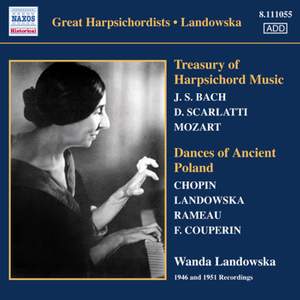
| |  | Great Harpsichordists - LandowskaTreasury of Harpsichord Music & Dances of Ancient Poland
anon.: | The Nightingale | Bach, J S: | Fantasia in C minor, BWV919 | Cato: | Chorea Polonica | Chambonnières: | Sarabande in D minor | Chopin: | Mazurka No. 34 in C major, Op. 56 No. 2 | Couperin, F: | Pièces de clavecin II: Ordre 6ème in B flat: Les baricades mistérieuses Pièces de clavecin IV: Ordre 23ème in F major: L'Arlequine Air dans le goût Polonois | Handel: | Keyboard Suite, HWV 430 in E major 'The Harmonious Blacksmith': Air & Variations | Landowska: | Bourée d'Auvergne The Hop | Mozart: | Rondo in D major, K485 Rondo alla Turca from Piano Sonata No. 11, K331 Minuet in D major, K355 | Oginski, M K: | Polonaise in A minor 'Farewell to the Homeland' Polonaise in G major | Polonais: | Gagliarda | Purcell: | Ground in C minor, ZD221 | Rameau: | La Dauphine Air grave pour les deux Polonois | Scarlatti, D: | Keyboard Sonata K443 in D major Keyboard Sonata K32 in D minor | trad.: | Three Polish Dances of the 17th Century | Vivaldi: | Concerto No. 1 in D major |
Recorded 1946 and 1951 | | | Usually despatched in 2 - 3 working days. |
|
|
| |  | Wanda Landowska - Dances of PolandA Treasury of Harpsichord Music
anon.: | The Nightingale | Bach, J S: | Keyboard Concerto in D major (after Vivaldi), BWV972 | Cato: | Chorea Polonica | Chopin: | Mazurka No. 34 in C major, Op. 56 No. 2 | Couperin, F: | Air dans le goût Polonois Pièces de clavecin II: Ordre 6ème in B flat: Les baricades mistérieuses Pièces de clavecin IV: Ordre 23ème in F major: L'Arlequine | Handel: | Keyboard Suite, HWV 430 in E major 'The Harmonious Blacksmith': Air & Variations | Landowska: | Bourrée D'Auvergne No. 2 | Mozart: | Turkish March Minuet in D major, K355 Rondo in D major, K485 | Oginski, M K: | Polonaise in A minor 'Farewell to the Homeland' Polonaise in G major | Polonais: | Gagliardi | Purcell: | Ground in C minor, ZD221 | Rameau: | Air grave pour les deux Polonois La Dauphine | Scarlatti, D: | Keyboard Sonata K443 in D major Keyboard Sonata K32 in D minor | trad.: | Three Polish Dances (17th Cent) The Hop (Wedding Folk Song) |
Mono | | | Usually despatched in 4 - 5 working days. |
|
|
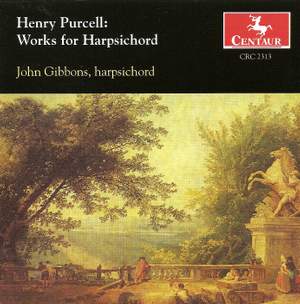
| |  | Purcell: Harpsichord Music
Purcell: | Ground in C minor, Zt 681 (from Ye Tuneful Muses) Song Tune in C major, Z 694 March in C major, Z 647 Minuet in A minor, Z 649 Minuet in A minor, Z 650 A New Scotch Tune Z 655 A New Ground in E minor, Z. T682 A New Irish Tune Z646 Riggadoon, Z653 Sefauchi's Farewell, Z656 Minuet in D minor, Z T688 Ground in D minor, ZD222 Ground in C minor, ZD221 Suite in C major, Z 665 Song Tune in C major, Z 695 March in C major, Z 648 New Minuet in D minor, Z 689 Suite No. 1 in G major, Z 660 Suite No. 2 in G minor, Z 661 Suite No. 3 in G major, Z 662 Suite No. 4 in A minor, Z 663 Suite No. 5 in C major, Z 666 Suite No. 6 in D major, Z 667 Suite No. 7 in D minor, Z 668 Suite No. 8 in F major, Z 669 |
John Gibbons (harpsichord) | |
|
| |  | Purcell: Eight Suites And Other Pieces
Malcolm Proud: (Harpsichord) | | | Usually despatched in 8 - 10 working days. |
|
|
| |
|