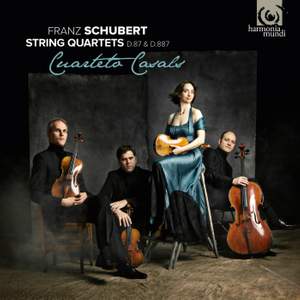
All recordingsPrices shown exclude VAT. (UK tax is not payable for deliveries to United States.) See Terms & Conditions for p&p rates. | |  | Schubert: String Quartets Nos. 10 & 15
For their first incursion into the works of Schubert on disc, the members of the Cuarteto Casals invite us to discover two quartets situated at the two extremes of the composer's life. Wrongly dated much later on its publication in 1830, the Quartet in E flat is in fact the work of a 16-year-old musician who had just entered teacher training college . . . Whereas its companion here was to be Schubert's very last quartet. Only 13 years separate the two pieces! But in the meantime a whole world had invaded his musical consciousness, and here the naivety of G major throws a deceptive veil over inner upheavals. “You’ll find plenty of Latin spirit in the Cuarteto Casals’s CD of two contrasting Schubert string quartets...Not all of the Casals’s current members are Spanish...But that never lessens the ensemble’s Latin passion and spunky attack. Their playing is a joy.” The Times, 27th July 2012 **** “Their account of the great G major is something out of the ordinary — I don’t recall a performance of this work in which Schubert’s existential angst is so relentlessly projected...The tragedy and drama of this music have rarely been so harrowingly delivered on disc.” Sunday Times, 22nd July 2012 “The excellent Spanish ensemble Cuarteto Casals...bring supple radiance and flair to these two works which span Schubert's brief career...Does music come any better?” The Observer, 22nd July 2012 “The Cuarteto Casals makes a clear distinction between the comparatively placid, sometimes lively progress of the early quartet and tough, symphonic nature of the G major work. The playing of the latter is strong, uncompromising, excellently structured and considered” International Record Review, September 2012 “Among modern performances I have heard none that surpasses this for obsessiveness. Even so, the Cuarteto Casals manage not to fall into the trap of making this an aural ordeal for the listener...but here there is unnerving exhilaration of riding in a fast vehicle that seems thrillingly unable to stop.” BBC Music Magazine, November 2012 ***** “these musicians shape the lines to reflect both poetry and youthful spirit. The Casals rightly scale down their their steely resolve that paid dividends in D887 but prefer detachment to ardour, particularly in the slow movement.” Gramophone Magazine, Awards Issue 2012 BBC Music Magazine
Disc of the month - November 2012 |
| | | In stock - usually despatched within 1 working day. |
|
|
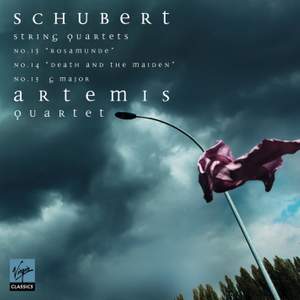
| |  | Schubert: String Quartets 'Rosamunde' & 'Death and the Maiden'
Following the Artemis Quartet‘s prizewinning Beethoven Quartet cycle on Virgin Classics, the Berlin-based ensemble has recorded Schubert’s last three quartets, works that Artemis cellist Eckart Runge praises for both their “incredible simplicity and purity” and their “almost terrifying modernism”. Awarded both Germany‘s prestigious Klassik ECHO award and France’s Grand Prix de l’Académie Charles Cros in 2011 for their Virgin Classics Beethoven cycle, the members of the Artemis Quartet now release an all-Schubert CD. It presents the composer’s final three string quartets: No 13 in A minor, ‘Rosamunde’ (which draws on his incidental music for Helmina von Chezy’s play Rosamunde); No 14 in D minor, ‘Death and the Maiden’ (with its haunting second movement based on his song Der Tod und das Mädchen), and No 15 in G major. Schubert and Beethoven were contemporaries in Vienna, and Beethoven is reputed to have returned some of the younger composer’s admiration, but, as Eckart Runge, cellist of the Artemis Quartet points out: “In some senses, Beethoven and Schubert could hardly be more different.” He goes on to say that “The Artemis Quartet’s intensive experience of performing and recording the Beethoven cycle between 2009 and 2011 has provided new perspectives on every other quartet we play. There is an almost terrifying modernism in these three late Schubert quartets, but it is totally different from the modernism of Beethoven. And, when placed together in a programme, the three quartets shine in another light: No 14 is concentrated and dramatic; No 15 is huge, symphonic, and cosmic, and No 13 is introspective and melancholy – less spectacular than the other two. “Technically, the Artemis's performances are very fine indeed; their choice of tempi tends towards briskness, but the articulation and sense of phrasing are generally so well judged that only in the first movement of the D minor Quartet, D810, Death and the Maiden, does the result seem just a bit breathless.” The Guardian, 14th June 2012 **** “ferocious fortissimos, pianissimos of wonderful delicacy, infinite variety of textures and elasticity of tempo, combined with an implacable pursuit of the musical argument worthy of the divine huntress from whom they take their name. Their unanimity of sound is matched by — and evidently springs from — an extraordinary unanimity of feeling.” Sunday Times, 1st July 2012 “Bold, unflinching readings...that nevertheless offer playing of great delicacy and refinement in quieter passages. With some of the finest Schubert playing on disc...this is urgently recommended.” Classical Music, August 2012 ***** “Go straight to D810, Death and the Maiden. The two opening fortissimo motifs are like clarion calls. The Artemis Quartet are tersely explosive, fiery in attack, the sforzandos in the transition stabbing the air...the Artemis enlarge perceptions, push frontiers and perhaps question received wisdom.” Gramophone Magazine, September 2012 “The Artemis enjoy growling, clashing, shivering, and the relentless energy of the last movements. Theirs is an impressive, vividly recorded approach.” BBC Music Magazine, September 2012 **** | | | In stock - usually despatched within 1 working day. |
|
|
| |  | Schubert & Berg: String Quartets
Schubert’s late masterpiece for string quartet, his 15th and final quartet in G major D887, was composed in 1826. Although the first movement was performed at a Vienna Musikverein concert devoted to his music, he couldn’t find anyone to publish it. It displays an almost Beethovenian profundity, and is a dramatic departure from the two previous song-based quartets that had proved popular. The writing is assured and the harmonies audacious. It is a dark, rather introverted work, full of passionate outbursts and drama. Berg’s Quartet op.3 was premiered in 1911 towards the end of his studies with Schoenberg. It was badly received and baffled listeners and performers alike. Like the Schubert G major, it displays daring harmonies and a remarkable technical assurance. This CD is the Kuss Quartet’s debut on ONYX. They are regular performers at the Edinburgh and Salzburg festivals, and also perform regularly in New York, London and their home city of Berlin. | | | In stock - usually despatched within 1 working day. |
|
|
| |  | Schubert - String Quintet
“The Belcea Quartet throw every fibre of their beings into the most vivid projection of the masterpieces they undertake” (The Independent), The Belcea Quartet has added three late masterpieces by Franz Schubert to their impressive discography on EMI Classics: the Quartet in D Minor ‘Death and the Maiden’, the Quartet in G Major D887 and the sublime String Quintet in C Major with Valentin Erben of the Alban Berg Quartet as the second cellist. The Quartet in D minor ‘Death and the Maiden’ is one of two large-scale string quartets that Schubert composed in 1824. The subtitle refers to his famous song of the same name, the melody of which he used here as the basis for a set of variations in the second movement. The G Major Quartet of 1826 was the composer’s 15th and final string quartet. Its emotional and technical challenges were such that only the first movement was performed in public during Schubert’s lifetime and he was unable to find a publisher for it. The Quartet was first performed in its entirety in 1850 and was first published the following year. The String Quintet in C Major dates from the last months of Schubert’s life, in 1828. The addition of the cello makes for a rich texture and powerful sound where needed but not to the exclusion of exquisite, soft, ethereal sections. Corina Belcea-Fisher, first violinist of the Belcea Quartet said, “It is a great challenge to capture all the varied emotions of the piece, emotions that can switch from one second to the next. It has been a great privilege for us to explore this work with Valentin (Erben), to be able to draw from his resources and his knowledge.” From November 2009 until January 2010, the Belcea Quartet and Valentin Erben will make an extensive tour of Switzerland, France, Italy, Spain, Austria, Germany and Holland with a programme that includes the Schubert String Quintet. Their tour features a concert at London’s Wigmore Hall on December 10th. The Belcea Quartet was established at the Royal College of Music in 1994 and has since been coached by the Chilingirian, Amadeus and Alban Berg Quartets. It is the Associate Ensemble at London’s Guildhall School of Music and Drama and Quartet in Residence at Bucharest’s Atheneum Concert Hall. The Quartet’s engagements regularly take them to such prestigious international venues as Vienna’s Konzerthaus and Musikverein, Amsterdam’s Concertgebouw, Brussels’ Palais des Beaux Arts, Lisbon’s Gulbenkian, Zurich’s Tonhalle, Stockholm’s Konzerthuset, Paris’ Châtelet and Opera Bastille, Milan’s Sala Verdi, New York’s Carnegie Hall and Lincoln Center and San Francisco’s Herbst Theatre, and to festivals throughout Europe. In the UK they regularly appear at the Edinburgh, Aldeburgh, Perth, Bath and Cheltenham festivals, and at the Wigmore Hall, where they were the Resident String Quartet from 2001 to 2006. Leading instrumentalists with whom they collaborate include Thomas Adès, Piotr Anderszewski, Natalie Clein, Michael Collins, Imogen Cooper, Valentin Erben, Isabelle van Keulen, Paul Lewis and Yovan Markovitch, as well as singers Ann Murray, Simon Keenlyside, Lisa Milne, Anne Sofie von Otter, Angelika Kirchschlager and Ian Bostridge. The Belcea Quartet has recorded exclusively for EMI Classics since 2001 and won the Gramophone Award for best Debut recording that year. Subsequent recordings for EMI include Schubert quartets (E-flat Major D87, Quartettsatz D703, A Minor D804 ‘Rosamunde’), Schubert’s ‘Trout’ Quintet with Thomas Adès and Corin Long, Brahms’s String Quartet Op. 51 No. 1 and String Quintet Op. 111 with Thomas Kakuska, Fauré’s La Bonne Chanson with Ian Bostridge, a double disc of Britten’s string quartets, Mozart’s ‘Dissonance’ and ‘Hoffmeister’ quartets, and, most recently, the complete Bartók quartets, for which the Quartet was named Chamber Music Ensemble of the Year by Germany's prestigious Echo Klassik Awards and nominated for a 2008 Gramophone Award. "The Belcea Quartet play with fire in their blood … their performances are never short of thrilling.” (The Scotsman) “The traditionally ceremonial key of C major takes on a different hue in Schubert's Quintet. …the playing is on the loftiest level, ensemble always transparently clean; and the ability to think, listen and prepare as a coordinated team results in an extraordinarily cogent performance sure in its grasp of phraseology, structure and dynamics. ...in the last 17 bars of the slow movement... absolute mastery over hushed tone, diaphanous texture and instrumental balance produces an awed stillness of time-stopping beauty. Here is technique fully subservient to emotional force not only in this movement, with its charged F minor middle section, but throughout the whole work. Throughout the other works too. ...Schubert's last quartet, in scope probably his greatest and most disquieting, ends in an Allegro assai finale where the Belceas underlines its message of discomfiture in a tour de force of icy intensity.” Gramophone Magazine, December 2009 “The Belcea’s urgent reading of the quintet’s opening (quicker and spikier than usual) establishes instantly the music’s deeply ambiguous character... The players, while alive to its beauties and sublimities, have no time for the old fallacy about the supposed light-hearted mood of the finale, which ends — rightly — on a note of violent tension. The obsessive rhythms and harmonic disruptions of both quartets are also vividly caught.” Sunday Times, 22nd November 2009 **** “The Belcea Quartet's performances of all three works are beautifully judged and technically polished. There's something refreshingly brisk and business-like about their approach...but nothing is pressed too hard, and the pacing always seems natural.” The Guardian, 29th November 2009 **** “This is Schubert played with heart-stopping freshness, the composer as romantic rather than classicist...Superb.” The Observer, 29th November 2009 | | | In stock - usually despatched within 1 working day. |
|
|
| |  | Schubert - String Quartets
“These accounts of two of Schubert's wonderful quartets, recorded in 1936 and 1938, will never be equalled, for range of expression and depth of insight. The sound is amazingly good, and on all grounds this is an indispensable disc.” BBC Music Magazine, November 2006 ***** | | | In stock - usually despatched within 1 working day. |
|
|
| |  | Schubert: Complete String Quartets Vol. 1
“A fine, intelligent and intensive performance of the G major Quartet. ... finely-phrased full of telling dynamic contrasts, worthy to stand alongside the Juillard version and even the Busch Quartet’s masterly account” Classic CD | | | In stock - usually despatched within 1 working day. |
|
|
| |  | Schubert & Beethoven: String Quartets
The two masterful quartets by Schubert and Beethoven on this disc were composed in the same year, 1826. They are performed here by the superb New Orford String Quartet. Through its many tours and recordings both at home and abroad, the Orford String Quartet became one of Canada's best-known and most illustrious musical ensembles. After 26 years and more than 2000 concerts on six continents, the Quartet disbanded, giving its last concert on July 28, 1991. In July 2009 the New Orford String Quartet arose from the fame and tradition of its glorious predecessor, giving its first concert for a sold-out audience at the Orford Arts Centre. This disc marks the New Orford's debut recording. | | | Usually despatched in 2 - 3 working days. |
|
|
| |  | Schubert: Famous String QuartetsPremium Composer Volume 7
“Beautifully blended sound works well in the reflective lyricism of the Rosamunde Quartet.The outer movements of the Death and the Maiden could be more demonic.” BBC Music Magazine, June 2012 *** | | | (also available to download from $21.00) | Usually despatched in 2 - 3 working days. (Available now to download.) |
|
|
| |  | Schubert: Late String Quartets, Nos 13–15 & Quartettsatz
Schubert’s late chamber music traverses some of the darkest territory in the introspective world of chamber music. As is typical of the composer, several works draw their music and hidden narrative from songs, most notably ‘Death and the Maiden’, with its spooky tale of love and loneliness. Everywhere a breadth of expression is evident, in long-breathed melodies, spacious developments and (in final movements) limitless reiteration of small motivic units towards conclusions of emphatic strength and resolution. These are works that take the time they need to say what they want to say, and they are marked by continual emotional turbulence, even obsession. The Guarneri Quartet were remarkable both for their longevity and their consistency of achievement until their retirement in 2007. They were a smoothly integrated ensemble almost from the start of their association in 1961, as a record executive recognised when he went to one of their early concerts and quickly signed them up. They went on to record all the standard repertoire of the genre and much more besides, and with a sweetness worthy of the instruments of their eponymous violin-maker’s name. “Lovely playing, as nearly always from these artists... The Quartettsatz was written four years before the A minor Quartet. There’s certainly no lack of shivers and shudders here: indeed, you get the impression that the
players were deliberately saving up all their disquiet for the key of C minor. The recording quality is very natural throughout.” Gramophone Magazine, February 1973 | | | Usually despatched in 2 - 3 working days. |
|
|
| |  | Schubert - String Quartets Nos. 10 & 15
The International Hugo Wolf Society of Vienna allowed this ensemble, founded in 1993 at the Vienna University for Music, to use the composer’s name. Shortly after, the quartet won the Fifth International String Quartet Competition in Cremona. What sets this quartet apart is its keen and insightful programming of the music of the Viennese Schools. | | | Usually despatched in 2 - 3 working days. |
|
|
| |
|