Prices shown exclude VAT. (UK tax is not payable for deliveries to United States.) See Terms & Conditions for p&p rates. | |  | Guitar - Greatest Works
Albéniz: | Córdoba (from Chants d’Espagne Op. 232) Sevilla (from Suite Española, Op. 47) | Beethoven: | Adelaide, Op. 46 | Brahms: | Wiegenlied, Op. 49 No. 4 (Lullaby) | Debussy: | Golliwog's Cakewalk (from Children's Corner) | Falla: | Polo (No. 7 from Siete canciones populares españolas ) Canción (No. 6 from Siete canciones populares españolas) El sombrero de tres picos: Danza del molinero (farruca) | Fürstenau, C: | Pieces (12) for flute & guitar, Op. 34: excerpts | Galilei, V: | Counterpoint for two guitars | Marais, M: | Les Folies d'Espagne, 32 Variations pour flûte seule | Martin, F: | Quatre Pieces Breves | Mendelssohn: | Auf Flügeln des Gesanges, Op. 34 No. 2 | Mozart: | Abendempfindung an Laura, K523 | Narvaez: | Diferencias on Guardame las Vacas Tres diferencias por otra parte Canción del Emperador (sobre "Mille Regretz" de Josquin des Prez) Baxa de contrapunto | Paganini: | Sonata for violin & guitar in A major, Op. 3 No. 1, MS 27/1 Sonata for violin & guitar in A major, Op. 3 No. 5, MS 27/5 Sonata for violin & guitar in E minor, Op. 3 No. 6 | Rodrigo: | Invocación y danza | Schubert: | Ständchen 'Leise flehen meine Lieder', D957 No. 4 Der Unglückliche, D713 | Sor: | L'Encouragement, Op. 34 | Vivaldi: | Trio Sonata for Violin, Lute and Basso Continuo in C major, RV 82 |
Klaus & Rainer Feldman, Monika & Jurgen Rost, Eckart Haupt & Christian Funke 2CDs for price of 1 This comprehensive collection includes works for two guitars, solo guitar, flute and guitar and violin and guitar. | | | In stock - usually despatched within 1 working day. |
|
|
| |  | La VihuelaThe Orphic Instruments of Spain
Joachim Gassman (cello), Julia Fritz (recorder), Imma Einsingbach (soprano), Franziska Konig (violin) The Spanish vihuela has taken a special place in the music of the 16th century. It is a cosmos of its very own, or rather a comet which blazed across the sky at about 1500 and soon after 1560/70 ceased to glow, not finding a real successor. It is courtly art – as such intended to please and delight to the listener – and by all means on a par with Spanish organ music in its compositional quality and earnestness. If it admits influences from abroad then only from the pinnacles of European music, works from Josquin, Richafort and other internally renowned composer of that time. The composers of the villancicos, fantasias, recercadas, canciones and, above all, the diferencias (formerly a novelty in Europe: the variation) were typical expressions of the Renaissance. They were educated, often engaged in various areas of artwork, for example, the poet Juan de Encina, or Luis de Milán who emulating the Italian role model of Castiglione wrote a book about the courtier, which dealt with the virtues distinguishing the nobleman at court. They were poetical composers of wonderful songs and, at the same time, austere counterpointers who elaborated congenially simple polyphonies which, however, particular for this reason touch us so strongly. To them, vocals and the vihuela belonged together. This is obvious in their efforts to merge with the succession of mythological vocalists. For example, the frontispiece of “El Maestro” (Valencia 1535) by Luis de Milán displays a representation of Orpheus as a singer who naturally plays the vihuela. Or Luis de Narváez has the image of the singer Arion precede his work “Los seys libros de Delfin” (Valladolid 1538), showinghow Arion is rescued from distress at sea by the dolphins he had summoned with his chant (which, of course, is accompanied by the vihuela). Hence the canciones and vilancicos accompanied by the vihuela certainly are the vihuela’s most significant contribution to the history of Spanish music. | | | (also available to download from $10.50) | Usually despatched in 4 - 5 working days. (Available now to download.) |
|
|
| |  | La Guitarra Española
José Miguel Moreno (vihuela, baroque guitar, classical-romantic guitar, post-romantic guitar) There is no question of José Miguel Moreno being anything other than the leading Spanish specialist in historical plucked string instruments. As a concert performer, researcher, builder and collector of instruments and co-founder of the Glossa label, Moreno has, over the last 30 years, been the guiding beacon for a number of succeeding generations of guitarists and lutenists the world over. Glossa was the label for which he recorded two of his now legendary programmes, La Guitarra Española (1536-1836) and La Guitarra Española (1818-1918). These had previously been deleted but Glossa are now bringing them back as a double set. Moreno plays a range of instruments made either by Lourdes Uncilla or by himself in order to infuse with a new vitality the fundamental repertories in the history of the guitar as bequeathed by the vihuelists Narváez, Milán and Mudarra, then later composed by figures such as Francisco Guerau, Santiago de Murcia and Gaspar Sanz, and subsequently through the romantic scores of Fernando Sor and Johann Kaspar Mertz. Tárrega and Llobet, the great masters of post-Romanticism, close this survey striding with infinite musicality across the most representative compositions of four centuries of the Spanish guitar. This special edition marks, as well, the departure point of a new process of collaboration between José Miguel Moreno and the label which he helped to create, with brand new recordings being planned, which will appear from the autumn of this year onwards. | | | (also available to download from $20.75) | Usually despatched in 3 - 4 working days. (Available now to download.) |
|
|
| |  | Madame d'amoursRennaissance Consort Music
Kate Clark (recorder & direction) The Attaignant Consort The elegant, keyless, cylindrical flute of the sixteenth century had a reedy, penetrating sound, closer to the cornetto than to any other wind instrument of the day. It had an impressive range of two and a half octaves and an evenness of tone quality that would not be matched again until the nineteenth century. The pieces on this recording focus on repertoire for the renaissance flute consort, almost all of which was originally vocal music. | | | (also available to download from $10.50) | Usually despatched in 4 - 5 working days. (Available now to download.) |
|
|
| |  | A Tribute to Andrés Segovia
Bach, C P E: | March attrib. to J S Bach Siciliana in F sharp minor | Brahms: | Waltz, Op. 39 No. 8 in B flat major | Castelnuovo-Tedesco: | Tonadilla on the name of Andrés Segovia, Op. 170, No. 5 | Chopin: | Prelude Op. 28 No. 7 in A major | Debussy: | Préludes - Book 1: No. 8, La fille aux cheveux de lin | Franck, C: | L'Organiste (extracts) Two pieces for organ | Haydn: | Menuet & Trio from String Quartet, Op. 76 No. 1 in G major | Milhaud: | Segoviana | Mussorgsky: | Pictures at an Exhibition: The Old Castle | Narvaez: | Canción del Emperador (sobre "Mille Regretz" de Josquin des Prez) | Ponce, M: | Preludio for Guitar | Roussel: | Segovia for guitar, Op. 29 | Schumann: | Romanza | Scriabin: | Prelude, Op. 16 No. 4 in E flat minor | Segovia: | Canciones populares de distintos paises World Premiere Recording Estudio sin luz La Marcarena Preludio No. 14 Para Deli World Premiere Recording Estudio Allegretto World Premiere Recording | Tansman: | Segovia World Premiere Recording |
| | | Usually despatched in 4 - 5 working days. |
|
|
| |  | Segovia - 1950s American Recordings Volume 41952-1957 Recordings
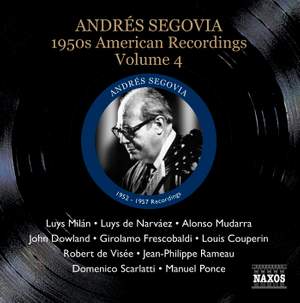
Volume 4 of Segovia’s 1950’s American recordings is devoted in the main to his arrangements of music composed between 1535 and 1750. Although today it is customary to play this repertoire on reproductions of instruments authentically modelled on concepts of musicological research, Segovia preferred the 20th Century guitar to all other instruments as an expressive medium. To his interpretations of the 16th century works of Milan, Narvaez, Mudarra and Dowland, as well as the Baroque guitar of Robert de Visee and transcriptions from Scarlatti or Rameau, Segovia brings the same application of colour, variety of dynamics and rhythmic freedom as he applied to romantic pieces. This full blooded approach to early music was greatly appreciated during his lifetime and often provided one of the few opportunities for the general public to become acquainted with this area of the repertoire. “Apart from two suits by Ponce, the repertoire here is genuine Renaissance and early Baroque. Segovia's approach may make early-music purists wince, but he still makes undeniably beguiling music.” BBC Music Magazine, April 2008 **** | | | (also available to download from $8.75) | Usually despatched in 2 - 3 working days. (Available now to download.) |
|
|
| |  | The Art of Melancholy
Monika Mauch & Natacha Ducret (soprano), Pascal Bertin (alto), Otto Rastbichler, Eitan Sorek & Josep Benet (tenor), Josep Cabré (baritone), Stephan Macleod, Daniele Carnovic & Paul Willenbrock (bass) Ensemble Daedalus, Roberto Festa (recorder & direction) Roberto Festa and his Ensemble Daedalus present a superbly expressive picture on the subject of “melancholy” in 16th and 17th century music. | | | Usually despatched in 2 - 3 working days. |
|
|
| |  | Segovia - The Great Master
Castelnuovo-Tedesco: | 5 Pieces from "Platero y yo", Op. 190 Quintet for guitar and string quartet, Op. 143 with strings of the Quintetto Chigiano | Dowland: | Captain Digorie Pipers Galliard First release on CD Allemande | Esplá: | Dos Impresiones Levantinas | Handel: | Suite in G minor, HWV 453: Allegretto grazioso Gavotte in G major, HWV 491 (transposed to A major) Minuet in G major, HWV 531 (transposed to D major) | Lauro: | Vals venezolano No. 3 'Vals criollo' or 'Natalia' | Milán: | Pavane Nos. 5 & 6 First release on CD | Narvaez: | Canción del Emperador (sobre "Mille Regretz" de Josquin des Prez) Variation on "Guárdame las vacas" | Ponce, M: | Canción Canción y Paisaje Preambulo (originally attributed to A. Scarlatti) Gavotta (originally attributed to A. Scarlatti) Prelude / Ballet and Gigue (originally attributed to S.L. Weiss) First release on CD Six Preludes First release on CD Valse | Scarlatti, D: | Keyboard Sonata K391 in G major | Tansman: | Suite in Modo Polonico First release on CD | Torroba: | Albada (from: Piezas características) First release on CD Sonatina in A major for solo guitar | Villa-Lobos: | Etude for Guitar, W 235 No. 8 in C sharp minor First release on CD Etude for Guitar, W 235 No. 1 in E minor First release on CD | Visée: | Passacaille First release on CD | Weiss, S: | Fantasie |
| | | Usually despatched in 8 - 10 working days. |
|
|
| |  | La Guitarra Española (1536-1836)Music for vihuela, baroque guitar and romantic guitar
| |
|
| |  | Love and ReconquestMusic from Renaissance Spain
Frances Cooper (soprano), Jo Hugh-Jones (bass and recorders), Gordon Ferries (vihuela and Renaissance guitar), Marcus Claridge (percussion) Scottish early music ensemble Fires of Love serve up a feast of songs and ballads from the Spanish Renaissance and early Baroque, with a freshness critic Norman Lebrecht calls simply ‘beautiful’. Repertoire includes works by Luys de Narváez, Miguel de Fuenllana, Luis Milán, Alonso Mudarra and Juan del Encina. "... full of vitality and will soon have your foot tapping... delightfully sung." - Early Music News, April 2002 “another well-produced disc from the Edinburgh-based company Delphian…reaching those parts of the repertoire many of the bigger boys fail to reach’” The Scotsman | | | Usually despatched in 3 - 4 working days. |
|
|
| |
|