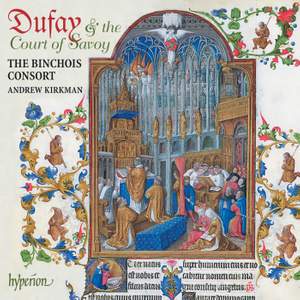
Prices shown exclude VAT. (UK tax is not payable for deliveries to United States.) See Terms & Conditions for p&p rates. | |  | Dufay & the Court of SavoyMissa Se la face ay pale and other works
The Binchois Consort’s first recordings of Dufay for Hyperion achieved iconic status, winning a Gramophone award along the way. Despite the proliferation of early music groups recording Dufay in their wake, the Binchois remain the ultimate musical authority on this great composer. Their latest recording contains what many consider to be Dufay’s masterpiece. His Missa Se la face ay pale is one of the best known, and perhaps most revered, of all polyphonic masses. Indeed, it is a work of such renown that it enjoys a special kind of status among Renaissance mass cycles. Along with a handful of other such works, it has become a touchstone for the idea and structural design of the unified cantus firmus mass, a classic exemplification of the musical style and achievement of an era. The work is presented here, however, not as a five-movement sequence but in a more differentiated and perhaps more appropriate dramatic fashion, interspersed with music in a contrasting style for the Proper of the Mass (also five movements: Introit, Gradual, Alleluia, Offertory, Communion). The programme is completed by two motets and the ballade on which the mass is based. This recording evokes in sound something of the cultural achievement and brilliance of the Court of Savoy at its first peak of maturity, during the middle decades of the fifteenth century. The musical works performed here complement and enrich the historical picture of the late-medieval and Renaissance duchy that can be gleaned from the archives, libraries and museums. Live sound vividly extends and deepens the scope of such a picture, just as does an appreciation of the geographical and architectural settings which are the physical stage for such cultural developments. “…the Binchois Consort… sounds both transparent and natural. The balance is superb; and all lines are presented in a free and supple manner that projects the music very well. This is easy, effortless musicianship.” Gramophone Magazine, March 2009 “Half a dozen recordings of Dufay's Missa Se la face are available but Kirkman's sweeps the board. …he employs just one singer per part, creating performances of great clarity, pliancy and historical value. The sound is close and clean, lending a spare, translucent edge to the beautifully sung plainsong sections of the Alleluia Iudicabunt and the intricate textures of the Credo.” BBC Music Magazine, March 2009 ***** “ Se la face ay pale remains Dufay's most approachable Mass – very much a tune with accompaniment, one that is assembled as though elegance of line was Dufay's main criterion of musical excellence. And Andrew Kirkman chooses to treat it as such: at least, he essentially persuades the singers on the contratenor line to keep well down so that borrowed melody in the tenor can come through while allowing the top line to stand out as it must. What the Binchois Consort do here sounds both transparent and natural. The balance is superb; and all lines are presented in a free and supple manner that projects the music very well. This is easy, effortless musicianship. Meanwhile Kirkman intersperses the five Ordinary movements with movements for the Proper for St Maurice. Much of the music is in three or two voices only, so sounding different from the Missa Se la face ay pale and contrasting with it neatly. Only the glowing Offertory is in four voices. Metrical complexities in the Alleluia and in the Offertory add neat spice to the music. Special credit here should be given to the soloists who sing the long and exposed duos: these have lines and phrases that seem to go on for ever, so they are astonishingly hard to sing, and these musicians do them marvellously. To fill out the disc they perform three more Dufay pieces that can be associated with the court of Savoy: the song Se la face ay pale is heard in the rarer four-voice version that may not have anything to do with Dufay but is delightful and eminently worth hearing, especially in a spirited performance like this; the famous Lament forConstantinople, a touch less transparent than one might wish; and the motet Magnanime gentis, sounding as though it was done in a hurry at the end of an exhausting session.” Gramophone Classical Music Guide, 2010 | | | In stock - usually despatched within 1 working day. |
|
|
| |  | Les Haulz et les Bas: ad modum tubae
This collection features music from the late Middle Ages using long straight trumpets, shawms, bagpipes and percussion. This type of ensemble came to Europe from the Far and Middle East, along the ancient trade routes. Les Haulz et les Bas is one of Europe’s most active alta capella ensembles. They have given lectures and masterclasses at the Universities of Oxford and London. | | | Usually despatched in 2 - 3 working days. |
|
|
| |  | Espris d’Amours: Miniatures flamandes
Capilla Flamenca, Marnix De Cat All the compositions in this collection are linked to the golden age of Flemish manuscript production in the fifteenth century. Included are works by Guillame Du Fay, Gilles Binchois and Walter Frye. The accompanying book is beautifully illustrated. “Any CD from this superb Belgian ensemble is a cause for celebration, but this recording of 15th-century music associated with the golden age of book illumination is a pure joy.” Early Music Review, February 2012 | | | Usually despatched in 2 - 3 working days. |
|
|
| |  | Sacred Songs and Folk Music from Renaissance Germany
Ciaramella, Adam and Rotem Gilbert | | | (also available to download from $6.00) | Usually despatched in 2 - 3 working days. (Available now to download.) |
|
|
| |
|