Chopin: Piano Trio in G minor Op. 8

This page lists all recordings of Piano Trio in G minor Op. 8, by Frédéric François Chopin (1810-49) on CD & download (MP3 & FLAC). Generally, more recent releases are listed first, but with priority given to those that are in stock.

Prices shown exclude VAT. (UK tax is not payable for deliveries to United States.)
See Terms & Conditions for p&p rates.

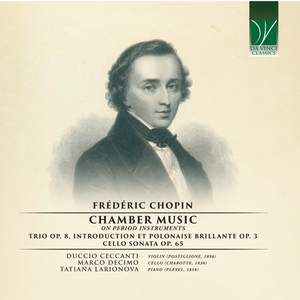
Chopin: Chamber Music

Chopin: Chamber Music


Chopin:

Cello Sonata in G minor, Op. 65

Introduction and Polonaise Brillante in C, Op. 3

Piano Trio in G minor Op. 8

Jakub Jakowicz (violin)


Jan Krzsztof Broja (piano), Andrzej Bauer (cello)

The latest release in this very well received series features the chamber works of Chopin. Broja has won many awards and has been acclaimed in the major concert halls of Eastern Europe. Bauer is also a prize winner and won a scholarship to study with William Pleeth.

“All the performers here are fine musicians, and the use of an 1849 Érard piano adds a four-dimensional perspective...An interesting release for the historically minded” BBC Music Magazine, December 2010 ***

Frederick Chopin Institute - The Real Chopin - NIFCCD013

(CD)

$17.75

In stock - usually despatched within 1 working day.

Trio Chausson play Chopin & Liszt

Trio Chausson play Chopin & Liszt


Chopin:

Introduction and Polonaise Brillante in C, Op. 3

Piano Trio in G minor Op. 8

Liszt:

Tristia, S723 (arranged from Vallée d'Obermann S160/6)


Trio Chausson

Frederic Chopin’s Polonaise Brillante, Op. 3, is one of the few pieces this composer ever wrote for an instrument besides piano. Written when he was only 19 years old, in the autumn of 1829, Chopin had fallen head over heels for a young woman in Warsaw. Unfortunately for Chopin, the love was unrequited. Chopin's father, in hopes of easing Chopin's heartbreak took his son on a week-long trip to visit the estate of Prince Radziwill, who had two beautiful young daughters. At least one of the daughters, Wanda, was a pianist. He composed the Polonaise Brillante for her to practice with her cello-playing father. Chopin wrote later to a friend that the piece was merely a salon piece to be enjoyed casually and that he had written it in a manner so as to show off the young Wanda's pretty fingers. However, he must have held it in some high regard, for he included it on a concert tour in 1830, dedicating it to Joseph Merk, a renowned cellist. Chopin also later added an introduction to the Polonaise, making the piece Introduction and Polonaise Brillante. His friend, the great cellist August Joseph Franchomme, helped Chopin make necessary revisions before its publication in 1833.

Mirare - MIR089

(CD)

$18.50

In stock - usually despatched within 1 working day.

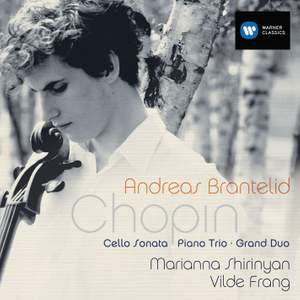
Chopin - Cello Music

Chopin - Cello Music


Chopin:

Cello Sonata in G minor, Op. 65

with Marianna Shirinyan (piano)

Piano Trio in G minor Op. 8

with Vilde Frang (violin) & Marianna Shirinyan (piano)

Grand Duo for Cello and Piano (on themes from Meyerbeer's Robert le Diable)

with Marianna Shirinyan (piano)


Andreas Brantelid (cello)

“In the Rococo Variations [Brantelid] is magnetic throughout, characterising each variation compellingly, with rubato finely controlled. His spontaneity in the little cadenza-like links is most persuasive too and that leads to an impulsive account of the last variation and the coda, with flawless double stopping.” (Gramophone)

Frédéric Chopin had been living in Paris only a matter of months when he was commissioned by the publisher Schlesinger in 1831 to write a work based on themes from Meyerbeer’s opera Robert le Diable, which had premiered some weeks earlier. The result was the Grand Duo for cello and piano. For assistance with the cello part, Chopin turned to a new acquaintance, the cellist Auguste Franchomme, who subsequently became a close friend and for whom he composed the Sonata in G minor 14 years later. The G minor Trio dates from 1828-29 and was dedicated to Prince Antoni Radziwill, an arts patron and amateur cellist. Chopin composed it in Poland but the work remained unpublished until 1833, by which time the composer was already living in Paris.

Andreas Brantelid (b. 1987), one of Scandinavia’s leading cellists, is quickly establishing an international reputation. Winner of a 2008 Borletti-Buitoni Trust Fellowship and a current member of the BBC’s New Generation Artist scheme, Brantelid was nominated for the European Concert Hall Organization’s "Rising Star" scheme in 2008-2009 and has performed in, among others, the Concertgebouw Amsterdam, Musikverein Vienna, Palais des Beaux Arts Brussels and Philharmonie Cologne.

Brantelid, who made his solo debut with orchestra at the age of 14 with the Royal Danish Orchestra, Copenhagen in the Elgar Cello Concerto, has since appeared with all the major orchestras in Scandinavia. He is the first Scandinavian to win 1st Prize in the Eurovision Young Musicians Competition (2006) and in the Paulo International Cello Competition (2007) and was Danish Radio’s “Artist in Residence, 2007.”

Brantelid made his Wigmore Hall debut in 2008 with the Swedish pianist Bengt Forsberg, with whom he collaborates regularly. He also performs frequently at important festivals including Risør and Bergen in Norway, Kuhmo in Finland and the City of London and Cheltenham Festivals in the UK.

He has been invited to join the New York Lincoln Center’s 'Chamber Music Society Two' programme for three seasons from 2009/10, with his first appearance in December 2009. Also this season, he performs with the Gothenburg and Hamburg symphonies, BBC Philharmonic and the Vienna Chamber Orchestra. He makes his debut at Carnegie Hall, gives recitals in London, Paris and the world premiere of Niels Rosing-Schow’s Cello Concerto with the Danish National Radio Symphony Orchestra.

Pianist Marianna Shirinyan hails from Yerevan, Armenia, where she began her piano studies before moving to Hamburg to work with Mathias Weber. She has also studied chamber music with Thomas Brandis and Maria Egelhof and is currently at the Musikhochschule Lübeck studying with Konrad Elserm, having won several competitions along the way in Germany, Spain, Italy and Denmark, most recently the annual prize of the Danish Music Critics’ Association in 2009. Shirinyan is establishing herself on the international stage as a soloist and chamber musician, working with such artists as Christian Altenburger, Shmuel Ashkenasi, Boris Baraz, Thomas Brandis, Wolfgang Bötcher, Ana Chumachenko, Ivry Gitlis, Ida Haendel, Midori and Pavel Vernikov and closely involved with the Schleswig-Holstein Music Festival as a coach for piano chamber music at its Orchestral Academy. Marianna Shirinyan has been a member of the Esbjerg Ensemble in Denmark since 2003.

Vilde Frang, the young Norwegian violinist and protégée of Anne Sophie Mutter, made her debut at the age of 10 with the Norwegian Radio Orchestra and was subsequently engaged by Mariss Jansons to perform with the Oslo Philharmonic. She has since performed extensively in Scandinavia, the UK, Germany, Switzerland and the Baltic countries and has appeared at international festivals in Verbier, Schleswig-Holstein, Mecklenburg-Vorpommern and Lucerne. Frang has performed in concert with Martha Argerich, Renaud and Gautier Capuçon, Gidon Kremer, Yuri Bashmet and Maxim Vengerov and has toured Europe and the United States with Anne-Sophie Mutter and Camerata Salzburg. The winner of a 2007 Borletti-Buitoni Trust Fellowship and of the 2009 Norwegian Soloist award, Frang recently signed with EMI Classics. Her debut release, scheduled for January 2010, features the Sibelius Violin Concerto and three Humoresques and Prokofiev’s Violin Concerto No. 1 with the WDR Sinfonieorchester Köln and conductor Thomas Søndergård.

“[Brantelid’s] interpretations...reveal a stylistic insight, elegance and emotional power to match his striking technical aplomb. This is an imaginative and fruitful combination of young talents on a disc that will be relished long after the bicentenary year is over.” The Telegraph, 26th January 2010 *****

“The Danish cellist Andreas Brantelid is only 23, but, with his Armenian pianist, he reveals astonishing maturity, bringing youthful freshness and vigour to a work championed on disc by Rostropovich and du Pré” Sunday Times, 7th March 2010 ****

“Brantelid's performance with the vivacious violinist Vilde Frang is entrancing. They draw us in to an engaging narrative and enjoy the play in the finale...an impressive cellist and definitely one to watch.” BBC Music Magazine, April 2010 ****

“Brantelid’s ability to reach the emotional core of a work is as evident here as on his previous disc, particularly in the Sonata...The overall sound is warm, technically perfect, and imbued with a youthful enthusiasm that is underpinned by interpretational maturity.” Charlotte Gardner, bbc.co.uk, 15th January 2010

EMI - 6877422

(CD)

$12.50

In stock - usually despatched within 1 working day.

Chopin, Rachmaninov & Shostakovich: Piano Trios

Chopin, Rachmaninov & Shostakovich: Piano Trios


Chopin:

Piano Trio in G minor Op. 8

Liszt:

Tristia, S723 (arranged from Vallée d'Obermann S160/6)

Rachmaninov:

Trio élégiaque No. 1 in G minor, Op. post.

Shostakovich:

Piano Trio No. 1 in C minor, Op. 8


Trio D’Ante Vienna

1CD (+Bonus DVD)

Gramola - GRAM98934

(CD)

$18.50

(also available to download from $11.00)

Usually despatched in 2 - 3 working days. (Available now to download.)

Chopin: Cello Sonata & Piano Trio

Chopin: Cello Sonata & Piano Trio


Chopin:

Cello Sonata in G minor, Op. 65

Abdel Rahman el Bacha (piano) & Antoine Pierlot (cello)

Piano Trio in G minor Op. 8

Olivier Charlier (violin), Abdel Rahman el Bacha (piano) & Antoine Pierlot (cello)


This live recording features two lesser known works by Chopin, performed by three first-class musicians. Olivier Charlier writes; “…this trio gives us the opportunity to hear how the genius of young talent within Chopin partially opened the door on chamber music, before devoting himself more exclusively to his ivory keys.”

Transart - TR171

(CD)

$17.75

Usually despatched in 2 - 3 working days.

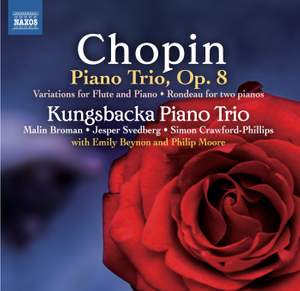
Chopin: Piano Trio, Op. 8

Chopin: Piano Trio, Op. 8


Chopin:

Rondo in C major for two pianos, Op. 73

Variations for flute and piano in E major, B 9

Emily Beynon (flute) & Philip Moore (piano)

Waltz No. 20 in F sharp minor, Op. posth., KK Ib/7 'Mélancolique'

Mazurka in D major (1832)

Piano Trio in G minor Op. 8


Kungsbacka Piano Trio

Exploring the byways of Chopin’s work reveals gems such as the elegant Rondeau for two pianos, and the Variations for flute and piano on a theme by Rossini then at the height of his popularity. The substantial Piano Trio Op. 8, dedicated to the cello-playing Prince Antoni Radziwill of Poznañ, is a work in which Chopin allowed his Polish patriotism to be heard. Of the Kungsbacka Piano Trio The Strad asked “is there a better Trio ensemble in Western Europe?”

“This CD opens with an enchanting, 1828 Rondo...it proves a fresh and joyous discovery, treated with plenty of TLC by the engaging duo of Simon Crawford-Phillips and Philip Moore...The Kungsbacka Trio balance the three instruments with care [in Op. 8], and they apply a good sense of early Romantic-period ethos, involving gentle string tone and plenty of portamentos.” BBC Music Magazine, February 2012 ***

Naxos - 8572585

(CD)

$8.50

(also available to download from $6.25)

Usually despatched in 2 - 3 working days. (Available now to download.)

Chopin & Schumann: Piano Trios in G Minor

Chopin & Schumann: Piano Trios in G Minor


Chopin:

Piano Trio in G minor Op. 8

Schumann:

Piano Trio No. 3 in G minor, Op. 110


Manhattan Piano Trio: Wayne Lee (violin), Dmitry Kouzov (cello), Milana Strezeva (piano)

The two piano trios coupled on this CD, Chopin’s Trio in G minor opus 8, and Schumann’s Trio opus 110 No. 3, also in G minor, were both written during the first half of the 19th century. They are performed by the exciting young American group, the Manhattan Piano Trio.

Since its inception in 2004, the Manhattan Piano Trio has quickly become one of the most creative, exciting, and dynamic young ensembles in the United States. With more than 300 concerts in its first five seasons alone, it is one of the most active groups in the classical music scene, and has won many prestigious awards, including prizes at the 2006 Plowman Chamber Music Competition and the 2007 Yellow Springs Chamber Music Competition.

Frederick Chopin wrote his Piano Trio in G minor, his only work for this particular combination, in 1830. He was only 19 years old, and consequently the piece is infused with a sense of youthful exuberance. Robert Schumann’s Piano Trio in G minor was written in 1851 and first performed publicly in Leipzig in 1852. It is dedicated to Danish composer Niels Gade.

Marquis - MARQUIS81411

(CD)

$16.25

Usually despatched in 4 - 5 working days.

Chopin: The Complete Chamber Works

Chopin: The Complete Chamber Works


Chopin:

Polonaise brillante Op. 3 for cello & piano

Piano Trio in G minor Op. 8

with Bartłomiej Nizioł (violin)

Grand Duo for Cello and Piano (on themes from Meyerbeer's Robert le Diable)

Cello Sonata in G minor, Op. 65


Marek Szlezer (Pleyel’s piano dating from 1845) & Jan Kalinowski (cello)

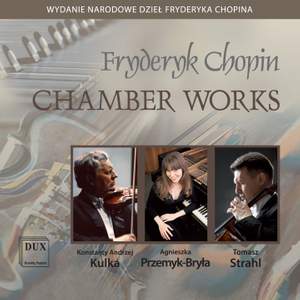
This delightful release draws the Chopin bicentenary year to a close with a recording of the complete chamber works of Chopin. In this recording the musicians use the first French edition of Chopin’s work from the collection of the Historical-Literary Society and the Polish Library in Paris. The Pleyel piano used dates from 1845 and once fully renovated was donated to the society in 2006 and is on permanent display devoted to the composer.

Dux - DUX0755

(CD)

$19.00

Usually despatched in 4 - 5 working days.

Chopin - Chamber Music

Chopin - Chamber Music


Chopin:

Cello Sonata in G minor, Op. 65

Carter Brey (cello)

Introduction and Polonaise Brillante in C, Op. 3

Carter Brey (cello)

Grand Duo in E KKIIb/1

Carter Brey (cello)

Piano Trio in G minor Op. 8

Leila Josefowicz (violin) & Carter Brey (cello)


While there is no composition by Chopin that does not involve the piano, the cello is the only other instrument for which he wrote any significant music. His first effort was a polonaise written in 1829 when he was visiting the home of Prince Radziwill, governor of the Principality of Poznan and himself a composer and cellist of sorts. Writing to his friend Tytus Woyciechowski in November, he is rather dismissive of his ‘alla polacca’ describing it as ‘nothing more than a brilliant drawing-room piece suitable for the ladies’. He hoped that the Prince’s daughter, Wanda, would practise the piano part (he was supposed to be giving her lessons) in which case she must have been an accomplished pianist, though her father would not have found the cello part over-taxing. The following year Chopin added an introduction, inspired by his friendship in Vienna with the cellist Joseph Merk. The Introduction and Polonaise brillante in C major for piano and cello Op 3 was dedicated to Merk. Carl Czerny (1791–1857) produced a piano solo version of the work but in the 1980s an arrangement by Chopin himself was unearthed.

The Piano Trio in G minor Op 8 was composed a year earlier, in 1828, for private performance at ‘Antonin’, the home of Prince Radziwill. This is Chopin’s only example of writing for the violin, and it shows a surprising lack of flair (in the first movement, for instance, the violinist rarely moves out of first position). It is a genial work in four movements (Allegro con fuoco, Scherzo, Adagio sostenuto and an Allegretto finale) but there is little of the interplay between the three instruments of the kind that makes the trios of Beethoven, Schubert and Hummel such a delight. Chopin seems hampered by the confines of classical procedures, working ideas through dutifully rather than with individuality and imagination, though various commentators have praised the Trio as ‘one of the most perfect and, unfortunately, most neglected of Chopin’s works’ (Charles Willeby) and wondered why ‘so graceful and winning a piece is not more of a staple in the concert hall’ (Emanuel Ax).

In the chronology of works for cello and piano, the Grand Duo in E major on themes from Meyerbeer’s Robert le Diable comes next. The opera had a sensational premiere in Paris on 21 November 1831. Set in thirteenth-century Sicily, the libretto, ‘in which the grotesque is carried to the point of absurdity’ (Kobbé), was saved by Meyerbeer’s brilliant score, and the work made a fortune for the Paris Opéra. Its themes attracted dozens of composers including Thalberg, Kalkbrenner, Herz and Liszt. Chopin was commissioned by his publisher Schlesinger to write this potpourri, a brilliant display piece of the kind that was so popular in the Parisian salons of the time. After the piano’s Largo introduction, among the themes used are the Romanza and the chorus ‘Non pietà’ from Act 1, and ‘Le mie cure ancor dei cielo’ (Act 5). Composed in 1831, it is one of only four Chopin works published in his lifetime without an opus number and the only one to be composed in collaboration, in this case with his friend the cellist August Franchomme.

‘I write a little and cross out a lot’, Chopin wrote to his sister during the composition of his final major work, the Cello Sonata in G minor Op 65, written in Paris in 1845 and 1846. ‘Sometimes I am pleased with it, sometimes not. I throw it into a corner and then pick it up again.’ No work of his gave him more trouble, as manifested by the extensive sketches. It was the last one to be published during his lifetime, written when his health was failing. The four movements (Allegro moderato, Scherzo, Largo and Allegro) show how far Chopin had developed in his ability to form a closely integrated sonata structure, with ideas developing from a variety of short but related motifs.

For some of Chopin’s contemporaries it was a difficult work to grasp. Moscheles found ‘passages which sound to me like someone preluding on the piano, the player knocking at the door of every key and clef, to find if any melodious sounds were at home’, yet he thought well enough of it to make an arrangement for piano four hands. The Allegro moderato, especially, puzzled even Chopin’s intimates—players today find it the most problematic in terms of balance—and he omitted the movement at the premiere given by himself and Franchomme, the work’s dedicatee, on 16 February 1848. This first movement clearly had some hidden significance for him. Various commentators have noted in it thematic references from Schubert’s Winterreise, notably the initial phrase of ‘Gute Nacht’, the opening song. The subject of the song-cycle, the disappointed lover in despair at leaving his beloved, would seem to reflect the circumstances of Chopin’s life when he was writing the Sonata. There is evidence that he turned to Winterreise at the time of his separation from George Sand. Could that be why the first movement was not played at the premiere? Is that why on his deathbed he asked Franchomme to play it but could not bear to hear more than the opening bars?

“…Ohlsson proves himself a sensitive chamber musician, joining forces with violinist Leila Josefowicz and cellist Carter Brey in an extremely convincing performance of the much underrated Piano Trio.” BBC Music Magazine, February 2010 ****

Helios - CDH55384

(CD)

$8.75

Usually despatched in 2 - 3 working days.

David Oistrakh plays Piano Trios

David Oistrakh plays Piano Trios


Chopin:

Piano Trio in G minor Op. 8

Dvorak:

Piano Trio No. 4 in E minor, Op. 90 (B166) 'Dumky'

Ravel:

Piano Trio in A minor

Smetana:

Piano Trio in G minor, Op. 15


David Oistrakh (violin), Lev Oborin (piano) & Sviatoslav Knushevitsky (violoncello)

2 CDs for 1

An ensemble of maestros offers four legendary interpretations from a golden age of chamber music playing.

Performances that display “richness, warmth and vitality” (American Record Guide).

Original “Westminster” couplings.

David Oistrakh remarked that chamber music “gives great joy not only to the listeners, but first of all to the performers themselves”. For 17 years after the Second World War, these three great soloists carried on a warm-hearted musical conversation and formed one of the finest chamber ensembles in the world.

Here are four of their legendary interpretations, praised by The American Record Guide at the time for their ”richness, warmth, and vitality” (Chopin and Ravel) and for their “well-integrated performances” (Dvoøák and Smetana). (Review quotes from The American Record Guide, 1957).

DG Original Masters - 4778537

(CD - 2 discs)

$15.75

(Sorry, download not available in your country)

Usually despatched in 2 - 3 working days.

Page: 

 1   2   3 

 Next >>

Copyright © 2002-13 Presto Classical Limited, all rights reserved.