Prices shown exclude VAT. (UK tax is not payable for deliveries to United States.) See Terms & Conditions for p&p rates. | |  | Neeme Järvi conducts Emmanuel Chabrier
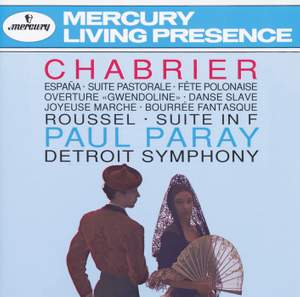
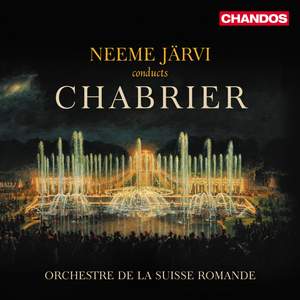
This disc of popular works by Emmanuel Chabrier marks the beginning of a new series of French repertoire, performed by the Orchestre de la Suisse Romande under its newly appointed Artistic Director, Neeme Järvi. After three attempts at comic opera, Chabrier finally achieved success in 1877 with L’Étoile, the plotline of which is set in the court of the somewhat emotionally unstable King Ouf. A couple of years previously, Chabrier had written a short Lamento for orchestra, a work which would not perhaps be considered revolutionary by today’s audiences, but which caused the committee of the Société nationale de musique to hum and haw over it for eighteen long months before finally letting it loose on the Parisian public in 1878. From July to December 1882, Chabrier took his family on an extended holiday to Spain, during which he kept himself busy by noting down the Spanish folk tunes and dance rhythms he encountered on his way. He put many of them into his orchestral masterpiece España, a work overwhelming in its orchestral colour, which is such a characteristic feature of this composer. The impressions of his Spanish holiday can also be heard in the Habanera. For six years Chabrier worked on Gwendoline, a two-act dramatic opera on a libretto by Catulle Mendès, set in Britain in what he called ‘barbarous times’. Inspired by Wagner and Berlioz, the Overture sets the scene perfectly for a drama of violence, treachery, and passion. A month after Gwendoline was premiered in Brussels in April 1886 the Opéra-Comique in Paris agreed to put on Chabrier’s next opera, Le Roi malgré lui, a melting pot of complex political intrigue, cheerful arias, and vivacious dances. In 1880 Chabrier had written his Dix Pièces pittoresques for piano, and over the next few years he orchestrated four of them to form the Suite pastorale, with its gently pulsing ‘Idylle’ movement (which inspired Poulenc to become a composer), the raucous ‘Danse villageoise’, the sultry ‘Sous-bois’, and last but not least the sunny, high-spirited ‘Scherzo-valse’. Also on this disc is the Joyeuse marche, one of Chabrier’s most popular works, and the Bourrée fantasque, based on a dance from the Auvergne region in France where the composer had spent his childhood. | 
| | | (also available to download from $10.50) | In stock - usually despatched within 1 working day. |
|
|
| |  | Chabrier: Orchestral, Vocal and Piano Works
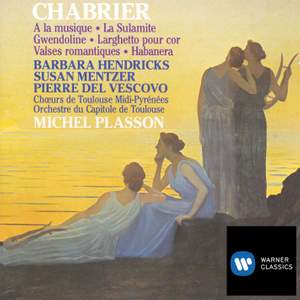
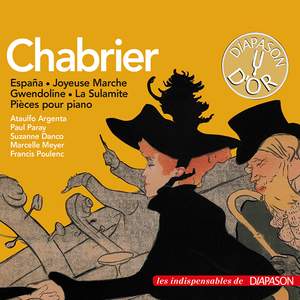
On a recent music forum the question was posed ‘What music makes you smile?’ The immediate answer ‘Anything by Chabrier’ initiated a chorus of approval as others responded with their favourite Chabrier pieces. Everyone knows Espana, many will recognise Joyeuse marche and an increasing number are now familiar with the exquisitely crafted L’étoile. This CD celebrates these works and much else besides in performances that have attracted the highest praise. Every emotion from the stormy (Gwendoline Overture) to the life-affirming (L’île heureuse) as well as the inevitable laugh out loud works, is covered, Chabrier’s genial nature, earthy sense of humour, unconventional keyboard technique and wide-ranging interests ensured that he moved easily in C19 artistic circles and amongst his closest friends were the finest composers, painters and writers of the day. His influence on twentieth century music was immense and if you enjoy Stravinsky, Debussy, Ravel, Satie, Poulenc and de Falla, then you will love this disc! “this is a fascinating collection which will have you going back to other recordings of these works to compare and contrast their approaches to the music of this most fascinating and surprising composer.” MusicWeb International, August 2012 | | | Usually despatched in 4 - 5 working days. |
|
|
| |  |
| | | Usually despatched in 4 - 5 working days. |
|
|
| |  | 50th Anniversary Celebration
| | | Usually despatched in 4 - 5 working days. |
|
|
| |  |
| | | Usually despatched in 8 - 10 working days. |
|
|
| |  | Sir Thomas Beecham
| | | (also available to download from $10.50) | Usually despatched in 2 - 3 working days. (Available now to download.) |
|
|
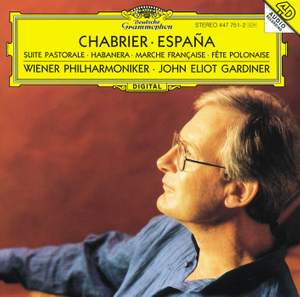
| |  | Chabrier: Españaand other Orchestral Works
| | | Usually despatched in 4 - 5 working days. |
|
|
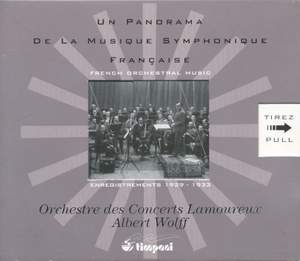
| |  | Orchestre Des Concerts Lamoureux: French Orchestral Music
Jeanne-Marie Darré (piano) Jean Boulze (flute) Orchestre des Concerts Lamoureux, Albert Wolff | | | (also available to download from $25.50) | Usually despatched in 2 - 3 working days. (Available now to download.) |
|
|
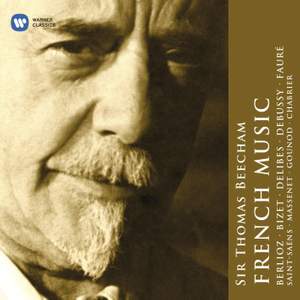
| |  | Sir Thomas Beecham conducts French Music
Berlioz: | Symphonie fantastique, Op. 14 Le Corsaire Overture, Op. 21 Marche troyenne (from Les Troyens) Chasse royale et Orage (from Les Troyens) Le carnaval romain Overture, Op. 9 King Lear Overture, Op. 4 La Damnation de Faust, Op. 24: Ballet des Sylphes La Damnation de Faust, Op. 24: Menuet des Follets | Bizet: | Symphony in C L'Arlesienne Suites 1 & 2 Carmen: Prelude to Act I Carmen: Entr'actes Patrie Overture, Op. 19 Roma: Carnaval | Chabrier: | Gwendoline Overture Joyeuse Marche España | Debussy: | Prélude à l'après-midi d'un faune L'Enfant prodigue: Cortege et Air de danse | Delibes: | Le Roi s'amuse: Incidental Music | Fauré: | Dolly Suite, Op. 56 Pavane, Op. 50 | Franck, C: | Symphony in D minor | Gounod: | Faust - Ballet Music Roméo et Juliette: Le Sommeil de Juliette | Gretry: | Ballet Suite Zémire et Azor | Lalo: | Symphony in G minor | Massenet: | Cendrillon Valse La Vierge: Le Dernier Sommeil de la vierge (Légende sacrée) | Saint-Saëns: | Danse des Prêtresses de Dagon (from Samson et Dalila) Bacchanale from Samson et Dalila Le Rouet d'Omphale, Op. 31 | Vidal, P-A: | Zino-zina: gavotte |
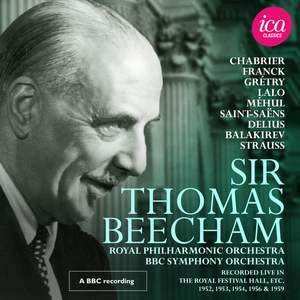
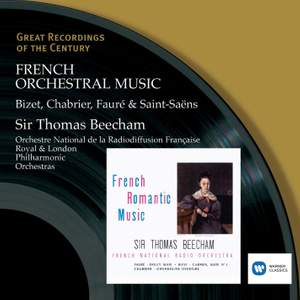
There can be few, if any, musicians who have singlehandedly done so much in the establishment of resources for musical performance than Sir Thomas Beecham. During WWI he conducted and supported financially both the Hallé and London Symphony Orchestras and the Royal Philharmonic Society. In 1915 he formed the Beecham Opera Company which trained many young British singers in this field. Eight years later this became the British National Opera Company and was absorbed into Covent Garden in 1932 when Beecham returned to be its Musical Director. To quote David Cairns “We are nationally and individually a more musically aware people because of him and what he gave us”. A forceful statement, true, but whose life could ever challenge it? Dissatisfied by conditions and practices, notably the supply of deputies for rehearsals, prevalent in British orchestras, he formed the London Philharmonic Orchestra that same year. Beecham was now able to be at the fulcrum of all developments in music in Britain. WWII put an end to this halcyon period. With Covent Garden shut he travelled, primarily in America, and did not return to Britain until 1944. The London Philharmonic had now become a self-governing body so Beecham, then aged 67, launched the Royal Philharmonic Orchestra. This was the orchestra with which he committed to disc so many classic recordings with which EMI Classics marks the 50th anniversary of his passing. It is true that Beecham had particular favourites in composers – Haydn, Mozart, Schubert, Berlioz, Bizet and Puccini spring immediately to mind; also his love for Handel – even though his performances were always BIG-scale! He was an early champion of Richard Strauss and became a most effective exponent of Sibelius. His name will always be inextricably linked with that of Delius whose music Beecham seemed to know better even than the composer and it is appropriate that they are buried not far apart in the graveyard at St. Peter’s Parish Church, Limpsfield, Surrey. He was knighted in 1916, the year he succeeded to his father’s baronetcy, and made a Companion of Honour in 1957.This affable, brilliant, usually charming, ever-communicative, quick-witted – even, at times, to the point of cruelty, dedicated conductor was also the most gifted executive musician England has ever produced. He was fortunate that his grandfather, a chemist, had created the highly successful pharmaceutical manufacturing business which bore his name. His father, who had started in the company whilst still a teenager, was also fond of music so he was prepared to fund his son’s enthusiastic appetite to attend operas and concerts both here and abroad. Born on 29th April 1879 in St. Helens, he attended public school at Rossall where his talent at the piano became a legend (the only boy ever to have been allowed a grand piano in his study!). From there he briefly attended Oxford (Wadham) but the composition classes, with Charles Wood in London and Moszkowski in Paris, were funded privately. As a conductor he was purely self-taught. He formed an orchestra in his home town and deputised for Richter at a Hallé concert when his father was mayor. His career path was clear: he would use his financial resources to support the art which he enjoyed with the aim of bringing it to as many as possible. At the age of 30 he launched the Beecham Symphony Orchestra, all young and carefully chosen. They would tour, play for opera and ballet and give concerts of adventurous music. London duly welcomed him for a season of intensive opera performances and over the next three years introduced many new ones to British audiences, including by Strauss, Delius and the Russians. He also brought Diaghilev’s Ballets Russes starring Nijinsky and Karsavina to the British stage. “The French accent he found for the RPO in Bizet's L'Arlesienne Suites is still deliciously colourful 55 years on. This is the box to explore first if you're a fan of Beecham's lollipops...no wonder he was awarded the Légion d'honneur for services to French music.” Gramophone Magazine, July 2011 **** “The finesse of the detail, the fierce attack, individual flair, corporate precision, blazing warmth: the sum total is playing of tangible personality and, often, ineffable beauty...Listen to...the strings’ silken tenderness in Grétry’s Zémire et Azor...Then there’s the fizz of Beecham’s Berlioz.” The Times, 18th February 2011 ***** | | | In stock - usually despatched within 1 working day. |
|
|
| |  | Sir Thomas Beecham: The Maestro
Beethoven: | Symphony No. 4 in B flat major, Op. 60 Arthur Rubinstein (piano) | Berlioz: | Le carnaval romain Overture, Op. 9 | Bizet: | L'Arlésienne Suite No. 1: excerpts L'Arlésienne Suite No. 2: excerpts Carmen Suite No. 1: excerpts Carmen Suite No. 2: excerpts | Borodin: | Prince Igor: Polovtsian Dances | Brahms: | Tragic Overture, Op. 81 | Chabrier: | España Joyeuse Marche Gwendoline Overture | Debussy: | Prélude à l'après-midi d'un faune | Delius: | Appalachia (Variations on an old slave song) | Dvorak: | Slavonic Rhapsody, Op. 45 No. 3 | Franck, C: | Symphony in D minor | Grieg: | Peer Gynt Suite No. 1, Op. 46 | Handel: | Messiah: Overture | Haydn: | Symphony No. 93 in D major Symphony No. 104 in D major 'London' | Mozart: | Symphony No. 40 in G minor, K550 Symphony No. 41 in C major, K551 'Jupiter' Violin Concerto No. 4 in D major, K218 Flute & Harp Concerto in C major, K299 | Mussorgsky: | Khovanshchina: Dance of the Persian Slaves | Offenbach: | Barcarolle (from Les Contes d'Hoffmann ) | Schubert: | Symphony No. 5 in B flat major, D485 | Sibelius: | Tapiola, Op. 112 Symphony No. 2 in D major, Op. 43 | Smetana: | The Bartered Bride Overture The Bartered Bride: Polka | Strauss, J, II: | Frühlingsstimmen Walzer Op. 410 | Strauss, R: | Don Quixote, Op. 35 | Tchaikovsky: | Francesca da Rimini, Op. 32 | Wagner: | Die Meistersinger von Nürnberg: Overture | Weber: | Der Freischütz Overture |
| | | Usually despatched in 4 - 5 working days. |
|
|
| |
|