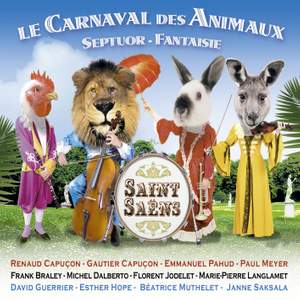
All recordingsPrices shown exclude VAT. (UK tax is not payable for deliveries to United States.) See Terms & Conditions for p&p rates. | |  | Saint-Saëns - Le Carnaval des Animaux
Renaud Capuçon (violin), Gautier Capuçon (cello), Frank Braley (piano), Michel Dalberto (piano), Emmanuel Pahud (flute), Paul Meyer (clarinet), David Guerrier (trumpet), Marie-Pierre Langlamet (harp), Béatrice Muthelet (viola), Esther Hoppe (violin), Janne Saksala (double bass), Florent Jodelet (percussion) “'What hard things,' wrote Saint-Saëns, 'have been said against virtuosity!… The fact must be proclaimed from the house-tops – in art a difficulty overcome is a thing of beauty.' There are many such beauties in Le Carnaval des animaux, and their difficulties aren't for the faint-hearted or the technically challenged, especially where the two pianists are concerned. On this disc not only are the difficulties overcome, but dispatched with tremendous verve and wit. In the Septet the players rightly refuse to make more of the music than is really there. This light touch allows us to relish Saint-Saëns's professionalism: every part in the texture has its own shape and colour and, if there were compositional difficulties to be overcome, you'd never know. The four shorter pieces on this splendid disc include the delicious Fantaisie for violin and harp, and three arrangements for cello and piano taken from the horn, organ and operatic repertoires.” Gramophone Classical Music Guide, 2010 | | | In stock - usually despatched within 1 working day. |
|
|
| |  | Saint-Saëns: Chamber Music with Winds
Saint-Saëns: | Bassoon Sonata in G major, Op. 168 Maurice Allard (bassoon), Annie d'Arco (piano) Clarinet Sonata in E flat major, Op. 167 Maurice Gabai (clarinet), Annie d'Arco (piano) Oboe Sonata in D major Op. 166 Maurice Bourgue (oboe), Annie d'Arco (piano) Romance in F major, Op. 36 Gilbert Coursier (horn), Annie d'Arco (piano) Cavatine, for trombone & piano, Op. 144 Jacques Toulon (trombone), Annie d'Arco (piano) Septet in E flat major for piano, trumpet, 2 violins, viola, cello and double bass Op. 65 Roger Delmotte (trumpet), Jeanne Marie Darre (piano), Gaston Logerot (double bass) Quatuor Pascal |
This historical testimony demonstrates that Saint-Saëns is the origin of the worldwide famous “French winds tradition”. In his twilight years and aged eighty five, Saint-Saëns came back to wind sonatas. Although being very classical, the three 1921 sonatas announce the “Groupe des Six” neo-classicism, and particularly Poulenc. In that respect, even at the very end of his life, Saint-Saëns remained an innovator. | 
| | | Usually despatched in 2 - 3 working days. |
|
|
| |  | French Music for Horn & Piano
Guglielmo Pellarin (french horn) & Federico Lovato (piano) This selection of French music for horn and piano reveals the increasing variety in sound which the horn was able to produce thanks to the invention of valves. The history of the horn and its technical development has been of particular importance to French music. In contrast to Germany, horn players in France initially declined to use the valved horn after its invention in the 19th-century, which was reflected in the style of contemporary composition. Juxtaposing works for horn and piano of the 19th and 20th centuries allows an insight into the different playing techniques of the instrument and its development from natural to valved horn, the turning point of which is exemplified by Paul Dukas’ Villanelle. The two Italian musicians Guglielmo Pellarin (horn) and Federico Lovato (piano) are making their joint recording début with this disc and have also chosen rarely heard works by the contemporary French composers Jean-Michel Damase and Jean-Michel Defaye, featuring surprisingly jazzy elements. The Sonata for Horn and Piano by Jean-Michel Damase is a première recording. Guglielmo Pellarin is principal horn of the Orchestra dell’Accademia Nazionale di Santa Cecilia in Rome. He also regularly performs with the Symphonica Toscanini, the orchestras of the Teatro Verdi di Trieste and the Teatro alla Scala di Milano and the Filarmonica della Scala under conductors including Lorin Maazel, Zubin Mehta and John Eliot Gardiner. He has won many prizes and has toured Italy, Austria, Slovenia and Canada. Federico Lovato studied piano in Venice and Imola. He has won numerous national and international competitions. He has given solo and chamber performances throughout Italy and Europe, including at the Gasteig in Munich, Teatr Mały in Warsaw, Teatro alle Erbe in Milan and Sala Mozart in Bologna. His repertoire spans from classicism to contemporary music. In addition to his career as concert pianist he teaches and is the Artistic Director of the orchestra I Solisti in Villa. “The familiar (to horn players at least) nestles alongside a couple of welcome rarities in this impeccably played horn and piano recital...Pellarin is principal horn of the Orchestra dell’Accademia Nazionale di Santa Cecilia, and his expressive, very European sound is captured close-up. Which means here that there’s a lovely, breathy softness to the horn tone, especially when it’s played quietly...Pellarin’s fruity low register delights” The Arts Desk, 14th January 2012 “This collection of pieces from the 19th and 20th centuries is intended to display the increasing range and versatility of the French horn following the addition of valves to the instrument – although the essential sonic personality remains unchanged throughout” The Independent, 29th July 2011 *** | | | (also available to download from $10.50) | Usually despatched in 3 - 4 working days. (Available now to download.) |
|
|
| |  | Saint-Saëns: Works for Cello
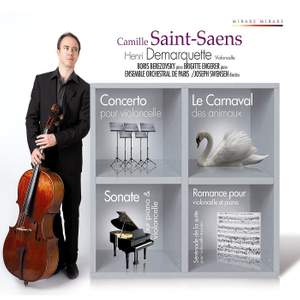
Le carnaval des Animaux was composed in February 1886 while Saint-Saëns was vacationing in a small Austrian village. It was originally scored for a chamber group of flute/piccolo, clarinet (B flat and C), two pianos, glass harmonica, xylophone, two violins, viola, cello and double bass. Saint-Saëns, apparently concerned that the piece was too frivolous and likely to harm his reputation as a serious composer, suppressed performances of it and only allowed one movement, ‘Le cygne’, to be published in his lifetime. Only small private performances were given for close friends like Franz Liszt. Saint-Saëns did, however, include a provision which allowed the suite to be published after his death. It was first performed on 26 February 1922, and it has since become one of his most popular works. It is a favourite of music teachers and young children, along with Prokofiev's Peter and the Wolf and Britten's The Young Person's Guide to the Orchestra. “Demarquette possesses the ideal soundworld for Saint-Saëns - clean focussed, tonally pure and expressively agile...[he] and distinguished colleagues steer a convincing interpretative course between Romantic restraint and Classical passion, revealing the full extent of Saint-Saëns's musical world.” Classic FM Magazine, January 2011 **** | | | Usually despatched in 3 - 4 working days. |
|
|
| |  | Saint-Saëns - Complete Chamber Music with Winds
Saint-Saëns: | Septet in E flat major for piano, trumpet, 2 violins, viola, cello and double bass Op. 65 Romance in F major, Op. 36 Tarantelle in A minor for flute, clarinet & piano/orchestra Op. 6 Le carnaval des animaux: Le Cygne Romance in D flat major, Op. 37 Cavatine, for trombone & piano, Op. 144 Romance, Op. 67 Mon cœur s'ouvre à ta voix (from Samson et Dalila) (transcription for bassoon and piano by Marc Trenel) Clarinet Sonata in E flat major, Op. 167 Prière for cello & piano, Op. 158 Oboe Sonata in D major Op. 166 Odelette in D major, Op. 162 Bassoon Sonata in G major, Op. 168 Le carnaval des animaux: L'éléphant Caprice sur des airs danois et russes for piano, flute, oboe and clarinet Op. 79 |
In a century mostly inspired by German romantic orchestral pieces, Saint-Saëns considered wind instruments as on the same level as violin and piano. He is the origin of the French Wind tradition and in the evening of his life, aged 85, came back to composing sonatas turning to wind instruments with enthusiasm. | | | Usually despatched in 2 - 3 working days. |
|
|
| |  | Saint-Saëns - Cello Sonatas Nos. 1 & 2
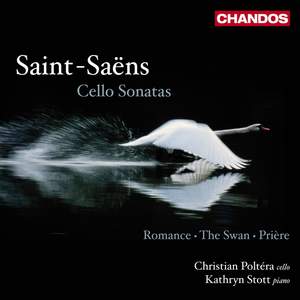
Saint-Saëns wrote a considerable amount of chamber pieces during his life, and his works for cello are seen as some of the most supreme for the cello repertoire. Christian Poltéra and Kathryn Stott, best known for her performances of French repertoire perform Saint-Saëns melodic cello Sonatas, coupled with the legendary ‘Swan’ from The Carnival of the Animals. Romances Op.36 and Op.51 and Prière, Op.158 complete this programme. Saint-Saens remains one of the most important composers for the cello, and his contributions are considerable. Poltéra and Stott collaborate regularly in chamber music performances across the world and have recently recorded Faure Cello Sonatas for Chandos: ‘[Christian Poltéra]… is a fine choice of cellist for the two Sonatas. He phrases sensitively and makes the most of the composer’s dynamic markings… Kathryn Stott’s an ideal partner, managing her pedalling levels to produce a variety of textures.’ BBC Music Magazine “Why do these sonatas so rarely appear in recitals? Saint-Saëns's sensuous poeticism and ingenious craftsmanship are wonderfully combined in them. Despite Poltéra's elegance, it is the more extrovert Kathryn Stott who brings these performances truly alive. She has a true grasp of the idiom, and the sheer energy and range of sound to illuminate these big works. The disc is completed with a gloriously limpid Swan, and two further salon delicacies.” BBC Music Magazine, December 2009 “Saint-Saëns certainly knew how to tap the technical resources of his soloists and Poltéra and Stott are as one in playing some fleet, taxing passagework with fluency and power, Poltéra's mellow tone adding a dimension of poignancy and shapely phrasing that traces and defines the music's surging contours.” Gramophone Magazine, January 2010 | | | (also available to download from $10.50) | Usually despatched in 2 - 3 working days. (Available now to download.) |
|
|
| |  | Saint-Saens - Complete Works for Cello & Orchestra
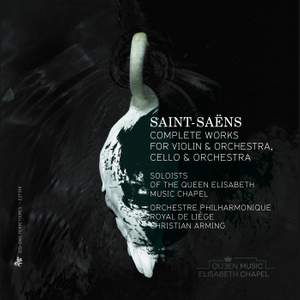
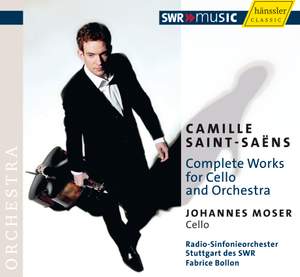
These works are both sweepingly romantic and an acid test for any player’s technical finesse. Apart from the popular First Concerto and the ubiquitous “Swan”, Saint-Saëns composed a Second Cello Concerto in addition to several other shorter works for Cello and orchestra, most of which are seldom heard in performance. Stunning performances from the young start cellist, Johannes Moser. “Hearing the two concertos in succession brings it home how much more inspired the First is, with its thrillingly dramatic opening. Moser plays it with overwhelming passion, while firmly controlling tempo and intonation.” Gramophone Magazine, January 2009 “…Moser gives a strong, impassioned account of the Second Concerto… It's in this work that Moser distances himself most noticeably from Maria Kliegel… overall, Moser is more imaginative and alive to the music's dramatic possibilities. And why isn’t the wonderful Suite Op. 16 heard more often?” BBC Music Magazine, April 2009 ***** | | | (also available to download from $10.50) | Usually despatched in 2 - 3 working days. (Available now to download.) |
|
|
| |  | Saxophone & Harp
Hermann Rid (saxophone), Martina Holler (harp) | | | This item is currently out of stock at the UK distributor. You may order it now but please be aware that it may be six weeks or more before it can be despatched. |
|
|
| |  | Chant d'AutomneForgotten Treasures Vol. 6
Ulrich Hubner (horn) Kolner Akademie, Michael Alexander Willens | | | (also available to download from $10.50) | Usually despatched in 4 - 5 working days. (Available now to download.) |
|
|
| |  | Horn - Greatest Works
Brahms: | Horn Trio in E flat major, Op. 40 Peter Damm (hunting horn), Amadeus Webersinke (piano), Manfred Scherzer (violin) | Françaix: | Divertimento Peter Damm (horn), Peter Rösel (piano) | Gounod: | 6 Mélodies (selection) Peter Damm (horn), Peter Rösel (piano) | Haydn: | Horn Concerto No. 1 in D major, Hob.VIId:3 Peter Damm (horn), Matthias Eisenberg (harpsichord), Matthias Pfaender (cello), Manfred Pernutz (double bass) Kammerorchester C. P. E. Bach der Deutschen Staatsoper Berlin, Hartmut Haenchen | Heinichen: | Concerto for 2 Horns and 2 Flutes in F major Peter Damm (horn), Dieter Pansa (horn) Capella Sagittariana, Eduard Melkus | Mendelssohn: | Der Jäger Abschied: Wer hat dich, du schöner Wald, Op. 50 No. 2 (arr. for horn quartet) Members of the Leipzig Radio Symphony Orchestra Abschied vom Walde (No. 3 from Sechs Lieder in Freien zu singen, Op. 59) (arr. for horn quartet) Members of the Leipzig Radio Symphony Orchestra | Rossini: | Le rendez-vous de chasse Prelude, Theme & Variations Peter Damm (horn), Peter Rösel (piano) | Saint-Saëns: | Morceau de concert in F minor, Op. 94 Peter Damm (horn) Staatskapelle Dresden, Siegfried Kurz Romance in F major, Op. 36 Peter Damm (horn), Peter Rösel (piano) | Schumann: | Konzertstück for four horns, Op. 86 Peter Damm (horn), Klaus Pietzonka (horn), Dieter Pansa (horn), Johannes Friemel (horn) Staatskapelle Dresden, Siegfried Kurz Adagio and Allegro in A flat major, Op. 70 Peter Damm (horn), Amadeus Webersinke (piano) | Weber: | Horn Concertino in E minor, Op. 45 Peter Damm (horn) Staatskapelle Dresden, Siegfried Kurz |
| | | Usually despatched in 4 - 5 working days. |
|
|
| |
|