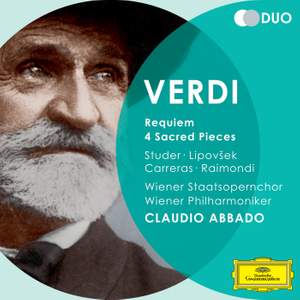
All recordingsPrices shown exclude VAT. (UK tax is not payable for deliveries to United States.) See Terms & Conditions for p&p rates. | |  | Verdi: Requiem & Quattro Pezzi Sacri
| | | In stock - usually despatched within 1 working day. |
|
|
| |  | Verdi: Requiem & Four Sacred Pieces
Hailing the ‘burning conviction’ of this recording, Gramophone awarded Riccardo Muti ‘the victor's palm’ for his incandescent interpretation of Verdi’s apocalyptic, yet deeply compassionate setting of the Requiem Mass. Renata Scotto, one of the great Verdi sopranos of her time, leads a powerful quartet of soloists, while the Philharmonia Orchestra and Ambrosian Chorus rise to every challenge of a score that brings the heightened drama of the opera house to a solemn liturgical text. | | | In stock - usually despatched within 1 working day. |
|
|
| |  | Choirboys From Heaven
Allegri: | Miserere mei, Deus with Timothy Beasley-Murray & Gerald Finley Choir of King's College, Cambridge, Stephen Cleobury | Britten: | Rejoice in the Lamb, Op. 30 with Simon Channing & James Lancelot A Ceremony of Carols, Op. 28: excerpts with James Clark & Julian Godlee Choir of King's College, Cambridge, Sir David Willcocks | Copland: | Old American Songs: excerpts with The American Boychoir, Matthew Schwinghammer | Dvorak: | Four Duets, Op. 38 The American Boychoir, James Litton | Fauré: | Requiem: Pie Jesu Ave Maria, Op. 67 No. 2 | Franck, C: | Panis Angelicus Alleluia! (from Choeur de Pâques) | Greene, M: | The Lord is my shepherd | Hadley, P: | I sing of a maiden with The Boys of King's College Choir, Cambridge, Stephen Cleobury | Ireland: | Ex ore innocentium (It is a Thing Most Wonderful) | Mendelssohn: | I Waited for the Lord Lift Thine Eyes to the Mountains from Elijah | Newton, E: | Amazing Grace The American Boychoir, James Litton | Orff: | Carmina burana: Amor volat udinque with Southend Boys' Choir & Philharmonia Orchestra, Riccardo Muti | Rorem: | What is Pink? - Cycle of 6 songs with The American Boychoir, Matthew Schwinghammer | Rutter: | Pie Jesu (from Requiem) with Edward Saklatvala Choir of King's College, Cambridge & City of London Sinfonia, Stephen Cleobury | Schubert: | Psalm 23 'Gott ist mein Hirt', D706 | Verdi: | Quattro Pezzi Sacri: Laudi alla Vergine Maria |
plus: Muramatsu: You were there Libera Solo: Tom Cully Tavener: Mother of God Libera Prizeman: The Secret Libera Solo: Joshua Madine Caccini: Ave Maria Libera Solo: Tom Cully Bach: Air on the G string Libera Solos: Tom Cully, Edward Day, Joshua Madine & Liam Connery Humperdinck; Prayer Libera Solos: Michael Horncastle & Callum Payne Sibelius: Be still my soul Dvorak: Going Home Libera Solos: Michael Horncastle & Tom Cully Robert Prizeman Prince: Nothing compares to you Hoffs: Eternal Flame Byrne: Burning down the house Enya: Only Time with The Vienna Boys' Choir
This 2-CD set contains an extremely wide range of music for boys' choirs, from the early polyphony of Allegri's Miserere to the present-day popular songs of Prince and Enya. Also included are some interesting works by some great 20th-century composers such as Copland, Britten and Ned Rorem. The featured choirs are some of the world's most notable boys' choirs, from the Vienna Boys' Choir and the American Boychoir to, perhaps the best-known of them all, the Choir of King's College, Cambridge. The most recent of the choirs here is Libera, formed by their conductor, Robert Prizeman, from school boys from around south London. So, for those who already find the freshness and youthfulness of boys' voices uniquely appealing here is the perfect compilation. For those who have yet to make the discovery this set should prove a delightful musical journey. | | | In stock - usually despatched within 1 working day. |
|
|
| |  | Verdi: Requiemand Quattro Pezzi Sacri
| | | In stock - usually despatched within 1 working day. |
|
|
| |  | Heavenly Voices
| | | In stock - usually despatched within 1 working day. |
|
|
| |  | Verdi: Requiem and Quattro Pezzi Sacri
“Reiner's opening of the Requiem is very slow and atmospheric...Yet as the work proceeds the performance soon sparks into life, and there is some superb and memorable singing from a distinguished team of soloists. THe recording has a spectacularly wide dynamic range” Penguin Guide, 2010 **/* | | | (Sorry, download not available in your country) | In stock - usually despatched within 1 working day. |
|
|
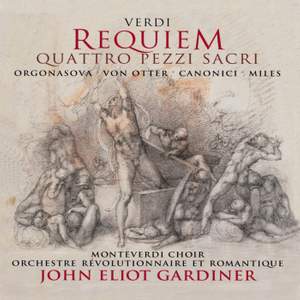
| |  | Verdi: Requiem & Quattro Pezzi Sacri
“Gardiner's Verdi Requiem is in a class of its own. His are readings that combine a positive view and interpretative integrity from start to finish, something possible only in the context of the superb professionalism of the (augmented) Monteverdi Choir, which sings with a burnished and steady tone throughout and suggests, rightly, a corporate act of worship. Its contribution is beyond praise. He might also have been surprised and delighted to ear the soloists' contribution sung with such precision by such a finely integrated quartet, who perform the important unaccompanied passages with special grace and sensitivity. Instead of the usual jostle of vibratos, here the four voices are firm and true. Individually they're also distinguished. Pride of place must go to Orgonášová who gives the performance of her life. The exactly placed high B in the 'Quid sum miser' section of the 'Dies irae', the perfect blending with von Otter at 'Dominum', the whole of the Andante section of the 'Libera me', sung with ethereal tone and a long breath, make the heart stop in amazement. In 'Oro supplex' Gardiner follows Verdi's tempo marking. More often he follows tradition, with slower speeds than those suggested, and he allows more licence than the score, or conductors like Toscanini. But as his liberties all seem so convincing in the context of the whole, who should complain? In the Pezzi sacri, Gardiner gives the most thrilling account yet to appear. The recording, made in Westminster Cathedral, has a huge range which may cause problems in confined spaces. You're liable to be overwhelmed, for instance, by the 'Dies irae'.” Gramophone Classical Music Guide, 2010 “Gardiner, using period forces, is searingly dramatic and superbly recorded, with fine detail, combining transparent textures, weight and atmospheric bloom...The soloists make a characterful quartet, with the vibrant Orgonasova set against the rock-steady Von Otter” Penguin Guide, 2010 **** | | | (Sorry, download not available in your country) | In stock - usually despatched within 1 working day. |
|
|
| |  |
| | | In stock - usually despatched within 1 working day. |
|
|
| |  | Verdi: Requiem & Four Sacred Pieces
| | | Usually despatched in 4 - 5 working days. |
|
|
| |  | Verdi: Four Sacred Pieces & Hymn of the Nations
This is a recording of rarely heard choral works by Verdi, performed by all-Italian forces – the Orchestra and Chorus of Teatre Regio in Turin, with the soloists Barbara Frittoli and Francesco Meli, under the conductor Gianandrea Noseda, an exclusive Chandos artist – for totally idiomatic results. The opera La forza del destino was first performed in the Bolshoi Kamenny Theatre of St Petersburg in 1862. Featured on this recording is ‘La vergine degli angeli’, the chorus that ends Act III. Here Leonora (whom everyone supposes to be a man) is sent by the Monastery of Hornachuelos to live in a hermit’s cave for the rest of her life. The monks invoke the Virgin to protect the new hermit and send Leonora off with one of Verdi’s most beautiful choruses (which also features an exquisite solo for Leonora). Soon after completing La forza del destino, Verdi was asked to prepare an Italian entry for the London International Exhibition. He agreed, and the result was the Inno delle nazioni, to words by Arrigo Boito. The piece ultimately did not figure in the official celebrations, but was performed to great acclaim in London in 1862. The work includes an orchestral introduction and a chorus, an impassioned recitation by the soloist, and a beautiful melody for soloist, then chorus. Verdi cites the national anthems of England, France, and Italy, before combining them in a contrapuntal tour de force. With the death in 1868 of Gioachino Rossini, Verdi took it upon himself to commission all the most important composers of Italy to prepare a composite Mass in his memory. The mass was to be performed on the first anniversary of Rossini’s death, but when the city of Bologna proved unable to arrange the performance in time, the project was abandoned. Verdi, however, persevered and did complete the intended final movement, ‘Libera me, Domine’, recorded here. He would rework the movement for his later Messa da Requiem. Completing the disc are the Quattro pezzi sacri (Four Sacred Pieces): Ave Maria, Laudi alla Vergine Maria, Stabat Mater, and Te Deum. The two choruses with full orchestra, the Stabat Mater and Te Deum, Verdi’s last compositions, are based on well-known poems. The first, celebrating Mary as she stands by the Cross, was set by many composers. For the Te Deum, written for double chorus, Verdi turned to a text often, though not here, used to celebrate victories and coronations. It quickly became common practice to perform the four pieces together, with a chorus singing the unaccompanied, but moving, Ave Maria and Laudi alla Vergine Maria, originally composed for solo voices. “The Hymn of the Nations was the Italian musical contribution to the London International Exhibition of 1862...Under Gianandrea Noseda's alert baton, it registers well here...[Barbara Frittoli] provides an ethereal close to the Te Deum, last of the Four Sacred Pieces - visionary, distilled examples of Verdi's late style whose mystery Noseda presents with considerable sensitivity.” BBC Music Magazine, June 2011 **** “the Teatro Regio forces (under the baton of Gianandrea Noseda) deliver them with a bold sense of drama. The soloists are top-drawer Verdians too: tenor Francesco Meli has an impressively ringing top register, and Barbara Frittoli bring weight, richness and sensitive phrasing to the soprano solos.” Classic FM Magazine, May 2011 **** “it comes as a shock (albeit a pleasantly fascinating one) to hear Verdi's rather disjointed initial thoughts for the piece...though [his] contrapuntal acrobatics in the "Libera me" fugue continue to delight and amaze, and his orchestration fizzes with its characterful vigour and colourfulness...this performance lacks nothing in terms of forward momentum or choral declamation.” Gramophone Magazine, May 2011 “It is temperament rather than smoothness in her singing that Frittoli brings, and it is interesting to hear the differences between this version and Verdi's later one...Gianandrea Noseda and Turin Opera's chorus master Robert Gabbiani do well to bring out the contrasts from their respective charges.” International Record Review, April 2011 “Francesco Meli and Barbara Frittoli, with her wide and warm vibrato, give performances of great energy and directness. Look out for a fascinating filler, Inno delle nazioni, which is a strangely wonderful “mash-up” of English, French and Italian national anthems.” The Telegraph, 8th April 2011 **** | | | (also available to download from $10.50) | Usually despatched in 2 - 3 working days. (Available now to download.) |
|
|
| |
|