All recordingsPrices shown exclude VAT. (UK tax is not payable for deliveries to United States.) See Terms & Conditions for p&p rates. | |  | Schoenberg: Orchestral WorksRecorded in concert 30th October - 7th November 2009
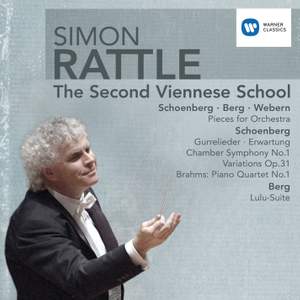
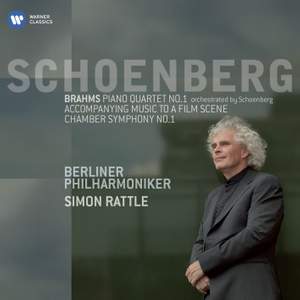
Following the release of the complete Brahms symphonies ("Altogether a marvellous achievement." The Daily Telegraph), Sir Simon Rattle and the Berliner Philharmoniker have performed and recorded a programme of orchestral works by Arnold Schoenberg, who was a great admirer of Brahms. In these three contrasting works, the spirits of Modernism, Romanticism and Classicism are invoked by Arnold Schoenberg – a revolutionary whose aesthetic roots lay firmly in tradition. Sir Simon Rattle, who first established his international reputation with masterpieces of the 20th century, explores these musical cross-currents with the Berliner Philharmoniker, long supreme in Austro-German repertoire. The repertoire, recorded in concert at Berlin’s Philharmonie in late October/early November 2009, consists of Schoenberg’s orchestration of Brahms’s Piano Quartet in G minor, Begleitungsmusik zu einer Lichtspielszene (Accompanying Music to a Film) and the full orchestra version of the Chamber Symphony No. 1. In these three contrasting works, the spirits of Modernism, Romanticism and Classicism are invoked by Arnold Schoenberg – a revolutionary whose aesthetic roots lay firmly in tradition. Sir Simon Rattle, who first established his international reputation with masterpieces of the 20th century, explores these musical cross-currents with the Berliner Philharmoniker, long supreme in Austro-German repertoire. Immediately after the recent performances/recordings, Sir Simon and the Orchestra set off on a coast-to-coast U.S. tour performing the Brahms symphonies and this Schoenberg programme at New York’s Carnegie Hall and in San Francisco, Los Angeles, Boston, Chicago and Ann Arbor. Schoenberg said that he had arranged Brahms’s Piano Quartet in G minor, Op. 25 for orchestra in 1937 for several reasons: “1) I like this piece; 2) It is seldom played; 3) It is always played badly, because the better the pianist, the louder he plays and you hear nothing from the strings. I wanted once to hear everything, and this I achieved.” He also stated that he intended to write his orchestration strictly in the style of Brahms, going no further than Brahms would have gone “if he had lived today.” Mark Swed, in The Los Angeles Times, said of the LA performance, “When [Schoenberg] made the version in 1937, he had recently moved from Berlin to Los Angeles and was clearly entranced by the resplendent light of his new home. He garbs the quartet in garish instrumental colors … Rattle emphasized everything in the most polystylistic way possible. A horn solo in the solo movement had a raw jazzy quality; a clarinet solo in the Gypsy-inspired last movement was klezmer-like. A xylophone clattered, a bass drum thumped. But within this ruckus was also ravishing ensemble playing and, from Rattle, the inspiration not only for great characterization but also for momentum.” Allan Kozinn in The NY Times wrote of the Carnegie Hall performance, “It can be hard to banish the original sound and texture from your inner ear, however convincing the new interpretation may sound. But it can be worth the effort, as Mr. Rattle and his musicians demonstrated in a vital, shapely account that found levels of drama in Schoenberg’s magnification that a performance of the chamber version could not possibly equal.” Simon Rattle previously recorded this work with the City of Birmingham Symphony Orchestra in 1985. “[The Brahms] is full of dash and gusto, especially during the concluding Rondo alla Zingarese. Elsewhere, the "Accompaniment to a Cinematographic Scene" offers a peek at the complex musical dramaturgy furnished by dissonant developments of the composer's later career.” The Independent, 5th August 2011 *** “Schoenberg’s version offers ingenious fun, and Rattle’s Berlin players, recorded two years ago in live concerts, dispatch it with loving swagger.” The Times, 19th August 2011 *** “[The Chamber Symphony] is a contradiction in terms with the Berliners’ massed and sleek strings, but the performance moves Schoenberg closer to Brahms, to which the former would certainly not have objected. For those out there who remain afraid of Schoenberg, this disc is an ideal entry point.” Sunday Times, 28th August 2011 “The sound is amazingly clear, and the virtuosity of the players, especially in the mad Hungarian dance of the finale [of the Piano Quartet], is astounding...[the Chamber Symphony is] performed with both heart-stopping urgency and radiant beauty.” The Telegraph, 25th August 2011 ***** “[Accompaniment to a Film Scene is] superbly played by the Berlin Phil, with Rattle encapsulating perfectly its concentrated drama.” The Guardian, 25th August 2011 **** “you can tell at once that this is the Berlin Phil, so smooth and seductive are their dulcet tones. This is high sonic luxury, with Rattle coaxing on the hushed plush strings, the silken clarinets, the gold-leaf sound of the trumpets.” Classic FM Magazine, October 2011 ***** “The accompanying pieces demonstrate the Berliners' litheness, while Schoenberg's bizarre orchestration of Brahms moves from academic exercise to cartoonish fantasy in four movements.” The Independent on Sunday, 12th September 2011 “Accompaniment to a Film Scene...sounds less nightmarish, and a lot more beautiful than in any previous version. In general, Rattle's Schoenberg is more the voluptuous late Romantic than the bogeyman of popular legend.” BBC Music Magazine, October 2011 **** “The BPO woodwind and strings, with horn priming the canvas, are absolute ringers [for Brahms], but a deeper truth emerges from Rattle's delight in (or celebration of) moments where Schoenberg's orchestration goes a bit Mike Yarwood...The omnivorous virtuoso shout of the final moments [of the Chamber Symphony] spills beyond the usual orchestral threshold, the BPO demonstrating why they're the BPO.” Gramophone Magazine, October 2011 “The Berliners’ playing is absolute perfection.” MusicWeb International, July 2012 | | | In stock - usually despatched within 1 working day. |
|
|
| |  | Stravinsky: The Soldier’s Tale
Boston Symphony Chamber Players Recordings: Symphony Hall, Boston, USA, May 1972 (The Soldier’s Tale: music), December 1974 (Octet, Pastorale, Ragtime, Septet, Concertino), April 1978 (Berg: Adagio, Schoenberg: Chamber Symphony); Polydor Studios, London, UK, July 1975 (The Soldier’s Tale: speech) Stravinsky’s tongue-in-cheek morality masterpiece, The Soldier’s Tale, is one of his cleverest and most enduring works, here receiving its first outing on CD, following several requests. It boasts a stellar cast, not only of musicians, drawn from the Boston Symphony and soloists in their own right, but also of the narrators/actors – Sir John Gielgud, Tom Courtenay and Ron Moody, with English texts by Michael Flanders & Kitty Black. The couplings include the BSCP’s complete LP of chamber music by Stravinsky (the Concertino and Septet being released on CD for the first time), and also works by Schoenberg and Berg, previously unissued internationally on CD. “absolutely sparkling playing...The playing and recording are excellent throughout” Records and Recording “These Boston players give immaculately polished accounts of all five [chamber] works … The recording is excellent – clear without dryness, warm without over-resonance” Gramophone Magazine “John Gielgud is a most beguiling narrator … Ron Moody makes a suitably sinister-sounding devil … A really outstanding issue” EMG Newsletter | | | In stock - usually despatched within 1 working day. |
|
|
| |  | Schoenberg - Verklärte Nacht
| | | In stock - usually despatched within 1 working day. |
|
|
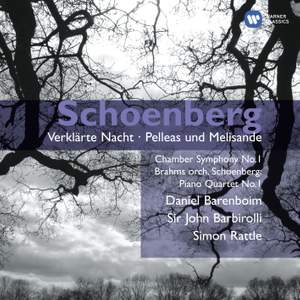
| |  | Schoenberg - Orchestral Works
“Barenboim's youthful passion in Verklärte Nacht is trumped by Barbirolli's ripe reading of Pelleas. Rattle is more clear-eyed, especially in the Brahms orchestration. Collectible non-scary Schoenberg.” BBC Music Magazine, March 2007 **** | | | In stock - usually despatched within 1 working day. |
|
|
| |  | Schoenberg - Friede auf Erden
| | | (also available to download from $10.75) | In stock - usually despatched within 1 working day. |
|
|
| |  | Arte Nova Voices: Mahler & Schoenberg
| | | In stock - usually despatched within 1 working day. |
|
|
| |  | Schoenberg: Suite, Op. 29
Zahir Ensemble, Juan Garcia Rodriguez Always among the most innovative of composers, Arnold Schoenberg (1874-1951) wrote several works that deliberately blur the distinction between chamber orchestra and chamber ensemble. Among these, the First Chamber Symphony compresses the classical symphonic format into a tensile single movement scored for only fifteen players, while the Suite draws its seven instruments into a maelstrom of vitality whose inspiration lies in the dance styles that were popular during the 1920s. The Zahir Ensemble is one of Spain’s most exciting modern music groups, whose passion and technical accomplishment have gained them an ardent following. | | | (also available to download from $6.00) | Usually despatched in 2 - 3 working days. (Available now to download.) |
|
|
| |  | Pražák Quartet play Schoenberg
The fifth volume devoted to Schönberg’s chamber music. On display here is writing that, after being based on traditional models (youthful Scherzo and Presto), evolves towards a melodic density and clarity of counterpoint making the Chamber Symphony, Op.9 (1906) accomplished and radiant as much in its chamber transcriptions as in the versions for full orchestra. The Quartet No.3 (1926) achieves a masterful balance between rhythm and harmony, melody and counterpoint, horizontality and verticality. For over 30 years, the Prazak Quartet has been at home on music stages worldwide. They are regular guests in the major European musical capitals—Prague, Paris, Amsterdam, Brussels, Milan, Madrid, London, Berlin, Munich, etc.—and have been invited to participate at numerous international festivals, where they have collaborated with such artists as Menahem Pressler, Jon Nakamatsu, Cynthia Phelps, Roberto Diaz, Josef Suk, and Sharon Kam. The Prazak Quartet records exclusively for Praga/Harmonia Mundi which, to date, has released over 30 award-winning CDs. In 2010 Pavel Hula succeeded founding first violinist Vaclav Remes, who was unable to continue performing due to a medical condition in his left hand. Pavel Hula was the longtime first violinist with the Czech-based Kocian Quartet, and has been a close friend of the Prazak Quartet for many years. “These players approach the music with poise and assurance, as a piece that comes at the advanced end of a long Viennese tradition as well as one that looks forward. The results are thoroughly convincing.” International Record Review, March 2011 | | | Usually despatched in 3 - 4 working days. |
|
|
| |  | Schoenberg - Verklärte Nacht & Chamber Symphony No. 1CD+DVD
Smithsonian Chamber Players, Kenneth Slowik The Smithsonian Chamber Players explore the early music that set the stage for the development of famed 20th century composer Arnold Schoenberg in this 2 disc, CD-DVD set. Performing in two historic Washington D.C. venues (the Smithsonian Castle Building and The Library of Congress' Coolidge Auditorium), this GRAMMY nominated ensemble led by conductor Kenneth Slowik, give not only an audio, but also video performance for these two great works. This DVD takes the viewer on a journey around the world, with full performances of Verklärte Nacht (filmed at the Smithsonian Castle) and Chamber Symphony No. 1 (filmed in the Coolidge Auditorium, Library of Congress), on to Schoenberg's home in Modling outside of Vienna, a satelite museum for the Schoenberg Center. In depth discussions about these two early works of Schoenberg by scholars and musicians, as well as those who knew Schoenberg through his life bring the music to life, giving the listener new insight into these pieces. Full musical breakdowns of the pieces with examples from Schoenbergs own notes as well as examples shown by conductor Kenneth Slowik, will provide an understanding of the music that could not be achieved by listening alone. Along with the interviews, the DVD is full of rare images provided by the Schoenberg Center, as well as discussions by Jon Newsom and Richard Hoffman regarding the connections between the Library of Congress and Schoenberg, a tour of the Schoenberg Center by Center director, Christian Meyer, and a discussion about the Smithsonian and it's continued commitment to music by Smithsonian under Secretary of History Arts and Culture, Richard Kurin. DVD Contains: Full performances of: Verklärte Nacht (filmed at the Smithsonian Castle) Chamber Symphony No. 1 (filmed in the Coolidge Auditorium, Library of Congress) Interviews and discussions of the works with Anner Bylsma, cellist Rene Clemencic-composer & ensemble leader, Richard Hoffmann-composer, student of and assistant to Schoenberg Reibert de Leeuw-pianist, conductor, founding director of the Schoenberg Ensemble Christian Meyer-Director of Arnold Schoenberg Center, Vienna And more. Narrated by conductor Kenneth Slowik. | | | (also available to download from $10.75) | Usually despatched in 2 - 3 working days. (Available now to download.) |
|
|
| |  | Schoenberg - Pierrot Lunaire
“Authoritative accounts of some of Schoenberg's greatest works, with Silja brilliant in Pierrot Lunaire, and the whole programme conducted with the deepest understanding by Craft, also author of the magnificent notes.” BBC Music Magazine, May 2007 ***** “There's no denying the sheer excitement, the authentically Schoenbergian iconoclasm of what Craft and his team of 15 virtuosos achieve.” Gramophone Magazine “one of the most enticing Schoenberg collections around” MusicWeb International | | | (also available to download from $6.00) | Usually despatched in 2 - 3 working days. (Available now to download.) |
|
|
| |
|