Prices shown exclude VAT. (UK tax is not payable for deliveries to United States.) See Terms & Conditions for p&p rates. | |  | R. Strauss: Oboe Concerto & Till Eulenspeigel
| | | In stock - usually despatched within 1 working day. |
|
|
| |  | Strauss, R: | Burleske for Piano and orchestra in D minor Jean-Yves Thibaudet (piano) Gewandhausorchester Leipzig, Herbert Blomstedt Duett-Concertino for Clarinet, Bassoon & Strings Dimitri Ashkenazy (clarinet), Kim Walker (bassoon) Radio-Symphonie-Orchester Berlin, Vladimir Ashkenazy Oboe Concerto in D Gordon Hunt (oboe) Radio-Symphonie-Orchester Berlin, Vladimir Ashkenazy Aus Italien, Op. 16 Cleveland Orchestra, Vladimir Ashkenazy Le Bourgeois Gentilhomme, Op. 60 Willi Boskovsky (violin), Emmanuel Brabec (cello), Friedrich Gulda (piano) Wiener Philharmoniker, Lorin Maazel |
Relative rarities among his output are Richard Strauss's concertos, many written later in his life. This collection brings together works for oboe, clarinet and bassoon (the Duet Concertino) and the scintillating Burleske for piano and orchestra. In addition to conducting the concertos, Ashkenazy also conducts the early tone poem "Aus Italien" and Maazel's humorous reading of Le Bourgeois Gentilhomme with the Vienna Philharmonic is restored to the catalogue. | | | In stock - usually despatched within 1 working day. |
|
|
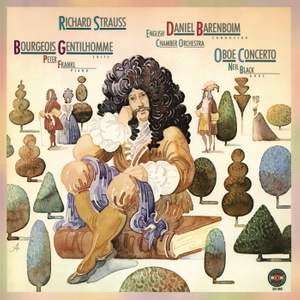
| |  | Strauss: Concerto for oboe and orchestra
The outstanding oboist Yeon-Hee Kwak pays tribute to three twentieth-century composers and gives the recording premiere of the orchestral version of the Concertino for Oboe and Orchestra by Nikos Skalkottas. The Inventions with a Postlude for Oboe and Cello by the Finnish composer Kalevi Aho form welcome encores. | | | Usually despatched in 2 - 3 working days. |
|
|
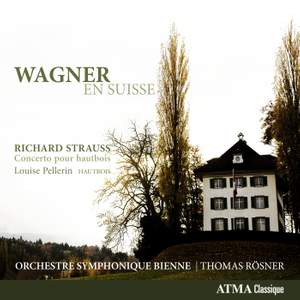
| |  | Wagner in Switzerland
Orchestre Symphonique Bienne, Thomas Rösner Wagner composed an arrangement of Gluck’s Iphigenie in Aulis, adding a new ending of his own and ATMA offers the first-ever recording of Wagner’s original, discovered in Zürich in the late 1990s. Two more gems are included; Siegfried-Idyll in its original version for chamber orchestra and Richard Strauss’ Oboe Concertos completes the CD. | | | (also available to download from $10.50) | Usually despatched in 2 - 3 working days. (Available now to download.) |
|
|
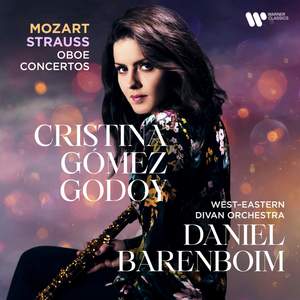
| |  | Mozart & R. Strauss: Oboe Concertos
Gramophone Good CD Guide Recommendation “This coupling links two of the most delightful oboe concertos ever written. Mozart's sprightly and buoyant work invests the instrument with a chirpy, bird-like fleetness encouraging the interplay of lively rhythm and elegant poise. Boyd's reading captures this work's freshness and spontaneity beautifully. If the Mozart portrays the sprightly side of the instrument's make-up the Strauss illustrates its languorous ease and tonal voluptuousness. Again Boyd allows himself the freedom and breadth he needs for his glowing interpretation; he handles the arching melodies of the opening movement and the witty staccato of the last with equal skill. Nicely recorded.” Gramophone Classical Music Guide, 2010 | | | Usually despatched in 2 - 3 working days. |
|
|
| |  | R. Strauss: Music for Wind Ensemble
Richard Strauss is best known for his large-scale orchestral music, and for operatic and vocal works, but he wrote a large amount of chamber music including works for wind-instrument ensemble. This outstanding collection of Richard Strauss’ works for wind instruments spans the whole of his creative career. The Serenade in E flat and Suite in B flat, both for thirteen wind instruments, were written in his late teens, and are full of the joy and vigour of youth. The Serenade is Mozartian in derivation, yet hints at the romantic melodies and the lush Straussian textures to come. The more ambitious Suite is heavily influenced by Brahms, with a tender Romanze, and a finale which ends in a full-bodied fugue. His three major works for wind instruments were composed after a gap of sixty years. The Sonatina No.1 in F and the Symphony for Wind Instruments in E flat (also called Sonatina No.2) are rich in invention, featuring the melody and texture of his maturity, yet somehow retaining the freshness of his early writing. The delightful Oboe Concerto has a lovely, warm lyrical theme, and a spirited finale. The classic performances of these works featured here were recorded in the early seventies, and most are given by the Netherlands Wind Ensemble, conducted by the distinguished Dutch conductor Edo de Waart. The Oboe Concerto is performed by the celebrated Swiss oboist Heinz Holliger, with the New Philharmonia Orchestra, also under Edo de Waart. “Edo de Waart and this team of youthful Netherlanders manage to secure the utmost clarity and delicacy in performance. Tonal nuance, phrasing, ensemble and balance alike are excellent, and the recording engineers
have achieved forwardness and richness of tone without excessive weight…the performance is superlative: altogether, this is an outstanding issue.” Gramophone Magazine | | | Usually despatched in 2 - 3 working days. |
|
|
| |  | Evelyn Rothwell 1911-2008
Bush, G: | Concerto for Oboe and Strings Proms, 27 August 1956 Halle Orchestra, George Weldon | Castelnuovo-Tedesco: | Concerto da camera for Oboe & strings, Op. 146 6 October 1950 Halle Orchestra, Sir John Barbirolli | Martinu: | Concerto for Oboe and Orchestra Proms, 24 August 1959 Halle Orchestra, Sir John Barbirolli | Mozart: | Oboe Concerto In C major, K314 15 August 1959 Halle Orchestra, Sir John Barbirolli | Rubbra: | Sonata for Oboe and Piano in C major, Op. 100 18 January 1959 with Edmund Rubbra (piano) | Strauss, R: | Oboe Concerto in D c.1950s Halle Orchestra, Sir John Barbirolli | Vaughan Williams: | Oboe Concerto in A minor Studio 1, Abbey Road, London 4 & 5 July 1955 Halle Orchestra, Sir John Barbirolli | Wordsworth: | Quartet in D minor, for Oboe and Strings 24 June 1958 Robert Masters String Trio |
Bonus track– Interview and concert preview – ABC Radio, Melbourne, 1951
This 2-CD set celebrates Evelyn Rothwell – Lady Barbirolli (1911-2008) and features rare recordings of her performing concertos and chamber works. The recordings originate from Lady Barbirolli’s own archive. Among the recordings selected for issue here it is good to find the Strauss Oboe Concerto, perhaps the greatest of the many concert for the instrument. Of her association with the Martinu concerto Evelyn was particularly proud. She was a friend of its dedicatee, the Czech player Jiri Tancubudek, and when he came over from Australia to introduce the concerto in Europe she was able to take over some of the performances he wasn’t able to honour, including its Proms première. It is especially good to hear Evelyn and Barbirolli in partnership in the Mozart Concerto K314. They gave the concerto’s first performance in the version that the Austrian musicologist and conductor Bernhard Paumgartner arranged and edited of the work (previously known only as a flute concerto). After the Salzburg première Evelyn introduced it at the Proms with the LSO under Basil Cameron. The circumstances surrounding the various performances of Castelnuovo-Tedesco’s Concerto da Camera are somewhat confusing. The performance included here was given by the Barbirollis in a BBC studio on 6 October 1950, yet when Evelyn played it with the BBC Symphony Orchestra conducted by Sir Malcolm Sargent at the Proms a year later (31 July 1951) it was announced as its first performance in England (in the BBC’s 1981 history of its symphony orchestra as a ‘World Première’). In 1956 when it was announced that illness would prevent Barbirolli’s appearances at the Proms, it was George Weldon who deputised for him in Geoffrey Bush’s Oboe Concerto. Little need be said about Vaughan Williams’s Concerto: the Barbirolli’s enjoyed an extraordinarily warm friendship with the composer and his wife, musically rewarded in the most handsome way with the dedication to the conductor of RVW’s Symphony No.8. The old composer seemed to have a special affection for Evelyn’s playing of it: ‘We listened to your record the other night, and it is lovely. I cannot imagine anything better in the way of a performance ...’ he wrote to her. | | | Usually despatched in 4 - 5 working days. |
|
|
| |  | Richard Strauss: Oboe Concerto
French oboist Francois Leleux presents a stunning recording of works by Richard Strauss, including his oboe concerto, one of the finest written for the instrument, and two chamber works, which he performs with his own ensemble, the Paris Bastille Ensemble. Joining Leleux on the concerto recording is the Swedish Radio Symphony Orchestra with Daniel Harding, one of our greatest young conductors. The album will be serviced to all classical media, and a promotional video for the album is being delivered to youtube and other relevant portals. Leleux’s previous Sony recordings have garnered fantastic critical acclaim, securing him as one of the greatest oboeists of his generation: “impeccable technique” BBC Music Magazine “a performer of …dexterity, charm and expressive power…” The Guardian “Equally inspired by Mozart are the much earlier wind ensemble pieces from the beginning of Strauss's career...has a Mozartian lightness and grace, captured here by François Leleux in playing that is not overpressured but lyrical and rhapsodically detailed.” The Observer, 31st October 2010 “[Leleux's] performance of the Oboe Concerto, with Daniel Harding and the Swedish Radio Symphony, is one of the finest on disc...Leleux's phrasing...rapturous yet infinitely sad, also reminds us that this is a work written in the aftermath of the second world war...Beautiful and hugely recommended.” The Guardian, 11th November 2010 **** “Strauss’s late Concerto for Oboe and Small Orchestra is one of the most perfect works...In Leleux, a player to rank beside Holliger and Nicholas Daniel, it finds an ideal exponent, full-toned and intellectually agile; and, in Harding, a conductor alert to every rhythmic nuance, and willing to indulge touching little string portamenti.” Sunday Times, 12th December 2010 *** “All the music is beautifully played here, with Francois Leleux leading the Ensemble Paris-Bastille spontaneously and elegantly. The Oboe Concerto is a live recording but all three works enjoy an ideal acoustic and are beautifully balanced.” Gramophone Magazine, February 2011 “Leleux's playing...captures the music's underlying calm serenity to near-perfection...Daniel Harding conducts a fine orchestral accompaniment, and the performances of the wind works nicely match the music's freshness.” Classic FM Magazine, February 2011 **** “Leleux's performance is marvellous. He draws the creamiest tone from his Marigaux instrument...I don't think I've heard as convincing a performance as this.” International Record Review, January 2011 | | | Usually despatched in 3 - 4 working days. |
|
|
| |  | Oboe Concertos
Stephan Schilli became solo oboist with the Bavarian Radio Symphony Orchestra at the age of only 20. Here he presents three masterpieces of the oboe repertoire. All three composers wrote their concertos within 10 years (1945-1955) but all are examples of very different traditions and styles. “All three works are superbly played here by the brilliantly nimble Stefan Schilli, and Mariss Jansons and the Bavarian orchestra give him vivid support. I cannot think of a more enticing triptych of modern oboe concertos from any other source.” Gramophone Magazine, January 2010 | | | (also available to download from $10.50) | Usually despatched in 2 - 3 working days. (Available now to download.) |
|
|
| |  | Mozart, Martinu & Strauss - Oboe Concertos
František Hanták (oboe) Czech Philharmonic, Brno State Philharmonic, Jaroslav Vogel, Martin Turnovsky The common denominator of the recordings of three virtuoso concertos is the name of the soloist. In 1932, while still a student, František Hanták was engaged by Václav Talich to take up the post of first oboist of the Czech Philharmonic Orchestra. At the same time, Hanták was a member of Czech Nonet and, later on, also played with the Czech Philharmonic Wind Quintet and the pioneering ensemble Ars rediviva. The concertos, however, are also related in the fact that all were created to the interpreter's order. Mozart composed his concerto in 1777 in Salzburg for Giuseppe Ferlendis, oboist of the Court Chapel. Only later on, under pressure of time, did he transpose it for flute, so as to meet another order. The initiator of Martinu’s oboe concerto was Jirí Tancibudek, oboist of the Czech Philharmonic Orchestra, who emigrated in 1950 to Australia. He premiered the work in Sydney and also played it on many occasions in Europe, yet it was František Hanták who premiered the concerto in Czechoslovakia in 1960, despite the disfavour against the composer prevailing at the authorities. Strauss’s lucid chamber score of the oboe concerto originated in 1945, following a casual visit from the American soldier John de Lanoy, in civilian life solo oboist of the Philadelphia Philharmonic Orchestra. The 81-year-old Strauss completed the exquisite work in the winter of the same year. | | | Usually despatched in 4 - 5 working days. |
|
|
| |
|