All recordingsPrices shown exclude VAT. (UK tax is not payable for deliveries to United States.) See Terms & Conditions for p&p rates. | |  |
| 
| | | In stock - usually despatched within 1 working day. |
|
|
| |  |
This recording by the leading baroque music director and keyboard specialist Ton Koopman is devoted to the Six Partitas for Harpsichord, BWV 825-830, by J.S. Bach. Koopman is recognised throughout the world as an expert in the interpretation of Bach’s music. As a harpsichord player and director of the group he founded, the Amsterdam Baroque Orchestra & Choir, Ton Koopman has been a regular guest at leading concert halls in Vienna, London, Berlin, Brussels, Madrid, Rome, Salzburg, Tokyo and Osaka. Between 1994 and 2004 he conducted and recorded all the existing cantatas of Johann Sebastian Bach, and this series received many international awards, among them the BBC Music Magazine Award in 2008. Ton Koopman is considered to be one of the world’s leading experts in the performance of music of the baroque period and particularly that of J.S. Bach. In August last year He released a recording with Catherine Manson of Bach’s six sonatas for harpsichord and violin BWV1014-1019 (CC72560), and in recent times has released critically acclaimed recordings of the harpsichord works of Dieterich Buxtehude as part of a cycle of his complete works. “Big effects are a hallmark of Koopman's style. The playing throughout these suites is consistently extrovert and red-blooded, with frequent changes of registration...There's rarely a sense of hesitation in Koopman's paying, even when a certain tentativeness is called for...The upside to all of this is dramatic interest and clarity.” Gramophone Magazine, May 2013 | 
| | | In stock - usually despatched within 1 working day. |
|
|
| |  | JS Bach: Piano Works
David Fray, described as “perhaps the most inspired, certainly the most original Bach-player of his generation,” launched his Virgin Classics career with Bach and this is his third album to feature the composer’s keyboard music. “We shouldn’t be afraid of acknowledging the expressiveness of Bach’s music,” says Fray. “The Romantics don’t have a monopoly on expressivity!” With this recital, David Fray returns to Bach, who featured on his first Virgin Classics release some five years ago, when the Partita No 4 and one of the French suites were programmed in illuminating (and prizewinning) fashion with pieces by Pierre Boulez. The recital was followed by a recording devoted entirely to Bach: keyboard concertos with the Deutsche Kammerphilharmonie Bremen. “We shouldn’t be afraid of acknowledging the expressiveness of Bach’s music,” Fray has said. “The Romantics don’t have a monopoly on expressivity!” The German news magazine Spiegel, observing that “he discovers more psychological depth, more well-rounded stories and more refined emotions than his colleagues,” described Fray as “perhaps the most inspired, certainly the most original Bach-player of his generation”. “It’s much more interesting to study Bach’s approach to the orchestra in the Magnificat or the Christmas Oratorio than to read books on how to play Bach on the piano,” continues Fray, “I try to make music like a conductor, not just as a pianist ... The piano constitutes a way of getting nearer the heart of the music. How do you balance the voices? How do you find a progression in a movement? How do you put the polyphony in place?” Gramophone has spoken of Fray’s “unselfregarding mastery and musical maturity,” and the “intimate, poetic spell” cast by his Bach with its “gorgeous tone and ravishingly shaded trills,” while The New York Times has praised his “articulate touch, splendid command of shadings and nimble finger work,” describing how “he brings a fluid sense of rhythm and much sparkle to Bach's D major Partita.” In his native France, Pianiste magazine has written of “a great limpidity in his piano sound ... both seraphic and intense, with tightly controlled sonorities ... David Fray delivers a penetrating vision of these works [the Bach concertos]... Beneath his fingers they become magisterial to a degree we had forgotten.” Le Monde de la musique, also discussing the Bach concerto album, declared that: “The interpretation is always generous, enthusiastic and rich in contrasts. The fast movements appeal with their healthy energy, exuberant humour in their finales and lyricism throughout. No moments of tension stiffen the pianist’s phrases and he gives free rein to the sound.” Le Figaro, meanwhile, highlighted “an incredible flexibility in the way he engages with the score. If you want Bach that is airy, imbued with an expressivity that the authenticists are not always in a position to supply, then this disc is for you ... David Fray’s fluidity is worthy of his idol, Wilhelm Kempff ... His playing is ruled by a dancing, questioning spirit.” “You can tell right from the opening notes of the "Partita No 2" that, as with Gould, every single keystroke has been painstakingly analysed, weighed and considered before Fray executes it – though judging by the sweep and flow of these performances, it's unlikely they were subject to the kind of finicky editing favoured by Gould.” The Independent, 12th January 2013 **** “Fray's touch is exactly nuanced, its technical control aristocratically poised, produces sonorities of irresistably pellucid light and shade. And his rhythmic vitality is acute.” BBC Music Magazine, March 2013 **** “His C minor Partita (No. 2) stands out for its diversified articulations and sensitive melodic pointing...Fray also digs deepest in the E minor Partita's Sarabande, spinning out the long lines as if they were a vocal aria in one of the Passions...Fray is at his consistent best in his forward-moving, assiduously unified and gorgeously controlled C minor Toccata.” Gramophone Magazine, March 2013 “those who love a bit of Bach on the piano will almost certainly enjoy what they hear...The occasional extra-musical blemish aside, this recording has to be given a firm recommendation, especially if you like your Bach rich and creamy, and nicely balanced with a bit of spice, but not too much.” MusicWeb International, 26th April 2013 | 
| | | In stock - usually despatched within 1 working day. |
|
|
| |  | JS Bach: Keyboard Partitas Nos. 2, 5 & 6(and bonus Paraty sampler CD)
Bach, J S: | Italian Concerto, BWV971 (1st Movement) Bruno Procopio (harpsichord) Viola da Gamba Sonata No. 1 in G major, BWV1027 Emmanuelle Guigues (viola da gamba), Bruno Procopio (harpsichord) Partita No. 2 in C minor, BWV826 Partita No. 5 in G major, BWV829 Partita No. 6 in E minor, BWV830 Bruno Procopio (harpsichord) | Couperin, F: | Suite 2, for viola da gamba & continuo (Pièces de viole) Emmanuelle Guigues (viola da gamba), Bruno Procopio (harpsichord) Pieces de Clavecin: selection Bruno Procopio (harpsichord) | Portugal: | Matinos do Natal Ensemble Turicum, Luiz Alves da Silva and Mathias Weibel |
| | | In stock - usually despatched within 1 working day. |
|
|
| |  |
Since Vladimir Ashkenazy’s debut with Decca in 1963, with more than 200 albums as pianist or conductor, he has never recorded the Six Partitas. The ‘master musician’ (Sydney Morning Herald) infuses a lifetime of pianistic and philosophical discernment into the Six Partitas of Bach. This album will become an obligatory purchase for Bach and Ashkenazy fans: a summit-meeting of masters. “Bach's impervious logicality here applied to such frothy material as the opening "Praeambulum" to the Partita No 5 in G major, and its later "Passepied" and "Gigue", where the balance of formality and courtly danceability is held in perfect equilibrium by Ashkenazy.” The Independent, 2nd July 2010 **** “...he plays them with uncomplicated joy, content to let Bach’s poetry and intellectual fibre speak for themselves. Articulation is crisp without ever being mannered, and the speedy dance numbers really dance. Stately preludes stand proud and tall...while the sarabandes shimmer with beauty.” The Times, 17th July 2010 **** “Bach's music seems to have lit a youthful spark under Vladimir Ashkenazy's 70-something fingers, and in fact there's nothing remotely arthritic about these joyful, invigorating and technically impressive Partita interpretations...Ashkenazy's innate musicality, impeccable taste and obvious love for these works permeate every bar.” Gramophone Magazine, September 2010 “His playing is intense, focused, almost austere....Ashkenazy refuses to seduce us with tonal opulence on this engrossing recording, yet that itself is a kind of seduction.” The Telegraph, 6th August 2010 **** “Ashkenazy's dexterity is breathtaking. The bounding left hand of self-fulfilling sequences of the Capriccio and the breathless Gigue (No. 2) are thrilling...At the other extreme, Ashkenazy is intensely sensitive...A fascinating opportunity for direct access to Bach, with minimal obstruction from his interpreter,” BBC Music Magazine, September 2010 **** “The thrill of fresh discovery runs through this set, with some exciting movements – like the last of Partita No 2 – dashed off with effortless virtuosity, while the sarabandes are very intense and sustained.” The Observer, 15th August 2010 “Ashkenazy's new recording stands high among recent versions of the Partitas on the modern piano” International Record Review, October 2010 | | | In stock - usually despatched within 1 working day. |
|
|
| |  | Bach: Partitas Nos. 1, 5 & 6
Eminent pianist Murray Perahia completes his recording of J.S. Bach’s Partitas. Exclusive Sony Classical pianist Murray Perahia releases his final volume of J.S. Bach’s Keyboard Partitas, his first new studio recordings in three years. Perahia’s previous Bach recordings have garnered a Gramophone and Grammy Award as well as several nominations for both. “Murray Perahia’s recent accounts of Bach on disc have been nothing less than impeccable and this concluding volume of the Partitas continues in the same vein, delighting and quietly dazzling with readings that are thoughtfully incisive and elegant in equal measure.” Michael Quinn, bbc.co.uk, 17th November 2009 “Bach keyboard playing doesn't come any finer than this. A set of true distinction, most truthfully recorded.” Penguin Guide, 2011 edition | | | In stock - usually despatched within 1 working day. |
|
|
| |  | Glenn Gould plays Bach: Volume 2Six Partitas
Bach, J S: | Partitas Nos. 1-6, BWV825-830 Six Little Preludes, BWV933-938 Nine Little Preludes, BWV924-930 Prelude & Fughetta in D minor, BWV899 Prelude & Fugue in A minor, BWV895 Fugue in C major, BWV952 Fugue in C major, BWV953 Prelude & Fughetta in G major, BWV902 Fughetta in C minor, BWV961 Prelude & Fughetta in G major, BWV902 |
| | | In stock - usually despatched within 1 working day. |
|
|
| |  | J S Bach: Six Partitas 'Opus 1'
| | | In stock - usually despatched within 1 working day. |
|
|
| |  | Glenn Gould: The Alchemist
Format: PAL Language: English Region: All Regions Aspect Ratio: 1.33:1 Number of discs: 1 DVD Release Date: 10 Sep 2007 Run Time: 157 minutes | | | In stock - usually despatched within 1 working day. |
|
|
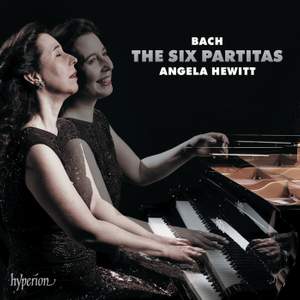
| |  | J.S. Bach: The Six Partitas
Astonishingly, the Six Partitas for Clavier were the first works Bach published – after more than twenty years of composing. 'Opus 1' (as he called it) was 'offered to music lovers in order to refresh their spirits' and the works scored an immediate hit, becoming core repertoire for keyboard players both professional and amateur. 'Partita' is simply another name for a suite of dance movements, and each of these collections combines grace, agility and sprightliness with a nobleness of spirit which makes them not only accessible and attractive, but also worthy in every way of their position in the Clavierübung – Bach's own summation of his compositional skills. “Everything has been deeply considered. Everything works. Hewitt makes a beautiful, limpid sound; her ornaments are exquisitely precise as well as sounding natural; she uses the subtle shadings and variations of volume possible on the piano without swamping the music. Technically the paying is faultless ... superbly poised, light and joyous. Indeed, that would sum up the entire set” Classic CD “If Bach is to be played on the piano, this is the kind of way to do it. Inherent in all Hewitt's playing is a rhythmic vitality, always under control, that sweeps you along with its momentum, subtly varied articulation, dynamics that follow the natural rise or fall of phrases without exaggerations, an appreciation of Bach's harmonic tensions, an ability to differentiate between the strength of contrapuntal lines, and an unfailing clarity of texture. This is a sane and sensible interpretation, deeply musicianly and devoid of eccentricity. Her attitude, rather like Toscanini's, is to accept the text com' è scritto and then to make legitimate adjustments, so we get double-dotting and assimilation of rhythms. Technically she's immaculate, with the cleanest possible ornaments. In the great E minor Sarabande Hewitt is justifiably emotional, without becoming soggy: only in the first half of the A minor Allemande is there a hint of coyness. No, the whole disc gives unalloyed pleasure.” Gramophone Classical Music Guide, 2010 | | | In stock - usually despatched within 1 working day. |
|
|
| |
|