All recordingsPrices shown exclude VAT. (UK tax is not payable for deliveries to United States.) See Terms & Conditions for p&p rates. | |  | Christian Lane
Dupré: | Prelude & Fugue in B major, Op. 7 No. 1 | Elgar: | Imperial March, Op. 32 arr. for organ | Liszt: | Variations on a theme from 'Weinen, Klagen, Sorgen, Zagen' (J S Bach) for piano, S180 | Roger-Ducasse: | Pastorale | Schumann: | Studies (6) in Canonic Form, Op. 56 arr. for organ | Vierne, L: | Pièces de fantaisie, 2nd suite, Op. 53: No. 5, Claire de lune Pièces de fantaisie, 3rd suite, Op. 54: No. 6, Carillon de Westminster | Whitlock: | Five Short Pieces: Folk Tune Five Short Pieces: Allegretto |
Christian Lane is one of America’s most accomplished young organists. He has been acclaimed for his “driving energy and mature interpretation” The American Organist. In 2011 he won 1st Prize in the Canadian International Organ Competition. | | | (also available to download from $10.50) | In stock - usually despatched within 1 working day. |
|
|
| |  | Schumann: Complete Piano Trios
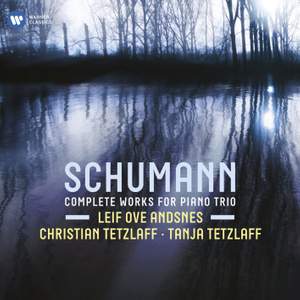
Frequent collaborators Leif Ove Andsnes, violinist Christian Tetzlaff and cellist Tanja Tetzlaff record three of Robert Schumann’s Piano Trios for this 2-CD set. The trio have recorded Piano Trio No. 1 in D minor, Op. 63, Piano Trio No. 2 in f and Piano Trio No. 3 in G minor. “there are so many praiseworthy things. The way these musicians approach Schumann's long spans of rhythmically repetitive writing shows such understanding and sensitivity that you forget there was ever a problem to be solved. There are some very memorable touches here, like the ghostly string tone at the heart of the first movement of the First Trio.” BBC Music Magazine, June 2011 *** “Andsnes and the Tetzlaff siblings adopt a restrained approach that works most convincingly in Schumann’s songful slow movements...there is rapport here.” Sunday Times, 15th May 2011 *** “as you would expect from such fine musicians, they make a formidably competent trio. Their playing of all the works here is technically beyond criticism, and there is plenty to admire, whether it's Andsnes's crystalline delicacy in the slow movements or the way in which the two string players can reduce their tone to the merest whisper for dramatic effect.” The Guardian, 19th May 2011 *** “So what makes this so special? First, the pianist: Leif Ove Andsnes has long been acclaimed for his Schumann...It's not just for their dramatic pacing that I treasure these performances but for their lyrical qualities too...in the 'Duett' from the Op. 88 Fantasiestücke I defy you to find more beauty and understanding bewteen two string players, with Andsnes the most sensitive of supporting artists...a remarkable achievement.” Gramophone Magazine, July 2011 “[Christian Tetzlaff's] strong personality and unmistakeable sound - plangent, witty and often lightly ironic - can seem quite dominant. But Andsnes's sparkling, solid and good-natured pianism is his ideal foil and on the whole the three play as if with one mind. In their hands Schumann emerges as blazingly inspired.” Classic FM Magazine, July 2011 ***** | | | In stock - usually despatched within 1 working day. |
|
|
| |  | Schumann: Piano Works
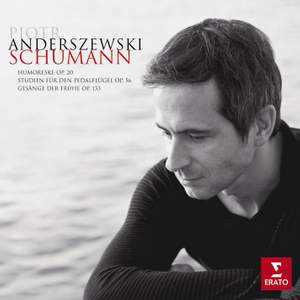
In his last Virgin Classics recital, a varied live programme from New York’s Carnegie Hall, Piotr Anderszewski included Faschingsschwank aus Wien by Schumann. On this new release, he focuses entirely on that quintessential German Romantic, whose 200th anniversary is celebrated in 2010. “For me, Schumann is the great humanist,” says Piotr Anderszewski. “His purity and honesty touch me profoundly.” This new recital brings together three of the composer’s more rarely performed keyboard works, including the last piano music he completed. “I fell back in love with Schumann a couple of years ago when I played the Humoreske,” explains Piotr Anderszewski. “For me, Schumann is the great humanist: there is more to his work and his life than music, and his purity and honesty touch me profoundly ... There is even greatness in the failures he experienced as a composer – with the orchestra and in matters of form … He doesn’t achieve the perfection of Chopin, Brahms or Mendelssohn. “I see him as someone of extreme sensitivity, and also as someone with a bourgeois side to him and a strong sense of family. He was very methodical in his work, meticulous to the point of obsession, with a mad, poetic, idealistic streak that for me is very German. There is an almost religious depth in his work … Even if it can be frenetic and unbalanced, with its rhythmical asymmetry, its digressions, its sudden fortissimos, I still hear reminiscences of Lutheran choirs. “There is such spontaneity, instability, whimsicality, even weirdness in his music. His writing is angular, as he propels you in one direction and then suddenly takes you the opposite way. His career as a pianist didn't work out, nor did his career as a conductor. He fails in certain compositions – and he even failed when he attempted suicide. There is a vulnerability about him and his music which touches me – and what a fascinating psychological case study he makes – but there is such beauty in what he did achieve.” For this new recital, Anderszewski turns his attention to some of Schumann’s less frequently performed works. The Humoreske of 1839, far more serious-minded and substantial than its name might suggest, is built in five discrete sections. Mercurial in it shifts of mood, it reflects the composer’s report to his wife Clara that, while working on the piece, he was “laughing and crying, all at once”. The Gesänge der Frühe date from 1853, the year before the composer’s attempted suicide, and form his last completed work for piano. Terse, introspective and harmonically adventurous they are expressive of the mood before sunrise. By contrast, the Six Studies in Canon Form are lyrical and unobtrusively contrapuntal. Schumann composed them for the pedal piano which, like an organ, had an extra set of notes played with the feet; an example of the instrument is on display at Schumann’s birthplace in Zwickau. Anderszewski himself has adapted the pieces for the range of the modern piano and for ten fingers rather than two hands and two feet. In response to Anderszewski’s Carnegie Hall recital, the Daily Telegraph praised “the intellectual power, profound emotional response and keen imagination that his playing conveys … Anderszewski’s remarkable ear for tonal shading and nuance is absorbingly to the fore … [His] command of perspective is paramount. The soft playing is mesmerising, the scope of his interpretation geared to probing deep into the music’s inner expressive tissues … Schumann’s Faschingsschwank aus Wien shows his romantic spirit and his instincts for drama and poetry. This is an outstanding release.” “He probes the extremes of Schumann's spiritual world, evoking a terrific spectrum of feeling...And he shows that the Gesänge der Frühe are in no way about mental disintegration: his mellifluous touch and carefully balanced voicing put them across as slivers of heaven. Anderszewski has the profundity of vision to comprehend these works, the intellect to pace their emotions and the virtuosity to perform them with flair, radiant tone and rapt wonder.” Classic FM Magazine, April 2011 ***** | | | In stock - usually despatched within 1 working day. |
|
|
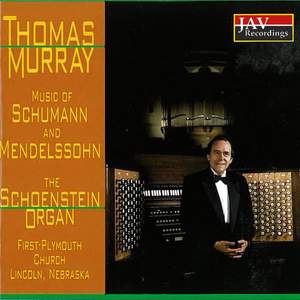
| |  | Schumann - Complete Organ Works
Mario Hospach-Martini (organ) Robert Schumann’s organ music pays respectful homage to Johann Sebastian Bach, linking polyphonic interweaving of voices with rich timbre and soulfulness to achieve an impressive ensemble of Romantic sound. Mario Hospach-Martini plays on the great Walcker organ of the Stadtkirche in Winterthur, one of the few historically appropriate instruments for this music. | | | In stock - usually despatched within 1 working day. |
|
|
| |  | Debussy TranscriptionsTranscriptions of Debussy for 2 pianos and transcriptions by Debussy for piano 4 hands or for 2 pianos
Jean-François Heisser & Georges Pludermacher (pianos) | | | In stock - usually despatched within 1 working day. |
|
|
| |  | Schumann: Complete Organ Works
“A very interesting issue of neglected music.” Classic CD | | | In stock - usually despatched within 1 working day. |
|
|
| |  | Piano-Pédalier
This is an interesting disc of works written for pedal piano by composers, Alkan, Dubois, Franck, Liszt and Schumann, performed here in their original form by expert Jean Dubé. | 
| | | Usually despatched in 2 - 3 working days. |
|
|
| |  | Robert Schumann: Piano Trios
| |
|
| |  | Mendelssohn: Piano Trios Nos. 1 & 2
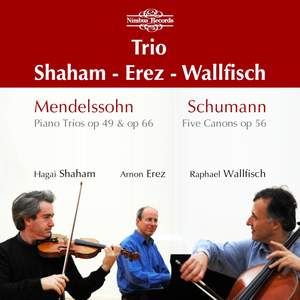
“The debut collaboration of these three distinguished soloists is less of an ego-fest than you might imagine. The reciprocity in their playing allows you to listen to it as chamber music for its own sake rather than the musical curiosity these all-star combinations can often be...the disc's programming [is] as enjoyable as much for its conception as its substance” Gramophone Magazine, June 2012 “This is a most distinguished example of chamber music making by a relatively recent ensemble...Shaham’s vibrato is often quite light and quick and he and Wallfisch ensure that vibrato speeds and colours are consonant and consistent.
...first class performances are evidence of sensitive and imaginative music-making.” MusicWeb International, May 2012 | | | Usually despatched in 4 - 5 working days. |
|
|
| |  | Doppio Borgato - Concert Grand Piano with Pedalboard
Mirco Bruson (Doppio Borgato) However unusual or even bizzarre it may seem, the idea of a piano endowed with a pedalboard similar to that of an organ actually has a long history behind it. Its antecedents are the clavichord and the harpsichord with single or double keyboard, which also often had a pedalboard attached. Johann Sebastian Bach owned a clavichord with two keyboards and pedalboard for which he composed the Trio Sonata BWV 525-530, the Passacaglia in C minor BWV 582 and other works. Wolfgang Amadeus Mozart owned a fortepiano with independent pedals, built expressly for him in 1785 by Anton Walter. The instrument Robert Schumann refers to as a pedalflügel (piano with pedalboard) first entered his home in Dresden in 1845. He was also able to convince F. Mendelssohn Bartholdy to inaugurate a class especially for the pedalflügel in the Conservatorium of Leipzig. There are various systems with which a pedalboard was attached to the piano: the most common was that of a pedalboard fastened under the piano that activated its mechanics-keyboard; another System, though less frequent, was that of placing two independent pianos (each with its separate mechanics and strings). At the end of this last century the piano-maker Luigi Borgato realized a new instrument, the "DOPPIO BORGATO": a double piano of extensive form, joining a concert-grand together with a second piano activated by a pedalboard comprised of 37 pedals, thus augmenting the expressive qualities of its 18th century predecessors. The DOPPIO BORGATO opens up a new page for the musical world, this particular instrument offering new possibilities to both composers and interpreters. | | | Usually despatched in 3 - 4 working days. |
|
|
| |
|