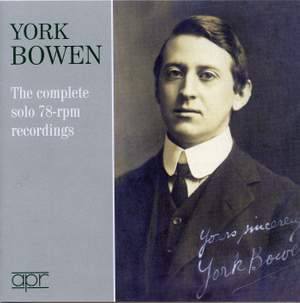
All recordingsPrices shown exclude VAT. (UK tax is not payable for deliveries to United States.) See Terms & Conditions for p&p rates. | |  | York Bowen - The complete 78rpm Recordings
Bach, J S: | Capriccio from Partita No. 2 in C minor, BWV826 recorded 1923? | Beethoven: | Piano Concerto No. 4 in G major, Op. 58 recorded 1925 Aeolian Orchestra, Stanley Chapple Piano Sonata No. 13 in E flat major, Op. 27 No. 1 'Quasi una fantasia' (Andante) recorded 1923? Piano Sonata No. 24 in F sharp major, Op. 78 recorded 1927 | Bowen: | Suite No. 2, Op. 30: Finale ‘A Romp’ recorded 1925 The Way to Polden (an ambling tune) Op. 76 recorded 1925 Arabesque, Op. 20, No. 1 recorded 1925 Fragments from Hans Andersen, Op. 58 recorded 1926 (with spoken introductions) | Brahms: | Capriccio in B minor, Op. 76 No. 2 recorded 1925 | Chopin: | Ballade No. 3 in A flat major, Op. 47 recorded 1925 Scherzo No. 2 in B flat minor, Op. 31 recorded 1926 Waltz No. 2 in A flat major 'Grande Valse Brillante', Op. 34 No. 1 recorded 1926 Polonaise No. 1 in C sharp minor, Op. 26 No. 1 recorded 1926 Étude Op. 25 No. 5 in E minor recorded 1927 Prelude Op. 28 No. 23 in F major recorded 1927 Prelude Op. 28 No. 20 in C minor recorded 1927 Prelude Op. 28 No. 3 in G major recorded 1927 | Cochrane: | Le Ruisseau recorded 1925 | Debussy: | Estampe No. 3 - Jardins sous la pluie recorded 1925 Arabesque No. 2 recorded 1926 | Gardiner, H B: | London Bridge from Five Pieces recorded 1926 Gavotte from Five Pieces recorded 1926 | Liszt: | Eglogue (Années de pèlerinage I, S. 160 No. 7) recorded 1925 | Mendelssohn: | Scherzo in E minor, Op. 16 No. 2 released January 1915 | Moscheles: | Etude, Op. 70 No. 5 recorded 1925 | Rachmaninov: | Prelude Op. 23 No. 5 in G minor recorded 1926 Polichinelle, Op. 3, No. 4 recorded 1925 | Schumann: | Faschingsschwank aus Wien, Op. 26 (Allegro) recorded 1926 | Schütt: | Etude Mignonne in D major, Op. 16, No. 1 released January 1915 |
In recent years York Bowen, the composer, has enjoyed a spectacular revival, but until now his talents as pianist (barring a late recording of his own music for Lyrita) have not been heard since the days of 78s. At the height of his success, in the first decades of the 20th century, Bowen was as much known as pianist as composer and frequently performed at the Proms amongst other things. His first recording, a very rare disc on the Marathon label, was released in 1915, but the bulk of his work was done for Vocalion; after they went bankrupt in 1927 he appears to have made no further 78s. Pride of place must go to Bowen’s Beethoven 4th Piano Concerto. This was the very first recording of the work and its neglect has been due to the fact that it was one of the last recordings to be made under the old acoustic process which was superseded the year the work was issued. Bowen’s pianism is extremely fluent and he plays his own cadenzas! Through all the featured works we hear a pianist who plays in the ‘grand manner’ and that, and his preference for romantic repertoire, reveal him as somewhat atypical of the English pianist of his time. Perhaps his nickname ‘the English Rachmaninov’ did indeed hit the nail on the head. “Bowen's supple musicianship and commanding technique (you sense there's always more in reserve) could hold their own with anyone's in his era. His Beethoven and Debussy are special. Reasonable sound for the vintage.” BBC Music Magazine, February 2009 **** “…throughout this collection, Bowen comes across as a wonderfully assure musician for whom the studio held no fears. Few pianists have ever played the middle section of Rachmaninov's G minor Prelude No 5 to such telling effect.” Gramophone Magazine, December 2008 | | APR - APR6007 (CD - 2 discs) Normally: $19.50 Special: $15.60 |
| | Usually despatched in 2 - 3 working days. |
|
|
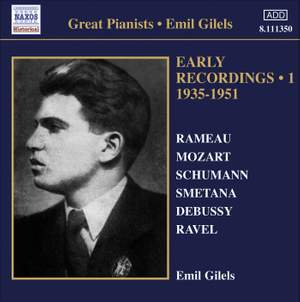
| |  | Emil Gilels: Early Recordings Volume 1All tracks recorded in the USSR, 1935-1951
Debussy: | Clair de Lune (from Suite Bergamasque) Trois Nocturnes: Fêtes arr. Borwick | Godowsky: | Renaissance - No. 12, Gigue in E (Loeillet) | Mendelssohn: | Scherzo in E minor, Op. 16 No. 2 Song without Words, Op. 38 No. 6 in A flat major 'Duetto' Song without Words, Op. 38 No. 6 in A flat major 'Duetto' | Mozart: | Piano Sonata No. 14 in C minor, K457 | Rameau: | La villageoise Le rappel des oiseaux | Ravel: | Le Tombeau de Couperin: Prelude Le Tombeau de Couperin: Forlane Le Tombeau de Couperin: Toccata | Schumann: | Toccata in C major, Op. 7 Traumes Wirren (Fantasiestucke, Op. 12 No. 7) Der Kontrabandiste, Op. 74 No. 10 arr. C. Tausig | Smetana: | Czech Dances, Book 1, No. 2 Polka in A minor Polka in F major |
Emil Gilels was one of the greatest Russian pianists of the twentieth century, born in Odessa in 1916. The recordings on this first disc of his early recordings, made in the USSR, come from the first stage of Gilels’s career and include his first known recordings from1935. Leopold Godowsky’s arrangement of the Gigue by Jean-Baptiste Loeillet immediately shows the immense power the nineteen-year old Gilels had at the keyboard. His playing, especially in his youth, was fiery, volatile and exciting, and even late in his career it still retained grandeur and sweep of a great master in the Russian tradition. “Gilels had a sense of grandeur tempered by discipline and respect for the text….strong and massive without being harsh…. A fine pianist.” BBC Music Magazine “Here was a real artist, and a real communicator.” BBC Music Magazine “…here, in performance after performance, is the sort of playing that made Rubinstein, on hearing the teenage Gilels in Russia, exclaim, "if that boy ever comes to America I might as well pack my bags and retire".” Gramophone Magazine, February 2009 “these are now the transfers of choice for this body of recordings” MusicWeb International “Here, in performance after performance, is the sort of playing that made Rubinstein, on hearing the teenage Gilels in Russia, exclaim, 'if that boy ever comes to America I might as well pack my bags and retire'. Even in dated sound an 'elemental virtuoso gift' and a 'sonority rich in noble metal' are omnipresent. And whether you hear Gilels in his exquisite Rameau, the thunderous brilliance of his Godowsky or in the way his decorations in Smetana's A minor Polka shimmer like the beating of a hummingbird's wings, you will hear a nonpareil pianism. True, in years to come Gilels would find greater depth than his enviably spruce and immaculately turned Mozart conveys, but even here the playing is of an aristocratic distinction and finesse. All in all these performances is a reminder of this grandest of musical titans. Ward Marston's transfers come up excellently and special thanks go to Judith Rayner for the loan of discs from her priceless collection.” Gramophone Classical Music Guide, 2010 | | | (also available to download from $9.25) | Usually despatched in 2 - 3 working days. (Available now to download.) |
|
|
| |  | Mendelssohn - Piano Music
Mendelssohn: | Prélude in B Minor, Op. 104a, No. 2 Rondo capriccioso in E major, Op. 14 3 Etudes, Op. 104b Auf Flügeln des Gesanges, Op. 34 No. 2 transc. Liszt Song without Words, Op. 38 No. 2 in C minor Scherzo in E minor, Op. 16 No. 2 Das erste Veilchen, Op. 19a No. 2 Variations sérieuses in D minor Op. 54 Song without Words, Op. 102 No. 5 in A major 'Childrens Piece' Caprice in E Major, Op. 33, No. 2 Caprice in B Flat Minor Op. 33, No. 3 Suleika (Goethe/von Willemer) Op. 34 No. 4 transc. Liszt Song without Words, Op. 67 No. 2 in F sharp minor Song without Words, Op. 67 No. 5 in B minor A Midsummer Night's Dream: Scherzo transc. Rachmaninov |
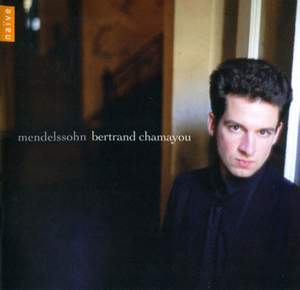
During his tragically short life, Felix Mendelssohn produced an extensive output of music covering every genre. Although he claimed that he took little pleasure in writing for the piano and felt that it was not an area of composition that he was particularly good at, the music itself has always retained a place in the affection of performers. After the sonatas of his early youth, he concentrated mostly on producing short pieces which could more readily be put together during the limited gaps in his busy professional life. The anthology selected for this recording by Bertrand Chamayou interweaves many of these shorter works with more substantial pieces, and includes some rarely performed music alongside established masterpieces like the “Songs without words “The Songs Without Words are among the least difficult of the pieces here technically, but the other pieces are much more demanding… It says much for Chamayou's virtuosity and artistry that he makes the results so magnetic.” Gramophone Magazine, October 2008 “There was a time in the 19th century when Mendelssohn's Songs Without Words were regularly regarded as the third great collection of piano music after Beethoven's 32 sonatas and Bach's 48 Preludes and Fugues. While Chopin's piano music is still dominant, Mendelssohn's star as a pianist-composer has faded. It is a splendid idea of the young Toulouse-born French pianist Bertrand Chamayou to choose five of the most striking Songs Without Words and make them a centrepiece for what he describes as a 'Liederabend without words'. The Songs Without Words are among the least difficult of the pieces here technically, but the other pieces are much more demanding, not just the two bigger pieces, the Variations sérieuses and the Rondo capriccioso, but such pieces as the ThreeStudies. It says much for Chamayou's virtuosity and artistry that he makes the results so magnetic. He opens with a brief and powerful Prelude in B minor, leading to a sparkling account of the Rondo capriccioso bringing out echoes of the Scherzo from A Midsummer Night's Dream, which right at the end of the recital comes as a tailpiece in Rachmaninov's arrangement. The articulation in the Three Studies is phenomenally clear and light, as it is too in Chamayou's dazzling account of the Caprices. There are similar qualities in the longest and most ambitious of the pieces, the Variations sérieuses. Along with the Songs Without Words it is good too to have Liszt's surprisingly unshowy arrangements of Mendelssohn's most famous Lied, 'On Wings of Song'. Clean, clear sound to match the playing.” Gramophone Classical Music Guide, 2010 | | | (also available to download from $11.00) | Usually despatched in 3 - 4 working days. (Available now to download.) |
|
|
| |  | Earl Wild at 30 - Live broadcast from the 1940's
Live Radio Broadcasts from the 1940's by a young 30-year-old legendary virtuoso of the keyboard, Earl Wild. Radio Broadcasts from NBC and ABC in New York City of rare Earl Wild performances of Scarlatti, Daquin, Mussorgsky, MacDowell, Mendelssohn, Rachmaninoff, Chopin and an absolutely staggering Liszt Piano Sonata. Not to be missed by anyone. | | | Usually despatched in 4 - 5 working days. |
|
|
| |  | Shura Cherkassky
Live Recording 1951/1953 | | | Usually despatched in 3 - 4 working days. |
|
|
| |  | Mendelssohn: Songs Without Wordsand other piano favourites
Mendelssohn: | Caprice, Op. 33 No. 1 Andante and Rondo capriccioso in E major Op. 14 Prelude & Fugue for piano in E minor, Op. 35 No. 1 Study No. 2 in F major Prelude & Fugue for piano in F minor, Op. 35 No. 5 Scherzo in E minor, Op. 16 No. 2 Variations sérieuses in D minor Op. 54 Characteristic Pieces (7), Op. 7: No. 7 Klavierstucke, No. 2 Song without Words, Op. 19b No. 1 in E major 'Sweet Remembrance' Song without Words, Op. 19b No. 3 in A major 'Hunting Song' Song without Words, Op. 19b No. 6 in A minor 'Venetianisches Gondellied' Song without Words, Op. 30 No. 4 in B minor Song without Words, Op. 53 No. 4 in F major Song without Words, Op. 62 No. 5 in A minor 'Venetianisches Gondellied No. 3' Song without Words, Op. 62 No. 6 in A major 'Spring Song' Song without Words, Op. 67 No. 4 in C major 'Spinning Song' or 'Bee's Wedding' Song without Words, Op. 85 No. 1 in F major Song without Words, Op. 102 No. 3 in C major Song without Words, Op. 102 No. 4 in G minor |
“Recommended with enthusiasm.” CD Review | | | Usually despatched in 4 - 5 working days. |
|
|
| |  | Great Pianists - Ignaz Friedman
Beethoven: | Piano Sonata No. 14 in C sharp minor, Op. 27 No. 2 ‘Moonlight' 2nd & 3rd movements | Chopin: | Polonaise No. 6 in A flat major, Op. 53 'Héroïque' Mazurka No. 5 in B flat major, Op. 7 No. 1 Berceuse in D flat major, Op. 57 Étude Op. 25 No. 9 in G flat major 'Butterfly' Étude Op. 10 No. 5 in G flat major 'Black Key' Piano Sonata No. 2 in B flat minor, Op. 35 'Marche funèbre' 3rd & 4th movements | Friedman, I: | Elle danse, Op. 10 No. 5 Tabatière à musique Marquis et Marquise | Grieg: | Piano Concerto in A minor, Op. 16 | Mendelssohn: | Scherzo in E minor, Op. 16 No. 2 | Mittler: | Music Box for the Little Nana, Op. 2 No. 2 | Rubinstein: | Romance in E flat major, Op. 44 No. 1 'The Night' | Suk: | Minuet, Op. 21 No. 2 |
| | | (also available to download from $9.25) | Usually despatched in 2 - 3 working days. (Available now to download.) |
|
|
| |  | Great Pianists - Moiseiwitsch 2
Beethoven: | Andante Favori in F, Wo057 | Henselt: | Etude caracteristique, Op. 2 No. 6 | Hummel, J: | Rondo for piano in E flat major, Op. 11 | Liszt: | La leggierezza - Étude de concert No. 2, S144 Hungarian Rhapsody, S244 No. 2 in C sharp minor Liebestraum, S541 No. 3 (Nocturne in A flat major) Isolde's Liebestod (after Wagner), S447 (fragment) Ouvertüre zu R Wagners Tannhäuser S442 | Mendelssohn: | Scherzo in E minor, Op. 16 No. 2 Song without Words, Op. 19b No. 3 in A major 'Hunting Song' Song without Words, Op. 53 No. 4 in F major | Schumann: | Fantasiestücke, Op. 12 No. 4 'Grillen' Romance in F sharp major, Op. 28 No. 2 The Prophet Bird Op. 82 No. 7 | Weber: | Invitation to the Dance, Op. 65 (arr. Tausig) |
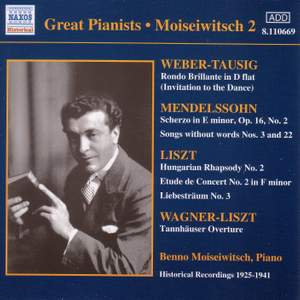
“These recordings, made between 1925 and 1945, confirm Benno Moiseiwitsch (1890-1963) as one of the truly great pianists of the last century. With his awesome technical command, far-ranging repertoire and innate taste, he is that rare being whose playing is instantly recognizable” International Record Review | | | (also available to download from $9.25) | Usually despatched in 2 - 3 working days. (Available now to download.) |
|
|
| |  | Great Pianists - Ignaz Friedman
Beethoven: | Piano Sonata No. 14 in C sharp minor, Op. 27 No. 2 ‘Moonlight' | Chopin: | Mazurka No. 41 in C sharp minor, Op. 63 No. 3 Waltz No. 6 in D flat major, Op. 64 No. 1 'Minute Waltz' Mazurka No. 23 in D major, Op. 33 No. 2 Prelude Op. 28 No. 19 in E flat major Étude Op. 25 No. 6 in G sharp minor Ballade No. 3 in A flat major, Op. 47 Mazurka No. 23 in D major, Op. 33 No. 2 Étude Op. 10 No. 12 in C minor ‘Revolutionary' Étude Op. 10 No. 7 in C major Waltz No. 3 in A minor 'Grande Valse Brillante', Op. 34 No. 2 Prelude Op. 28 No. 15 in D flat major ‘Raindrop' Mazurka No. 25 in B minor, Op. 33 No. 4 | Friedman, I: | Elle danse, Op. 10 No. 5 | Gärtner: | Viennese Dance No. 1 | Hummel, J: | Rondo for piano in E flat major, Op. 11 | Liszt: | Étude d'exécution transcendante d'après Paganini, S. 140 No. 3 (arr. Busoni) | Mendelssohn: | Scherzo in E minor, Op. 16 No. 2 | Moszkowski: | Serenata in D major, Op. 15 No. 1 | Mozart: | Rondo alla Turca from Piano Sonata No. 11, K331 | Scarlatti, D: | Pastorale | Schubert: | Ständchen 'Horch! Horch! die Lerch!', D889 (arr. Liszt) |
| | | (also available to download from $9.25) | Usually despatched in 2 - 3 working days. (Available now to download.) |
|
|
| |  | Ignaz FriedmanHighlights (1925-36) from his discography
Beethoven: | Piano Sonata No. 14 in C sharp minor, Op. 27 No. 2 ‘Moonlight' | Chopin: | Étude Op. 10 No. 12 in C minor ‘Revolutionary' Étude Op. 10 No. 7 in C major Polonaise No. 6 in A flat major, Op. 53 'Héroïque' Piano Sonata No. 2 in B flat minor, Op. 35 'Marche funèbre' Étude Op. 25 No. 9 in G flat major 'Butterfly' Étude Op. 10 No. 5 in G flat major 'Black Key' Waltz No. 9 in A flat major, Op. 69 No. 1 'Farewell Waltz' Mazurka No. 17 in B flat minor, Op. 24 No. 4 Mazurka No. 25 in B minor, Op. 33 No. 4 Impromptu No. 2 in F sharp major, Op. 36 Nocturne No. 16 in E flat major, Op. 55 No. 2 | Friedman, I: | Elle danse, Op. 10 No. 5 Tabatière à musique Old English Minuet (Shield) | Hummel, J: | Rondo for piano in E flat major, Op. 11 | Liszt: | Grande Étude de Paganini, S. 141 No. 3 'La Campanella' (arr. Busoni) Ständchen - Horch, horch! die Lerch (No. 9 from Zwölf Lieder von Franz Schubert, S558) | Mendelssohn: | Scherzo in E minor, Op. 16 No. 2 |
“Who else launches Chopin’s "Revolutionary" Study with such incredible velocity, raising an aural storm in the process but with every note intact? Mendelssohn's elfin E minor Scherzo is a rocket trailed by stardust; Chopin's A flat Polonaise is all thunder and pride, and Hummel's elegant Rondo becomes a tonal hurricane... Four previously unissued tracks add further confirmation of Friedman's pianistic genius” The Independent | | | Usually despatched in 2 - 3 working days. |
|
|
| |
|