All recordingsPrices shown exclude VAT. (UK tax is not payable for deliveries to United States.) See Terms & Conditions for p&p rates. | |  | Dvorak: Songs my Great-Grandfather Taught MeTranscriptions by Josef Suk of 30 Dvorak songs
Dvorak: | Gypsy Melodies (7), Op. 55 (B104) Liebeslieder (8), Op. 83 Four Songs, Op. 82: No. 1, ‘Leave Me Alone’ Lullaby, B194 Die Gefangene, Op. 32 No. 11 Biblical Songs (10), Op. 99 Dobrú noc, má milá (Goodnight, My Darling), Op. 73 No. 1 Ach, neni, neni tu (There is nothing here to comfort me), Op. 73 No. 3 |
Two of world’s greatest musicians appear together – for the first time anywhere – on Toccata Classics, playing an hour of ‘new’ Dvorák. Josef Suk – the great-grandson of Antonín Dvorák – undertook these transcriptions of 30 Dvorák songs at the suggestion of Martin Anderson of Toccata Classics. Josef Suk had Dvorák’s own viola restored for the recording sessions, which took place in Prague at the beginning of September. Suk’s transcriptions turn the songs into exquisitely beautiful instrumental miniatures. “...the opportunity to hear these evocative and melodious miniatures in affectionate and warmly recorded performances from these great musicians should not be passed up lightly.” BBC Music Magazine, May 2010 **** “…the same vibrant tone, pure intonation and confident musicianship that has thrilled us for many years.” Gramophone Magazine, March 2010 “The inauthentic doesn’t come much more authentic....From the Love Songs, Op 83, the intense “Death reigns in many a human heart” stands out. For the Op 99 Biblical Songs, Suk takes up the viola, but his violin tone is so rich, you could believe he was playing one all along.” Sunday Times, 14th February 2010 *** “[Martin Anderson] has persuaded Josef Suk to transcribe the songs of his great-grandfather, Antonín Dvořák, for violin and viola, giving new life to these charming but neglected miniatures...A tender and highly personal collection to cherish.” The Observer, 4th July 2010 | | | In stock - usually despatched within 1 working day. |
|
|
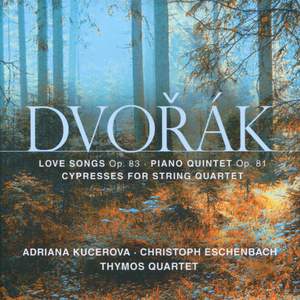
| |  | Dvorák: Love Songs, Op. 83, Cypresses & Piano Quintet
Three romantic works by Dvorák from the 1880’s receive soulful performances by the Paris-based Thymos Quartet, pianist Christoph Eschenbach, and soprano Adriana Kucerova. “Think about a young man in love – this is what they are about", wrote Dvorák to his publisher when he was preparing Cypresses for string quartet. The title is taken from a volume of poems by Gustav Pfleger-Moravsky which inspired the composer’s earlier burst of song writing in 1865, eight of which later became the cycle Love Songs Op. 83, and 12 of which were arranged for string quartet, five of them presented here. Recalling youthful love letters that are preserved and cherished, Love Songs and Cypresses combine beautiful melodic simplicity with the technique of a composer who was, by the mid-late 1880s, at the height of his powers. Cypresses in their string quartet form were premiered on 6 January 1888, on a bill which also featured the first performance of the Piano Quintet, Op 81. The Paris-based Quatuor Thymos – named after an ancient Greek term meaning “spiritedness” – comprises four First Prize winners from the Paris and Lyon conservatoires. Following acclaimed performances throughout France and in other European capitols, they were invited to perform at the Ravinia Festival in Chicago by Christoph Eschenbach. This recording brings the foursome together with the eminent pianist, who also accompanies the Slovakian soprano Adriana Kucerova whose star is rapidly in the ascendant. “[Eschenbach] is still a magnificent player, as witness his ability to make Dvorak's occasionally awkward piano writing sound like spun silk...the Quintet sounds utterly enchanting in this gloriously unhurried reading.” Classic FM Magazine, February 2012 **** “A great programming idea, this...[Kucerova is] a vocal epitome of amatory responsiveness...Throughout the entire performance there's no mistaking the leader of the pack: one is always aware of listening to an excellent quartet and an exceptional pianist. Absolutely no harm in that!” Gramophone Magazine, January 2012 “The playing in the quartet arrangements and the Quintet is very fine, but not everyone will respond to an interpretation which, in search of an expressive edge, often adopts abrupt changes of tempo” BBC Music Magazine, February 2012 *** | | | Usually despatched in 4 - 5 working days. |
|
|
| |  | Martina Janková: VoyageRecorded at the Radio Studio DRS Zurich, Switzerland, September 2004
Martina Janková (soprano) & Gérard Wyss (piano) The gracious young soprano Martina Janková has established a firm position amidst fierce international competition. Since 1998 she has been an Oper Zürich soloist and has featured in productions by conductors of such renown as Gardiner, Harnoncourt, Fedoseyev, Herreweghe, Rattle, etc. With Sir John Eliot Gardiner, she has recorded, among other things, Bach’s cantatas. Yet Martina Janková keeps returning to the emotionally rich realm of the song. “Voyage” is not merely a song recital. It is a journey from the child’s wonderment at the colourfulness of the world through amorous enthralment to self-knowledge and finally (in Dvořák’s Biblical Songs) also to that which transcends us. A voyage through life in images, where every word and every tone bears a meaning of its own. In the songs, Martina Janková lets personal stories revive and peers into the innermost corners of the soul. Martina Janková’s “Voyage” – a journey into the mysteries of the soul and an invitation to an encounter. “This is a particularly fine collection...[Jankova] has a wonderfully free, sweet upper range (she reaches up for high notes exquisitely, without a hint of strain or wobble). Her phrasing too is magically, richly flexible. In short, her vocal colouring is incredibly fresh and young-sounding...Those top notes are really something never to forget. A disc to treasure.” Gramophone Magazine, September 2011 | | | Usually despatched in 4 - 5 working days. |
|
|
| |  | Schumann/Dvorak/Brahms - Lieder
Brahms: | Schwalbe, sag' mir an, Op. 107 No. 3 O schönste Schäfrin mein, WoO 33/1 Schwesterlein, WoO posth. 37 No. 1 Feinsliebchen, du sollst mir nicht barfuß gehen (No. 12 from Deutsche Volkslieder, WoO 33) Wie komm ich denn zur Tur herein (No. 34 from Deutsche Volkslieder, WoO 33) | Dvorak: | In Folk Tone - four songs, Op. 73 Liebeslieder (8), Op. 83 | Schumann: | Tragödie Op. 64 No. 3 Die beiden Grenadiere, Op. 49 No. 1 Die Lotosblume, Op. 25 No. 7 Die feindlichen Brüder, Op. 49 No. 2 Der Soldat, Op. 40, No. 3 Lehn deine Wang' Op. 142 No. 2 Rätsel, Op. 25 No. 16 Romanzen und Balladen III, Op. 53 Der arme Peter, Op. 53 No. 3 Belsazar, Op. 57 Schön ist das Fest des Lenzes, Op. 37 No. 7 Wiegenlied |
Dedicated and sold in aid of Cleft Children International (CCI) Foundation | | | Usually despatched in 2 - 3 working days. |
|
|
| |  | Dvorak: Songs
“These four cycles make an excellent and generous coupling, with Dagmar Pecková, brilliantly supported by Irwin Gage, a most persuasive advocate. Hers is an ideal voice, unmistakably Slavonic in timbre, yet firm and pure as well as rich. She retains a freshness specially apt for the songs inviting a girlish manner, including Dvorák's most famous song, the fourth of the seven Gypsy Melodies, 'Songs my mother taught me', sounding fresh and new. The four cycles represent the full span of Dvorák's career. The eight Love Songs, B160 may officially date from 1888, but Dvorák in fact reworked a selection from 18 songs he'd written passionately at high speed over 20 years earlier – charming pieces which already reveal his unquenchable lyrical gift. Next chronologically are the Gypsy Songs of 1800, bold and colourful, here nicely contrasted by Pecková and Gage with four simpler, less exotic songs, In Folk Tone, of six years later. Last and longest is the cycle of ten Biblical Songs, written in the United States in 1894, when he was feeling homesick. They are more often sung by male singers, gaining from weight and gravity, but here with the mezzo, Pecková, they prove just as moving and intense. The sound is clear and well balanced.” Gramophone Classical Music Guide, 2010 | | | Usually despatched in 4 - 5 working days. |
|
|
| |  |
| | | Usually despatched in 2 - 3 working days. |
|
|
| |  | Dvorak: Zigeuermelodien Op.55
| | | Usually despatched in 4 - 5 working days. |
|
|
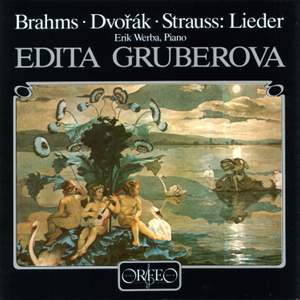
| |  | Edita Gruberova - Lieder
Brahms: | Lerchengesang Op. 70 No. 2 Auf Dem See op.106 No.2 In Waldeseinsamkeit, Op. 85 No. 6 Das Mädchen (No. 1 from Sieben Lieder, Op. 95) | Dvorak: | Liebeslieder (8), Op. 83 | Strauss, R: | Mädchenblumen (4 songs), Op. 22 An die Nacht, Op. 68 No. 1 Ich wollt ein Sträusslein binden, Op. 68 No. 2 Amor, Op. 68 No. 5 Ich Schwebe, Op. 48 No. 2 Freundliche Vision, Op. 48 No. 1 Schlechtes Wetter, Op. 69 No. 5 |
| | | Usually despatched in 3 - 4 working days. |
|
|
| |  | Dvorak: Biblical and Gypsy Songs
Vera Soukupova, Jindrich Jindrak, Beno Blachut, Ivan Moravec, Alfred Holecek, Ferdinand Pohlreich | | | Usually despatched in 4 - 5 working days. |
|
|
| |
|