All recordingsPrices shown exclude VAT. (UK tax is not payable for deliveries to United States.) See Terms & Conditions for p&p rates. | |  | Renaissance RadioSacred Music from the Renaissance Era for Celestial and Secular Radio
Allegri: | Miserere mei, Deus | Brumel, A: | Agnus Dei (Missa Et ecce terrae motus) | Byrd: | Mass for four voices - Agnus Dei O Lord, make thy servant Elizabeth Nunc Dimittis (The Great Service) | Clemens: | Ego flos campi | Cornysh the elder: | Ave Maria Mater Dei | Despres: | Ave Maria ... Virgo serena Agnus Dei (Messe de l'Homme Armé ‘sexti toni') | Gesualdo: | Precibus et meritis Maria, Mater gratiae | Guerrero: | Ave Virgo sanctissima | Lasso: | Ave Regina caelorum Salve Regina | Mouton, J: | Salva nos, Domine | Palestrina: | Agnus Dei (Missa brevis) Sicut lilium inter spinas (from Canticum canticorum, Motets Book IV) | Praetorius, H: | Joseph lieber, Joseph mein | Rore: | Descendi in hortum meum | Sheppard, J: | In manus tuas I, II & III | Tallis: | Lamentations of Jeremiah I: Incipit Lamentations of Jeremiah I: Aleph Lamentations of Jeremiah I: Bet Mihi autem nimis O sacrum convivium O nata lux de lumine 5vv Miserere nostri, motet for 7 voices, P. 207 If ye love me Hear the voice and prayer A new commandment Why Fum'th in Fight? E'en like the hunted hind God Grant we grace (Tallis Canon) Veni creator: Come Holy Ghost | Taverner: | Kyrie 'Le Roy' Missa Gloria tibi Trinitas: Benedictus | Tomkins: | When David Heard | Victoria: | Ave Maria O vos omnes Requiem: Kyrie Requiem: Graduale Versa est in luctum | White, Robert: | Christe qui lux es et dies III |
| 
| | | In stock - usually despatched within 1 working day. |
|
|
| |  | Music for Compline
Aston, H: | Gaude, virgo mater Christi | Byrd: | Christe qui Lux Miserere mihi, Domini Nunc dimittis | Gregorian Chant: | Salva nos, Domine Miserere mihi, Domine Veni Domine | Sheppard, J: | Libera nos 1 & II In pace in idipsum Jesu salvator saeculi, verbum In manus tuas I, II & III | Tallis: | In manus tuas Miserere nostri, motet for 7 voices, P. 207 In pace in idipsum Te lucis ante terminum | White, Robert: | Christe qui lux es et dies |
Helen Ashby, Kate Ashby, Alison Hill (sopranos), Emma Ashby, Eleanor Harries, Carris Jones,Timothy Wayne-Wright (altos), Peter Asprey, Andrew Griffiths,Tom Herford (tenors) & Oliver Hunt, Matthew O' Donovan, David Wright (basses) Stile Antico Vocal ensemble Stile Antico made its harmonia mundi début with this programme of 16th- and 17th-century polyphony written by some of England's greatest composers for the office of Compline, last of the daily hours and a form of night prayer. It went on to become one of the year's best sellers and achieved worldwide critical acclaim. “This outstanding release … features absolutely ravishing performances by Stile Antico… This is an extraordinary recording: In its debut on Harmonia Mundi Stile Antico has given choral music lovers everywhere a reason to
celebrate what looks like the beginning of another beautiful relationship!” Classics Today 10/10 “Debut recordings rarely come as impressive as this sequence of 16th-century English music for the evening service that concluded the daily monastic round of prayer. It suggests that Stile Antico have a future as
bright as their pure and crystalline soprano sound, which is heard to special advantage in the pieces by John Sheppard, the most lavishly represented composer on the disc.” The Telegraph “The singing is staggeringly beautiful, the balance meticulous.” Sunday Times | | | In stock - usually despatched within 1 working day. |
|
|
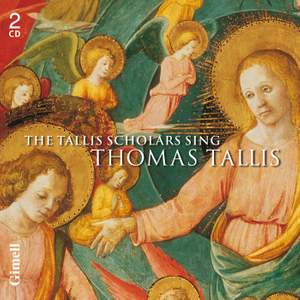
| |  | The Tallis Scholars sing Thomas Tallis
“The Tallis Scholars produce a distilled, transparent sound and the spiritual tone of their performance is one of serene contemplation through which the Requiem's ecstatic 'external light' shines.” BBC Music Magazine, September 2005 ***** | | | In stock - usually despatched within 1 working day. |
|
|
| |  | Tallis - Spem in alium
This is quite the best performance of Tallis's 40-part Spem in Alium that I have heard." Gramophone “This is quite simply the best performance of Tallis's 40-part Spem in alium to date. Sung by a constellation of singers, many of them familiar names from other wellestablished choral groups, it's a gripping realisation. The effect of the slowly moving harmonies is enhanced by a well-conceived and very positive use of dynamics. Precise entries, gently undulating rhythms that are wonderfully supple, and then those firm antiphonal phrases – one group of choirs answered by another at 'Creator coeli et terra' – raise the tension, until we twice almost miss a heart-beat at the well-placed rest before 'Respice …'. That great motet, so central to the whole programme, is well supported by the four-part Mass and the delightful group of other pieces for various combinations of voices. The hymn Te lucis with its alternating chant strophes sounding so very English (almost too perfect for what was, after all, just run-of-the-mill everyday chant!) has the tempo relationship of the chant to the polyphony just right, which is a tremendous plus, rarely achieved.” Gramophone Classical Music Guide, 2010 | | | (also available to download from $10.50) | In stock - usually despatched within 1 working day. |
|
|
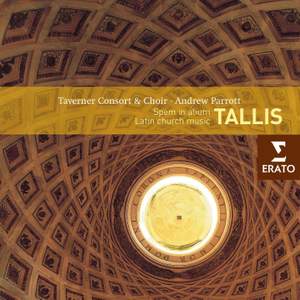
| |  | Tallis: Latin Church Music
“[In Spem in alium] Parrott's sure touch tells in the form: the first entry is clear and confident...the first Mexican wave spreads inexorably, the arrival on the second tutti rings out like a clarion-call, the antiphonal section doesn't flag, the initial 'Respice' is solemn and arresting, and the final tutti gloriously full-bodied.” Gramophone Magazine, February 2010 | | | In stock - usually despatched within 1 working day. |
|
|
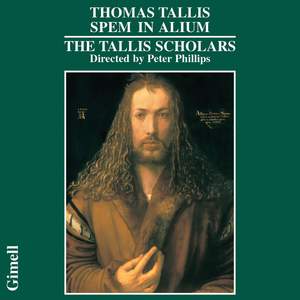
| |  | Thomas Tallis - Spem in alium
“For the 1985 quatercentenary of Tallis's death, Peter Phillips and The Tallis Scholars produced this version of Spem in alium; in many respects it's clearly the most successful ever recorded. Not only is the choir superb and the interpretation an intelligent one; this is also the only recording in which the eight choirs seem genuinely to sing from different positions in the stereo spread, a technical achievement that leads to some thrilling antiphonal exchanges. Above all, Phillips's reading is a confident and assertive one. The effect is more that of a plea than a prayer, and the overall shaping is most characterful. Inevitably there are problems of balance, both at the top of the texture (several of the trebles are given rather too much prominence) and in the middle, where in full sections the music of the inner voices sometimes blends too readily into rich chords rather than emerging as a complex web of counterpoint. But these are relatively small complaints to be made against an outstanding achievement. This is a Spem inalium to be cherished.” Gramophone Classical Music Guide, 2010 | | | In stock - usually despatched within 1 working day. |
|
|
| |  | Tallis & Byrd: Cantiones Sacrae 1575
Byrd: | Emendemus in melius Libera me, Domine, et pone Peccantem me quotidie Aspice, Domine quia facta est Attollite portas O Lux beata Trinitas Laudate, pueri, Dominum Memento homo Siderum rector SCTBarB Libera me Domine de morte Tribue, Domine Te deprecor Gloria patri qui creavit Miserere mihi, Domini Diliges Dominum Domine secundum actum meum Da mihi auxilium | Tallis: | Salvator mundi, salva nos 1 & 2 Absterge Domine In manus tuas Mihi autem nimis O nata lux de lumine 5vv O sacrum convivium Derelinquat impius Dum transisset sabbatum Honor, Virtus et Potestas Sermone blando angelus Te lucis ante terminum Miserere nostri, motet for 7 voices, P. 207 Suscipe quaeso Domine Si enim iniquitates In ieiunio et fletu Candidi Facti Sunt Te lucis ante terminum |
In 1575 'Thomas 'Tallis then an 'aged man', and his pupil and friend William Byrd, who was in his mid to late 30s, paid tribute to Elizabeth 1 by selecting 17 motets each for their Cantiones Sacrae ('Sacred Songs'), the first major printed collection of music to be published in England. Many of these works have since become staple in the repertoire of church and chamber choirs throughout the world. This is the first recording to present the Cantiones in their entirety, by the same group of singers, and in the composers' original order of publication. “Contrasts abound: Byrd’s florid three-section Tribue Domine is almost Marian in its vastness, while Tallis’s hymn setting O nata lux de lumine is brevity itself...The dozen singers perform expressively and blend beautifully throughout, while Skinner, who adopts a commonsense approach to pitch standards, injects passion into every note.” Sunday Times, 30th January 2011 **** “They use solo voices throughout, mixed voices with a fairly open sound that brings with it more vibrato than we are used to hearing in such music nowadays...That results in performances that are refreshingly free of self-indulgence. Some of the big Byrd pieces in particular are very good indeed.” Gramophone Magazine, March 2011 “The prevailing mood is penitential, but the pieces are never dull; there's much delight to be had in listening to the way the individual voice parts weave in and out...Skinner gets his singers to bring [the false relations] out so that they send shivers down your spine...[He] shapes the music extremely well.” Classic FM Magazine, March 2011 **** “Homophonic passages impress with their splendour, enriched here by the chestnut hues of basses William Gaunt and Robert Macdonald. The clarity of line lays bare the ingenuity of counterpoint, no matter how thick the texture becomes - a formidable achievement in Byrd's 'double imitation' motets.” BBC Music Magazine, March 2011 *** “This is the first time the Cantiones Sacrae has been recorded complete and 'in the original order intended by the composers themselves'...An auspicious beginning to a mighty undertaking.” International Record Review, May 2011 | | | (also available to download from $21.00) | Usually despatched in 2 - 3 working days. (Available now to download.) |
|
|
| |  | Ceremony & DevotionMusic for the Tudors
To coincide with the tenth anniversary of the Choral Pilgrimage, Harry Christophers and The Sixteen return to the repertoire of Tudor England that made their first tour such a success. Sixteenth-century England was a place of much religious change. It was a dangerous and confusing time as Henry VIII, who had split with Rome, was succeeded by his young son Edward VI, then by the ardent Catholic, Mary, and finally by the Protestant, Elizabeth I. Composers of the day, such as William Byrd, John Sheppard and Thomas Tallis, were required to adapt to rapidly changing musical requirements and it is testament to their incredible skill and musical mastery that they produced such magnificent works in such troubled times. At the heart of this programme are Sheppard’s monumental Media vita in morte sumus and Byrd’s deeply personal setting of Infelix ego. Set amongst these exceptional masterpieces are Byrd’s joyful motets Laudibus in sanctis and Haec dies, and one of the gems of this recording – Tallis’ Miserere nostri. “Christopher’s choir, The Sixteen, is arguably the most visible professional choral ensemble in Britain” The Times (London) “The singing is pure, yet overlaid with an emotional intensity that takes the music far beyond supine devoutness.” Sunday Times, 7th February 2010 **** “There are glorious moments, particularly in the centrepiece, Sheppard's Media vita, where The Sixteen's perfect ensemble, translucent colours and sensitivity to the text set the spine tingling.” BBC Music Magazine, June 2010 *** CD Review
Critics' Disc of the Year - December 2010 |
| | | Usually despatched in 2 - 3 working days. |
|
|
| |  | Music for Queen Elizabeth
Thomas Tallis served four English monarchs during his long life. A Catholic, he survived the tumultuous religious and political upheavals and persecutions of Edward VI and Mary I. He adapted to the demands of the new reformed church, the Church of England under Henry VIII, self appointed ‘Defender of the Faith’. Under Elizabeth I a more tolerant approach to religion emerged – even the ever-present threat of invasion by Catholic Spain did not deter the Queen from allowing her subjects freedom of worship and expression. Elizabeth’s tolerance may have been dueto the fact that she herself was raised as a Catholic, and it is possible that she missed the pomp and ceremony of the Mass compared to the plain and simple Protestant services of her father’s new Church. Tallis had seen most of the old choirs of the monasteries disbanded, and the music destroyed in the dissolution. He had learned his trade in this world, and to younger colleagues such as William Byrd he must have appeared as if from a bygone age. However, the great survivor was also very open to new compositional techniques from the continent. He adapted many of his Latin settings for the new Church – this practice called ‘contrafactum’ saw many older works given new life. This extended to his masterwork, the huge 40-part motet Spem in alium (which opens this CD) from 1573. Possibly written to celebrate Elizabeth’s 40th anniversary on the throne, it reappeared as Sing and glorify heaven’s high majesty, in which form it was used in 1616 at the investiture of the future Charles I as Prince of Wales. | | | Usually despatched in 4 - 5 working days. |
|
|
| |  | The Gents - 16th century English choral music
Bennet: | Eliza, her name gives honour | Byrd: | Ave verum Corpus My Ladye Nevells Booke: A Fancie in C major | Cornyshe: | Ave Maria, Mater Dei | Ferrabosco, A I: | Incipit Lamentatio Jeremiae Prophetae I ("... Aleph: Quodmodo sedet sola") Incipit Lamentatio Jeremiae Prophetae II ("... Zain: Vocavi amicos meos") | Ferrabosco, A II: | In depth no man remembreth Thee, for 5 voices | Holborne: | Paradizo The Sighes The Honie-suckle | Johnson, E: | Eliza is the fairest Queen | Parsons, R: | Ave Maria for 5 voices Credo quod Redemptor | Tallis: | Salvator mundi, salva nos 1 - antiphonn for five voices Miserere nostri, motet for 7 voices, P. 207 | Tomkins: | Remember me, O Lord (Psalm 106:4), anthem | Weelkes: | Lord, to Thee I make my moan, anthem for 5 voices Deliver us, O Lord, for 5(?) voices (doubtful) | White, Robert: | Christe qui lux es et dies |
The Gentlemen of the Chapel Royal, Diapente Viol Consort, Peter Dijkstra | | | Usually despatched in 4 - 5 working days. |
|
|
| |
|