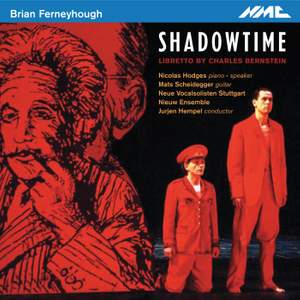
Shadowtime is an opera told in seven scenes across 2 CDs and a little over 2 hours of complex and fascinating music. Described as a "thought opera", it is based on the work and life of Walter Benjamin, one of the greatest philosophers and cultural critics of the twentieth century.
Usually despatched in 4 - 5 working days. (Available now to download.)
Brian Ferneyhough: Shadowtime
Scene 1: New Angels - Transient Failures (Prologue)
Scene 2: Les Froissements d'Ailes de Gabriel
Scene 3: The Doctrine of Similarity: Amphibolies I (Walk Slowly)
Scene 3: The Doctrine of Similarity: Dust to Dusk
Scene 3: The Doctrine of Similarity: Cannot Cross
Scene 3: The Doctrine of Similarity: Indissolubility (Motetus absconditus)
Scene 3: The Doctrine of Similarity: Amphibolies II (Noon)
Scene 3: The Doctrine of Similarity: In the Dark (But Even Fire Is Light)
Scene 3: The Doctrine of Similarity: Sometimes
Scene 3: The Doctrine of Similarity: Anagrammatica
Scene 3: The Doctrine of Similarity: dew and die
Scene 3: The Doctrine of Similarity: Schein
Scene 3: The Doctrine of Similarity: Dusts to Dusks
Scene 3: The Doctrine of Similarity: Amphibolies III (Pricks)
Scene 3: The Doctrine of Similarity: Salute
Scene 4: Opus Contra Naturam (Descent of Benjamin into the Underworld):
Scene 4: Opus Contra Naturam (Descent of Benjamin into the Underworld): Katabasis
Scene 4: Opus Contra Naturam (Descent of Benjamin into the Underworld): Kataplexy
Scene 5: Pools of Darkness: Three Giant Mouths
Scene 5: Pools of Darkness: Headless Ghoul
Scene 5: Pools of Darkness: Karl Marx and Groucho Marx, with Kerberus
Scene 5: Pools of Darkness: Pope Pius XII
Scene 5: Pools of Darkness: Joan of Arc
Scene 5: Pools of Darkness: Baal Shem Tov Disguised as Vampire
Scene 5: Pools of Darkness: Adolf Hitler
Scene 5: Pools of Darkness: Albert Einstein
Scene 5: Pools of Darkness: Border Guard
Scene 5: Pools of Darkness: Four Furies
Scene 5: Pools of Darkness: Golem
Scene 6: Seven Tableaux Vivants Representing the Angel of History as Melancholia: Laurel's Eyes (after Heine's "Die Lorelei")
Scene 6: Seven Tableaux Vivants Representing the Angel of History as Melancholia: Tensions
Scene 6: Seven Tableaux Vivants Representing the Angel of History as Melancholia: Hashish in Marseilles
Scene 6: Seven Tableaux Vivants Representing the Angel of History as Melancholia: After Heine's "Der Tod, das ist die kühle Nacht"
Scene 6: Seven Tableaux Vivants Representing the Angel of History as Melancholia: One and a Half Truths
Scene 6: Seven Tableaux Vivants Representing the Angel of History as Melancholia: Can'ts
Scene 6: Seven Tableaux Vivants Representing the Angel of History as Melancholia: Madame Moiselle and Mr. Moiselle
Scene 7: Stelae for Failed Time
“Bernstein's text makes oblique manoeuvres round the themes of Benjamin's work, and Ferneyhough sets them to complex yet frequently beautiful music, a mixture of tough and tender modernism”