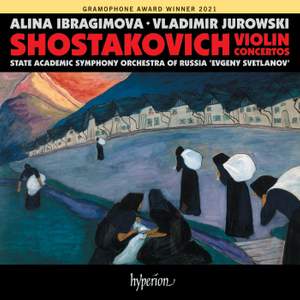
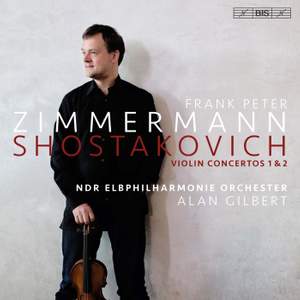
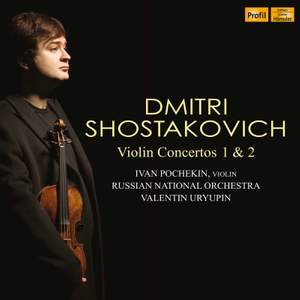
All recordingsPrices shown exclude VAT. (UK tax is not payable for deliveries to United States.) See Terms & Conditions for p&p rates. | |  | Shostakovich: Violin Concertos Nos. 1 & 2
| | | In stock - usually despatched within 1 working day. |
|
|
| |  | Shostakovich - Symphony No. 15 & Violin Concerto
| | | In stock - usually despatched within 1 working day. |
|
|
| |  | Prokofiev & Shostakovich: Symphonies
“Enthralling music-making.” BBC Music Magazine, April 2006 | | | In stock - usually despatched within 1 working day. |
|
|
| |  | Shostakovich: Violin Concertos Nos. 1 & 2
Sayaka Shoji (violin) Ural Philharmonic Orchestra, Dmitri Liss The two violin concertos occupy a major place, both musical and human, in Shostakovich's output and document particularly painful moments in his existence. The condemnation of his music in 1948 and the subsequent wilderness years in the Concerto No. 1, Op.99, and his incessant health problems after 1963 in No. 2, Op.129, which marks his first dodecaphonic experiments. These immense masterpieces are characterised by their sombre emotional hues, the sarcastic outbursts of the fast movements and the fiendish difficulties of the cadenzas. “Shoji delivers technically flawless and insightful performances. Despite its authentically grainy Russian timbre, the Ural Philharmonic is sometimes flaccid.” BBC Music Magazine, May 2012 *** | | | Usually despatched in 3 - 4 working days. |
|
|
| |  | David Oistrakh
Bliss: | Fanfare Recorded: Royal Festival Hall, London, 19 November 1967 London Symphony Orchestra, Eugene Ormandy | Shostakovich: | Violin Concerto No. 2 in C sharp minor, Op. 129 European Premiere. Recorded: Royal Festival Hall, London, 19 November 1967 David Oistrakh (violin) London Symphony Orchestra, Eugene Ormandy | Tchaikovsky: | Violin Concerto in D major, Op. 35 Recorded: Royal Albert Hall, London, 26 November 1972 David Oistrakh (violin) London Philharmonic Orchestra, Maxim Shostakovich |
David Oistrakh’s 1967 performance of Shostakovich’s Violin Concerto No. 2 with Eugene Ormandy conducting the LSO was the Western European Premiere of the work. This is a major historical document. Since this was a Gala concert in aid of the LSO Trust, the Shostakovich performance was preceded by a Fanfare composed by Arthur Bliss and this has been included. The Tchaikovsky Violin Concerto from 1972, a work very much associated David Oistrakh, was performed during a Russian Festival in London’s Royal Albert Hall is conducted by Maxim Shostakovich, the composer’s son. This makes a great combination. Both recordings are in very good stereo and David Oistrakh’s playing is sensational. David Oistrakh has a large and varied BBC Legends catalogue including a later version of the Shostakovich Violkin Concerto No.2 with Svetlanov (BBCL40602). “Shostakovich planned his Second Violin Concerto as a 60th birthday tribute to Oistrakh. …it's a splendid performance, and very well recorded, as we can hear already in the introductory Bliss Fanfare, an extraordinary contrast to the sombre Concerto. Oistrakh appears to command the stage effortlessly and to catch the mood exactly, whether it's the melancholy musings at the start, the fierce, declamatory interruption in the slow movement or the finale's cadenza, emerging in Oistrakh's hands as a mad devil's dance. ...the LSO sounds wonderfully confident and forceful... Barry Tuckwell's account of the prominent first horn part is quite magnificent.” Gramophone Magazine, February 2010 “Oistrakh's playing is thrilling both in this and the Tchaikovsky, recorded in 1972 with the LPO. Well-detailed and vivid sound.” Penguin Guide, 2011 edition | | | (also available to download from $10.50) | Usually despatched in 2 - 3 working days. (Available now to download.) |
|
|
| |  |
"One of the most substantial contributions to the Shostakovich year." Fono Forum | | | Usually despatched in 3 - 4 working days. |
|
|
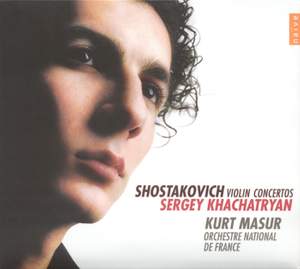
| |  | Shostakovich - Violin Concertos Nos. 1 & 2
“Though still only a teenager, the Armenian-born Sergey Khachatryan is a shining beacon among today’s young violinists, a persuasive interpreter with a musical personality all his own.” The Independent “Do we need another pairing of the Shostakovich violin concertos? The answer is an unequivocal yes when the playing is as sensational as this. Not just a preternaturally gifted teen, Sergey Khachatryan is a real rival to Maxim Vengerov in this repertoire: the Shostakovich No 1 is his party piece as well. Interpreting it with a less unyielding intensity, he too satisfies its demands as few have done since the great David Oistrakh. Rock-solid intonation is combined with wonderfully sweet tone. Kurt Masur's accompaniment is characteristic of him. You'll hear the important tam-tam contributions in the first movement, which Rostropovich and/or his sound team fail to clarify, but you shouldn't expect minatory timp thwacks when the third movement passacaglia launches with kapellmeisterish restraint. Masur's lack of theatricality puts the focus on the way the music is put together. One drawback hereabouts is a microphone placement that captures soloistic sniffles, distracting if you do your listening on headphones. The finale is aptly lighter in style, with a dash to the finishing-line perfectly calculated to win prizes and bring the house down. Authoritative booklet-notes portray the companion concerto as something of an also-ran, an impression the performance perhaps does too little to allay. There are some exquisite effects but Vengerov, Rostropovich and the LSO take us to another, darker place. In Paris the accompaniment has too much politesse and is backwardly balanced. Strongly recommended even so.” Gramophone Classical Music Guide, 2010 “Born in 1985 in Yerevan, Armenia, Sergey Khachatryan… is a real rival to Maxim Vengerov in this repertoire: the Shostakovich No 1 is his party piece as well. Interpreting it with a less unyielding intensity, he too satisfies its demands as few have done since the great David Oistrakh. Rock-solid intonation is combined with wonderfully sweet tone.” Gramophone Magazine, November 2006 | | | (also available to download from $10.50) | Usually despatched in 3 - 4 working days. (Available now to download.) |
|
|
| |  | Shostakovich: The 2 Violin Concertos
| | | (also available to download from $10.50) | Usually despatched in 2 - 3 working days. (Available now to download.) |
|
|
| |  | Shostakovich - Violin Concertos Nos. 1 & 2
“Daniel Hope – frighteningly gifted!” The Washington Post “…penetrating and intense performances. In the First Concerto he draws the listener into the atmosphere of each movement from the very outset - the bleak landscape of the Nocturne, the savage mockery of the Scherzo, the combination of nobility and world-weariness in the Passacaglia and the manic abandon of the Burlesque. ...in the emotionally elusive Second it's Hope who seems to probe further beneath the surface of this dark and desolate music... The slightly deliberate tempo taken by Hope and Maxim Shostakovich in the Finale serves to accentuate its anger and brutality. A very desirable release indeed.” BBC Music Magazine, May 2006 ***** “The British violinist Daniel Hope has the measure of the darkness at the heart of this concerto, and his playing is almost conversational...Maxim Shostakovich guides the players of the BBC Symphony Orchestra through his father's concerto with understanding, and respect...The integrity and introverted intensity of the reading makes this a special performance for me.” Andrew McGregor, bbc.co.uk, 16th May 2006 | | | Usually despatched in 4 - 5 working days. |
|
|
| |  | Shostakovich - Violin Concertos Nos. 1 & 2
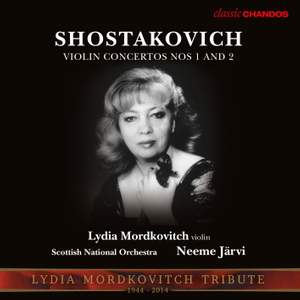
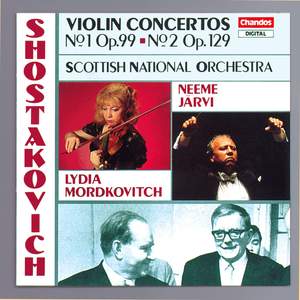
“This coupling completely explodes the idea of the Second Violin Concerto being a disappointment after the dramatic originality of No 1. Certainly No 2, completed in 1967, a year after the very comparable Cello Concerto No 2, has never won the allegiance of violin virtuosos as the earlier work has done, but here Lydia Mordkovitch confirms what has become increasingly clear, that the spareness of late Shostakovich marks no diminution of his creative spark, maybe even the opposite. In that she's greatly helped by the equal commitment of Neeme Järvi in drawing such purposeful, warmly expressive playing from the SNO. With such spare textures the first two movements can be difficult to hold together, but here from the start, where Mordkovitch plays the lyrical first theme in a hushed, beautifully withdrawn way, the concentration is consistent. It isn't just that Mordkovitch has the benefit of far fuller recording and a less close recording balance, but that her playing has an even wider range of colouring and dynamic than Oistrakh's. She conveys more of the mystery of the work and is perfectly matched by the orchestra. As in the First Concerto the principal horn has a vital role, here crowning each of the first two movements with a solo of ecstatic beauty in the coda. The range of the recording helps in the finale, where the Allegro has a satisfyingly barbaric bite, while the scherzando element is delectably pointed, as it is in the first movement too. In the First Concerto Mordkovitch is hardly less impressive. As in Concerto No 2 one of her strengths lies in the meditative intensity which she brings to the darkly lyrical writing of the first and third movements. Here, too, she has never sounded quite so full and warm of tone on record before. In the brilliant second and fourth movements she may not play with quite the demonic bravura of Oistrakh, but again there's no lack of power, and in place of demonry she gives rustic jollity to the dance rhythms, faithfully reflecting the title of the finale, Burlesque. She's helped by recorded sound far fuller than Oistrakh's. This is a superb disc.” Gramophone Classical Music Guide, 2010 | | | (also available to download from $10.50) | Usually despatched in 2 - 3 working days. (Available now to download.) |
|
|
| |
|