All recordingsPrices shown exclude VAT. (UK tax is not payable for deliveries to United States.) See Terms & Conditions for p&p rates. | |  | Enescu: Three Symphonies & Violin Sonata No. 3
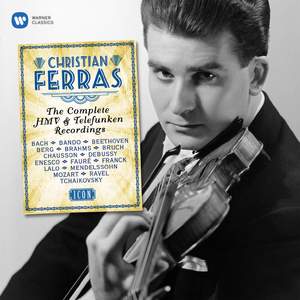
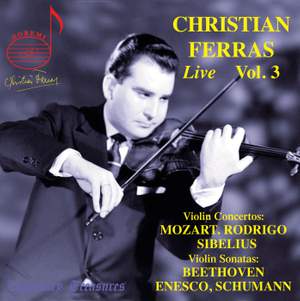
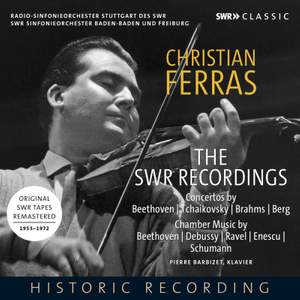
George Enescu (1881-1955) was known primarily as one of the great virtuoso violinists of his day, although he was also a celebrated conductor and influential teacher of his instrument – Yehudi Menuhin, Arthur Grumiaux, Ivri Gitlis, and Christian Ferras were just a few of the great violin soloists of the latter half of the 20th century who passed through his classes in Paris. Apart from the First Romanian Rhapsody, it is only recently that Enescu, the composer of a small but substantial catalogue of works, has come to the fore and this set, comprising his three completed symphonies and his best-known Violin Sonata, should further enhance his reputation. | | | In stock - usually despatched within 1 working day. |
|
|
| |  | Violon Passion
Laurent Korcia (violin), Jean-Marc Luisada (piano) Bourges Philharmonic | | | In stock - usually despatched within 1 working day. |
|
|
| |  | Enescu - String Octet & Violin Sonata No. 3
Enescu: | Octet in C major Op. 7 David Lefèvre, Marius Mocanu, Irina Simon-Renes, Peter Szüts (violin), François Mereaux, Cyrille Mercier (viola) & Stanimir Todorov, Thierry Amadi (cello) Orchestre Philharmonique de Monte Carlo, Lawrence Foster Violin Sonata No. 3 in A minor, Op. 25 'dans le caractère populaire roumain' Valery Sokolov (violin) & Svetlana Kosenko (piano) |
Two contrasting string works by Romania’s greatest composer, himself a legendary violinist, are performed by the soloists of the Orchestre Philharmonique de Monte Carlo – conducted by Enescu expert Lawrence Foster – and young violinist Valeriy Sokolov, whose international breakthrough came with his victory at the 2005 George Enescu International Competition in Bucharest. This new recording of string music by George Enescu, Romania’s greatest composer and a legendary violinist, brings together two works which contrast in both style and scale: the composer’s early string quartet in an orchestration by conductor Lawrence Foster, and his Violin Sonata No 3, performed by the young Ukrainian violinist Valeriy Sokolov (profiled by director Bruno Monsaingeon on the Virgin Classics DVD Un violon dans l’âme / Natural born Fiddler) and the pianist Svetlana Kosenko. Enescu has a distinguished history on EMI: as a violinist in the classic recording of Bach concertos with his pupil Yehudi Menuhin, and with recordings of his music conducted by Lawrence Foster: the opera Oedipe, winner of France’s Grand Prix du Disque in 1991, and the symphonies Nos 1 to 3 coupled with the symphonic poem Vox Maris; Foster conducted the Orchestre Philharmonique de Monte Carlo on both these releases – he was the ensemble’s Principal Conductor from 1980 to 1990. The Romanian composer (1881-1955) had a long connection with France, attending the Paris Conservatoire at the age of 14 and studying composition with Massenet and Fauré. The Octet was completed in 1900, when he was still just 18 years old, and Enescu judged it one of the first works to carry his personal stylistic and expressive stamp. Lawrence Foster, who first discovered the Romanian composer though his interest in the music of the composer’s friend Bartók, describes it as “a youthful, audacious piece, full of invention,” comparing its richly-layered late-Romanticism to Schoenberg’s in the more famous string work Verklärte Nacht (1899). Enescu’s octet is a large-scale piece, comprising four linked movements which last a total of some 40 minutes. Lawrence Foster cites a precedent in the composer’s letters for the idea of arranging the piece for string orchestra. At certain points in the score the conductor has made the choice of using a group of eight soloists rather than the full complement of players – not, he hastens to add, for technical reasons (though the music is often virtuosic), but to capture the special mood of the music at those moments. In September 2005 Valeriy Sokolov, born in 1986, won the Grand Prix at the George Enescu International Competition in Bucharest, as well as the award for Best Performance of Enescu’s Sonata No. 3, and the Enescu Foundation Prize. He has recently struck up a duo partnership with fellow Virgin Classics artist David Fray. Written in 1926 and subtitled ‘Dans le caractère populaire roumain’, the Sonata No 3 evokes the rhapsodic, highly ornamented spirit of Romanian folk music, although it does not quote any traditional melodies directly. It was Sokolov’s performance of this sonata that inspired Bruno Monsaingeon to make the violinist the subject of a documentary. He said: “… Not the slightest tension marred the impression he gave of being totally at ease with his instrument,” and praised Sokolov’s “absolute control of technique, his musical maturity, and above all an utter abandonment to the flow of the music.” “… Not the slightest tension marred the impression he gave of being totally at ease with his instrument,” and praised Sokolov’s “absolute control of technique, his musical maturity, and above all an utter abandonment to the flow of the music.” Bruno Monsaingeon “…if you compare the first couple of minutes of this version with a recording of the octet original you'll note how effectively Foster underlines the music's dialogic element, solo and tutti alternating in the manner of a concerto grosso… Foster's performance is a very good one and the recording focuses the fine Monte Carlo strings with admirable clarity, especially in the wildly assertive second movement, music that anticipates both Martinu and Honegger.” Gramophone Magazine, April 2009 “The Third Violin Sonata, rooted in Romanian folk music yet pushing both players to extremes in a quest for expressive subtleties, is one of Enescu's greatest scores. It gets a powerhouse performance from stars-in-the-making Valeriy Sokolov and Svetlana Kosenko.” The Guardian, 13th March 2009 *** | | | In stock - usually despatched within 1 working day. |
|
|
| | Tzigane: Musique d'Europe Central
| | | In stock - usually despatched within 1 working day. |
|
|
| |  | Enescu: Complete Works for Violin and Piano
Amiram Ganz (violin) & Alexandre Paley (piano) “An invaluable complete survey of Enescu's violin and piano works, especially for the two relatively rare early Sonatas. Ganz and Paley are entirely at ease with Enescu's mixing of idioms.” BBC Music Magazine, Christmas 2012 **** | | | Usually despatched in 2 - 3 working days. |
|
|
| |  | Works for Violin and Piano
Jarosław Nadrzycki (violin) & Tadashi Imai (piano) This new release from the Polish label DUX features a selection of pieces that are perfect examples of blending technical brilliance and ideas from composers who were great personalities of their time. The exciting programme is brought together by two rising stars who both studied at the Royal Academy of Music. Jarosław Nadrzycki, has toured extensively, with visits to Cadogan Hall, St.John’s Smith Square and Wigmore Hall. Tadashi Imai is no stranger to the UK either, having played at the Halifax Chamber Music Festival for Young Musicians and the Messiaen Festival (broadcast by BBC Radio 3’s ‘In Tune’). | | | Usually despatched in 4 - 5 working days. |
|
|
| |  | Eastern Europe: A Musical Journey
Alda Dizdari (violin) & Tom Blach (piano) “When not aiming at ferocity, Dizdari's tone is notably rich and expressive - especially in the Part, played with a very modest degree of slowish vibrato. The Hungarian Dances are given with great panache but the highlight of the programme, for me, is the Enescu...Dizdiri and Blach seem to get both the spirit and the letter just right.” Gramophone Magazine, October 2011 | | | Usually despatched in 2 - 3 working days. |
|
|
| |  | Ida Haendel: Live in Recital 2009
Bonus feature: Ida Haendel in conversation with Giselle Brodsky, Founder and Artistic Director of the Miami International Piano Festival. Color, stereo, 4:3, 66 mins. (recital) plus 59 mins. (bonus), all regions. | | | Usually despatched in 4 - 5 working days. |
|
|
| |  | Enescu: Complete Works for Violin/Viola and Piano
Laurent Albrecht Breuninger (violin and viola) & Thomas Duis (piano) George Enescu - a famous musician since his early childhood, highly praised in Europe and in North America for both his performances as a violin virtuoso as well as his well-known Romanian Rhapsodies. And yet, this musician represents the typical case of a composer whose importance has never been fully understood even during his lifetime. Collective memory has mainly focused firstly on the two Romanian Rhapsodies, that he composed at the aged of 20, then - to a much smaller degree - on a Sonata for Piano and Violin "in Romanian folkloristic character" (op.25). The composer Enescu was thereby attributed an exotic, folk quality, assuming further that he was to be regarded as another picturesque representant of a certain "national school". “[an] imposing reading, not least the fastidious tonal shadings of the slow movement or the rhythmic trenchancy of the finale...balance between violin and piano is admirable” International Record Review, March 2011 | | | (also available to download from $21.00) | Usually despatched in 2 - 3 working days. (Available now to download.) |
|
|
| |  | Enescu: Violin Sonatas
Antal Szalai (violin), Jozsef Balog (piano) Pablo Casals called George Enescu (1881-1955) 'the greatest musical phenomenon since Mozart'. For many people he is remembered as one of the greatest violin virtuosos of the 20th century. Whilst true, that would be to recognise only one facet of this artist. He considered himself primarily a composer (he also was a fine pianist and conductor), and though his most famous work is the early Romanian Rhapsody No.1, this colourfully nationalistic effort is a world away from the individual and sophisticated style of his chamber and orchestra music. These show Enescu to be every bit the equal of his contemporaries Bartok, Kodaly, Janácek, Martinu and Szymanowski. Like his contemporaries, he was very aware of the heritage of the traditional music of his country, and his style is a highly personal blend of folk music with the chromatic language of Wagner and Faure's sophistication and delicacy. Early in his career he played in orchestras conducted by Brahms, and studied in Paris with Massenet and Faure -- Ravel was a fellow pupil. “Antal Szalai is especially good in the Second Sonata's finale, where the dawning folk element is underlined, though the Brahmsian axis of the rest also comes across well...He makes a credible case for the early First Sonata too...the Third is given a clean, expertly balanced reading.” Gramophone Magazine, May 2011 “Szalai makes [much] of the first movement's pivoting between stasis and dynamism...listen to the uninhibited interplay between the two instruments in the fateful closing bars.” International Record Review, March 2011 | | | Usually despatched in 4 - 5 working days. |
|
|
| |
|