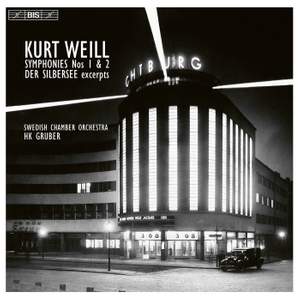
All recordingsPrices shown exclude VAT. (UK tax is not payable for deliveries to United States.) See Terms & Conditions for p&p rates. | |  | Kurt Weill: Symphonies Nos. 1 & 2
CD 2 Weill on Broadway with Thomas Hampson, Elisabeth Futral, Jerry Hadley, Donald Maxwell, Vernon Midgley, Simon Green, Brian Parsons, Christopher Dee, Simon Keenlyside, Justin Lavender, Terry Edwards, Richard van Allen, Michael Magee, Peter Sidholm, Stephen Adler, Simon Birchall, Stuart Kale, Jeffrey Carl, Michael Dore, Robert Fardell, Jeanne Lehman London Sinfonietta Chorus, London Sinfonietta John McGlinn
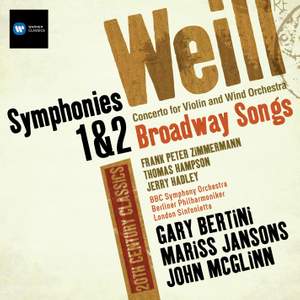
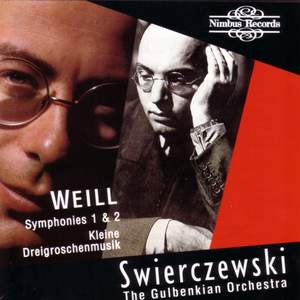
The year 1933 marks a clear divide in the life and music of Kurt Weill (1900-1950). This was the year in which he fled Nazi Germany for the USA and this move brought about a stylistic shift in his outlook and music. The works on the first disc here are from his early years in Germany: the First Symphony and the Violin Concerto date from 1921 and 1925 respectively and the Second Symphony, his last purely orchestral work, was completed in 1934. Once settled in the States Weill took up studies in American popular song and stage music and soon began a highly successful career as a writer of many Broadway shows and Hollywood films. The second of these discs contains some fine examples of Weill's work on Broadway. He became an American citizen in 1943 and died of a heart attack just a few weeks after his 50th birthday. He was twice married to Lotte Lenya who, after his death, devoted a great deal of her time to promoting and performing Weill's music. | | | In stock - usually despatched within 1 working day. |
|
|
| |  | Weill - Symphony No. 2 & The Seven Deadly Sins
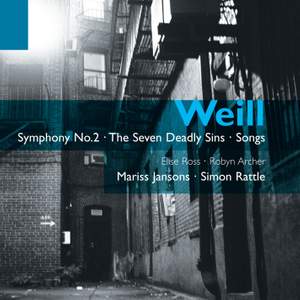
Kurt Weill was born in Dessau in 1900 and studied at the Berlin Musihhochschule with Humperdinck and then later and privately with Busoni. He was also one of a number of composers who had to flee Germany once the Nazis started to carry out their atrocities, indeed Weill had more than most to fear as not only was he a Jew but he had collaborated with Berthold Brecht in works some of which had lampooned the Nazis and their leader and cronies. His career may therefore be split between his mother country which he left in 1933 and America where he settled in 1935 and died in 1950. The earliest work in this collection is the Concerto for violin and wind orchestra written in 1924 and is clearly influenced by his study of atonality developed by Schoenberg. Three years later he became Brecht’s composer and together they produced Die Dreigroschenoper (The Threepenny Opera) in 1928, Aufstieg und Fall der Stadt Mahagonny (Rise and Fall of the City Mahagonny) in 1930 – the Suite prepared by his champion, Wilhelm Brückner-Rüggeberg, is included in this set – and Die sieben Todsünden (The Seven Deadly Sins) in 1933 which also is included. The same year he also wrote his second symphony. Once in America he became a leading composer of Broadway Musicals and extracts from two of them complete the collection. One of his main performers was his wife, Lotte Lenya, whose characteristic voice made many of his songs standards of the popular song repertory; she was also a character actress, who could forget her as the villainous Rosa Klebb, with the spike in her shoe, in the James Bond film: From Russia with Love? | | | In stock - usually despatched within 1 working day. |
|
|
| |  |
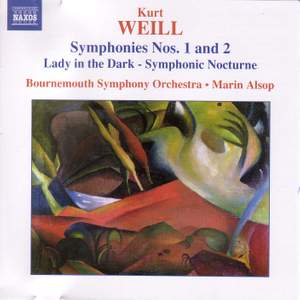
“Weill's Symphony No 2 is one of his most important works but it is not music calculated to cheer one up. Commissioned by the Princesse de Polignac in 1933, Weill completed it during the months immediately following his flight from Germany, after the Nazi seizure of power. Coming just after Der Silbersee and Die sieben Todsünden, it has a number of thematic similarities to those works but also seems to hint at some of Weill's later music, composed in America. A deeply pessimistic piece in its first two movements, it nevertheless ends on a questioning note that may express hope, or at least the energy to continue. The Bournemouth Symphony Orchestra under Marin Alsop give a satisfying performance. For those who already possess versions of the ballet-chanté or the concerto, Alsop's programme may be more alluring. She achieves quite a triumph with the very early single-movement First Symphony, a student work never performed in the composer's lifetime: it's rarely played as confidently as here. The suite from Lady In theDark is just a curiosity; without Ira Gershwin's lyrics the tunes don't sound particularly enticing. At least, though, it lightens the mood after some pretty relentless gloom. Excellent clear sound, at Naxos's price an easy recommendation.” Gramophone Classical Music Guide, 2010 | | | (also available to download from $6.00) | In stock - usually despatched within 1 working day. |
|
|
| |  |
Conductor Yannick Nézet-Séguin is as well-loved by the public as he is appreciated by his peers, who awarded him the Canada Council for the Arts Virginia Parker Prize in September 2000. At the helm of the Orchestre Métropolitain du Grand Montréal since March 2000, Yannick Nézet-Séguin has worked tirelessly to broaden the scope of the orchestra’s involvement in a variety of venues, while always maintaining his own rigorous standards and keeping in close touch with the music-loving public. Renowned as a prolific composer of film soundtracks, Nino Rota is chiefly associated with directors such as Zeffirelli, Coppola, and above all, Fellini, for whom he became the regular composer. Composed in 1966, the ballet La Strada is the result of a commission by La Scala of Milan. Rota grouped the highlights in a symphonic suite, which aptly summarizes the plot. Kurt Weill’s universal appeal rests foremost upon his unforgettable output of ballads and songs with their characteristic blend of satire and nostalgia. Some of them have become Jazz standards, such as the famous Ballad of Mack the Knife. Composed in 1933, the Symphony No. 2 was premiered in Amsterdam the following year, and constitutes the only symphonic work of Weill’s mature years. | | | (also available to download from $10.50) | Usually despatched in 2 - 3 working days. (Available now to download.) |
|
|
| |  |
| | | (also available to download from $10.50) | Usually despatched in 2 - 3 working days. (Available now to download.) |
|
|
| |  |
At the invitation of Yannick Nézet-Séguin, Diane Dufresne sang some of the best-known Kurt Weill songs at an all-Weill concert that took place in March 2003 in Montreal and that is already regarded as one of the most important events of recent years on the Montreal music scene. The recording was done shortly after the concert. The CD also contains Symphony No. 2, a work Yannick Nézet-Séguin had dreamed of performing for a long time. The provocative Diane Dufresne has been the object of an enduring fascination on the part of audiences everywhere. An real artist right down to the core, La Dufresne has explored various musical styles, including symphonic concerts where even Mahler has had a place. She is accompanied in this Kurt Weill exploration by the Orchestre Métropolitain du Grand Montréal under Yannick Nézet-Séguin. | | | (also available to download from $10.50) | Usually despatched in 2 - 3 working days. (Available now to download.) |
|
|
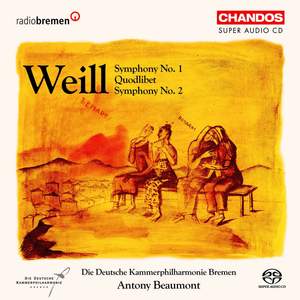
| |  | Weill: Symphonies Nos. 1 & 2
| | | Usually despatched in 4 - 5 working days. |
|
|
| |
|