Prices shown exclude VAT. (UK tax is not payable for deliveries to United States.) See Terms & Conditions for p&p rates. | |  | The Very Best of Elisabeth Schwarzkopf
Bach, J S: | Cantata BWV51 'Jauchzet Gott in allen Landen': Aria Bist du bei mir, BWV508 | Beethoven: | O wär' ich schon mit dir vereint (Marzelline) | Heuberger: | Gehen wir ins Chambre séparée) from The Opera Ball | Humperdinck: | Brüderchen, komm tanz mit mir (Dance Duet from Hänsel und Gretel) | Lehár: | Viljalied (from Die lustige Witwe) | Mozart: | Non so più cosa son, cosa faccio (from Le nozze di Figaro) Porgi amor (from Le nozze di Figaro) E Susanna non vien! … Dove sono i bei momenti (from Le nozze di Figaro) In quali eccessi ... Mi tradì quell'alma ingrate (from Don Giovanni) Come scoglio (from Così fan tutte) Ridente la calma, K152 | Schubert: | An die Musik D547 Das Lied im Grünen, D917 Nachtviolen D752 (Mayrhofer) Der Musensohn, D764 (Goethe) | Siecynski: | Wien, du Stadt meiner Traüm | Smetana: | Endlich allein (from Die verkaufte Braut) | Strauss, J, II: | Klänge der Heimat (from Die Fledermaus) | Strauss, R: | Da geht er hin (from Der Rosenkavalier, Op. 59) Es gibt ein Reich (from Ariadne auf Naxos) Das war sehr gut, Mandryka (from Arabella) Frühling (from Vier Letzte Lieder) Im Abendrot (from Vier Letzte Lieder) Muttertändelei, Op. 43 No. 2 Zueignung, Op. 10 No. 1 | trad.: | Gsätzli | Wagner: | Einsam in trüben Tagen (from Lohengrin) | Weber: | Wie nahte mir der Schlummer … Leise, leise, fromme Weise (from Der Freischütz) | Wolf, H: | Auch kleine Dinge (No. 1 from Italienisches Liederbuch) Mein Liebster hat zu Tische mich geladen (No. 25 from Italienisches Liederbuch) Ich hab in Penna einen Liebsten (No. 46 from Italienisches Liederbuch) Verschling der Abgrund meines Liebsten Hütte Wiegenlied im Sommer (from Sechs Lieder für eine Frauenstimme) In dem Schatten meiner Locken (No. 2 from Spanisches Liederbuch: Weltliche Lieder) Mignon IV 'Kennst du das Land' (No. 9 from Goethe-Lieder) Mausfallen-Sprüchlein (from Lieder für eine Frauenstimme) |
Multi-award winning opera singer Elisabeth Schwarzkopf, praised for the ‘pristine beauty of her lyric soprano’ (The Guardian), was revered in opera houses worldwide and is perhaps most famous for her Mozart roles. However, she was also at home on the concert stage and this collection combines her acclaimed portrayals of Donna Elvira, Countess Almaviva and Richard Strauss’s Marschallin, among others, with her affecting interpretations of lieder and song-cycles. | 
| | | In stock - usually despatched within 1 working day. |
|
|
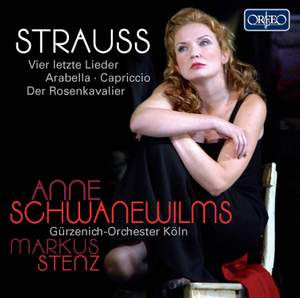
| |  | R. Strauss: Four Last Songs
A setting of poems by Hermann Hesse and Joseph von Eichendorff, Richard Strauss’s 'Four Last Songs' afford ultimate proof of Strauss’s unique ability to write soaring melodic lines for the soprano voice. Many outstanding Strauss sopranos have faced up to the challenge and now Anne Schwanewilms joins them, ahead of her Proms performance on 17th July. She is one of the most sought-after Strauss sopranos of our day; a regular visitor to all the world’s leading opera houses and festivals, from Salzburg Festival and the Royal Opera, Covent Garden, to the Bavarian, Dresden and Vienna State Operas. She has also been heard in many of Strauss’ works at the Cologne Opera, most recently at a recital in 2011, when she was joined by the Gürzenich Orchestra under Cologne’s general music director, Markus Stenz, which included excerpts from roles with which she is most closely associated. The valedictory tone of the songs contrasts with that of the final scene from 'Arabella,' in which Schwanewilms strikes just the right balance between the simplicity of the opening and the increasingly jubilant note on which the opera ends. In the final scene from 'Capriccio', this last-named quality is combined with the singer’s ability to achieve the parlando style ideally demanded by Strauss. In the 'Rosenkavalier' trio her emotionally-charged singing captures the Marschallin’s rejection in favour of a younger woman with an immediacy that is altogether overwhelming. “There’s some wonderful singing [in the Capriccio extract]...She’s also excellent as Arabella. At the start of the solo her singing is touching and with a hint of vulnerability to it. Later...she becomes more impassioned, as the music and the sentiments of the text demand...the Gürzenich-Orchester is inspired by Markus Stenz to some gorgeous playing.” MusicWeb International, August 2012 “Schwanewilms is arguably the finest native German interpreter of Strauss’s more lyrical operatic roles, yet despite a soprano of considerable loveliness, she can sound disengaged, particularly from the words. Here, she gives a good account of herself, especially in the closing monologues of Arabella and Countess Madeleine” Sunday Times, 22nd July 2012 “she soars through them all, pearl-like, backed by the succulent purr of Cologne’s Gürzenich Orchestra, conducted by Markus Stenz.” The Times, 20th July 2012 **** | | | In stock - usually despatched within 1 working day. |
|
|
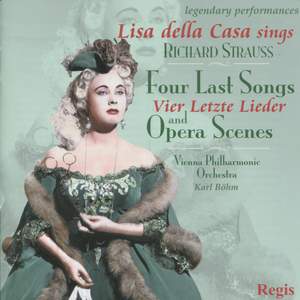
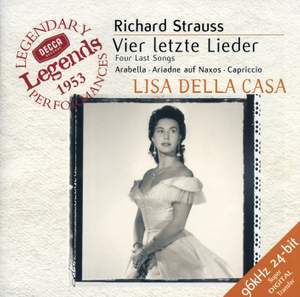
| |  | Lisa Della Casa sings Richard Strauss
Strauss, R: | Four Last Songs Vienna Philharmonic Orchestra, Karl Böhm Ein schones war (from Ariadne auf Naxos) Berlin Philharmonic Orchestra, Alberto Erede Es gibt ein Reich (from Ariadne auf Naxos) Berlin Philharmonic Orchestra, Alberto Erede Circe, Ich konnte fliehen! (from Ariadne auf Naxos) with Rudolf Schock, Lisa Otto, Nada Puttar & Leonore Kirchstein Berlin Philharmonic Orchestra, Alberto Erede Er ist der Richtige nicht für mich … Aber der Richtige, wenn's einen gibt für mich (from Arabella) Vienna Philharmonic Orchestra, Georg Solti Mein Elemer! Das hat so einen sonderbaren (from Arabella) Vienna Philharmonic Orchestra, Georg Solti Das war sehr gut, Mandryka (from Arabella) with George London Vienna Philharmonic Orchestra, Georg Solti |
“Whichever are your preferred Four Last Songs, this performance will equal them. The excerpts from Arabella and Ariadne are just as impressive.” BBC Music Magazine, February 2012 ***** | | | In stock - usually despatched within 1 working day. |
|
|
| |  | Kiri te Kanawa sings Mozart & Strauss
Mozart: | E Susanna non vien! … Dove sono i bei momenti (from Le nozze di Figaro) Porgi amor (from Le nozze di Figaro) Ruhe sanft, mein holdes Leben (from Zaïde) Crudeli, oh dio! (from La Finta Giardiniera) S’altro che lagrime (from La clemenza di Tito) Ei parte...Per pietà (from Così fan tutte) L'amerò, sarò costante (from Il re pastore) Pupille amate (from Lucio Silla) Se il padre perdei (from Idomeneo) Bella mia fiamma, addio... Resta, oh cara, K528 Ach, ich fühl's (from Die Zauberflöte, K620) Bester Jüngling (from Der Schauspieldirektor) Nehmt meinen Dank, ihr holden Gönner!, concert aria K383 | Strauss, R: | Four Last Songs Madrigal, Op.15, No. 1 Morgen, Op. 27 No. 4 Er ist der Richtige nicht für mich … Aber der Richtige, wenn's einen gibt für mich (from Arabella) Und jetzt sag ich Adieu, mein lieber Dominik (from Arabella) O Arabella, gibt es was Schöneres als Sie auf einem Ball! (from Arabella) Das war sehr gut, Mandryka (from Arabella) Dann aber, wie ich Sie gespürt hab hier im Finstern stehn (from Arabella) Allerseelen, Op. 10 No. 8 Die Nacht, Op. 10 No. 3 Capriccio: Intermezzo (Moonlight Music) Wo ist mein Bruder? (from Capriccio) Kein andres, das mir so im Herzen loht (from Capriccio) Du Spiegelbild der verliebten Madeleine (from Capriccio) |
Dame Kiri te Kanawa was presented with a lifetime achievement award at the Classical Brits 2010. Decca’s first-ever compilation devoted to the two composers most closely associated with Kiri te Kanawa: Mozart & Richard Strauss. Selection includes arias from operas by both composers which te Kanawa has sung on stage as well as concert arias and songs she has featured in concert. Kiri te Kanawa is accompanied by two of her greatest musical mentors – Sir Georg Solti - in his dual role as conductor and pianist – and Sir Colin Davis (with whom she first sang the role of the Countess in Le nozze di Figaro at The Royal Opera House, Covent Garden, in 1971. | | | (Sorry, download not available in your country) | In stock - usually despatched within 1 working day. |
|
|
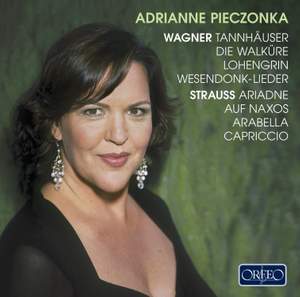
| |  | Adrianne Pieczonka Sings Strauss & Wagner
| | | In stock - usually despatched within 1 working day. |
|
|
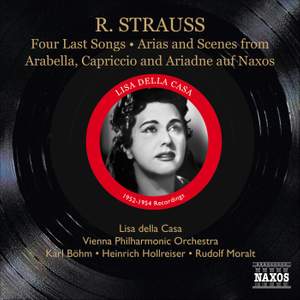
| |  | Strauss - Four Last SongsRecorded at the Musikvereinssaal, Vienna, June, 1953
Producer and Audio-Restoration engineer: Mark Obert-Thorn. Acclaimed as one of her generation’s finest interpreters of Richard Strauss (the composer himself identified her as his ideal Arabella), the Swiss soprano Lisa della Casa was blessed with a seemingly effortless, shimmeringly beautiful voice as well as an innate sense of musical style. In the words of the distinguished critic John Steane: ‘Della Casa remains one of the best of all sopranos in Richard Strauss. Her voice has that touch of spring and silver that Strauss loved and wrote for; her tone will float and soar’. These vivid recordings are essential for every collection. | | | (also available to download from $9.25) | Usually despatched in 2 - 3 working days. (Available now to download.) |
|
|
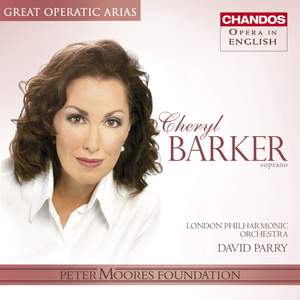
| |  | Great Operatic Arias 21 - Cheryl BarkerSung in English
Following her superb Katya in Katya Kabanova, her Emilia Marty in The Makropulos Case, recorded live at the London Coliseum, and her Butterfly for Chandos Opera in English, we were delighted to have enticed Cheryl Barker into our studios to record these thrilling samples of her dramatic artistry in music both familiar and fresh. The repertoire chosen for the solo disc includes works, actually performed by her on stage, as well as arias Cheryl has always enjoyed listening to. ‘There were two arias that I was very keen to include one was the scene from The End of the Affair by the brilliant American composer Jake Heggie. I premiered the role of Sarah in Houston and I think this scene is dramatic and fantastically composed. I am very proud to have recorded the aria Each Afternoon from the Violins of St Jacques by Malcolm Williamson, a fellow Australian. It is very atmospheric with its simply vocal line. I have also included some popular arias and some repertoire performed by Dame Joan Hammond with whom I studied with as a student.’ ‘As an English speaker, performing these arias in English means that I can relay the emotions of the arias in my native language and I think it is interesting to an English speaking audience to hear the arias in their native tongue. Also, it is important to have an accurate translation of the original text and I think in these arias we have that.’ “Anguish… the keynote, coming across best in Margarita's prison aria from Boito's Mefistofele and Lisa's midnight soliloquy in Tchaikovsky's Queen of Spades.” BBC Music Magazine, December 2009 “Cheryl Barker is always clean in her placing of notes and clear in her articulation of the English words. …sometimes (as in the opening of the Arabella-Mandryka duet) she sings quite beautifully. …William Dazeley (surely one of our best baritones) has an attractive timbre, heard pleasingly throughout. David Parry's speeds tend to be a little too slow for my liking but the orchestral playing refined and responsive.” Gramophone Magazine, Awards Issue 2009 | | | (also available to download from $10.75) | Usually despatched in 2 - 3 working days. (Available now to download.) |
|
|
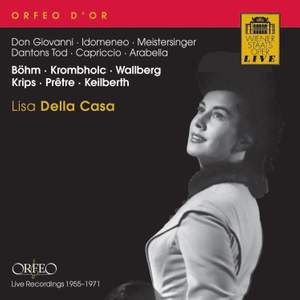
| |  | Lisa della CasaVienna State Opera 1955-1971
Einem: | Das ist eine böse Zeit (from Dantons Tod) | Mozart: | Fuggi, crudele, fuggi! (from Don Giovanni) sung in German Crudele? Ah no, mio bene! ... Non mi dir, bell'idol mio (from Don Giovanni) sung in German Quando avran fine omai ... Padre, germani, addio! (from Idomeneo) Principessa, a' tuoi sguardi...Spiegarti non poss'io (from Idomeneo) | Strauss, R: | Morgen mittag um elf! (from Capriccio) Ich danke, Fraulein (from Arabella) Das war sehr gut, Mandryka (from Arabella) | Wagner: | O Sachs, mein Freund (from Die Meistersinger) Selig, wie die Sonne (from Die Meistersinger von Nürnberg) |
No singer at the Vienna State Opera or elsewhere has been as closely associated with the title role in Strauss's Arabella as Lisa Della Casa, who celebrates her 90th birthday on 2 February 2009, and yet we should be guilty of doing the Swiss soprano a grave disservice by reducing her repertory to this one role alone.This point is well illustrated by an impressive portrait of the singer that is released as part of ORFEO's series 'Wiener Staatsoper live'. Lisa Della Casa took part in the opening performances in the rebuilt house in 1955, a bundle of nervous energy as Donna Anna under Karl Böhm, with Anton Dermota as Don Ottavio.With the silvery gleam of her soprano and her crystalline high notes, she was also a natural choice as Eva in Die Meistersinger, a role she also sang at Bayreuth and the Met. Here she demonstrates that she was capable of raising standards to those worthy of an international festival whenever she appeared with other world-class singers.The same is true of the closing scene from Capriccio under Georges Prêtre and of the scene from Arabella in which her sister, Zdenka, is played by Anneliese Rothenberger in an inspired piece of casting. As Lucile in Gottfried von Einem's Dantons Tod, under Josef Krips in 1967, she proved a worthy successor to Maria Cebotari, who at the start of Della Casa's career had recommended her younger colleague for more challenging roles.Von Einem's opera by no means marked a new direction in the singer's career: far from taking on character roles in the later stages of her career, she was still singing lyric soprano roles until shortly before she retired from the stage. A unique voice, with distinctive simplicity and even phrasing. | | | Usually despatched in 3 - 4 working days. |
|
|
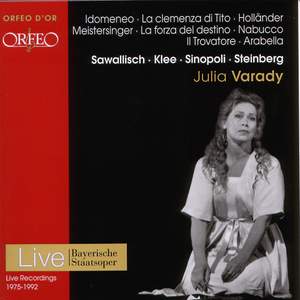
| |  | The Munich Roles of Julia Varady
Recorded 1975-1992 “the most versatile, committed and technically assured lyric-dramatic soprano of the 20th century’s final quarter.” Gramophone Magazine | | | Usually despatched in 3 - 4 working days. |
|
|
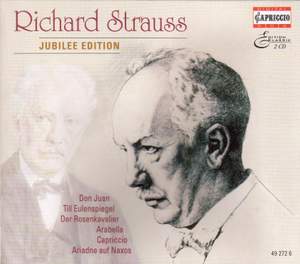
| |  | Strauss: Orchestral Music & Opera ExcerptsJubilee Edition
Bo Skovhus (baritone), Pamela Coburn (soprano), Regina Klepper (soprano), Michele Crider (soprano), Franz Hawlata (bass), Martina Borst (mezzo-soprano) Munich Radio Orchestra, Bavarian Radio Chorus, soloists, Stuttgart Radio Symphony Orchestra , Manfred Honeck, Neville Marriner | |
|
| |
|