Prices shown exclude VAT. (UK tax is not payable for deliveries to United States.) See Terms & Conditions for p&p rates. | |  | Kiri te Kanawa sings Mozart & Strauss
Mozart: | E Susanna non vien! … Dove sono i bei momenti (from Le nozze di Figaro) Porgi amor (from Le nozze di Figaro) Ruhe sanft, mein holdes Leben (from Zaïde) Crudeli, oh dio! (from La Finta Giardiniera) S’altro che lagrime (from La clemenza di Tito) Ei parte...Per pietà (from Così fan tutte) L'amerò, sarò costante (from Il re pastore) Pupille amate (from Lucio Silla) Se il padre perdei (from Idomeneo) Bella mia fiamma, addio... Resta, oh cara, K528 Ach, ich fühl's (from Die Zauberflöte, K620) Bester Jüngling (from Der Schauspieldirektor) Nehmt meinen Dank, ihr holden Gönner!, concert aria K383 | Strauss, R: | Four Last Songs Madrigal, Op.15, No. 1 Morgen, Op. 27 No. 4 Er ist der Richtige nicht für mich … Aber der Richtige, wenn's einen gibt für mich (from Arabella) Und jetzt sag ich Adieu, mein lieber Dominik (from Arabella) O Arabella, gibt es was Schöneres als Sie auf einem Ball! (from Arabella) Das war sehr gut, Mandryka (from Arabella) Dann aber, wie ich Sie gespürt hab hier im Finstern stehn (from Arabella) Allerseelen, Op. 10 No. 8 Die Nacht, Op. 10 No. 3 Capriccio: Intermezzo (Moonlight Music) Wo ist mein Bruder? (from Capriccio) Kein andres, das mir so im Herzen loht (from Capriccio) Du Spiegelbild der verliebten Madeleine (from Capriccio) |
Dame Kiri te Kanawa was presented with a lifetime achievement award at the Classical Brits 2010. Decca’s first-ever compilation devoted to the two composers most closely associated with Kiri te Kanawa: Mozart & Richard Strauss. Selection includes arias from operas by both composers which te Kanawa has sung on stage as well as concert arias and songs she has featured in concert. Kiri te Kanawa is accompanied by two of her greatest musical mentors – Sir Georg Solti - in his dual role as conductor and pianist – and Sir Colin Davis (with whom she first sang the role of the Countess in Le nozze di Figaro at The Royal Opera House, Covent Garden, in 1971. | | | In stock - usually despatched within 1 working day. |
|
|
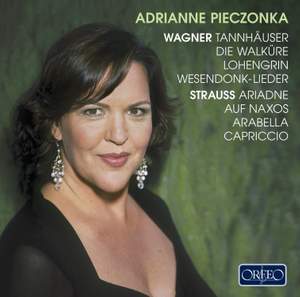
| |  | Adrianne Pieczonka Sings Strauss & Wagner
| | | In stock - usually despatched within 1 working day. |
|
|
| |  | Anton Dermota: Vienna State Opera Recordings 1944-81
Beethoven: | Jetzt Schätzchen, jetzt sind wir allein (from Fidelio) Recorded 5th August 1950 Elisabeth Schwarzkopf (Marzelline) Wilhelm Furtwängler Gott! Welch Dunkel hier! (from Fidelio) Recorded 5th November 1955 Karl Böhm | Mozart: | Dies Bildnis ist bezaubernd schön (from Die Zauberflöte) Recorded 14th September 1950 Karl Böhm Mich schreckt kein Tod (from Die Zauberflöte) Recorded 11th - 14th November 1944 Irmgard Seefried, Josef Witt, Paul Schöffler Dalla sua pace (from Don Giovanni) Sung in German as 'Nur ihrem Frieden' Sola, sola in bujo loco (from Don Giovanni) Sung in German as 'Einsam hier an dunkler Stätte'; recorded 6th November 1955 Sena Jurinac (Elvira), Lisa Della Casa (Anna), Irmgard Seefried (Zerlina), Erich Kunz (Leporello), Walter Berry (Masetto) Il mio tesoro intanto (from Don Giovanni) Sung in German as 'Folget der Heißgeliebten'; recorded 14th September 1950 Wiener Philharmoniker, Karl Böhm La mia Dorabella capace non e' (from Così fan tutte) Erich Kunz (Guglielmo), Paul Schöffler (Don Alfonso) Fra gli amplessi (from Così fan tutte) Recorded 8th August 1956 Irmgard Seefried (Fiordiligi) Karl Böhm Die Weisheitslehre….. führt mich der Ton zu ihr from Die Zauberflöte Recorded 21st January 1981 Hans Helm (Sprecher) Thomas Sanderling | Pfitzner: | Allein, in dunkler Tiefe (from Palestrina) Recorded 12th May 1970 Rita Streich (Engel), Hilde Rössel-Majdan (Lucrezia) | Shostakovich: | Katerina! Sinowi! (from Katerina Ismailowa) Recorded 10th May 1968 Inge Borkh (Katerina), Fritz Uhl (Sergei) Serge Baudo | Strauss, R: | Di rigori armato il seno (from Der Rosenkavalier) Recorded June 1954 Ludwig Weber (Ochs), Franz Bierbach (Notar) Wiener Philharmoniker, Erich Kleiber Arabella? Unmöglich! (from Arabella) Recorded June 1957 Lisa Della Casa (Arabella) Wiener Philharmoniker, Georg Solti Kein andres, das mir so im Herzen loht (from Capriccio) Recorded 15th May 1960 Lisa Della Casa (Countess), Paul Schöffler (La Roche), Walter Berry (Olivier) Karl Böhm | Tchaikovsky: | Mesdames! Ya na sebya vzyal smyelost (from Eugene Onegin) Sung in German as 'Mesdames, verzeih’n Sie meine Kühnheit'; recorded on 17th June 1955 Leonie Rysanek (Tatyana), George London (Onegin), Mira Kalin (Olga) Berislav Klobučar Kuda, Kuda 'Lensky's Aria' (from Eugene Onegin) Sung in German as 'Wohin? Wohin?' Duel scene (from Eugene Onegin) Sung in German as 'Da kommen sie'; recorded 26th January 1961 Dietrich Fischer-Dieskau (Onegin), Ljubomir Pantscheff (Zaretsky) Lovro von Matačić Voilà tsaritsa etot dyen (from Eugene Onegin) Sung in German as 'Voilà – die Königin des Tags'; recorded on 10th November 1973 Peter Schrottner | Wagner: | Gleich, Meister! Hier! (from Die Meistersinger von Nürnberg) Recorded September 1951 Paul Schöffler (Hans Sachs) Hans Knappertsbusch |
Where is the likes of Anton Dermota today? The Slovenian tenor was not just a member of the Vienna State Opera ensemble for over 50 years, he was also a master of the stage and concert hall, celebrated all over the world from Milan to Buenos Aires. This new release of his performances at the Vienna State Opera makes evident this versatility. His Tamino is given here both at the beginning and the end of our selection,from the immediate post-war years under Karl Böhm, plus an excerpt from the run of performances under Sanderling with which Demota made his farewell to the stage in 1981, at the age of 71! Nor can Dermota’s interpretations of Ferrando and Don Ottavio be omitted from this double CD. It is delightful to contrast the buffo roles and Dermota’s exploits as a tenore lirico spinto, such as Florestan. The tricky, brief roles in Richard Strauss’ operas, such as the Singer in Rosenkavalier and Matteo in Arabella, were ones he mastered superbly. They too are to be found here, as in the legendary Capriccio ensemble with Elisabeth Schwarzkopf as the Countess. Dermota appeared with various, equally splendid partners in Tchaikovsky’s Eugene Onegin – as Lenski he duelled before the radio microphone with George London and Dietrich Fischer-Dieskau, while as late as the 1970s he turned Monsieur Triquet’s burlesque into a subtle character study. | | | Usually despatched in 3 - 4 working days. |
|
|
| |  | Strauss: Orchestral Music & Opera ExcerptsJubilee Edition
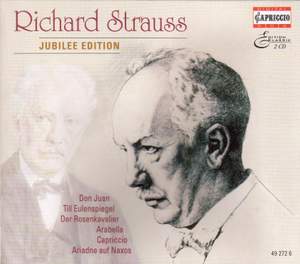
Bo Skovhus (baritone), Pamela Coburn (soprano), Regina Klepper (soprano), Michele Crider (soprano), Franz Hawlata (bass), Martina Borst (mezzo-soprano) Munich Radio Orchestra, Bavarian Radio Chorus, soloists, Stuttgart Radio Symphony Orchestra , Manfred Honeck, Neville Marriner | |
|
| |  | Strauss- Julia Varady
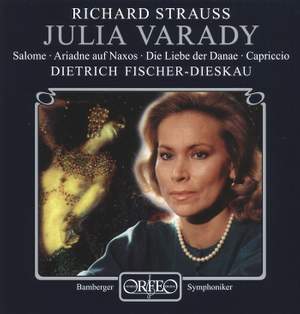
“After giving choice recitals of Verdi and Wagner, Varady turned her attention to Strauss, and once again the results are for the most part rewarding. The final scene of Salome, under the watchful eye of Varady's husband, Fischer-Dieskau, has the perfection of pitch and phrase one expects of this singer, as well as an expected acuity for the meaning of the text. Perhaps, away from the theatre in a part she never undertook on stage, the absolute conviction of such great interpreters as Cebotari, Welitsch and Rysanek is absent, but not by much. The two almost consecutive solos of Ariadne benefit from shapely, poised singing, ever obedient to the score, although occasionally one misses the creamier tones that Lisa della Casa (DG) and Gundula Janowitz (DG video, and EMI) brought to the part. As Danae, Varady seems a shade tentative and vocally out of sorts. There need be no reservations about the final scene of Capriccio, in which she catches ideally Countess Madeleine's emotional perplexity as she tries (unsuccessfully) to choose between her poet and musician admirers. Both her identification with the role and her execution of Strauss's operatic farewell to his beloved soprano voice are near-ideal. Fischer- Dieskau, endearingly, sings the short part of the Haushofmeister. However, his conducting, although sensibly paced, sometimes errs on the side of caution. As a whole, this CD nicely complements Fleming's Strauss concert on Decca, the two discs offering a compendium of the composer's writing for the soprano voice he loved so much.” Gramophone Classical Music Guide, 2010 “this wide-ranging collection of excerpts contains some of the most magnificent Strauss singing in years. The wonder is that any soprano can range so wide, while producing the most beautiful,full and even stream of sound” Penguin Guide, 2010 edition *** | | | Usually despatched in 3 - 4 working days. |
|
|
| |  | Peter Schreier - Legendary Recordings
Albert, H: | Du mein einzig Licht | Albert, M: | Feelings Sung in German | anon.: | Weiss mir ein Blumlein blaue | Bach, J S: | St John Passion, BWV245: Es ist vollbracht Mass in B minor, BWV232: Agnus Dei Es kostet viel, ein Christ zu sein, BWV459 Ich halte treulich still und liebe, BWV466 O wie selig seid ihr doch, ihr Frommen, BWV495 Cantata BWV134 'Ein Herz, das seinen Jesum lebend weiss' Cantata BWV36 'Schwingt freudig euch empor' Frohe Hirten, eilt, ach eilet (from Christmas Oratorio) Ich will nur dir zu Ehren leben (from Christmas Oratorio) Lobe den Herren, den machtigen Konig der Ehren, BWV137: Lobe den Herren, der deinen Stand Cantata BWV21 'Ich hatte viel Bekümmernis': Bäche von gesalznen Zähren Wie schon leuchtet der Morgenstern, BWV1: Unser Mund und Ton der Saiten | Becker, R: | Fruhlingszeit, Op. 3 No. 3 | Beethoven: | Maigesang, Op. 52 No. 4 Resignation, WoO 149 Der Wachtelschlag, WoO 129 Neue Liebe, Neues Leben, Op. 75, 2 Zärtliche Liebe 'Ich liebe dich', WoO 123 Fruhlingslied (No. 3 from 6 Gesange, Op. 34) Gruss (No. 5 from 6 Gesange, Op. 19a) Hexenlied (No. 8 from 12 Gesange, Op. 8) | Bohm, C: | Still as the Night Sung in German | Brahms: | Wiegenlied, Op. 49 No. 4 (Lullaby) arr. Mauersberger | Brandt, J: | Mir ist ein feins brauns Maidelein | Cornelius: | The Three Kings Simeon (No. 4 from Weihnachtslieder, Op. 8) | Fesca: | An der saale hellem Strande | Giordani, G: | Caro mio ben | Glück , F: | Das zerbrochene Ringlein | Grieg: | Hjertets Melodier af H. C.Andersen, Op. 5 No. 3 'Jeg elsker Dig' Våren, Op. 33 No. 2 | Handel: | Con l'ali di costanza (from Ariodante) Sung in German Judas Maccabaeus: So rapid thy course is Sung in German Judas Maccabaeus: Wise men, flattering, may deceive you Sung in German Jephtha: Virtue shall still my soul embrace Sung in German Jephtha: Waft her, angels, through the skies Sung in German | Haydn: | In vollem Glanze (Die Schöpfung) Mit Würd und Hoheit angetan (Die Schöpfung) | Kalman: | Gruss mir die sussen, die reizenden Frauen (from Gräfin Mariza) | Kattnigg: | Leise erklingen Glocken vom Campanile (from Balkanliebe) | Liszt: | Es muss ein Wunderbares sein, S. 314 | Lortzing: | Lied: Vater, Mutter, Schestern, Bruder (from Undine) | Love: | Das Alte Lied (from The Third Man) | Mauersberger, R: | Geistlichen Sommermusik: Er wartet alles auf dich Dresdner Requiem, RMWV 10: Aus der Tiefe rufe ich zu dir Geistlichen Sommermusik: Lasst uns beten Tag und Ewigkeit: Ein Sonntag Erzgebirge: Ich hort eine Amsel schlagen Erzgebirge: Zugvogele | Melichar: | In mir klingt ein Lied (after Chopin, Etude No. 3 in E major, Op. 10 No. 3) | Mendelssohn: | Auf Flügeln des Gesanges, Op. 34 No. 2 Reiselied 'Der Herbstwind', Op. 34 No. 6 | Monteverdi: | Ecco pur ch'a voi ritorno (from L'Orfeo) | Mozart: | Un'aura amorosa del nostro tesoro (from Così fan tutte) Konstanze, Konstanze...O wie ängstlich (from Die Entführung aus dem Serail) Nelle guerre d'amore (from La Finta Semplice, K51) Dalla sua pace (from Don Giovanni) Fuor del mar ho un mar in seno (Idomeneo) Del più sublime soglio (from La Clemenza di Tito) E tollerare io posso si temerari oltraggi? (from Lucio Silla) Dies Bildnis ist bezaubernd schön (from Die Zauberflöte) | Nicolai, C O: | Horch, die Lerche singt im Hain! 'Romance' (from Die lustigen Weiber von Windsor) | Perez-Freire: | Schlaf ein, mein Blond Engelein | Praetorius, M: | Nach gruner Farb mein Herz verlangt | Radecke, R: | Aus der Jugendzeit arr. Mauersberger | Raymond: | Schau einer schonen Frau nie zu tief in die Augen (from Maske in Blau) | Reichardt, J F: | Wenn ich ein Voglein war' | Rhau: | Herzlich tut es mich erfreuen | Rossini: | Ecco, ridente in cielo (from Il Barbiere di Siviglia) | Schubert: | Der Musensohn, D764 (Goethe) Das Wandern (No. 1 from Die schöne Müllerin, D795) Wohin? (No. 2 from Die schöne Müllerin, D795) Du bist die Ruh D776 (Rückert) Ständchen 'Leise flehen meine Lieder', D957 No. 4 Heidenröslein, D257 Wandrers Nachtlied II 'Über allen Gipfeln ist Ruh', D768 Das Fischermädchen D957 No. 10 Sei mir gegrüsst! D741 (Rückert) Der Lindenbaum (No. 5 from Winterreise, D911) | Schulz, J A P: | Der Mond ist aufgegangen | Schumann: | Widmung, Op. 25 No. 1 Mondnacht (No. 5 from Liederkreis, Op. 39) Wanderlied (No. 3 from 12 Gedichte, Op. 35) Du bist wie eine Blume, Op. 25 No. 24 Die Lotosblume, Op. 25 No. 7 Frühlingsgruss Op. 79/4 | Schütz: | Kleiner geistlichen Concerten: Eins bitte ich vom Herren, SWV294 Was hast du verwirket SWV 307 | Silcher: | Das Lieben bringt gross Freud Im schonsten Wiesengrunde Loreley Wenn alle Brunnlein fliessen | Spoliansky: | Voice in the Night Sung in German | Stolz, R: | Eine wie du war immer mein Traum (from Venus in Seide) | Strauss, R: | Kein andres, das mir so im Herzen loht (from Capriccio) | Suder: | Es fiel ein Reif in der Fruhlingsnacht | Tauber: | You are the world to me from Der singende Traum Sung in German | trad.: | Der weisse Hirsch Nun sei willkommen, Herre Christ Es flog ein kleins waldvogelein Sie gleicht wohl einem Rosenstock Im Krug zum grünen Kranze Wonne des Liebenden Verstohlen Geht Der Mond Auf All mein Gedanken ‘Minnelied’ Nachtigall | Werner, H: | Heidenroslein | Winkler, G: | Chianti-Lied - Ja ja der Chiantiwein | Youmans: | Without a Song Sung in German | Zuccalmaglio: | Mein Madel hat einen Rosenmund |
Peter Schreier (tenor, boy alto) Berlin Chamber Orchestra, Berlin Radio Symphony Orchestra, Berlin Staatskapelle Orchestra, Dresden Philharmonic Orchestra, Dresden Staatskapelle, Jürgen-Erbe Choir, Leipzig Radio Symphony Orchestra, New Bach Collegium Musicum Leipzig, Martin Flämig, Robert Hanell, Herbert Kegel, Bernhard Klee, Helmut Koch
Siegfried Kurz, Hans-Joachim Rotzsch,Otmar Suitner | |
|
| |
|